

How IFFCO Could Eliminate Thousands of Tonnes of Plastic Packaging
An independent analysis of India’s largest fertilizer cooperative and its untapped biopackaging opportunity.
Disclaimer: This case study is based entirely on publicly available information. IFFCO has not endorsed, sponsored, or participated in this content. If you represent IFFCO and wish to correct, update, or remove any information, please contact us.
The Problem Nobody Talks About
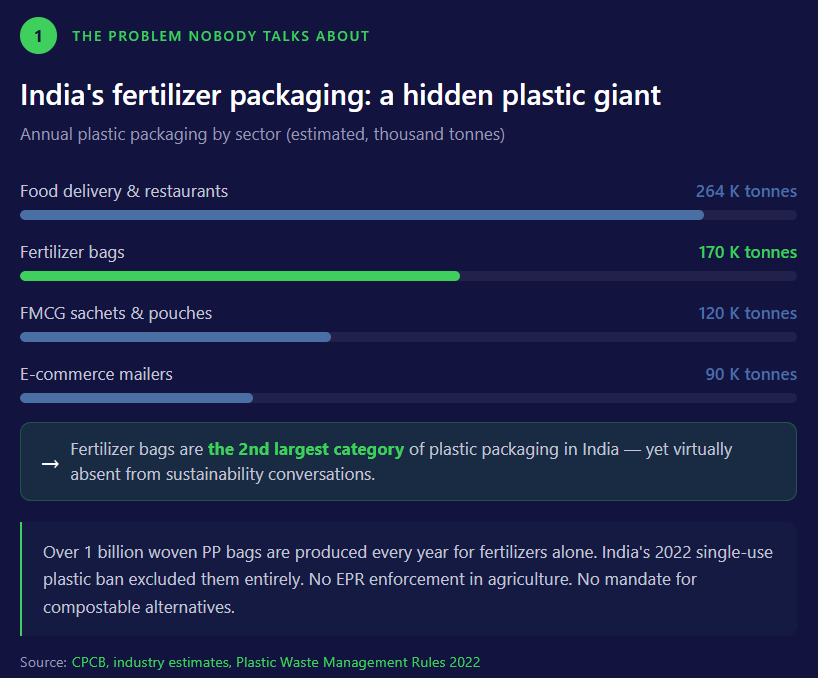
Here are some numbers and facts:
- India consumes over 60 million metric tonnes of fertilizers every year. Nearly all of it is packed in woven polypropylene (PP) or HDPE bags, each weighing 45–50 kg. That adds up to well over a billion plastic bags entering the system annually.
- Unlike packaging in cities, where some recycling infrastructure exists, these bags end up in rural India, where they are burned in fields, dumped near irrigation channels, or buried in soil where they take hundreds of years to break down.
- India’s single-use plastic ban, which came into effect on July 1, 2022, targeted items like plastic straws, plates, and cutlery. But it did not cover woven PP fertilizer bags.
- The Plastic Waste Management Rules require Extended Producer Responsibility (EPR) registration for companies that package products in plastic, but enforcement in the agriculture sector remains weak.
- The Fertilizer Control Order of 1985, which governs how fertilizers must be packaged and labelled, focuses on moisture resistance and product integrity. There is no mandate for biodegradable or compostable fertilizer bags in India.
This is a regulatory blind spot, and it covers one of India’s largest packaging categories.
60M+
MT Fertilizers / year
1B+
Plastic bags annually
26.7M
Bags avoided
4,000T
Plastic reduction
Who Is IFFCO?
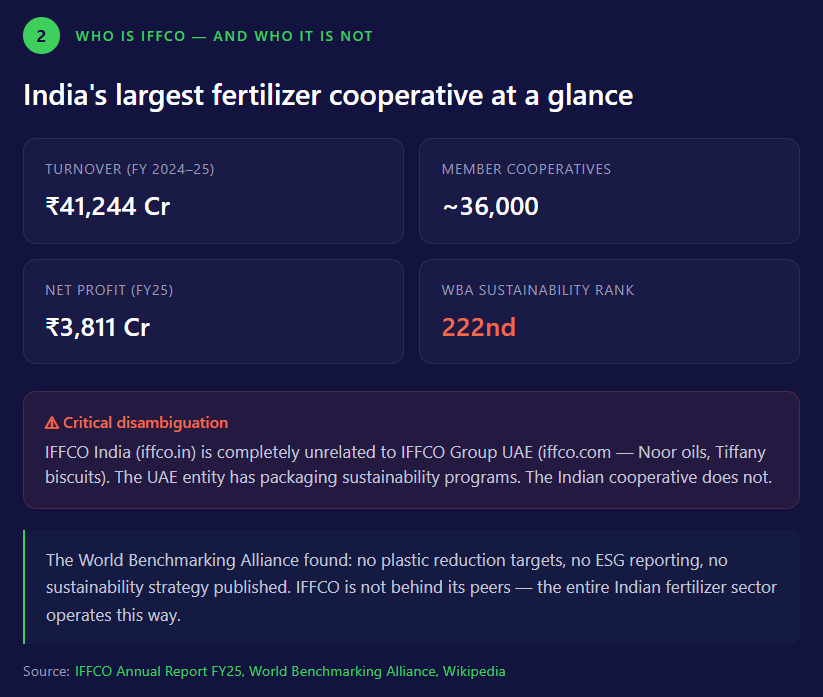
In FY 2024–25, IFFCO reported a turnover of ₹41,244 crore and a net profit of ₹3,811 crore. Its product range includes Urea, DAP, NPK complexes, Nano Urea, Nano DAP, and the Sagarika seaweed bio-stimulant.
It operates major production units at Kalol (Gujarat), Aonla and Phulpur (Uttar Pradesh), Paradeep (Odisha), and Kandla (Gujarat).
What IFFCO's Packaging Looks Like Today
Across every product line, IFFCO uses standard industrial plastic packaging:
Crucially, no product line was found using any form of bioplastic, compostable material, or recycled-content packaging.
The World Benchmarking Alliance, in its Food and Agriculture Benchmark, noted that IFFCO lacks targets to reduce plastic use in its operations and supply chain.
IFFCO ranked 222nd overall, with the assessment noting significant room for improvement across all measurement areas. The cooperative does not publish ESG or sustainability reports.
This is not an attack on IFFCO. It is simply the factual baseline. The entire Indian fertilizer sector operates the same way.
IFFCO is not behind its peers, but as the largest player, it is best positioned to lead.
The Nano Urea Story: Accidental Packaging Reduction at Massive Scale
In 2021, IFFCO launched Nano Urea, the world’s first commercially available nano-scale liquid urea fertilizer. The first dedicated Nano Urea plant was inaugurated by Prime Minister Modi at Kalol, Gujarat. The core idea: a single 500 ml bottle of Nano Urea is designed to replace one full 45 kg bag of conventional urea.
In FY 2024–25, IFFCO sold 365 lakh (36.5 million) bottles of nano fertilizers (268 lakh Nano Urea Plus and 97 lakh Nano DAP) a 47% increase over the previous year.
IFFCO claims this is equivalent to replacing 12 lakh MT of conventional urea and 4.85 lakh MT of conventional DAP.
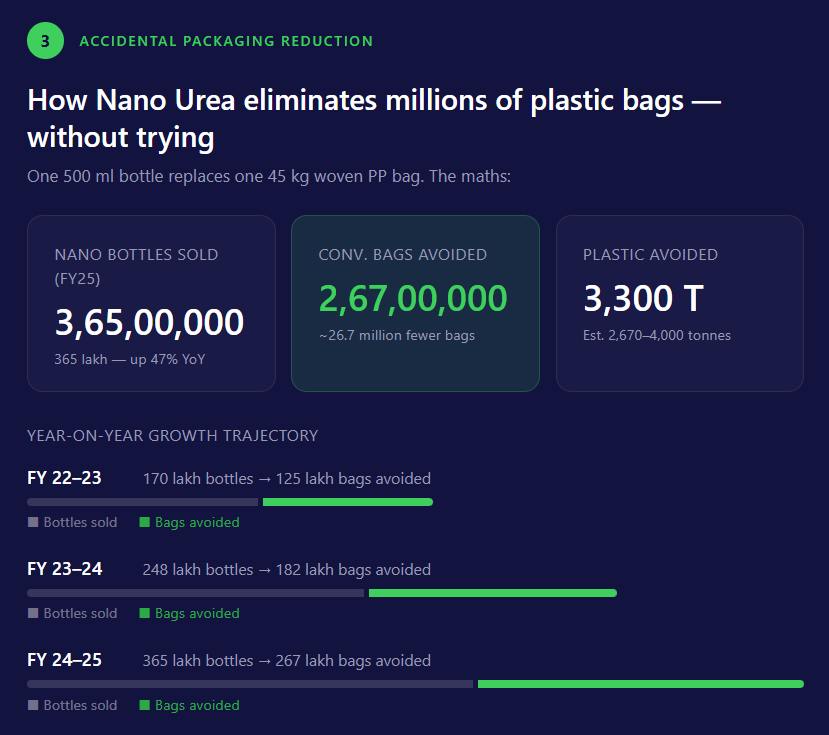
If 12 lakh MT of conventional urea (normally packed in 45 kg woven PP bags) is replaced by small HDPE bottles, that means roughly 26.7 million fewer large plastic bags produced, shipped, and discarded.
Each conventional bag weighs approximately 100–150 grams. That translates to an estimated 2,670–4,000 tonnes of woven polypropylene packaging avoided in a single year.
IFFCO now operates nano fertilizer plants across Kalol, Aonla, Phulpur, and Bengaluru. Each plant has the capacity to produce 2 lakh (200,000) bottles per day.
Government plans call for 10 new nano fertilizer factories with a target annual capacity of 440 million bottles.
This is a sustainability story IFFCO has not chosen to tell, but it is entitled to tell. The nano programme is marketed around agricultural efficiency and farmer economics, not packaging reduction. The bottles themselves are standard HDPE with no recycled or bio-based content.
The Impact If IFFCO Adopted Compostable Packaging
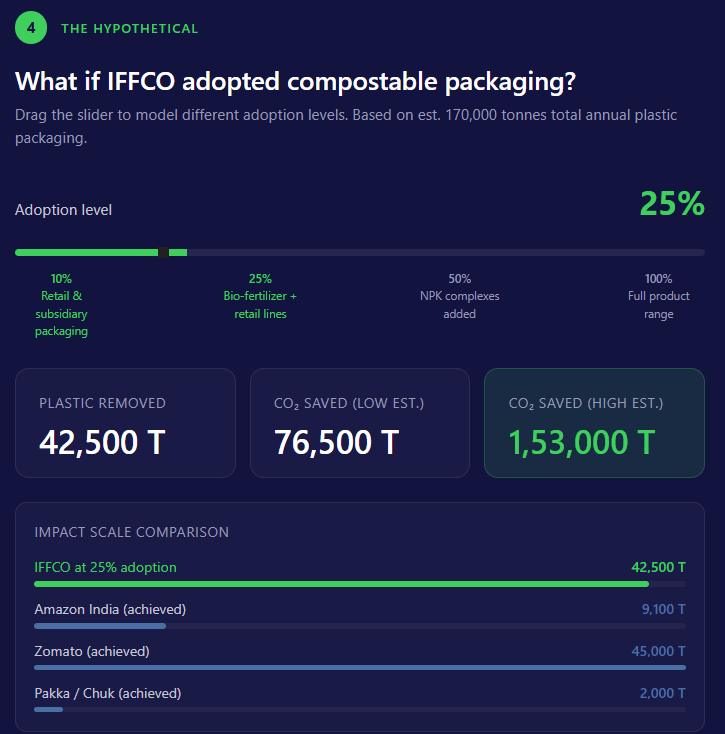
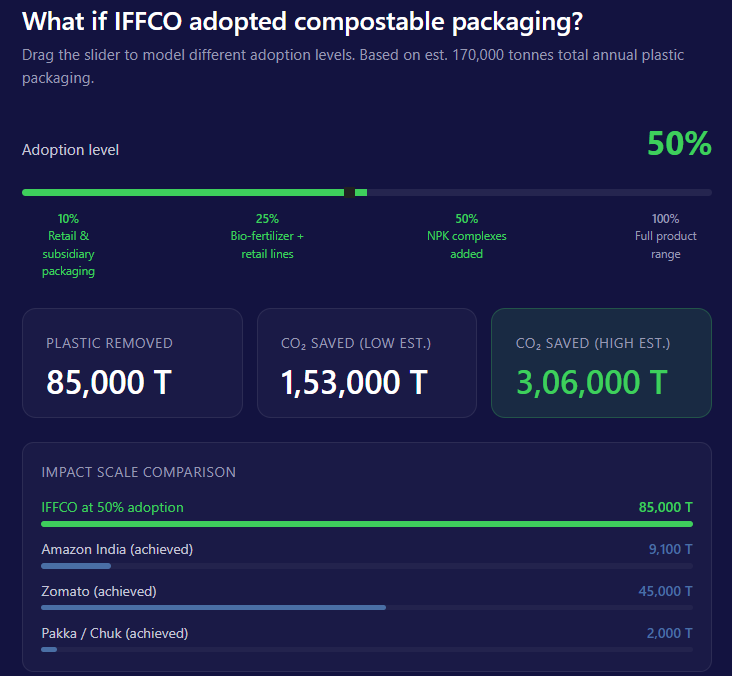
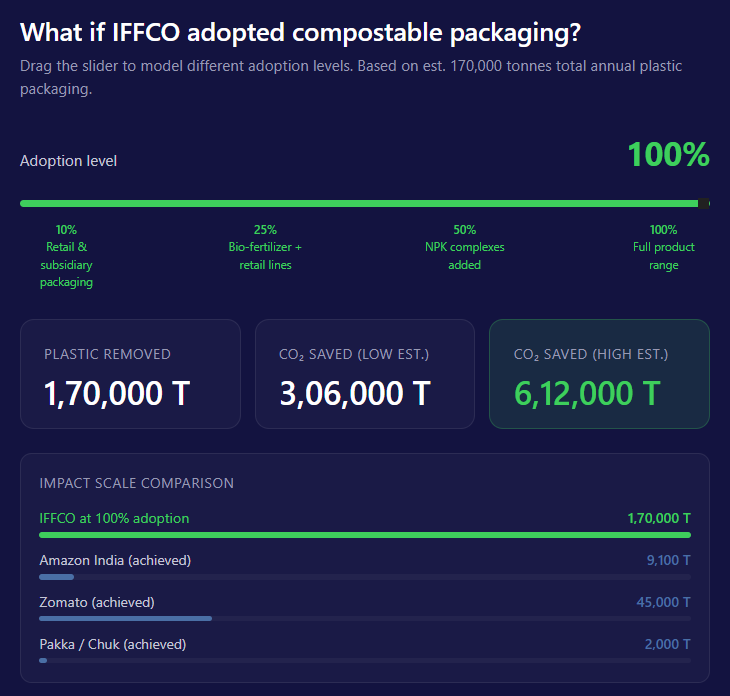
All this is doable, but not easy. Three barriers stand in the way: the cost premium of compostable materials over woven PP at bulk scale, the performance requirements specific to fertilizer storage, and the absence of any regulatory mandate forcing the change.
But each barrier is shrinking.
Bioplastic production costs are falling as the sector scales. Film technology is advancing rapidly. And India’s broader regulatory direction (tightening EPR packaging rules, the 2070 net-zero commitment, the push for nano fertilizers) signals that agriculture’s packaging exemption will not last forever.
Exploring the Switch?
Ukhi manufactures and supplies compostable packaging raw materials (including EcoGran granules) suitable for blown film, injection moulding, and extrusion. These are the same processes already used in fertilizer packaging production. Ukhi’s materials are available through DCGpac, India’s largest B2B packaging platform with over 60,000 customers.
For fertilizer companies, agricultural cooperatives, or packaging converters looking into compostable alternatives, Ukhi provides material samples, technical datasheets, and formulation support.
To learn more, ask your DCGpac partner about Ukhi or reach out to us directly.
Sources consulted: IFFCO official website (iffco.in), IFFCO Nano Urea portal (nanourea.in), World Benchmarking Alliance Food & Agriculture Benchmark, Agriculture Post, Global Agriculture, SABIC press releases, Wikipedia, Springer (Plant and Soil, 2023), India’s Plastic Waste Management Rules 2016/2022, Fertilizer Control Order 1985.