

Zepto and Compostable Packaging: 90 Million Bags Saved, Still Far To Go?
Zepto delivers groceries in 10 minutes to customers across India. It operates over 700 dark stores, handles millions of orders, and is preparing for an IPO expected sometime in 2026.
But every order needs a bag. Every bag creates waste. And in a country that generates 3.5 million tonnes of plastic waste annually, what that bag is made of matters.
This case study looks at what Zepto has actually done to reduce its packaging footprint and what it means for the future of compostable packaging in India’s quick commerce sector.
But every order needs a bag. Every bag creates waste. And in a country that generates 3.5 million tonnes of plastic waste annually, what that bag is made of matters.
This case study looks at what Zepto has actually done to reduce its packaging footprint and what it means for the future of compostable packaging in India’s quick commerce sector.
The Problem: Every 10-Minute Delivery Leaves a Packaging Trail
A typical Zepto order involves an outer carry bag, inner wrapping on products (usually plastic, from the brand itself), and sometimes insulation material for perishables.
Multiply this across millions of daily deliveries, and the numbers get large very quickly.
India’s single use plastic ban, which took effect on 1 July 2022, prohibited 17 categories of items. But enforcement has been weak.
A Toxics Link study found that 64% of market sites still had banned plastics nearly two years after the ban.
Multiply this across millions of daily deliveries, and the numbers get large very quickly.
India’s single use plastic ban, which took effect on 1 July 2022, prohibited 17 categories of items. But enforcement has been weak.
A Toxics Link study found that 64% of market sites still had banned plastics nearly two years after the ban.
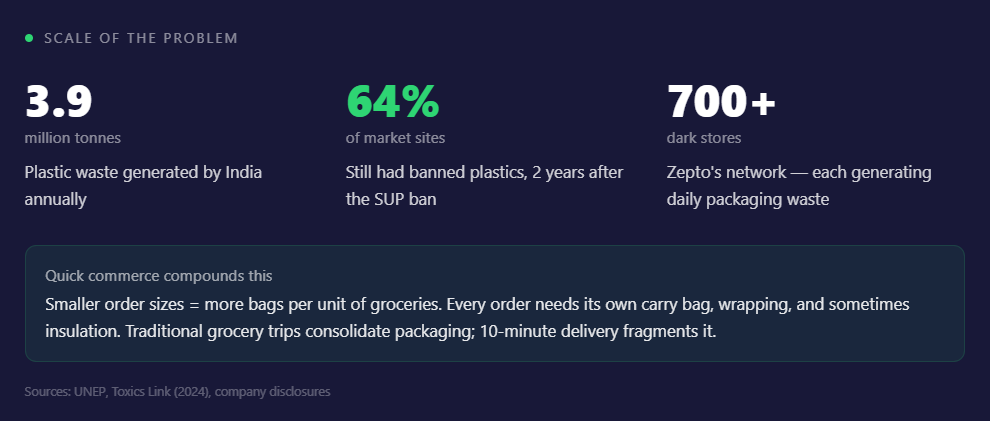
Quick commerce compounds this problem because the delivery model creates more packaging per item than a traditional grocery trip. Also, smaller basket sizes mean more order numbers for a typical household basket, and more bags per unit of groceries purchased.
Zepto used brown kraft paper bags from the time of its founding in 2021. This was better than plastic, but paper carries its own costs such as water use, energy-intensive pulping, and deforestation concerns.
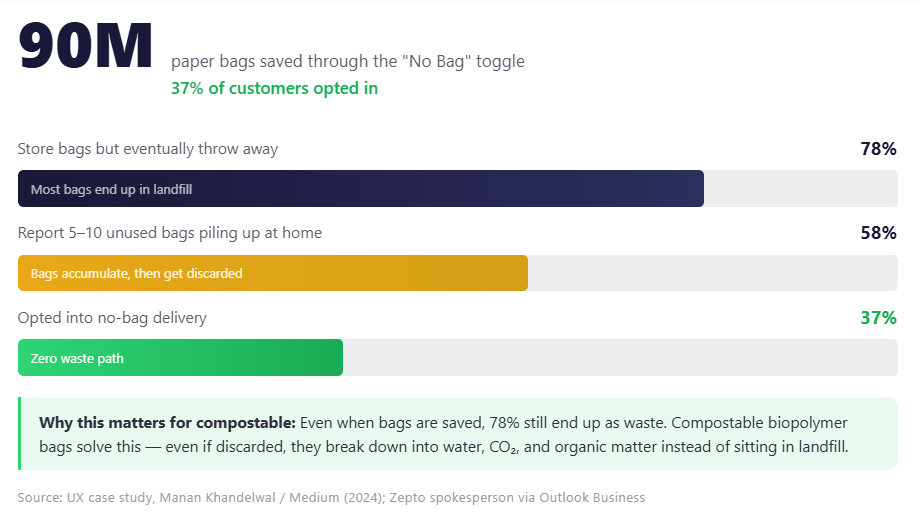
A UX case study found that 78% of surveyed Zepto users stored paper bags but eventually threw them away, with 58% reporting 5 to 10 unused bags piling up at home. The bags were not being reused or composted. They were just becoming a different kind of waste.
Zepto used brown kraft paper bags from the time of its founding in 2021. This was better than plastic, but paper carries its own costs such as water use, energy-intensive pulping, and deforestation concerns.
A UX case study found that 78% of surveyed Zepto users stored paper bags but eventually threw them away, with 58% reporting 5 to 10 unused bags piling up at home. The bags were not being reused or composted. They were just becoming a different kind of waste.
90M+
Bags Saved
37%
Opt-in
700+
Stores
1T+
Plastic Recycled
What Zepto Has Actually Done: Four Verified Initiatives
Initiative 1 — Paper Bags as Default (2021 onwards)
From the start, Zepto chose paper over plastic for its delivery bags. Suppliers include Adeera Packaging, based in Greater Noida, which scaled its paper bag business significantly during the pandemic. This gave Zepto a head start when the SUP ban arrived, though paper bags were already standard practice across most quick commerce platforms.
Initiative 2 — "No Bag Delivery" In-App Toggle
Zepto introduced an option in its app allowing customers to skip the bag entirely.
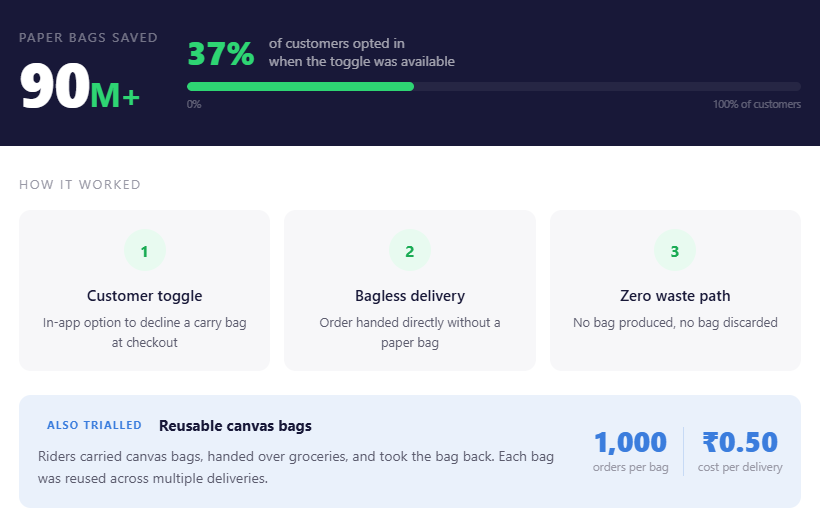
According to a Zepto spokesperson, 37% of customers opted in, saving more than 90 million paper bags. The company also trialled reusable canvas bags carried by delivery riders and returned after each order.
Each canvas bag lasted roughly 1,000 orders at a cost of about 50 paisa per delivery. This is Zepto’s strongest initiative by the numbers as 90 million bags is a meaningful reduction. However, the no-bag option was not consistently available across all versions of the app.
According to a Zepto spokesperson, 37% of customers opted in, saving more than 90 million paper bags. The company also trialled reusable canvas bags carried by delivery riders and returned after each order.
Each canvas bag lasted roughly 1,000 orders at a cost of about 50 paisa per delivery. This is Zepto’s strongest initiative by the numbers as 90 million bags is a meaningful reduction. However, the no-bag option was not consistently available across all versions of the app.
Initiative 3 — Coca-Cola PET Bottle Recycling Pilot (November 2022)
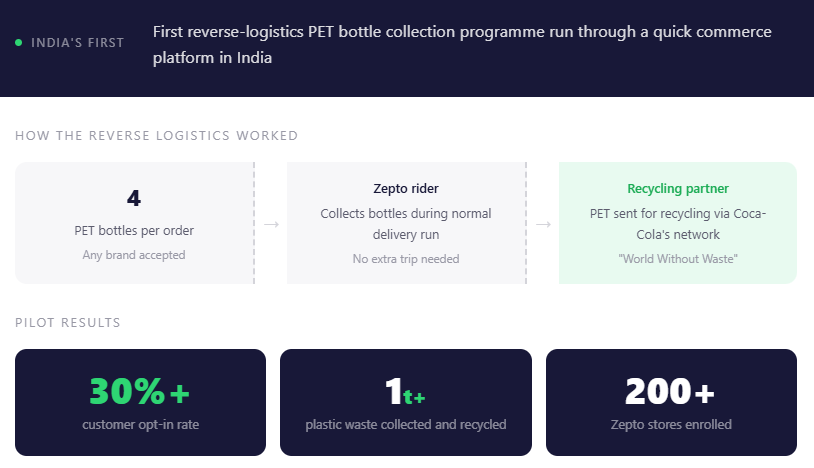
Zepto partnered with Coca-Cola India to allow customers to return up to four empty PET bottles of any brand through Zepto’s delivery riders. This was tied to Coca-Cola’s “World Without Waste” programme.
During the pilot, over 30% of customers opted in, and more than 1 tonne of plastic waste was collected and sent for recycling. The programme expanded to over 200 Zepto stores across Delhi NCR, Mumbai, Bangalore, Hyderabad, Chennai, Pune, and Kolkata. This was the first reverse-logistics PET bottle recycling programme run through a quick commerce platform in India.
During the pilot, over 30% of customers opted in, and more than 1 tonne of plastic waste was collected and sent for recycling. The programme expanded to over 200 Zepto stores across Delhi NCR, Mumbai, Bangalore, Hyderabad, Chennai, Pune, and Kolkata. This was the first reverse-logistics PET bottle recycling programme run through a quick commerce platform in India.
Initiative 4 — Compostable Delivery Bags (November 2025)
Zepto launched compostable delivery bags made from renewable plant-based biopolymers. These bags decompose into water, carbon dioxide, and organic matter. The company said the bags avoid the resource-intensive pulping process required for paper bags. Zepto stated the compostable bags would become a permanent part of its operations. Chandan Mendiratta, Chief Brand Officer, described it as a step reflecting the company’s intent to act responsibly.
This is the initiative most relevant to the compostable packaging industry.
However, some important details are missing from the announcement: the specific biopolymer supplier was not named, no volume data was shared, no CPCB certification details were mentioned, and it is unclear whether the rollout covers all cities or only select markets.
This is the initiative most relevant to the compostable packaging industry.
However, some important details are missing from the announcement: the specific biopolymer supplier was not named, no volume data was shared, no CPCB certification details were mentioned, and it is unclear whether the rollout covers all cities or only select markets.
What the Public Record Shows — and What They Don't
1. Zepto is a pre-IPO company, and that matters when comparing its disclosures to publicly listed competitors. Listed companies in India are required by SEBI to file Business Responsibility and Sustainability Reports (BRSR). Zepto does not yet have this obligation, which means several data points that exist for rivals aren’t yet available for Zepto yet.
2. No ESG or sustainability report has been published so far. Carbon footprint data, Science-Based Targets commitments, and formal environmental frameworks are not yet part of Zepto’s public record. The climate tracker DitchCarbon notes that Zepto has not publicly committed to specific 2030 or 2050 climate goals through any major framework. This is not unusual for a company at Zepto’s stage, but it does mean the full picture of its environmental efforts is incomplete.
3. On EPR compliance, India’s Plastic Waste Management Rules require all producers, importers, and brand owners to register on the CPCB’s Extended Producer Responsibility portal and file annual action plans. No public record currently confirms Zepto’s registration or action plan — though it is worth noting that EPR compliance data is not easily searchable for most Indian companies. A 2024 CSE report found widespread gaps across Indian industry as a whole, including 700,000 fake recycling certificates, suggesting this is a systemic challenge rather than a company-specific one.
4. The November 2025 compostable bag announcement did not reference certification under IS/ISO 17088, ASTM D6400, or CPCB standards. For compostable packaging to be verified as genuinely compostable, such certification is important, and disclosing it would strengthen Zepto’s claim considerably.
5. Zepto filed a confidential DRHP with SEBI on 26 December 2025 for a planned IPO worth approximately ₹11,000 crore. The filing likely contains compliance and sustainability disclosures that will become visible once the document goes public.
How Zepto Compares to Competitors
Zepto’s competitors have had a head start — partly because they listed earlier and faced mandatory disclosure requirements sooner.
1. Blinkit (owned by Zomato) partnered with CHUK, India’s leading compostable tableware brand, as early as February 2022, nearly four years before Zepto’s compostable bag launch. Parent company Zomato has achieved 100% plastic-neutral food deliveries since FY22 and holds an MSCI AA ESG rating.
2. Swiggy published its first Business Responsibility and Sustainability Report for FY2024-25, disclosing that it achieved 100% reduction or offset of direct operations plastic. Swiggy Instamart now delivers in compostable bags.
3. BigBasket (Tata) published a comprehensive 2023 sustainability report documenting 6,491 electric vehicles, 10,429 tonnes of CO₂ avoided, and over 100 tonnes of waste recycled monthly.
What Comes Next
The regulatory environment is tightening for everyone. India updated its plastic waste rules in 2025 to require QR codes on all plastic packaging for traceability. New EPR for Packaging Rules taking effect from April 2026 will expand obligations to cover all packaging materials, including paper, glass, and metal. SEBI’s BRSR requirements will bring formal sustainability disclosures once Zepto’s IPO filing goes public.
Zepto has the infrastructure to move fast on this with 700+ dark stores, an integrated delivery fleet, and proven in-app tools like the No Bag toggle that already nudge consumer behaviour at scale. With the IPO approaching and regulations expanding, the opportunity is to turn these individual pilots into a connected sustainable packaging strategy. The building blocks are already in place.
Zepto has the infrastructure to move fast on this with 700+ dark stores, an integrated delivery fleet, and proven in-app tools like the No Bag toggle that already nudge consumer behaviour at scale. With the IPO approaching and regulations expanding, the opportunity is to turn these individual pilots into a connected sustainable packaging strategy. The building blocks are already in place.
About Ukhi
Ukhi is India’s compostable packaging raw material and finished goods supplier. We manufacture EcoGran compostable granules and supply compostable bags, films, and packaging solutions to brands, converters, and platforms making the switch from conventional plastic.
Our distribution partnership with DCGpac (India’s largest B2B packaging platform serving 60,000+ customers) means compostable alternatives are available at competitive pricing and scale. If your brand or platform is exploring a transition to compostable packaging, whether in quick commerce, D2C, FMCG, or logistics, we can help with material supply, product development, and certification guidance. Write to us or ask your DCGpac account manager about Ukhi’s EcoGran range.
Our distribution partnership with DCGpac (India’s largest B2B packaging platform serving 60,000+ customers) means compostable alternatives are available at competitive pricing and scale. If your brand or platform is exploring a transition to compostable packaging, whether in quick commerce, D2C, FMCG, or logistics, we can help with material supply, product development, and certification guidance. Write to us or ask your DCGpac account manager about Ukhi’s EcoGran range.