

How Zomato Is Tackling India's Food Delivery Plastic Crisis: A Case Study
Disclaimer: This case study is compiled from publicly available sources including ITC’s corporate disclosures, sustainability reports, press releases, and independent media coverage. Ukhi is not affiliated with ITC Limited.
Contact us at info@ukhi.com to request corrections or removal of any information.
45,000 MT
Plastic recycled
74%
Orders cutlery-free
7,500+
Restaurants enrolled
51,000+
EV delivery partners
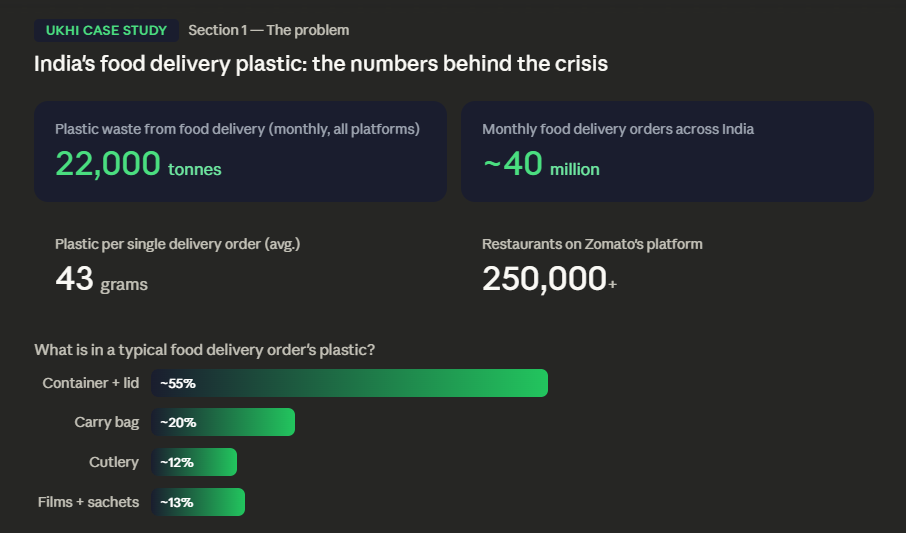
In 2018, Zomato CEO Deepinder Goyal publicly acknowledged something most food delivery companies avoided talking about. He estimated that food delivery plastic waste in India reaches roughly 22,000 tonnes every single month. That is across all platforms, not Zomato alone. But the number put a face on a problem the industry had been quietly growing for years.
A typical food delivery order generates about 43 grams of plastic. That includes the container, lid, cutlery, carry bag, sauce packets, and sometimes an extra layer of cling film. Multiply that by tens of millions of monthly orders across Zomato’s 250,000+ restaurant partners, and you begin to see the challenge.
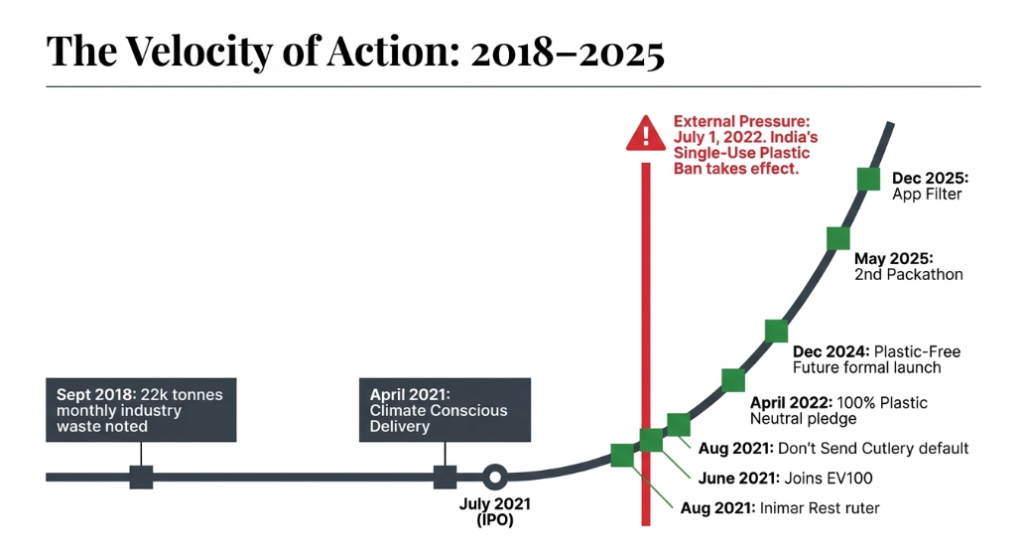
When India’s single use plastic ban took effect on July 1, 2022, it prohibited 19 specific items including plastic cutlery, straws, plates, and stirrers. This was a significant regulatory step. However, the rigid polypropylene containers that carry the bulk of delivered food were not included in the ban. These containers remain legal, cheap, and widely used across the food delivery ecosystem.
What makes Zomato’s position particularly complex is that as a platform, it does not manufacture or supply most of the packaging. Restaurants choose their own containers. Under India’s plastic waste management rules 2022 and the EPR packaging India framework, the formal obligation sits with producers and brand owners rather than with aggregators. Zomato has stated in its BRSR filings that EPR is not currently applicable to its standalone entity. Everything the company does on plastic is, for now, voluntary.
That context makes what Zomato has built all the more notable.
Four Programs Driving Change At Zomato
Zomato’s sustainable packaging strategy rests on four connected initiatives.
Announced on Earth Day 2022, this is Zomato’s flagship commitment. For every gram of plastic used in packaging across its platform, Zomato ensures an equivalent amount is collected and recycled through ISO-certified waste management partners across India.
The numbers have scaled steadily. According to Zomato’s ESG Factsheets (assured by Ernst & Young for FY23 and Deloitte Haskins & Sells for FY24), the company recycled approximately 20,000 MT in FY23 alone.
By June 2025, the cumulative total had crossed 45,000 metric tonnes of plastic recycled. This makes Zomato’s program one of the largest voluntary plastic recycling commitments by any food delivery company globally.
The recycled plastic is repurposed into non-food-grade products such as detergent bottles and paint containers.
This was a deceptively simple change. Zomato switched cutlery from being included by default to being available only on request. Customers now have to actively opt in if they want disposable cutlery with their order.
As of FY24, approximately 74–75% of all Zomato orders go cutlery-free. This prevented roughly 933 MT of cutlery waste in FY24, with cumulative savings of approximately 1,933 MT through early 2025.
This program identifies restaurants that already use minimal plastic for their main dishes and beverages and gives them a visible “Low Plastic Packaging” badge on the Zomato app.
As of mid-2025, the program covers 7,500+ restaurants across 400+ cities and more than 200 restaurant brands.
Roughly 80 million orders have been placed with these restaurants, and the target is 100 million by FY2026.
Zomato’s B2B supply arm, Hyperpure, offers approximately 100 sustainable packaging products to restaurant partners. Currently, 10,000 to 12,000 restaurants per month purchase sustainable packaging through Hyperpure, and over 50,000 kg of biodegradable packaging was sold in FY24.
The Innovation Pipeline: Packathon with Startup India
Zomato has also invested in finding new materials and solutions through its Plastic-Free Future Packathon, organized in partnership with Startup India under DPIIT. The first edition in 2024 attracted 85 startups from 18 states. The second edition concluded on May 9, 2025 at Bharat Mandapam in New Delhi. It drew 128 applicants from 21 states with 47 women-led startups participating. Winning innovations included seaweed-based packaging, coconut fiber containers, materials made from water lily waste, and edible cutlery.
The Packathon reflects an important reality. The compostable packaging industry in India is still early-stage. Restaurants need proven, affordable, scalable alternatives before they can move away from conventional plastic. Zomato’s approach is to actively scout for and support packaging startups to help build that ecosystem.
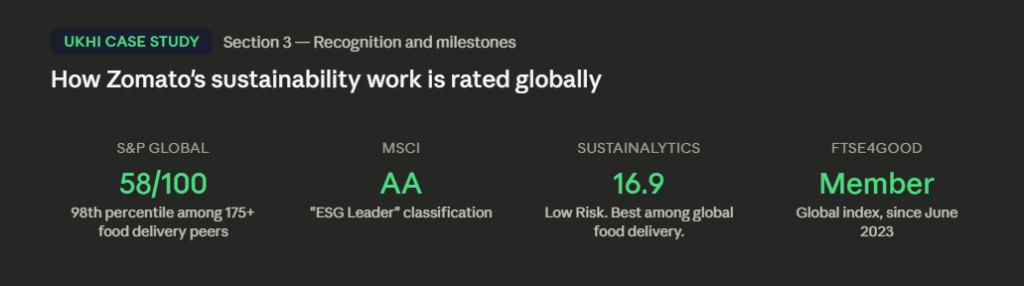
ESG Recognition and What It Signals
The Opportunity Ahead
Zomato’s journey shows that India’s largest food delivery platforms are keen to build infrastructure for a plastic to compostable packaging switch.
The demand signals are impressive, including a dedicated app filter for low-plastic restaurants, a growing Packathon pipeline, Hyperpure scaling sustainable SKUs, and 7,500+ restaurants that are already badged as low-plastic.
What this transition needs now is supply. Restaurants across India need compostable packaging granules and finished products that can match conventional plastic on cost, food safety, and performance. The intent is not the gap here.
About Ukhi
Ukhi manufactures and distributes EcoGran, compostable packaging granules that converters use to make finished compostable food containers, carry bags, courier mailers, and films. EcoGran is available through DCGpac, India’s largest B2B packaging platform. If you are a restaurant, cloud kitchen, or packaging converter exploring the switch from conventional plastic to CPCB certified compostable alternatives, explore Ukhi’s product range or ask your DCGpac partner about EcoGran.