

How Myntra Eliminated 100% Single-Use Plastic From Millions of Shipments
Disclaimer: This case study is based on publicly available information from Myntra, Flipkart Group, Bambrew, Canopy, and credible media sources. Ukhi is not affiliated with Myntra or the Flipkart Group. Contact us to request corrections or removals, at [email protected].
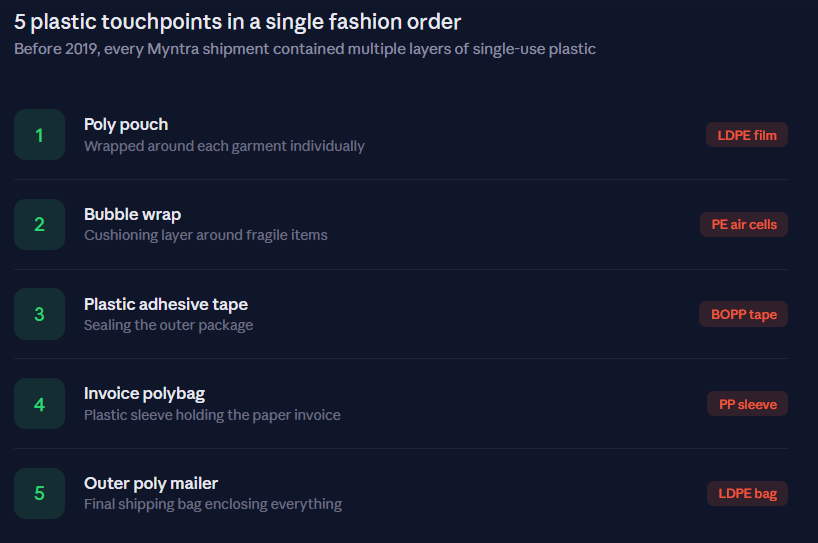
Every time someone orders a kurta or a pair of sneakers online, the product typically arrives wrapped in a poly pouch, sealed with plastic tape, cushioned with bubble wrap, placed inside another poly bag, with an invoice tucked into a small plastic sleeve.
100%
Plastic-free shipments
5,000+
Sellers converted
670 T
Plastic diverted
1,500 T
Landfill eliminated
Now multiply that by millions of orders every month.
Myntra, India’s largest fashion and lifestyle e-commerce platform owned by Flipkart Group (a Walmart subsidiary), processes orders from over 5,000 brand and seller partners.
Before 2019, every one of those shipments followed the standard industry playbook, with single-use plastic packaging at every stage. The assumption across Indian e-commerce was simple: plastic is cheap, plastic is waterproof, plastic is what the machines are built for. Nobody had proven otherwise at scale.
Meanwhile, India’s plastic waste crisis was growing. The country generates over 3.5 million tonnes of plastic waste annually, and e-commerce packaging is one of the fastest growing contributors. The government’s Plastic Waste Management Rules 2022 and the national single-use plastic ban (effective July 1, 2022) were on the horizon, creating both regulatory urgency and commercial opportunity for brands willing to move early.
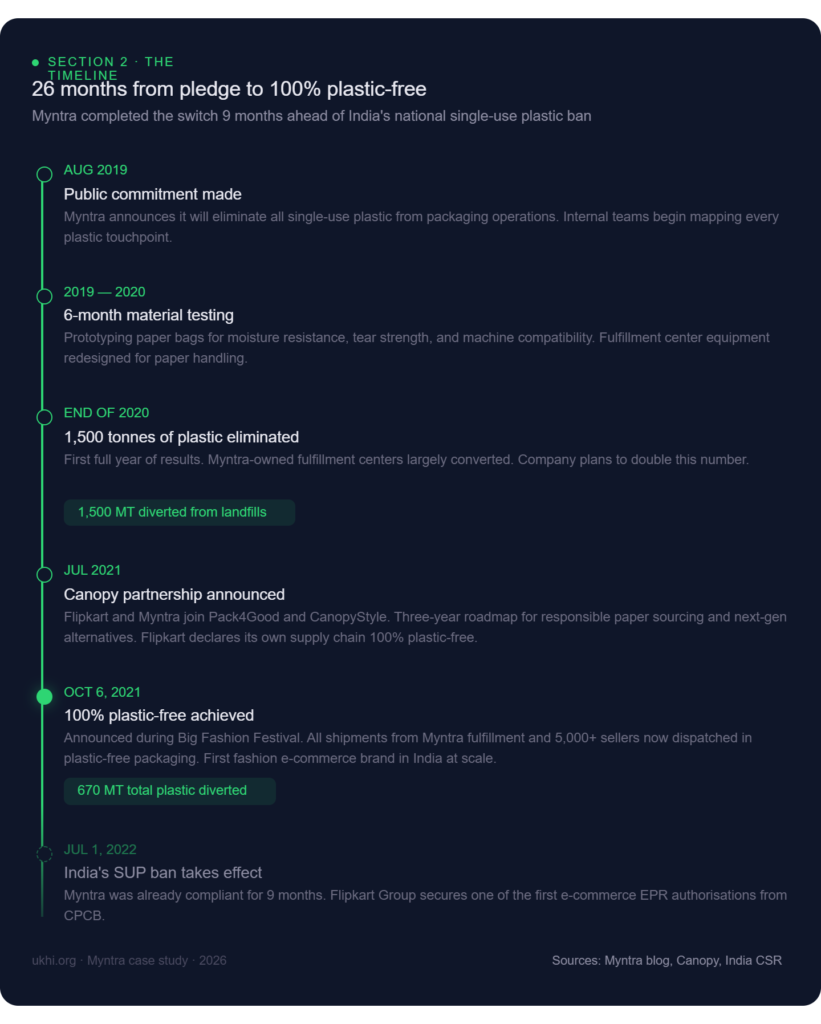
Myntra's 26-Month Journey: August 2019 Pledge to October 2021 Completion
In August 2019, Myntra publicly committed to eliminating all single-use plastic from its packaging operations.
The company set out to:
The six-month testing phase was critical.
Fashion products need moisture protection, and paper tears more easily than poly film. Automated packing lines behave differently with rigid paper than with flexible plastic. Each replacement material had to match plastic on performance before Myntra would approve it for large-scale use.
What Replaced What: The Exact Material Swap for Every Plastic Component
By the time the transition was complete, Myntra had replaced every plastic component with a specific alternative:
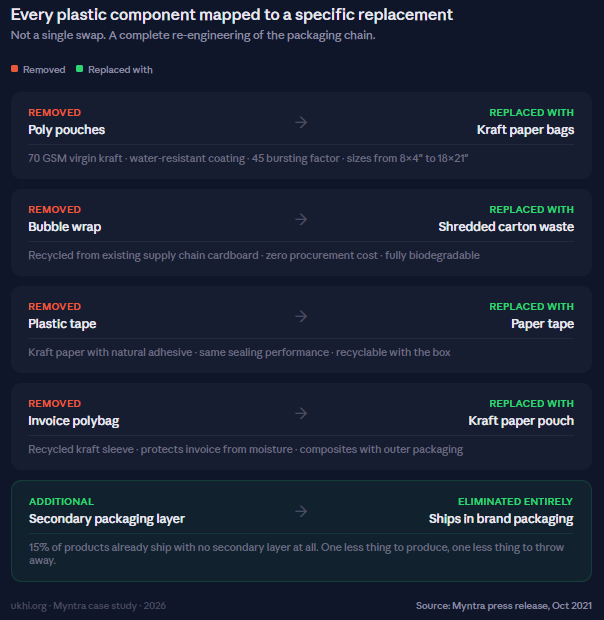
This was much more sophisticated than a simple material swap, and more of a system swap.
Bambrew, the Bengaluru-based sustainable packaging startup, holds a special place in this story.
Myntra was Bambrew’s very first client when the company started operations in 2019. In February 2025, Bambrew formalised the relationship further by becoming a strategic supply partner for Myntra-branded paper mailer bags.
The engagement allowed sellers to purchase approved bag types and sizes directly through Bambrew’s platform. Bambrew uses bamboo, sugarcane bagasse, and natural fibres to produce packaging, and its proprietary material Biofil is marketed as home-compostable.
Beyond Bambrew, Myntra works with a distributed network of authorised manufacturers including Origin Biopack, LETS PAK, Aristo Eco Pack, Pacfo, and Avon Packaging. This multi-supplier model ensures that packaging availability does not become a bottleneck even during peak sale events like Big Fashion Festival.
How Myntra Got 5,000+ Sellers to Switch Using QR Code Enforcement
Myntra deployed four mechanisms.
670 Tonnes Diverted, 1,500 Tonnes Eliminated: The Verified Numbers
Myntra officially announced the completion of its plastic-free packaging transition on October 6, 2021, during the Big Fashion Festival (October 3 to 10, 2021).
By that date, 100% of shipments from both Myntra’s own fulfillment centers and seller partners were dispatched in entirely plastic-free packaging. This made Myntra the first fashion e-commerce platform operating at scale in India to reach this milestone, nine months before the national single-use plastic ban took effect.
As Myntra scales these numbers further each year, the company’s packaging data continues to feed into Flipkart Group’s broader sustainability reporting, which covers GHG emissions, waste diversion, and water recycling across all subsidiaries.
Net Zero by 2040: Flipkart Group's Forward Commitments and India's $57 Billion Packaging Opportunity
Myntra officially announced the completion of its plastic-free packaging transition on October 6, 2021, during the Big Fashion Festival (October 3 to 10, 2021).
By that date, 100% of shipments from both Myntra’s own fulfillment centers and seller partners were dispatched in entirely plastic-free packaging. This made Myntra the first fashion e-commerce platform operating at scale in India to reach this milestone, nine months before the national single-use plastic ban took effect.
As Myntra scales these numbers further each year, the company’s packaging data continues to feed into Flipkart Group’s broader sustainability reporting, which covers GHG emissions, waste diversion, and water recycling across all subsidiaries.
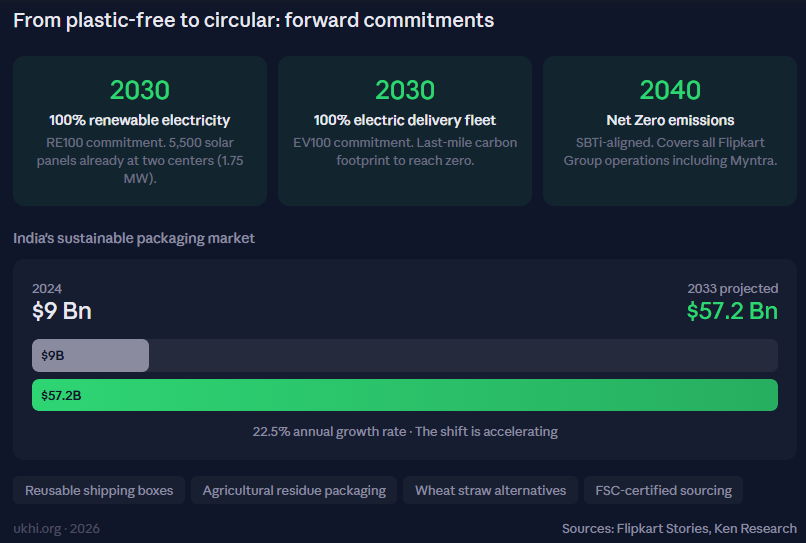
In July 2021, Flipkart and Myntra jointly partnered with Canopy, the global forest conservation non-profit, joining the Pack4Good and CanopyStyle initiatives.
This committed both companies to a three-year roadmap covering responsible sourcing of forest-derived packaging material.
The Flipkart Group has also committed to:
What This Means for the Industry
Myntra’s transformation demonstrates that full plastic-to-compostable packaging transition is operationally viable at a massive scale in Indian e-commerce.
And with India’s sustainable packaging market projected to grow from $9 billion (2024) to $57.2 billion by 2033, the commercial logic is only getting stronger.
The starting point for any brand, packaging converter, or e-commerce seller exploring this switch is the right base material.
About Ukhi
Ukhi manufactures compostable granules (EcoGran), the raw input for producing compostable bags, films, and flexible packaging. EcoGran is designed to meet CPCB compostability standards and can be processed on standard blown-film machinery with minimal retooling, addressing the same infrastructure challenge that Myntra solved across its network. EcoGran is distributed through DCGpac, India’s largest B2B packaging platform serving 60,000+ customers. Ask your DCGpac partner about Ukhi, or reach out to us directly.