

Haldiram's, and a Massive Compostable Packaging Opportunity
Disclaimer: This is an independent market analysis based on publicly available information. Haldiram’s is not a partner or customer of Ukhi. Contact us to correct or remove any information.
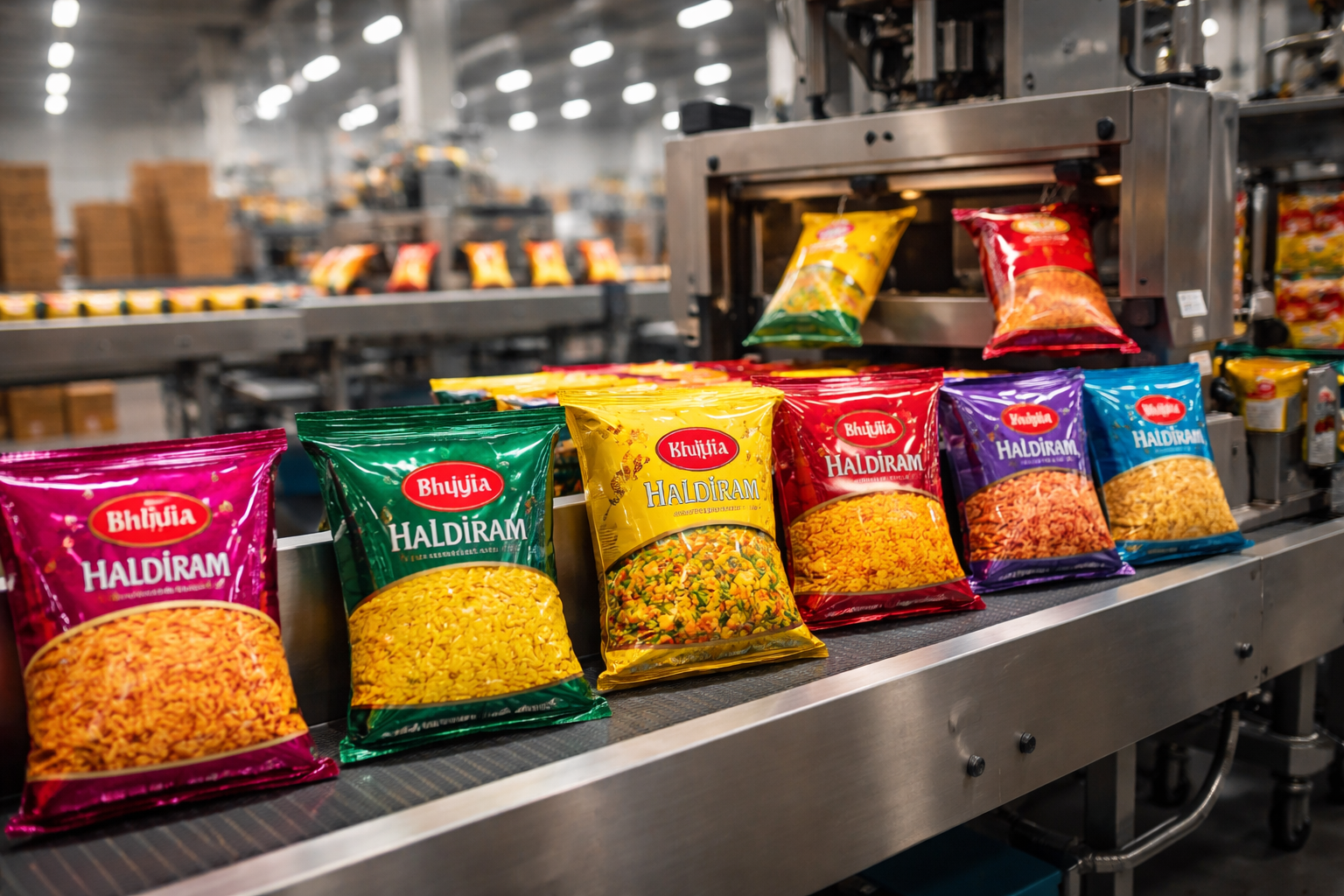
Every day, roughly 500 tonnes of food leaves Haldiram’s factories across India.
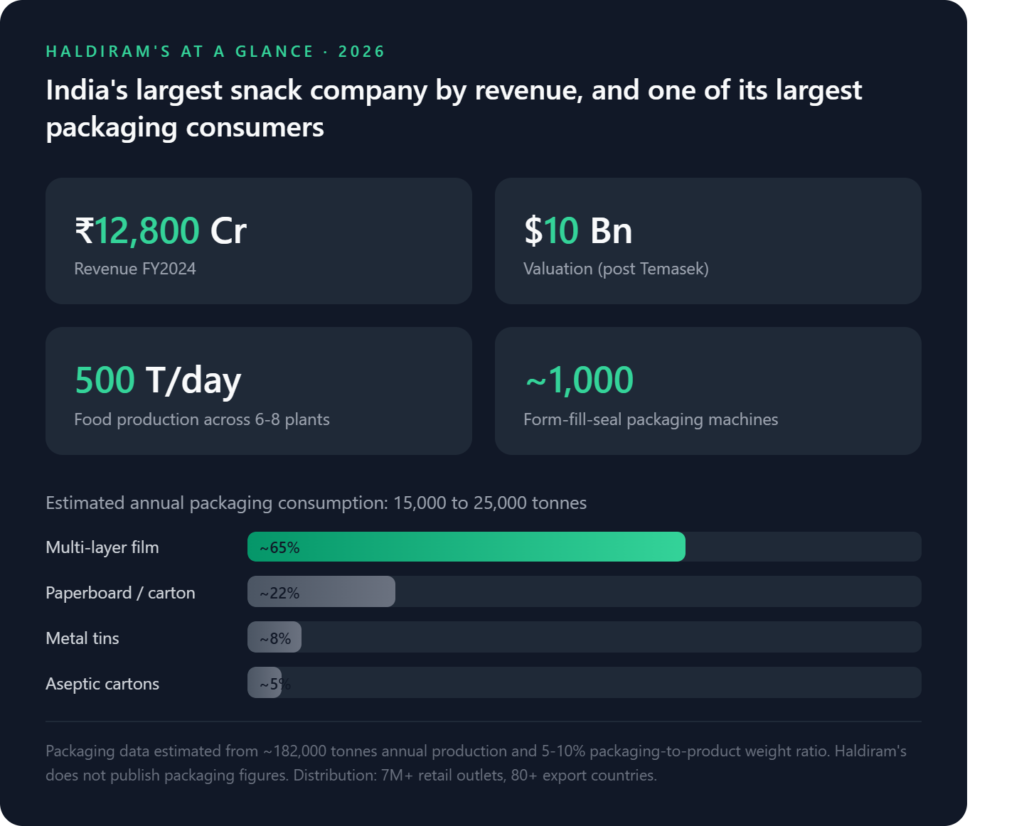
That includes namkeen, sweets, chips, frozen meals, cookies, and ready-to-eat packets moving through about 1,000 packaging machines, into the hands of more than 1,000 distributors, and onto the shelves of over 7 million retail outlets.
The company exports to 80+ countries.
In FY2024, Haldiram’s reported approximately ₹12,800 crore in revenue, and after Temasek picked up a roughly 10% stake for around $1 billion in early 2025, the company’s valuation crossed $10 billion.
An IPO is widely expected within the next 18 to 24 months.
All of this makes Haldiram’s not just India’s largest snack company, but also one of its largest users of packaging material. And that is where the story gets interesting.
45,174 MT
Plastic used in FY25
47,000 MT
Plastic processed
79%
Recyclable packaging
2030
Bio-based target
How much plastic does Haldiram's actually use?
Haldiram’s does not publish its packaging data, so no official number exists. But the math is fairly straightforward.
With roughly 182,000 tonnes of finished product per year and a typical packaging-to-product weight ratio of 5% to 10% for snack foods, a reasonable estimate puts total packaging consumption at 15,000 to 25,000 tonnes annually.
This includes paperboard, metal tins, cartons, and a significant share of flexible plastic film.
The snack packaging itself is mostly multi-layer laminate: metallized polyester or polypropylene pouches, nitrogen-flushed to keep products fresh for six to nine months.
Sweets tend to come in paperboard boxes or rigid plastic containers with in-mould labels.
Ready-to-eat meals like the Minute Khana range use retort pouches inside printed cartons. Haldiram’s beverages moved to SIG aseptic cartons in 2021 after a ₹100 crore investment in dairy manufacturing.
So it is a mixed portfolio, and a meaningful portion already sits on paper and board. But the flexible plastic used for namkeen sachets and chips packets, especially in the high-volume ₹5, ₹10, and ₹20 price points, represents the bulk of units produced.
PET as a material is important here because it is one of the most widely recycled plastics in India and is compatible with food-grade recycled PET, or rPET. India’s packaging regulations are moving toward a requirement of 40% recycled content in beverage PET packaging by 2026, and this line positions Britannia ahead of that requirement rather than scrambling to meet it.
What Haldiram's is already doing on sustainability
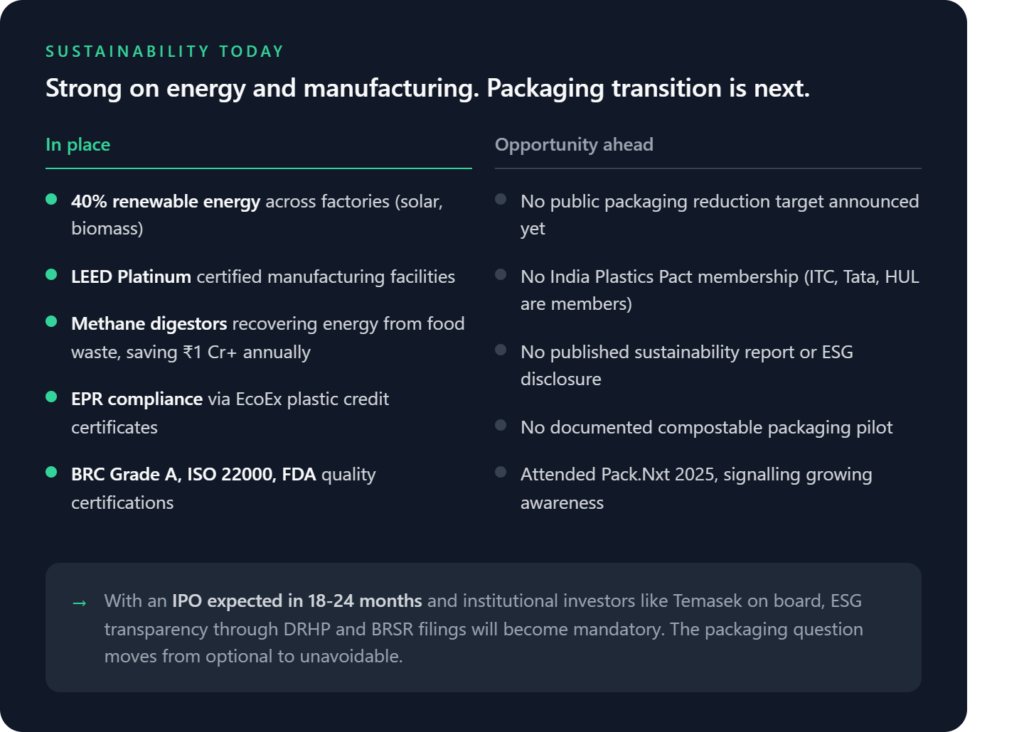
Haldiram’s has already invested in making its manufacturing cleaner and more sustainable.
On EPR (Extended Producer Responsibility) compliance, Haldiram’s works with EcoEx, India’s digital marketplace for plastic credit certificates.
This is the standard compliance route used by most large FMCG companies in India today, alongside brands like Dabur and Hindustan Coca-Cola.
The company also attended Pack.Nxt 2025, one of India’s most prominent sustainable packaging conferences.
Why switching to compostable packaging is technically difficult for snacks
Here is the core challenge, and it applies to every snack brand in India, not just Haldiram’s.
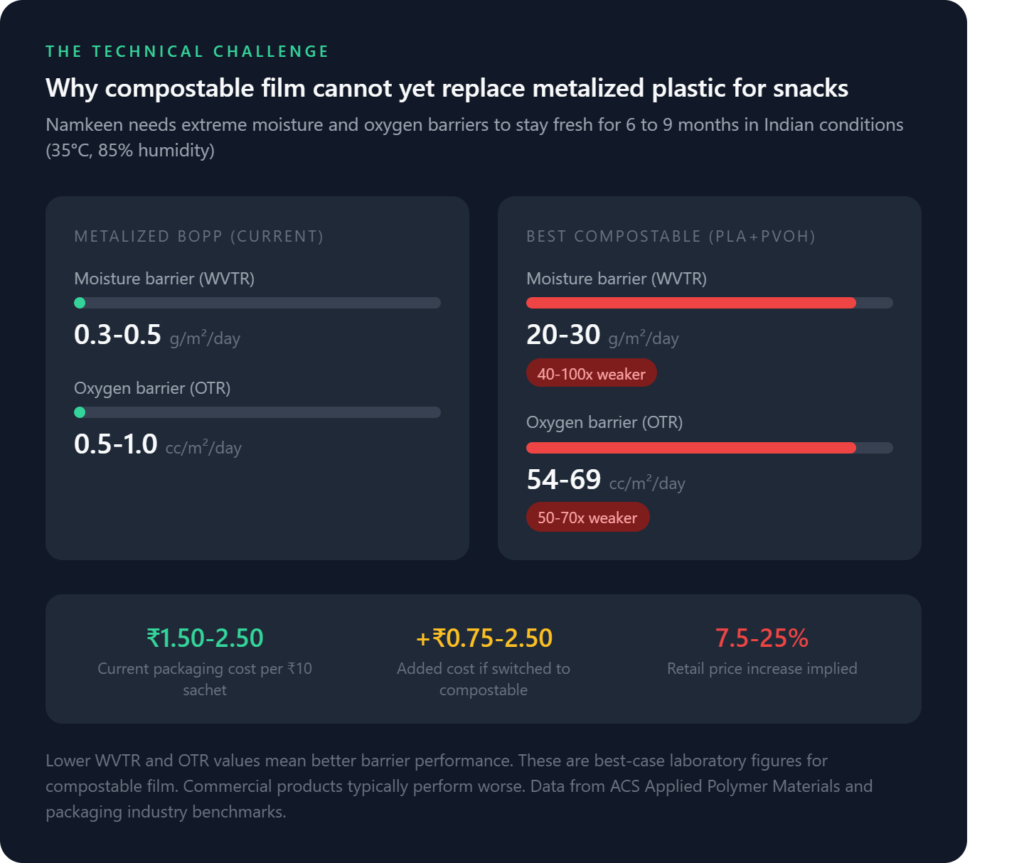
The metallized film used for namkeen pouches is extremely effective at keeping moisture and oxygen out.
Oxygen transmission rate: 0.5 to 1.0 cc
These numbers are what give a packet of bhujia a six to nine month shelf life in Indian conditions of 35°C temperature and 85% humidity.
Oxygen barrier is 50 to 70 times weaker
In plain terms, a namkeen packet made from today’s compostable materials would go stale in days or weeks rather than months.
What is changing, and why the next two years matter
Here is the core challenge, and it applies to every snack brand in India, not just Haldiram’s.
The metallized film used for namkeen pouches is extremely effective at keeping moisture and oxygen out.
Oxygen transmission rate: 0.5 to 1.0 cc
These numbers are what give a packet of bhujia a six to nine month shelf life in Indian conditions of 35°C temperature and 85% humidity.
Oxygen barrier is 50 to 70 times weaker
In plain terms, a namkeen packet made from today’s compostable materials would go stale in days or weeks rather than months.
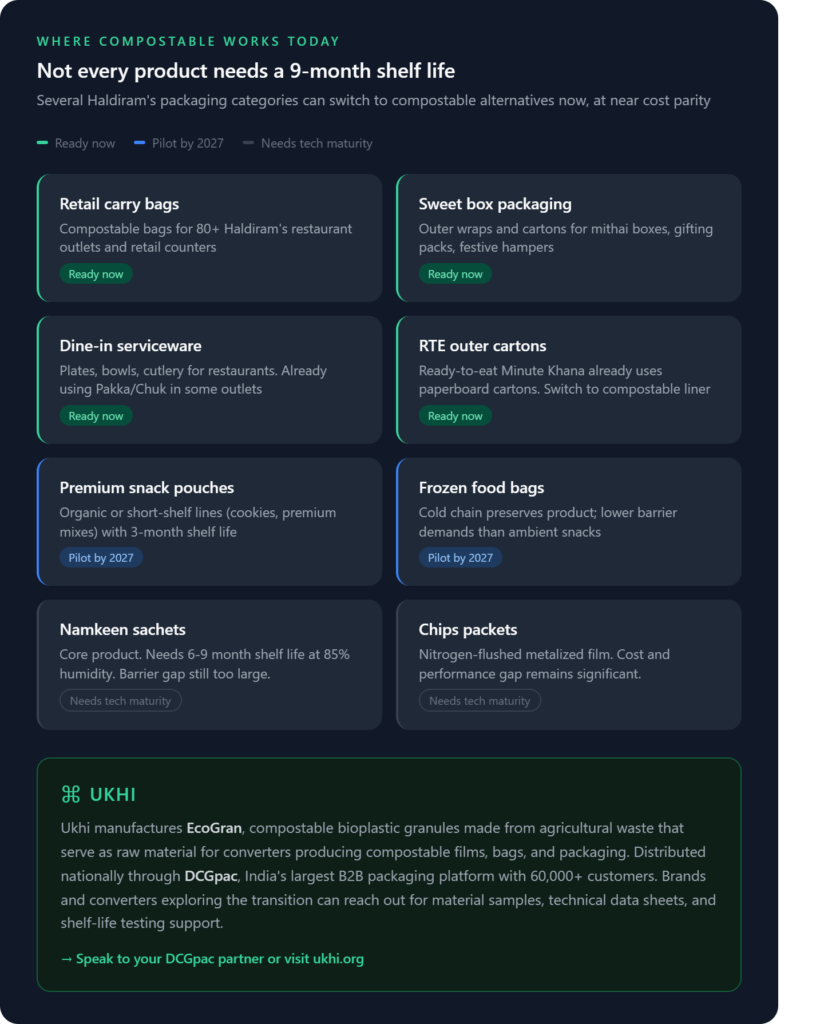
The pathway forward for Haldiram’s is clearly phased.
Where the Indian snack industry stands overall
Here is the core challenge, and it applies to every snack brand in India, not just Haldiram’s.
The metallized film used for namkeen pouches is extremely effective at keeping moisture and oxygen out.
Oxygen transmission rate: 0.5 to 1.0 cc
These numbers are what give a packet of bhujia a six to nine month shelf life in Indian conditions of 35°C temperature and 85% humidity.
Oxygen barrier is 50 to 70 times weaker
In plain terms, a namkeen packet made from today’s compostable materials would go stale in days or weeks rather than months.
About Ukhi
Ukhi manufactures EcoGran, compostable bioplastic granules that serve as raw material for converters producing compostable films, bags, and packaging. EcoGran is distributed nationally through DCGpac, India’s largest B2B packaging platform serving over 60,000 customers. Brands, converters, and packaging manufacturers exploring the transition to compostable materials can reach out for samples, technical data sheets, and shelf-life testing support. Speak to your DCGpac partner or contact us at ukhi.com.