

How BigBasket Built One of India's Most Commendable Packaging Sustainability
Disclaimer: Published by Ukhi. Information is compiled from public sources. If you represent any organisation mentioned here and would like anything corrected or removed, please contact us at [email protected].
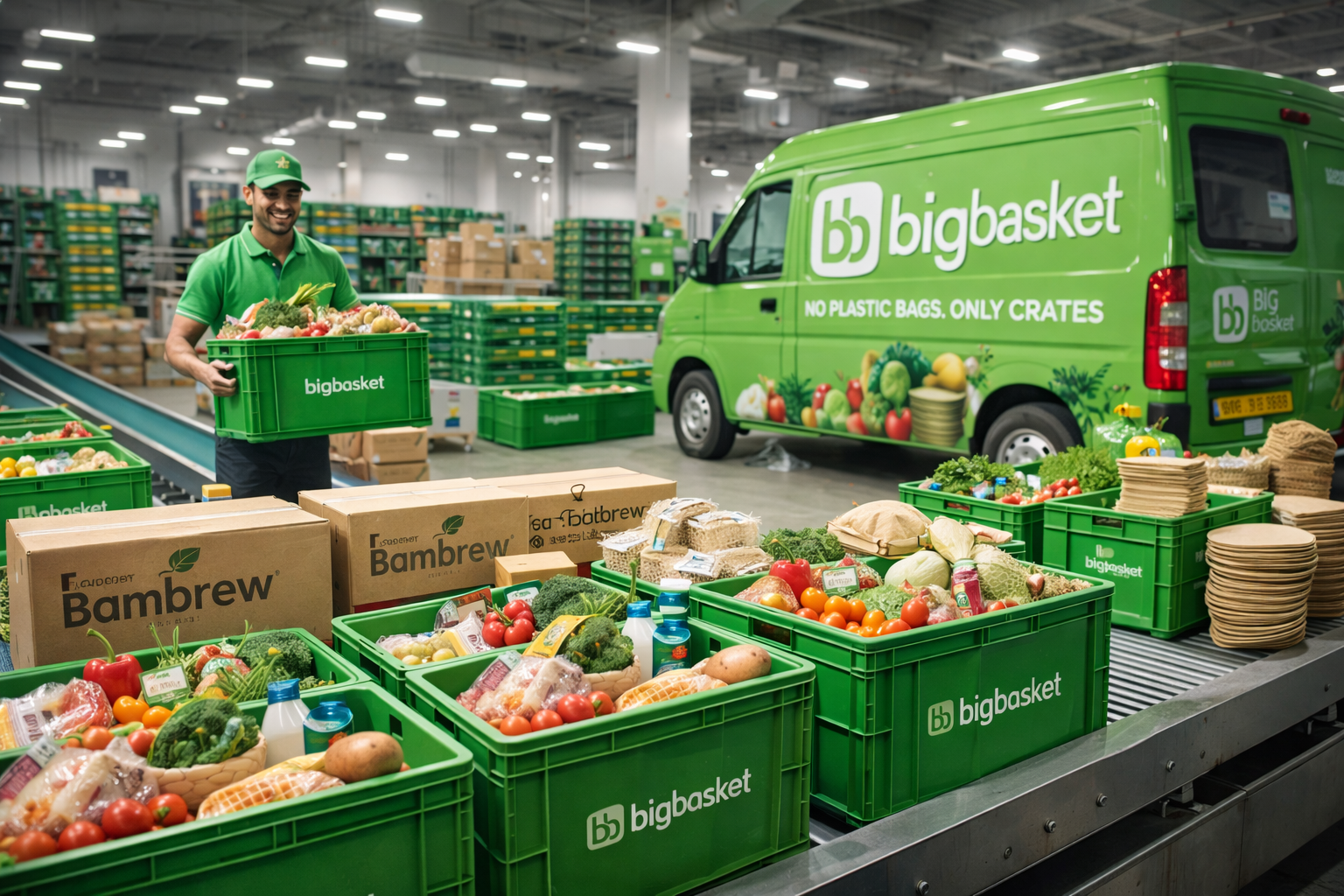
Every time a BigBasket delivery arrives at a customer’s door, it comes in a hard plastic crate.
Not a plastic bag.
Not a cardboard box that gets thrown away.
It’s a crate that goes back to the warehouse, gets used again, and keeps circulating for many more years before it is finally recycled.
That one decision, made when the company was founded in 2011, is the foundation of everything BigBasket has done on packaging since.
It was not the easy choice. Crates are actually more difficult to handle than simply delivering in plastic bags, and they represent a large capital investment for the company.
BigBasket paid more, worked harder, and chose the crate anyway.
That is the thread that runs through this case study: a company that has consistently made structurally better packaging choices, even when those choices cost more, and is now navigating what is genuinely the hardest part of that journey.
45,174 MT
Plastic used in FY25
47,000 MT
Plastic processed
79%
Recyclable packaging
2030
Bio-based target
Where It Started: Eliminating the Plastic Bag Before Anyone Was Talking About It
Between roughly 2015 and 2019, BigBasket phased out plastic packaging for fruits and vegetables entirely.
At the time, this was not a regulatory requirement. India’s single-use plastic ban came into effect only on 1 July 2022.
BigBasket made this shift years before it was mandated, and the company was open about the operational difficulty.
By 2022, BigBasket introduced cornstarch-based packaging for delicate produce, a material that breaks down significantly faster than conventional plastic.
On 5 June 2022 (World Environment Day), the company launched what it described as India’s first packaging-free doorstep delivery of fresh fruits and vegetables. Delivery agents carry reusable multi-pocket bags, customers transfer their produce, and the bag returns with the delivery agent.
What the Numbers Show
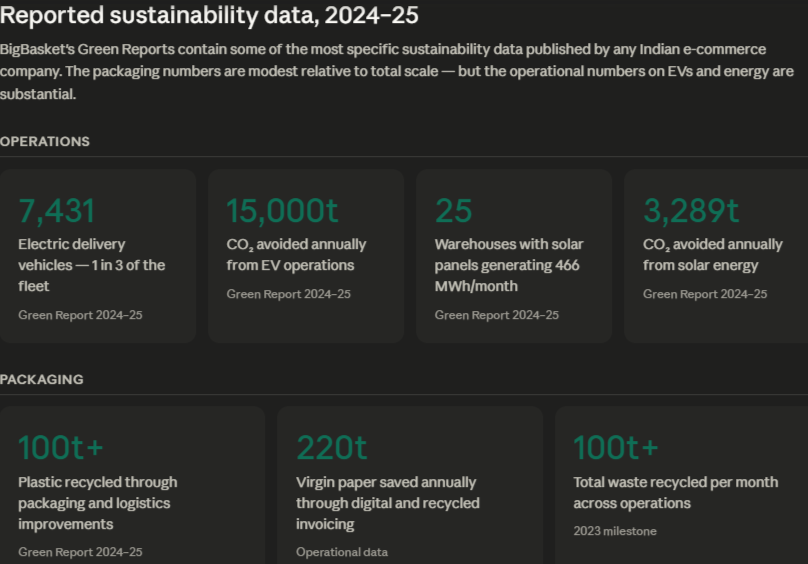
BigBasket’s annual Green Reports, released every World Environment Day, contain some of the most specific sustainability data published by any Indian e-commerce company.
The compostable packaging and materials side is where the company still has the most room to grow its reporting.
The 100-tonnes recycled figure is currently the only packaging-specific number published, and it covers recycling rather than elimination or substitution.
An anticipated IPO under SEBI’s BRSR reporting framework, which requires detailed and audited sustainability disclosure, is likely to significantly improve transparency.
The Supplier Network Building This Out
BigBasket is not doing this alone.
The company works with Bambrew, a Bengaluru-based sustainable packaging startup that supplies paper-based mailer bags made from bamboo, sugarcane, seaweed, and FSC-certified wood pulp.
Bambrew produces over 75 million bags per month and counts Amazon, Nykaa, Flipkart, and Myntra among its clients alongside BigBasket.
The startup raised ₹90 crore in Series B funding in 2025, which reflects the scale at which sustainable e-commerce packaging in India is now operating.
BigBasket’s Tata Group parentage also plays a major role.
Tata Group’s Project Aalingana commits to net-zero emissions by 2045 and requires 100% recyclable, compostable, or reusable packaging by 2030, with a 70% interim milestone by FY 2025–26.
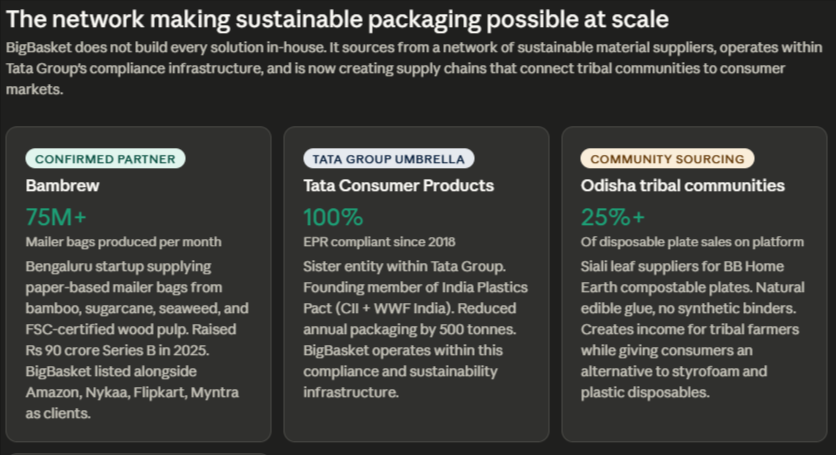
BigBasket operates within this ecosystem, which provides both infrastructure and accountability structures that most standalone e-commerce players do not have access to.
The Quick Commerce Question
In August 2024, BigBasket made BB Now its default delivery mode. BB Now is its 10-minute grocery delivery service, now operating out of approximately 700 dark stores across India, with plans to scale to 900 to 1,200.
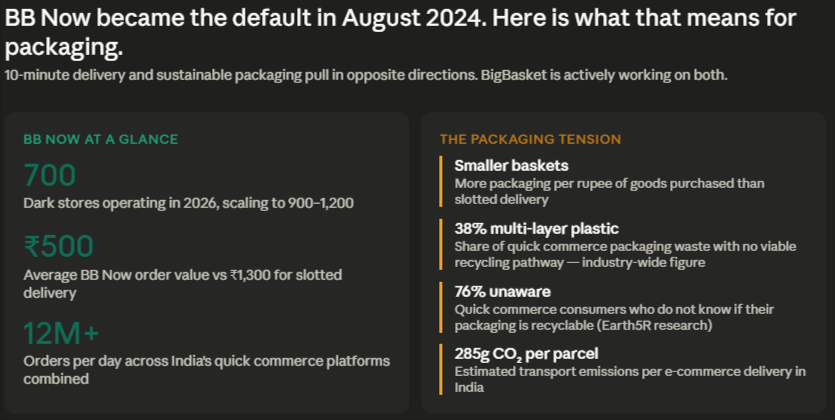
Quick commerce, meaning grocery or retail delivery in under 15 minutes, is growing rapidly across India.
Combined across platforms, the sector now handles an estimated 12 million+ orders every day. That is an enormous amount of packaging moving through the system daily.
BigBasket’s BB Now orders already use 100% digital invoices, eliminating paper waste from every quick commerce transaction.
The company’s broader sustainable materials, including cornstarch packaging and returnable bags, apply across operations.
In June 2025, BigBasket launched a circular return program allowing customers to send back used bags and cardboard boxes with their next order.
This is a direct attempt to apply the same crate logic to smaller-format packaging.
The wider quick commerce packaging challenge is one the entire sector is still working through:
BigBasket’s sustainability program, already one of the most developed in Indian e-commerce, is now being actively extended into quick commerce.
The Newest Chapter: Products That Are Themselves the Solution
In November 2025, BigBasket launched BB Home Earth Siali leaf plates under its in-house brand.
These are compostable plates made from Siali leaves sourced from tribal communities in Odisha, using natural edible glue instead of synthetic binders.
CEO Menon described the product as “one of our fastest-growing product lines”, and the company reported that it accounts for 25%+ of sales in the disposable plates segment on its platform.
This is a meaningful development because it moves BigBasket from being a company that manages its own packaging footprint to becoming a distribution channel for compostable food packaging at consumer scale.
Every Siali leaf plate sold is one plastic or styrofoam plate not sold.
The product also connects sustainability to livelihood creation. Tribal communities in Odisha supply the raw material, creating a supply chain with built-in social value.
What This Tells the Packaging Industry
BigBasket’s journey from reusable crates in 2011 to cornstarch packaging, packaging-free delivery pilots, circular return programs, and compostable consumer products in 2025 is one of the longest and most consistent sustainability records in Indian retail.
The company has consistently operated at the frontier of what is structurally possible in plastic-free e-commerce in India at every stage of its growth.
For packaging manufacturers and material suppliers working in compostable packaging for e-commerce and biodegradable packaging for grocery delivery, BigBasket’s scale and consistency represent both validation and opportunity.
The demand for certified compostable materials — whether films, bags, or food-contact packaging — will continue to grow as platforms like BigBasket deepen their commitments and quick commerce scales across India.
About Ukhi
Ukhi supplies compostable granules and materials to packaging manufacturers across India. We publish research like this because the transition from plastic to compostable packaging in Indian retail and e-commerce is the industry we work in. If you are a packaging manufacturer supplying e-commerce or grocery brands and want to explore compostable material options, we would be glad to talk.