

How Blinkit Is Moving From Plastic to Compostable Packaging Across India's Quick Commerce Network
This case study is based on publicly available information from news reports, company blogs, regulatory filings, and industry sources. Ukhi is not affiliated with Blinkit or Zomato/Eternal Ltd. Contact us to get anything corrected or removed.
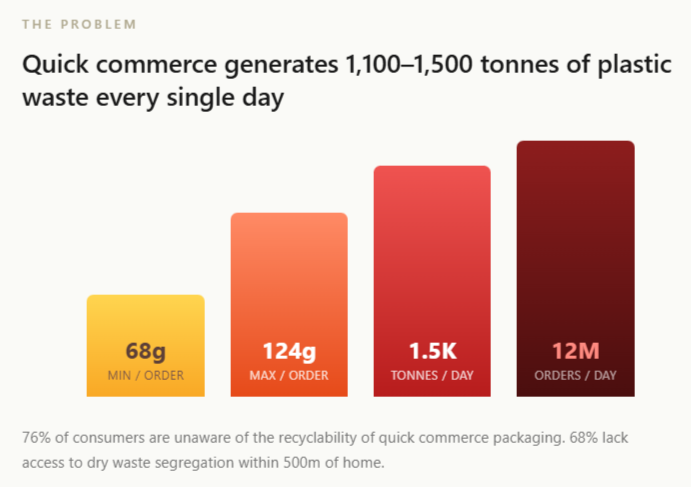
India’s quick commerce sector now handles roughly 12 million orders every day. Each order generates between 68 and 124 grams of packaging waste, which adds up to an estimated 1,100 to 1,500 tonnes of packaging entering the waste stream daily from quick commerce alone.
Blinkit, with over 600 dark stores and a dominant share in most major metros, sits at the centre of this challenge. The sheer volume of orders means that even small changes in packaging materials can have an outsized impact, both positive and negative.
India’s single use plastic ban, which came into effect on July 1, 2022, targeted 19 specific items like straws, plates, and cutlery. But it largely left delivery packaging untouched.
The more relevant regulation is India’s EPR (Extended Producer Responsibility) guidelines for plastic packaging, notified in February 2022 and amended in 2024. These require companies with annual packaging turnover above ₹50 crore to register, report their waste collection quarterly, and meet rising targets that go from 35% collection in FY25 up to 70% by FY29.
45,174 MT
Plastic used in FY25
47,000 MT
Plastic processed
79%
Recyclable packaging
2030
Bio-based target
What Blinkit Has Done So Far Towards Sustainable Packaging
Blinkit’s shift toward sustainable packaging started earlier than most people realize. Back when the company was still called Grofers, around mid-2020, it began replacing food-grade plastic delivery bags with biodegradable alternatives.
By May 2021, its official blog confirmed the change had been in place for about a year. This was well before the government’s plastic ban, which gives Blinkit a credible claim as an early mover in the space.
Today, paper bags are the primary packaging for most Blinkit grocery deliveries.
Fruits and vegetables are packed in recycled paper.
Private-label products like atta, sugar, and staples have gone through packaging redesigns to reduce plastic use.
The company’s polybags exceed the government-mandated 120-micron minimum thickness, are ROHS-compliant (meaning they meet safety standards for hazardous substances), and are rated food-safe.
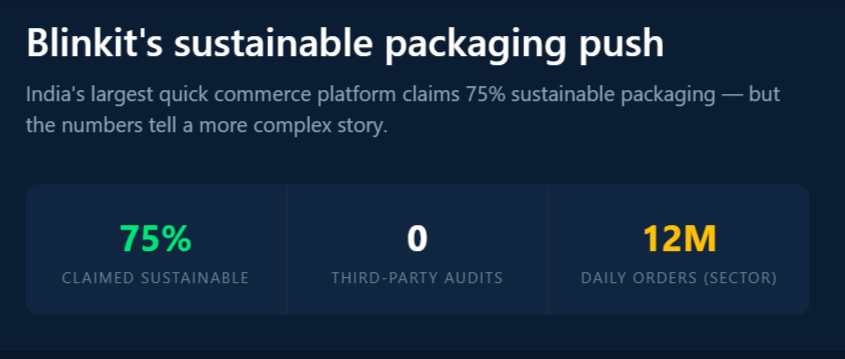
CEO Albinder Dhindsa has stated publicly that over 75% of Blinkit’s packaging already uses sustainable materials, including compostable bags, cloth bags, and recycled paper. This is the most specific figure available on Blinkit’s packaging mix.
One practical innovation worth noting is the dustbin-friendly bag redesign. Blinkit resized and reshaped its carry bags to fit standard household dustbins, with handles designed for easy knotting. This turns a single-use delivery bag into something the customer reuses at home for waste disposal. The redesign rolled out across Delhi NCR, Bangalore, and Mumbai.
The CHUK Partnership: Compostable Tableware at 10-Minute Delivery Speed
Blinkit’s most visible sustainability partnership is with CHUK, which is a brand of Yash Pakka Ltd. Announced in 2022, the partnership made CHUK Blinkit’s official sustainability partner.
Through this tie-up, Blinkit now delivers CHUK’s compostable tableware (plates, bowls, meal trays) made from sugarcane bagasse. These products carry CPCB compostable certification and meet the IS/ISO 17088 standard, which means they are tested and verified to break down in industrial composting conditions.
The partnership set an initial target of 10 million (1 crore) compostable pieces to reach consumers through Blinkit in FY 2022-23.
So, when a customer orders party plates or meal trays through Blinkit, they receive bagasse-based products by default. This happens without them having specifically searched for a sustainable option.
How Zomato's Sustainability Framework Connects to Blinkit
Blinkit has been a wholly-owned subsidiary of Zomato (now renamed Eternal Ltd.) since 2022.
- Zomato has built one of the strongest sustainability records among Indian technology companies, with an MSCI AA ESG rating, inclusion in the FTSE4Good Global Index, and a net zero target set for 2033.
- Zomato’s headline achievement on plastic is its 100% Plastic Neutral Deliveries programme, which was launched on Earth Day 2022.
- The company has facilitated the recycling of over 45,000 metric tonnes of plastic waste since FY23, and this has been verified by Ernst and Young.
- Its Plastic-Free Future Programme has enrolled over 10,000 restaurants across 490+ cities, and Hyperpure (Zomato’s B2B supply arm) delivered 2,700 MT of sustainable packaging to 47,000+ restaurant outlets in FY25.
Through FY24, Zomato’s formal ESG reporting was scoped to its food delivery operations.
Starting in FY25, under the Eternal rebrand, consolidated metrics have begun to include Blinkit.
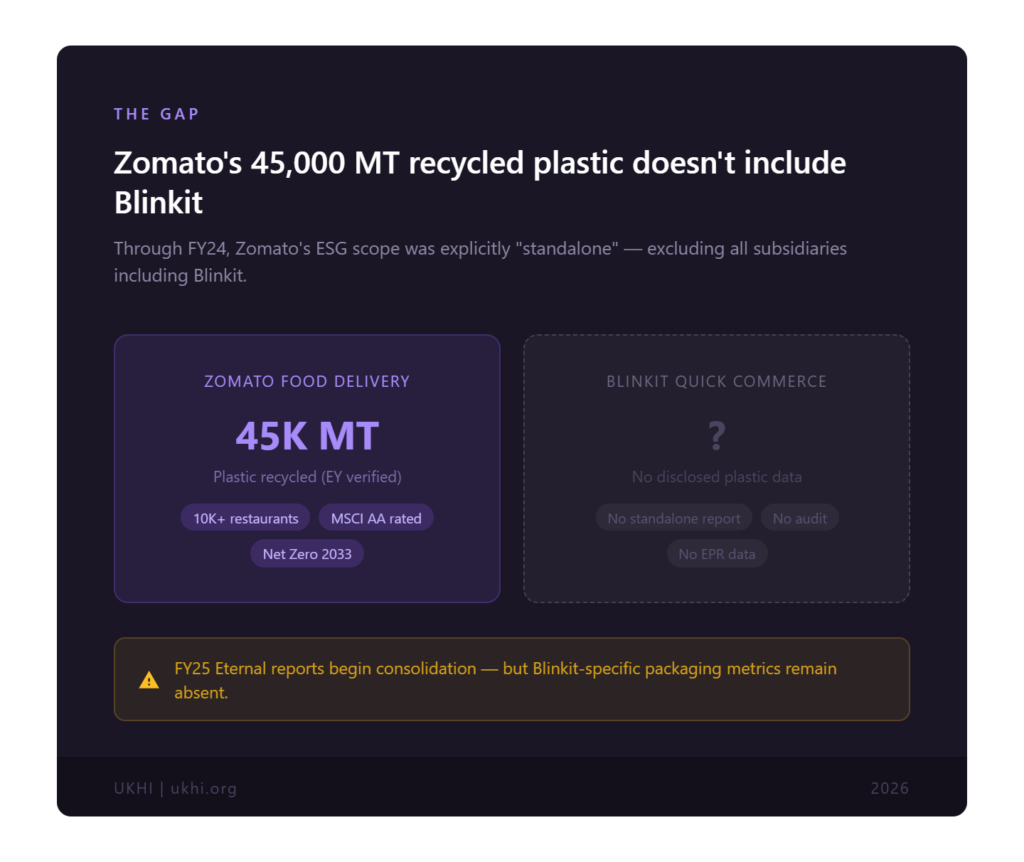
Blinkit’s packaging data is expected to become part of the group’s formal sustainability disclosures in the near future.
Where Blinkit Stands Among Competitors
The broader quick commerce packaging sustainability picture in India is evolving rapidly.
Swiggy Instamart, as a publicly listed company, publishes a full Business Responsibility and Sustainability Report. It claims 100% offset of direct-use plastics in FY25, deploys PLA-based compostable delivery bags, and offers a “No Bag” option where riders use reusable bags. Its 2030 targets include a 70% reduction in single-use plastic across partner packaging.
BigBasket became the first Indian brand to offer packaging-free doorstep delivery for fresh produce in June 2022. Its returnable packaging programme lets customers hand back used bags and boxes with their next order. It recycled over 100 tonnes of plastic in 2024-25 and operates 7,431 EVs.
Zepto launched compostable bags made from plant-based biopolymers in November 2025,. Its “No Bag Delivery” initiative has saved over 90 million paper bags.
Blinkit’s advantage is timing. It began its transition in 2020, before most competitors and before the regulatory push. Its CHUK partnership gives it a verified product-level sustainability story.
The next step is publishing detailed packaging data as part of Eternal’s consolidated ESG framework.
The Opportunity Ahead
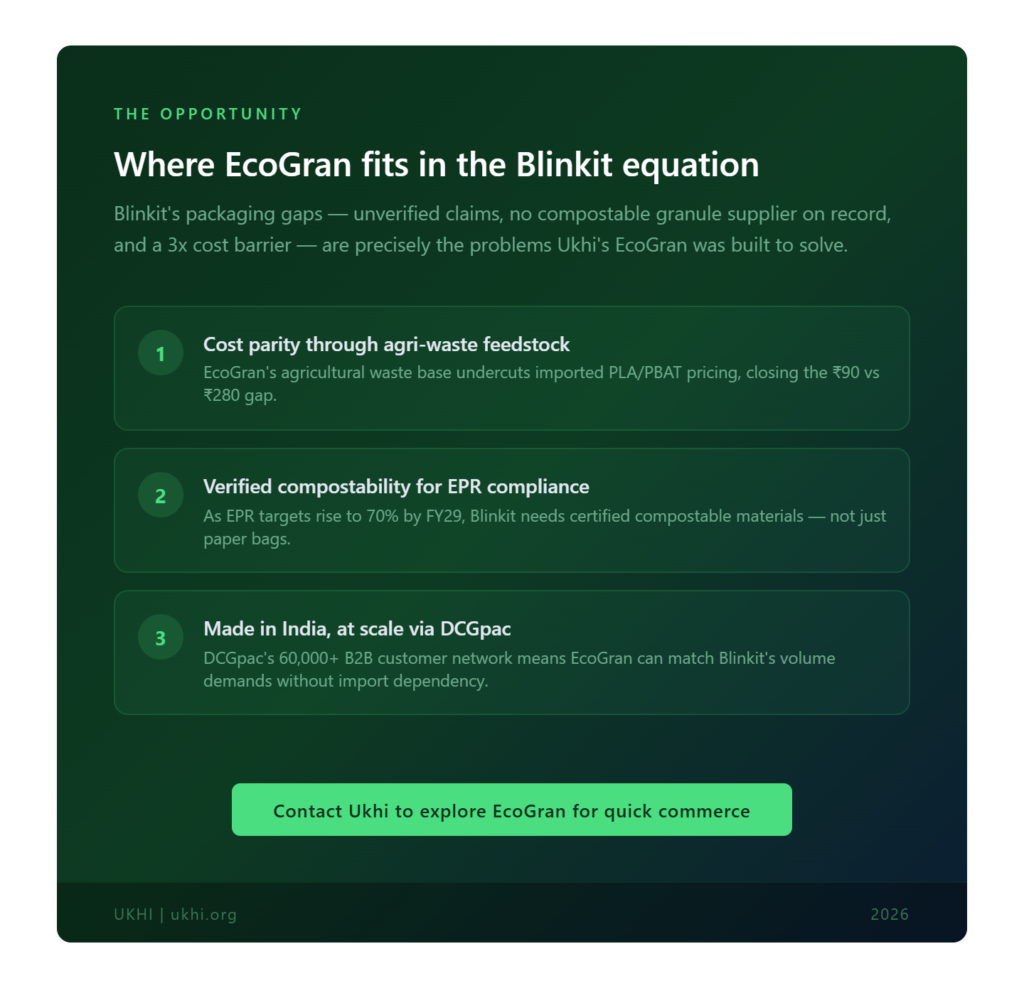
India’s biodegradable packaging market is valued at $3.09 billion, and it is a growing market. The cost gap between conventional plastic (approximately ₹90/kg for raw material) and compostable alternatives like PBAT (₹280 to 300/kg) is significant, but it is narrowing as domestic production scales up and import dependence reduces.
For a company that is operating at Blinkit’s volume, even a small percentage shift from plastic to compostable packaging means hundreds of tonnes of plastic is avoided every year. The infrastructure to support this is expanding across India.
About Ukhi
Ukhi (ukhi.org) is an open knowledge platform for compostable packaging in India and a directory connecting brands, manufacturers, and raw material suppliers working on plastic alternatives. Ukhi’s parent product, EcoGran, supplies compostable granules, the base raw material from which compostable bags, films, and packaging products are manufactured. EcoGran is distributed through DCGpac, India’s largest B2B packaging platform serving 60,000+ customers.