

Can Nestlé India Shift 25,000 Tonnes of Plastic Packaging to Compostable?
Disclaimer: This is an independent analysis by Ukhi. Nestlé India is not a customer, partner, or client of Ukhi. All information used here is drawn from public sources including company press releases, annual reports, regulatory filings, NGO audits, and mainstream media coverage. If you represent Nestlé India and want a correction, update, or any content removed, please write to [email protected] and we will act on it.
45,174 MT
Plastic used in FY25
47,000 MT
Plastic processed
79%
Recyclable packaging
2030
Bio-based target
The Scale of Nestlé India's Packaging Challenge
Every day in India, around 16.4 million Maggi packets are opened, cooked, and eaten.
Every year, Nestlé India sells 6 billion Maggi servings and 4.2 billion KitKat fingers.
Nescafé sachets, Munch wrappers, Polo rolls, Milkmaid tins, Cerelac boxes, and Everyday pouches run into billions more units.
All this is the everyday reality of a ₹20,078 crore FMCG giant that reaches nearly every kitchen in the country.
Inside Nestlé India's 25,000-Tonne Plastic Packaging Footprint
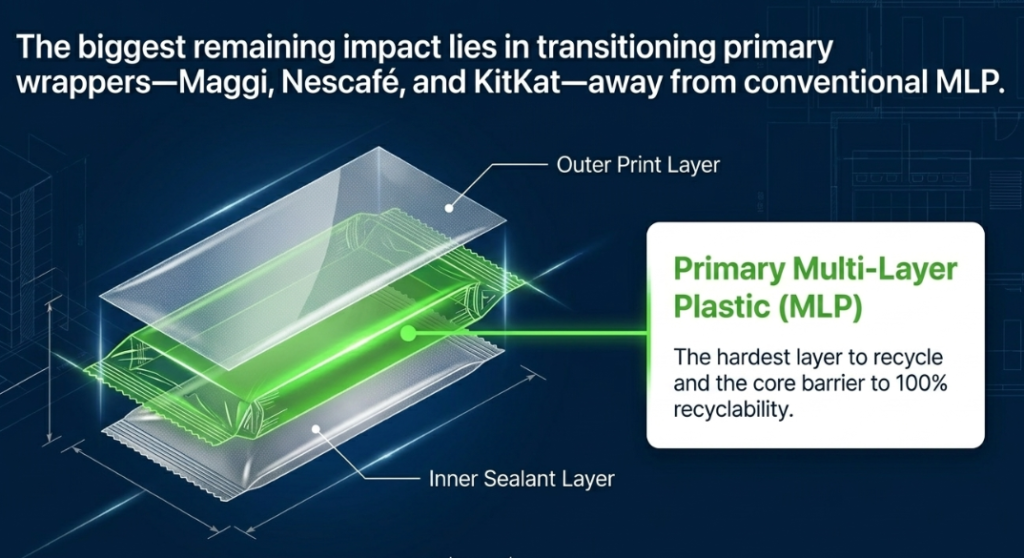
Behind all these products is a packaging footprint of roughly 25,000 tonnes of plastic every year. Nestlé India is one of the country’s largest FMCG companies, and like others in the sachet economy, a big share of this packaging is multi-layer plastic (MLP), which is the hardest type of plastic to recycle.
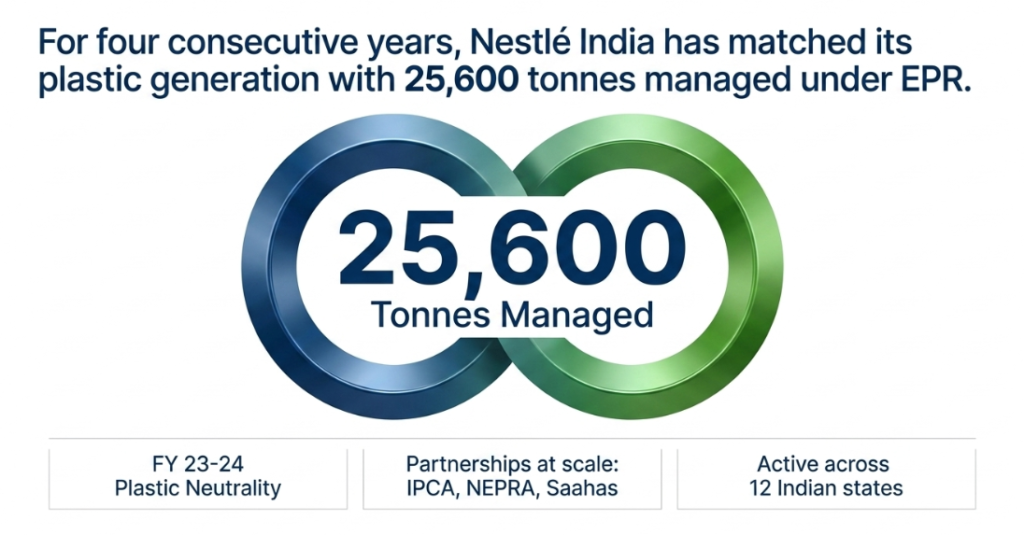
Quick stat: Nestlé India used about 25,000 tonnes of plastic packaging in FY 2023-24, and managed about 25,600 tonnes under EPR rules, going slightly beyond its assigned target.
This case study looks at what Nestlé India is doing to move away from traditional plastic, where real progress has been made, and where the opportunities are for a larger shift to compostable packaging in India.
What Nestlé India Is Doing to Move Away From Plastic Packaging
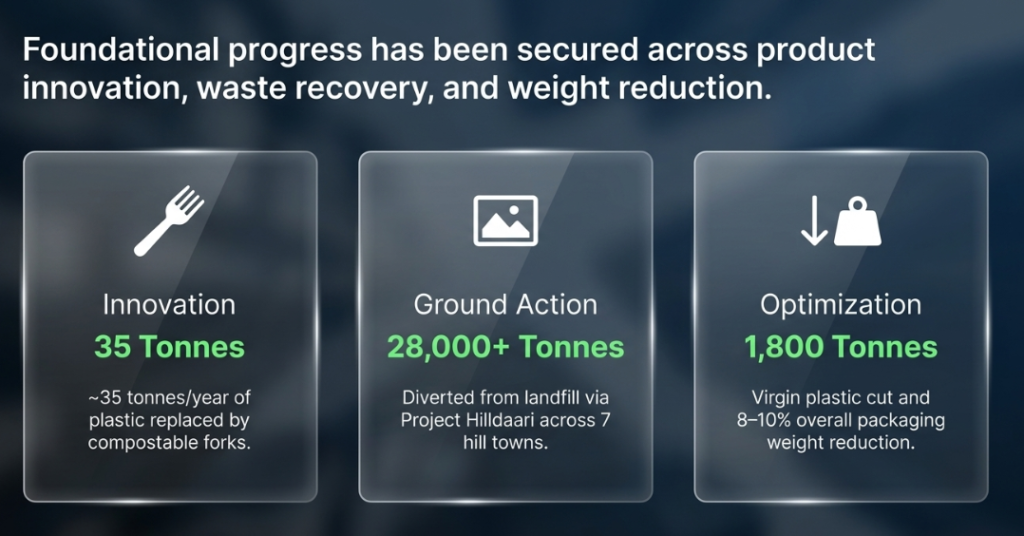
Nestlé India has built its packaging work on three tracks: product-level innovations, on-ground waste management programmes, and packaging weight reduction. Each has produced tangible numbers.
1. Compostable and Edible Forks for Maggi
In 2023, Nestlé India launched compostable foldable forks for Maggi Cuppa Noodles. The forks were developed together with Kaneka India Pvt. Ltd. and the Nestlé Institute of Packaging Sciences in Lausanne. This single switch removed about 35 metric tonnes of plastic every year from the Maggi cup pack.
In May 2024, the company went a step further and launched India’s first edible wheat-flour fork for Maggi Masala Cuppa Noodles, co-developed with the Indian startup Trishula. The pack is priced at ₹50 for 79.5g and is sold in major metros.
2. Project Hilldaari
Launched in 2018-19, Project Hilldaari is Nestlé India’s biggest ground-level programme. It runs in seven hill towns where plastic waste is highly visible: Mussoorie, Mahabaleshwar, Munnar, Dalhousie, Darjeeling, Palampur, and Ponda (Goa).
The programme works with PLAN Foundation, Stree Mukti Sangathana, and Recity Network India. The numbers speak for themselves:
| Figure | Value |
|---|---|
| Waste diverted from landfill | 28,000+ tonnes |
| Source segregation rate | 80% |
| Collection points covered | 20,000+ |
| Waste workers trained and insured | 560+ |
3. Packaging Weight Reduction and Virgin Plastic Cuts
Nestlé India has worked on making its packaging lighter. It reduced packaging weight by around 800 tonnes in 2016 and 1,500 tonnes in 2017, and has achieved an overall 8 to 10% reduction in packaging materials.
Over two years, the company also eliminated around 1,800 tonnes of virgin plastic by removing plastic straws, using recycled content in Nescafé secondary packaging, and cutting overwraps on nutrition products.
4. The Maggi Wrappers Return Scheme
In Dehradun and Mussoorie, Nestlé India piloted a simple scheme with about 250 retailers: consumers return 10 empty Maggi wrappers and get one free packet in exchange. It is a consumer-level take-back model aimed at high-footfall areas.
5. Plastic Neutrality
Nestlé India has been plastic neutral for four years in a row since 2020, meaning the plastic it generates is matched by plastic collected and processed under its EPR (Extended Producer Responsibility) obligations. It works with partners like IPCA, NEPRA, and Saahas Zero Waste across 12 states.
The Impact of Nestlé India's Sustainable Packaging Initiatives
Put together, these initiatives have delivered real, measurable outcomes.
- 28,000+ tonnes of waste kept out of landfill through Hilldaari
- ~35 tonnes/year of plastic replaced by compostable forks
- ~1,800 tonnes of virgin plastic cut over two years
- 25,600 tonnes of plastic managed under EPR in a single year
- ~8 to 10% overall packaging material reduction achieved
Insight: Nestlé India is one of the few Indian FMCG companies that has been publicly plastic neutral for four straight years and has published specific tonnage numbers, which is a level of transparency that is still uncommon in the sector.
The Biggest Compostable Packaging Opportunity for Nestlé India
Nestlé India has now built a strong base in waste management, packaging design, and consumer-level programmes. The next frontier, where the biggest single impact is possible, is the primary wrapper itself.
At present, the main wrappers on Maggi noodles, Nescafé sachets, KitKat fingers, Munch, and Polo are still made of conventional multi-layer plastic. Nestlé globally has already tested alternatives (paper-wrapped KitKat in Japan and Australia, mono-material polyolefin sachets for Nescafé Blend & Brew in Thailand).
If these and similar compostable solutions scale into India, the impact could be an order of magnitude larger than current initiatives.
Why This Is the Moment
- Regulation is tightening every year. India’s Plastic Waste Management Rules have been amended in 2022, 2024, 2025, and 2026. From July 2025, every plastic package now needs a QR code or barcode for traceability. Recycled content mandates have risen to 30% for rigid plastics from FY 2025-26 and 60% by FY 2028-29.
- CPCB-certified compostable packaging is exempt from EPR obligations, which is a direct financial incentive to switch.
- Consumers are ready. A 2025 McKinsey survey found 85% of Indian consumers are willing to pay more for sustainable packaging, the highest percentage of any country surveyed.
- The market is scaling fast. India’s green packaging market is expected to grow from USD 9 billion in 2024 to USD 57.2 billion by 2033, a 22.5% annual growth rate, which means supply is expanding and unit costs are falling.
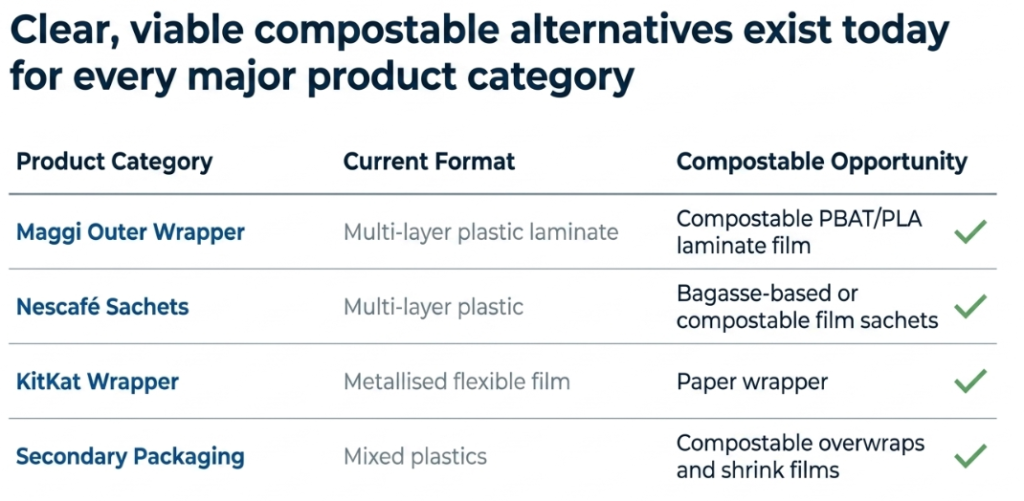
| Product | Current Format | Compostable Opportunity |
|---|---|---|
| Maggi outer wrapper | Multi-layer plastic laminate | Compostable PBAT/PLA laminate film |
| Nescafé single-serve sachets | Multi-layer plastic | Bagasse-based or compostable film sachets |
| KitKat wrapper | Metallised flexible film | Paper wrapper (already live in Japan, Australia) |
| Secondary and tertiary packaging | Mixed plastics | Compostable overwraps and shrink films |
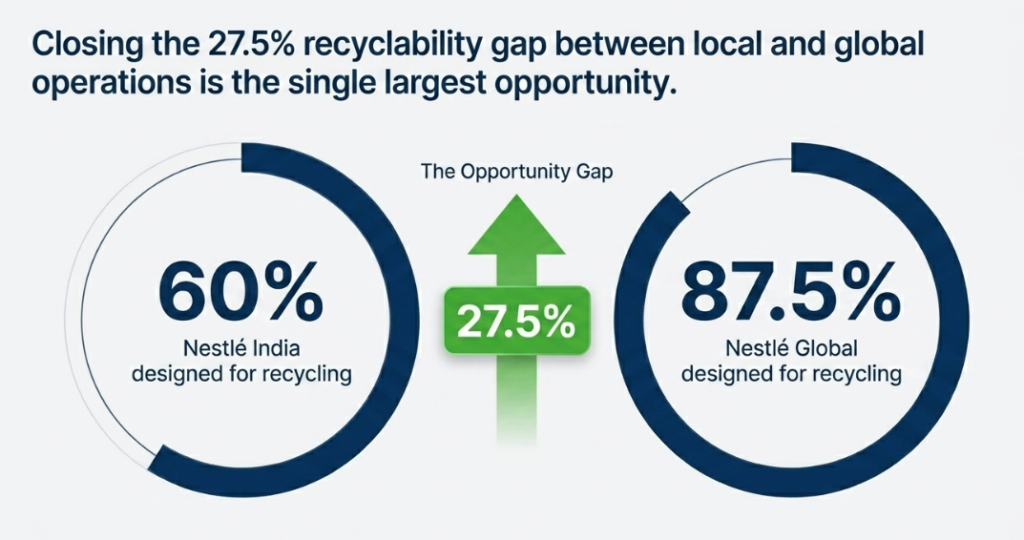
Stat: Nestlé India has stated that about 60% of its packaging is currently designed for recycling, while Nestlé globally stands at around 87.5%. Closing this 27.5-percentage-point gap is the single biggest packaging opportunity in front of the company.
About Ukhi
Ukhi makes EcoGran, a compostable bioplastic resin that is CPCB-certified and complies with IS/ISO 17088:2021. It is designed to replace conventional plastic in flexible packaging, sachets, wrappers, and films, and it runs on existing extrusion and laminating lines without any change in machinery. That matters because switching to compostable packaging should not mean rebuilding a factory.
If you are an FMCG brand, a contract packager, or a converter exploring a move to compostable formats, Ukhi already works with partners across India and is distributed at scale through DCGpac, India’s largest B2B packaging platform.
Write to us at [email protected] or visit ukhi.com.
Sources: Nestlé India Creating Shared Value reports, company press releases, Business Today, Eco-Business, Down To Earth, Central Pollution Control Board (CPCB) notifications, Ministry of Environment Forest and Climate Change, McKinsey Global Packaging Survey 2025, IMARC Group India Green Packaging Report.