

H&M India and compostable packaging: 55 stores, 8 brands, and an estimated 200 to 400 tonnes of plastic ready to replace
Disclaimer: This case study is based on publicly available information, sustainability reports, and industry data. It is not endorsed by or affiliated with H&M Group. If you represent H&M or any entity mentioned here and would like anything corrected or removed, please contact us at info@ukhi.com.
H&M opened its first India store in October 2015 at Select Citywalk, New Delhi.
Today, the company operates around 65 stores across major Indian cities including Mumbai, Bangalore, Chennai, Hyderabad, Pune, Kolkata, Chandigarh, and Lucknow. It also sells online through hm.com/in and through a distribution partnership with Myntra, which is part of the Flipkart Group.
India is one of H&M’s fastest growing markets globally. The H&M Group runs eight brands worldwide, including COS, Monki, Weekday, and ARKET, and reported total global revenues of approximately SEK 236 billion (around $22 billion) in 2023.
India contributes a growing share of the Asia Pacific business, though the company does not publicly break out India-specific revenue.
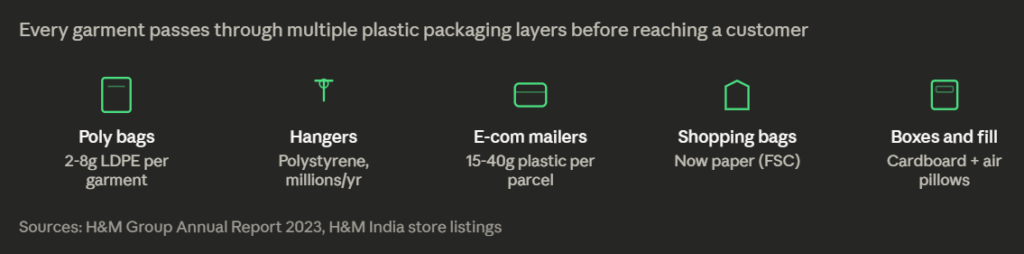
Every garment H&M sells in India passes through several layers of packaging before it reaches a customer. Individual items are wrapped in poly bags at the factory. They are shipped in cardboard boxes. In stores, they hang on plastic hangers and go home in shopping bags. Online orders add another layer of mailers, tape, and protective fill. At the scale H&M operates, even small per-unit packaging adds up to significant volumes.
65
Stores in India
8
Global brands
200–400 T
Plastic packaging
2025
Global target
What H&M has committed to globally: 100% sustainable packaging by 2025
In 2018, H&M Group made a formal commitment: 100% of packaging materials to be recycled or sustainably sourced by 2025. This target covers all packaging types across all brands and all markets.
The same year, H&M signed the Ellen MacArthur Foundation’s New Plastics Economy Global Commitment, under which it pledged to eliminate problematic plastic packaging, move toward reuse, and ensure all plastic packaging is reusable, recyclable, or compostable.
The company reports its progress to the Foundation annually.
H&M is also a founding member of The Fashion Pact (launched in 2019 at the G7 summit), which includes specific targets around reducing ocean plastic pollution.
It is a signatory to the UN Fashion Industry Charter for Climate Action and has validated targets under the Science Based Targets initiative (SBTi).
The company has made the most progress in paper and cardboard categories.
The biggest remaining challenge globally is poly bags for garment packaging. These thin LDPE plastic films represent the highest volume of plastic in H&M’s packaging and the hardest category to fully transition.
The company has been shifting to recycled polyethylene with up to 80% recycled content in some product lines, while also running pilots with paper-based alternatives.
H&M has taken a cautious approach to bioplastic and compostable packaging globally. Their strategy so far has leaned toward recycled content and paper-based solutions rather than compostable films, primarily due to concerns around limited industrial composting infrastructure in many markets.
What H&M India has done so far: paper bags, recycled poly bags, and hanger reuse
H&M India stores have adopted paper shopping bags, consistent with the global policy and aligned with India’s regulatory requirements.
These bags follow the H&M Group’s global standard of FSC certification or equivalent sustainable sourcing.
The transition to paper bags in India was already underway before the Indian government’s July 2022 single-use plastic ban, which prohibited around 19 categories of disposable plastic items and raised the minimum carry bag thickness to 120 microns by December 2022.
For garment-level poly bags, H&M India follows the group’s global sourcing standards, which means a shift toward recycled polyethylene (rPE).
Since a large share of garments sold in India are manufactured either domestically or imported from Bangladesh, China, and Turkey, poly bag specifications are set at the global procurement level rather than market by market.
This centralized approach ensures consistency but also means that India-specific packaging data is not separately reported in H&M’s global sustainability disclosures.
H&M India’s online orders through hm.com/in follow global packaging guidelines.
Orders fulfilled through Myntra use Myntra’s own logistics and packaging infrastructure. Myntra has been publicly active in this space and has reported near-complete removal of single-use plastic from its own shipment packaging by 2022–2023, with partnerships involving paper-based mailer alternatives.
H&M also operates a global hanger reuse and recycling programme. Millions of hangers are collected, sorted, and reused across markets each year, reducing the need for new plastic hanger production.
What Indian law now requires: EPR targets, plastic bans, and rising penalties
India’s Plastic Waste Management Rules (2016, amended 2021 and 2022) and the Extended Producer Responsibility (EPR) framework introduced in February 2022 have created one of the world’s most demanding compliance environments for packaging.
Under the EPR rules, H&M India (registered as H&M Hennes and Mauritz Retail Pvt. Ltd.) is classified as a Brand Owner and Importer, which means it must:
These targets are set to reach 80% to 100% by FY 2028–29. Minimum recycled content requirements in packaging are expected to reach 40% to 60% by FY 2026–27.
Non-compliance carries environmental compensation of approximately ₹10,000 per metric tonne of shortfall.
State-level regulations add another layer. Maharashtra’s 2018 plastic ban is among India’s strictest. Tamil Nadu, Karnataka, and Delhi each enforce additional restrictions. For a national retailer like H&M, the practical approach is to adopt the strictest standard across all stores for operational simplicity.
Any brand choosing compostable packaging in India must meet BIS IS 17088:2019, which requires at least 90% biodegradation within 180 days, at least 90% disintegration within 12 weeks, along with ecotoxicity and heavy metal testing. Products must carry the BIS certification mark.
What a full switch to compostable packaging could look like for H&M India
If H&M India sells an estimated 20 to 30 million garments per year in the country, and each garment uses one poly bag averaging 5 grams, that alone accounts for 100 to 150 tonnes of plastic film annually, before factoring in e-commerce packaging, hangers, and protective materials.
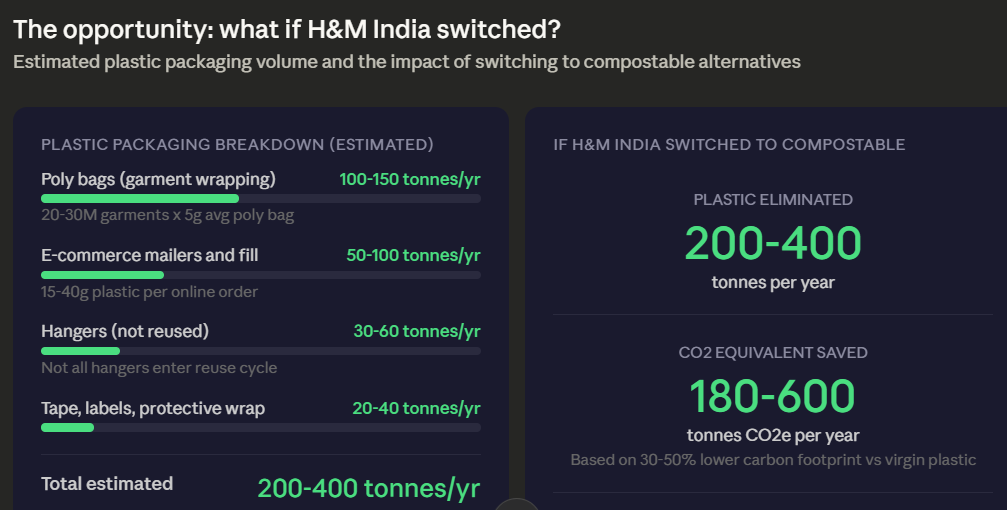
If H&M India sells an estimated 20 to 30 million garments per year in the country, and each garment uses one poly bag averaging 5 grams, that alone accounts for 100 to 150 tonnes of plastic film annually, before factoring in e-commerce packaging, hangers, and protective materials.
About Ukhi
Ukhi supplies EcoGran, a range of compostable and bioplastic granules used by converters and packaging manufacturers to produce compostable bags, films, and mailers. These granules are certified to relevant Indian and international compostability standards and are available through partners including DCGpac, India’s largest B2B packaging platform serving over 60,000 customers. For any brand, converter, or manufacturer exploring the transition from conventional plastic to compostable packaging in India, Ukhi provides the raw material foundation. Visit ukhi.com or ask your DCGpac partner to learn more.