

How Amazon India Removed 9,100 Metric Tonnes of Plastic from Its Packaging
Disclaimer: This is an independent case study compiled from publicly available sources and Amazon’s official sustainability disclosures. Contact us at info@ukhi.com to correct or update any information.
When Amazon India decided to act on packaging in 2019, it was not dealing with a small operational footnote.
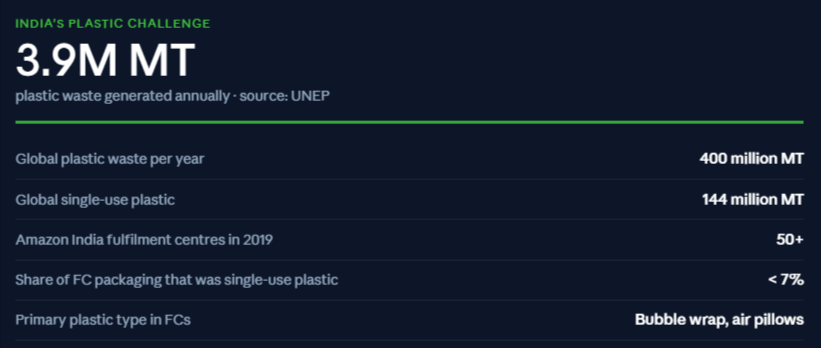
The company ran 50+ fulfilment centres across India, processing millions of orders every day, shipping to hundreds of cities.
Inside each of those orders sat the standard toolkit of single-use plastic packaging: bubble wrap, air pillows, and thin plastic delivery bags. These are called “dunnage” in logistics terms, and their job is to fill empty space inside boxes so products do not shift and break in transit.
Less than 7% of Amazon India’s fulfilment centre packaging was single-use plastic at that point.
In the context of India generating an estimated 3.9 million tonnes of plastic waste annually, with e-commerce packaging being one of the fastest-growing contributors, even a 7% share at Amazon’s scale matters.
9,100 MT
Plastic avoided
50+
Fulfilment centres
300+
Cities under PFS
47.5%
Orders with less packaging
The other pressure was regulatory. India’s Plastic Waste Management Rules had been tightened progressively since 2016, and the direction of travel was clear: single-use plastic was going to face increasing restrictions. Amazon was not waiting for enforcement.
The 2019 Commitment
In September 2019, Amazon India made a specific, time-bound public commitment: eliminate all single-use plastic from packaging originating across its entire fulfillment network by June 2020. That is nine months. For a network of 50+ centres, that timeline was aggressive.
The commitment had two parts.
This second part addressed the EPR (Extended Producer Responsibility) principle that brands are accountable for the plastic they put into the market, not just what they produce going forward.
What They Actually Changed
The Paper Cushion Switch
The most immediate change was replacing bubble wrap and air pillows with paper cushions. This happened across all 50+ fulfilment centres starting December 2019, and it was completed before the June 2020 deadline.
Paper cushions serve the same mechanical function as bubble wrap: they fill void space and absorb shock. The difference is that paper is curbside recyclable by the end consumer, while most bubble wrap and air pillows are not accepted by mainstream recycling systems in India.
This was not a small operational change. Dunnage runs through every packing station in every fulfilment centre. Switching materials means retraining workers, adjusting packing station equipment, re-running quality checks on damage rates during transit, and doing this simultaneously across dozens of locations in different states. Amazon completed it in under six months.
Packaging-Free Shipping
The second lever was more innovative. In June 2019, three months before the public pledge, Amazon India launched a programme called Packaging-Free Shipping (PFS).
The concept: instead of putting a product inside an Amazon box with added packaging, the product ships in its original manufacturer packaging, or with dramatically reduced added material. Multiple customer orders are grouped together and transported in reusable totes during last-mile delivery.
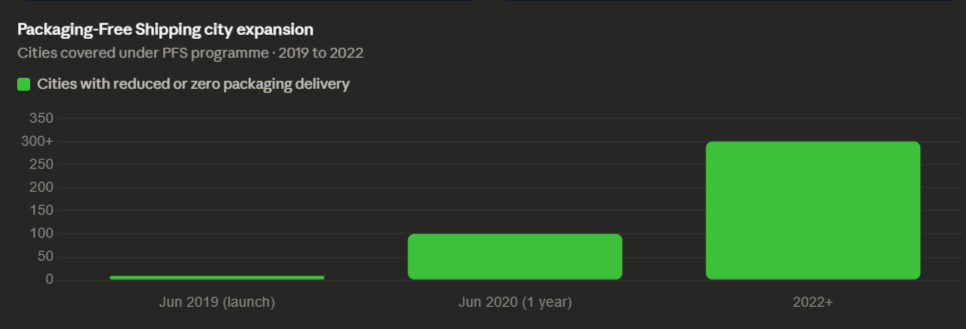
PFS launched in 9 cities. Within a year it had expanded to 100+ cities. By the time of Amazon’s more recent sustainability disclosures, PFS was live in over 300 cities across India.
The technology behind PFS uses machine learning algorithms that assess each order individually. The algorithm considers the product category, the distance it needs to travel, the customer’s location, and the specific transit conditions on that route.
If the system determines the product can survive transit without added packaging, it ships without it. Fragile products, liquids, and items that genuinely need protection continue to be packed with appropriate material. This is not a blanket rule. It is a per-order decision made at scale.
The result: approximately 47.5% of all orders shipped from Amazon India’s fulfilment centres now go out with reduced or zero added packaging. Nearly one in two orders. In a network processing millions of shipments, this is a good example of how sustainable e-commerce packaging in India can work at the fulfillment layer.
The Numbers
Amazon India’s plastic-free packaging results, as reported in its official sustainability disclosures:
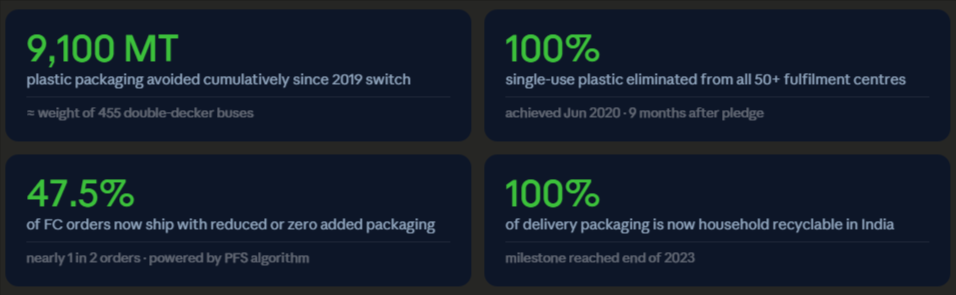
Key insight: The 9,100 tonne figure is worth pausing on. That is the weight of roughly 455 double-decker buses. Removed from India’s waste stream, not through collection or offset programmes, but by simply not using the material in the first place.
The Next Chapter: Packaging Made from Crop Waste
The most significant development in Amazon India’s packaging journey is recent and points toward where compostable packaging in India is heading at industrial scale.
In early 2026, Amazon announced a research partnership with IIT Roorkee’s INNOPAP Lab to develop packaging material from agricultural waste. The 15-month project is led by Prof. Vibhore Kumar Rastogi and Dr. Anurag Kulshreshtha at the Saharanpur Campus, and is converting crop residue including wheat straw and sugarcane bagasse into high-quality paper mailers.
The properties being targeted are specific: lightweight, strong enough for shipping, and both recyclable and home compostable.
India generates approximately 500 million tonnes of agricultural waste every year. A significant portion of that is burned in fields, contributing to the severe air quality crises seen across North India each winter.
The IIT Roorkee project is designed to redirect some of that waste into packaging feedstock, which simultaneously reduces stubble burning and creates an additional income source for farmers.
Industrial trials and commercial production from this research are expected to begin by late 2026. If successful, this will become a template for biodegradable packaging in India sourced entirely from domestic agricultural by-products, at costs that can eventually compete with conventional paper.
What This Means for Brands Considering the Switch
Amazon India’s journey from 2019 to today contains some practical observations for any brand evaluating a move away from single-use plastic packaging in India.
A Note on Compostable Packaging Supply in India
The Amazon India story reflects a broader shift: demand for certified compostable packaging materials in India is growing, and it is being driven by procurement decisions at scale, not just consumer sentiment.
The practical challenge for most brands is not intent. It is sourcing. Finding raw material that meets certification standards, performs reliably in manufacturing, and can be procured without depending entirely on imports.
About Ukhi
Ukhi manufactures EcoGran, certified compostable granules that are the input material for compostable courier bags, mailer bags, garment bags, and carry bags. These granules are available to packaging manufacturers, converters, and brand procurement teams building domestic compostable supply chains.
If your organisation is evaluating a move to certified compostable packaging, Ukhi’s team is available to discuss material specifications, certifications, and supply arrangements.