

How Delhi Metro Replaced Single-Use Plastic with Compostable Packaging Across Its Network
Published by Ukhi. Information is compiled from public sources. If you represent any organisation mentioned here and would like anything corrected or removed, please contact us at info@ukhi.com.
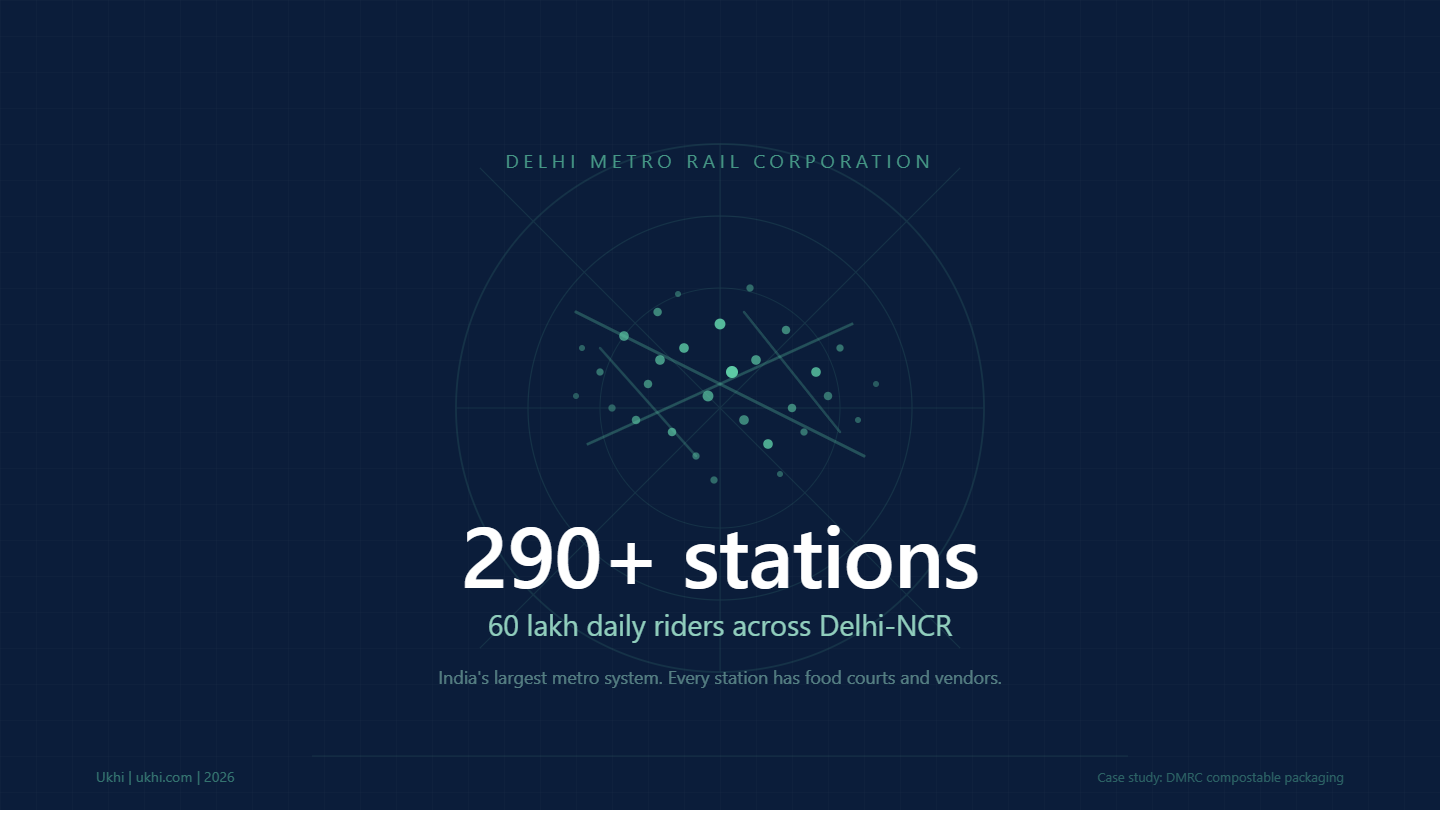
The Delhi Metro Rail Corporation (DMRC) is India’s largest metro system. It operates over 290 stations across Delhi-NCR and serves roughly 60 lakh daily riders.
Every DMRC station has food courts, retail kiosks, and vendor-operated outlets.
Before India’s single-use plastic ban took effect, these spaces relied heavily on plastic plates, cups, cutlery, straws, and containers. When an institution of this size decides to switch from plastic to better packaging, the volume impact is massive. And just as importantly, the signal it sends reaches every other metro system, airport, and transit operator in the country.
Insight: DMRC prohibits eating inside trains and within the paid areas of stations. This means the plastic packaging footprint was concentrated in unpaid concourses, food courts, and surrounding vendor zones rather than spread across the entire system. That concentration made a targeted switch more practical than it would be for, say, Indian Railways, where on-board meals generate packaging waste across thousands of moving trains daily.
45,174 MT
Plastic used in FY25
47,000 MT
Plastic processed
79%
Recyclable packaging
2030
Bio-based target
The Regulatory Push: India's Single-Use Plastic Ban
Key points:
- India’s Plastic Waste Management (Amendment) Rules, 2021 banned the manufacture, import, stocking, distribution, sale, and use of 19 identified single-use plastic items from July 1, 2022.
- The list included plastic plates, cups, glasses, cutlery, straws, trays, stirrers, polystyrene (thermocol), and wrapping or packaging films under 75 microns.
- Enforcement in Delhi falls under the Delhi Pollution Control Committee (DPCC), with the Central Pollution Control Board (CPCB) providing oversight nationally.
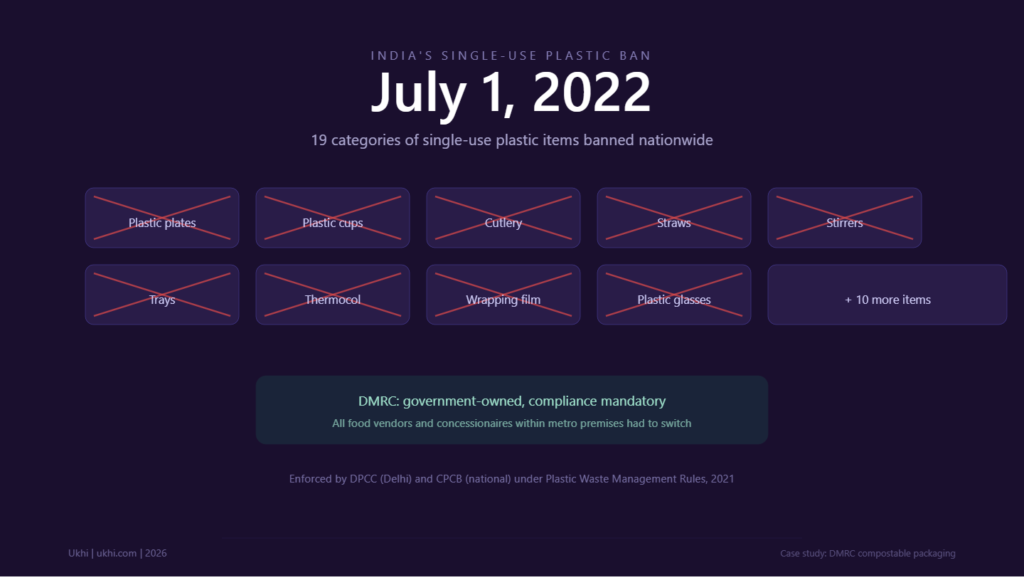
For DMRC, as a government-owned corporation, the mandate was clear. Every food vendor and concessionaire operating within metro premises had to stop using banned plastic items.
DMRC had already built one of the world’s most recognised sustainable public transit brands. The packaging switch was a natural next step in that journey.
The Solution: Ecoware and Compostable Packaging
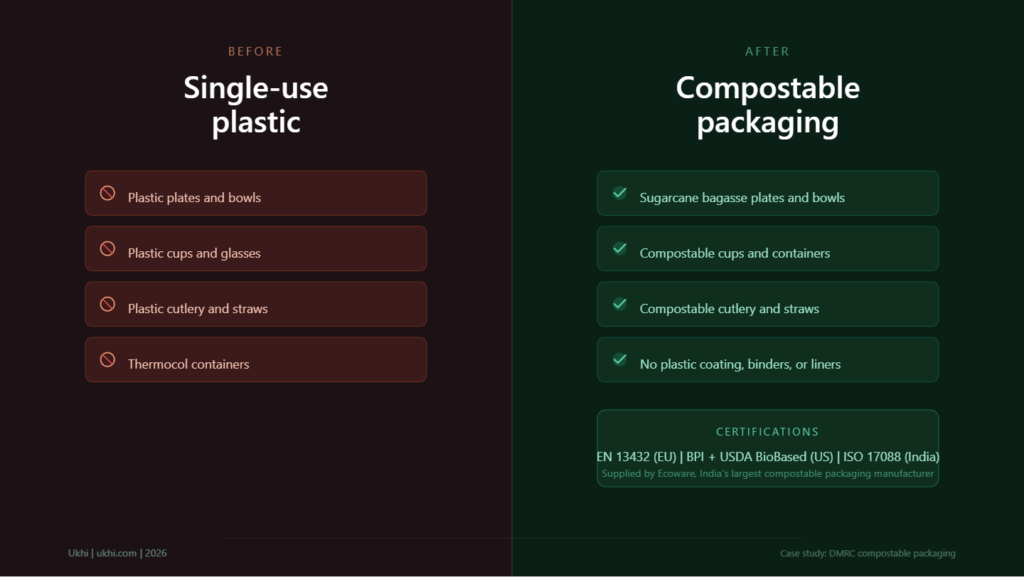
DMRC partnered with Ecoware, one of India’s leading compostable food packaging manufacturers, to replace single-use plastic tableware across metro food courts and vendor outlets. Ecoware was founded in 2010 by Rhea Mazumdar Singhal and produces 100% compostable products made from sugarcane bagasse, including plates, bowls, containers, cutlery, cups, and straws. None of these products contain plastic coating, binders, or liners.
The Supplier Network Building This Out
BigBasket is not doing this alone.
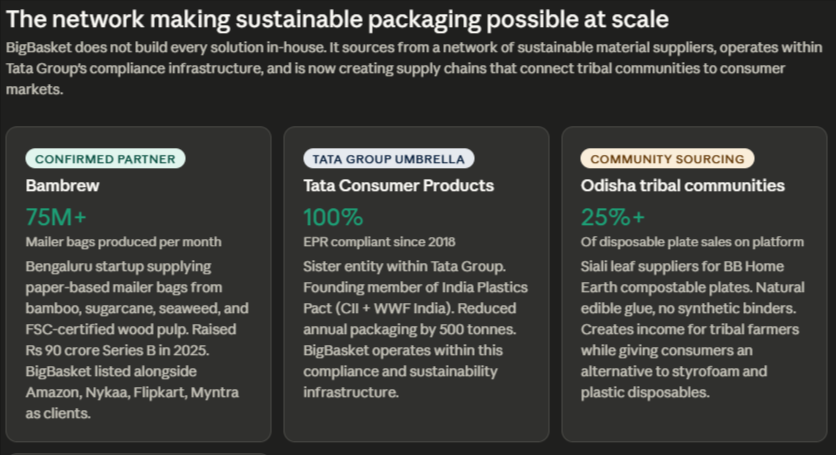
The company works with Bambrew, a Bengaluru-based sustainable packaging startup that supplies paper-based mailer bags made from bamboo, sugarcane, seaweed, and FSC-certified wood pulp.
Bambrew produces over 75 million bags per month and counts Amazon, Nykaa, Flipkart, and Myntra among its clients alongside BigBasket.
The startup raised ₹90 crore in Series B funding in 2025, which reflects the scale at which sustainable e-commerce packaging in India is now operating.
BigBasket’s Tata Group parentage also plays a major role.
Tata Group’s Project Aalingana commits to net-zero emissions by 2045 and requires 100% recyclable, compostable, or reusable packaging by 2030, with a 70% interim milestone by FY 2025–26.
What makes Ecoware’s certification stack notable is its breadth. The company holds EN 13432 (European standard), BPI and USDA BioBased (United States), and ISO 17088 (India) certifications simultaneously.
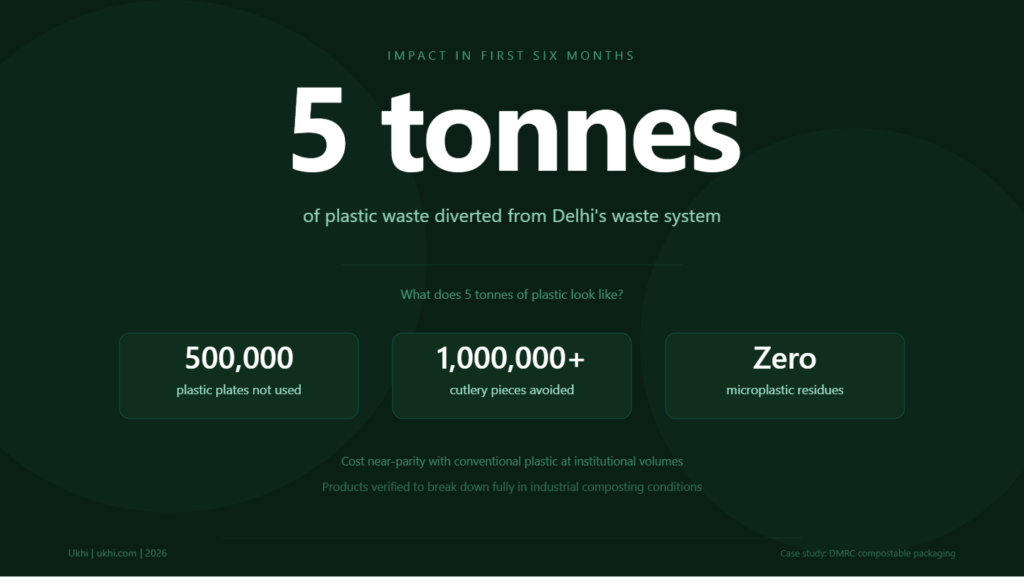
For institutional buyers like DMRC, this level of CPCB certification and international validation reduces procurement risk. The products are verified to break down fully in industrial composting conditions without leaving microplastic residues.
The switch covered the main consumer-facing touchpoints:
- food court tableware,
- vendor-served meals,
- takeaway containers,
- and beverages.
Within six months, the partnership reportedly helped divert over 5 tonnes of plastic waste from the metro network. To put that in everyday terms, 5 tonnes is roughly equivalent to 500,000 plates or over 1 million pieces of cutlery that did not end up in Delhi’s already-strained waste system.
Vendors who want to operate inside metro premises follow the rules. So this is a model that other transit systems and institutional campuses can replicate.
DMRC's Broader Sustainability Record
The packaging switch sits within a much larger Delhi Metro sustainability story that spans energy, carbon, construction, water, and waste.
Solar energy
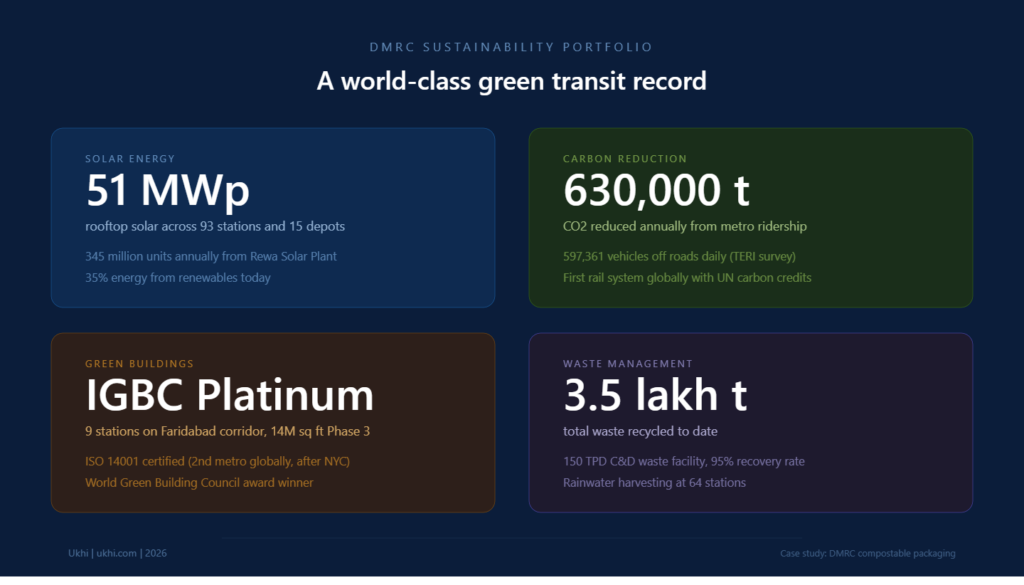
The system operates 51 MWp of rooftop solar capacity across 93 stations and 15 depots.
Off-site, it draws 345 million units of electricity annually from the Rewa Mega Solar Power Plant in Madhya Pradesh, a 750 MW facility supported by the World Bank.
Currently, approximately 35% of DMRC’s total energy comes from renewable sources, with a target of 50% by 2031.
Carbon neutrality
In 2011, it became the first metro and rail system in the world to receive UN-certified carbon credits under the Clean Development Mechanism. It earned approximately 19.5 crore rupees from the sale of 3.55 million carbon credits over six years.
Metro Bhawan, the DMRC headquarters, achieved PAS 2060 carbon neutral certification. Line 4 (Blue Line, Yamuna Bank to Vaishali) followed with its own carbon neutral certification in October 2024.
DMRC operations reduce annual emissions by roughly 630,000 tonnes of CO2. A TERI survey found that approximately 597,361 vehicles are taken off Delhi’s roads daily because of metro ridership.
Green building certifications
- All nine stations on the Badarpur to Escorts Mujesar (Faridabad) corridor hold IGBC Platinum ratings.
- Phase 3 was constructed covering approximately 14 million square feet to the highest green building standards.
- DMRC was also only the second metro system in the world, after New York City Subway, to achieve ISO 14001 environmental management certification.
- More recently, it earned PEER certification for Lines 2, 3, 4, 5, and 6, recognising excellence in electricity and renewable energy performance.
- DMRC was the first Indian company to receive the World Green Building Council’s Asia Pacific Network Award for industry leadership in sustainability.
Waste Management
DMRC operates a 150 TPD Construction and Demolition waste recycling facility at Ranikhera, Mundka, recovering approximately 95% of incoming waste into usable materials like aggregates, sand, concrete bricks, and pavement blocks. The system has recycled over 3.5 lakh tonnes of waste to date.
How DMRC Compares to Other Indian Transit Systems
Indian Railways, through the Northeast Frontier Railway zone, launched a pilot in August 2025 replacing plastic bedroll packaging with ISO 17088 compliant compostable bio-plastic bags developed with IIT Guwahati. Around 40,000 biodegradable bags were distributed across 25 trains, with plans for national expansion.
IRCTC has also been testing bagasse plates on select Rajdhani and Shatabdi trains. These are promising steps, though they currently cover a fraction of the railway network’s enormous scale.
Kochi Metro has taken a different approach. It focuses on plastic recycling infrastructure. It installed plastic bottle recycling machines at stations starting in 2017 and has deployed recycled-plastic benches across its network. Other metro systems like Chennai, Hyderabad, and Lucknow have focused primarily on solar energy and green building certifications rather than packaging-specific initiatives.
DMRC’s advantage is that it has moved on both fronts: the upstream energy and carbon story is already world-class, and the downstream packaging switch through Ecoware addresses the waste stream that riders actually experience daily.
What Comes Next In DMRC’s Journey To Sustainability
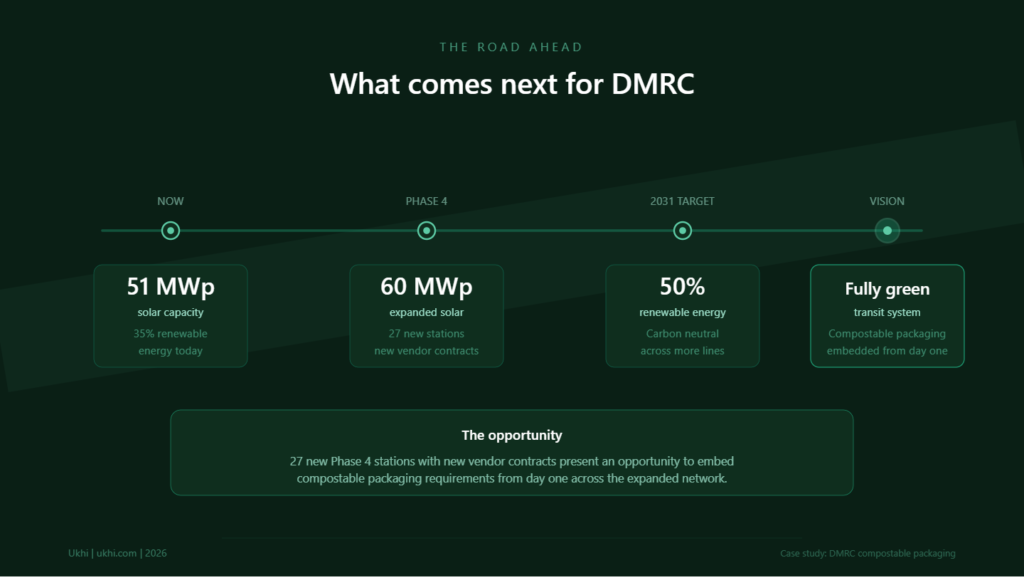
DMRC has announced plans to expand solar capacity to 60 MWp by the end of Phase 4 and reach 50% renewable energy by 2031.
Carbon neutral certification is being extended to additional lines and facilities.
The “CarbonLite Metro Travel” initiative, which displays CO2 savings on QR-coded tickets, is described as possibly the world’s first such feature for metro riders.
On packaging, the foundation has been laid.
The Ecoware partnership proved that compostable food packaging works at institutional scale in Indian conditions, handling the heat, oil, and weight of everyday Indian food without performance issues.
With Phase 4 adding 27 new elevated stations, each with new vendor contracts, the opportunity to embed compostable packaging requirements from day one is significant.
For any transit system, airport, institutional campus, or food-service chain considering a similar plastic to compostable packaging switch, the DMRC experience offers a useful reference point: the alternatives exist, the certifications are robust, the cost gap has narrowed to near-parity, and the operational model works.
About Ukhi
Ukhi manufactures compostable granules (EcoGran), the base raw material from which finished compostable products like plates, bags, cutlery, and films are produced. Ukhi supplies through DCGpac, India’s largest B2B packaging platform serving over 60,000 customers, making compostable raw materials accessible at scale across India. If your organisation is exploring a transition from conventional plastic to compostable packaging, you can learn more at ukhi.com or ask your DCGpac partner about Ukhi’s EcoGran range.