

How DMart Can Scale Compostable Packaging Across 479 Stores
Disclaimer: This is an independent analysis by Ukhi based on publicly available information from BRSR filings, annual reports, and news coverage. DMart (Avenue Supermarts Limited) is not a Ukhi customer or partner. If you represent the company and wish to request edits or corrections, please write to info@ukhi.com.
45,174 MT
Plastic used in FY25
47,000 MT
Plastic processed
79%
Recyclable packaging
2030
Bio-based target
DMart's Packaging Scale: Why It Matters
India’s most efficient retailer is also one of its largest movers of retail plastic packaging.
With 479 stores across 12 states, 17.2 million square feet of retail space, and annual revenue of ₹57,790 crore in FY25, DMart handles packaging at a scale that few Indian companies match.
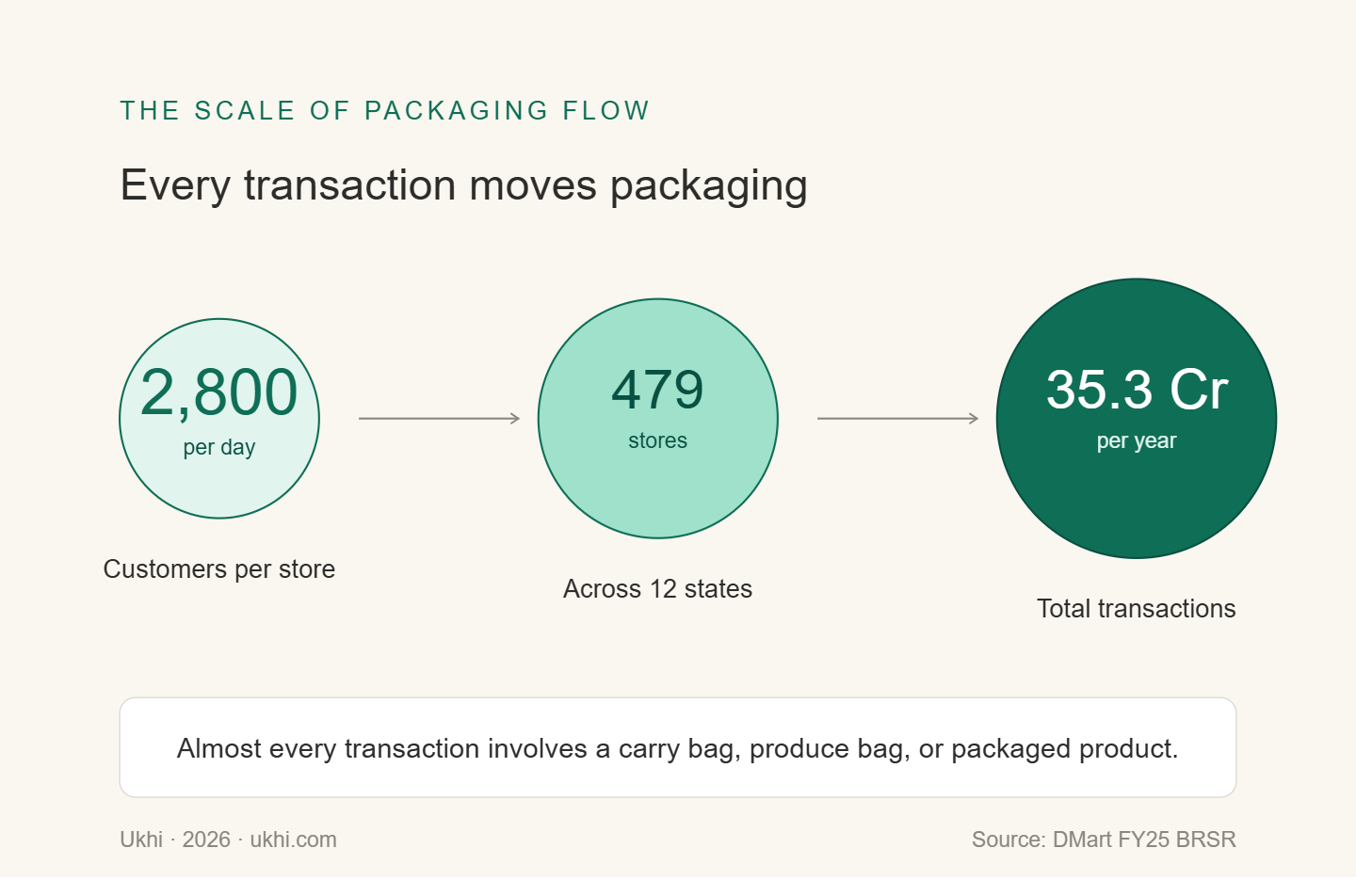
Around 2,800 customers walk into each DMart store every single day. That translates to roughly 35.3 crore customer transactions a year across the chain. Almost every one of those transactions involves a carry bag, a produce bag, or a packaged product moving through a checkout counter.
By the numbers: 479 stores, 76 distribution centres, 90,280 employees, 17.2M sq ft retail space, ₹57,790 crore FY25 revenue, 353 million annual bill cuts.
This scale is why DMart’s packaging choices matter so much. Even a small shift in materials creates large environmental outcomes.
Mapping DMart's Plastic Packaging Footprint
DMart does not publish a single total number for its annual plastic use. However, using its own disclosed customer footfall and standard industry benchmarks, the picture becomes clearer.
The company’s product mix tells the first part of the story:
| Category | Share of FY25 Revenue |
|---|---|
| Food and Grocery | 57.73% |
| General Merchandise and Apparel | 22.26% |
| Non-food FMCG | 20.01% |
Almost all of this is packaged. Private label brands like DMart Premia, DMart Minimax, and D Homes all use primary packaging. On top of this, carry bags and produce bags flow through every store every day.
Based on typical supermarket patterns, DMart likely uses:
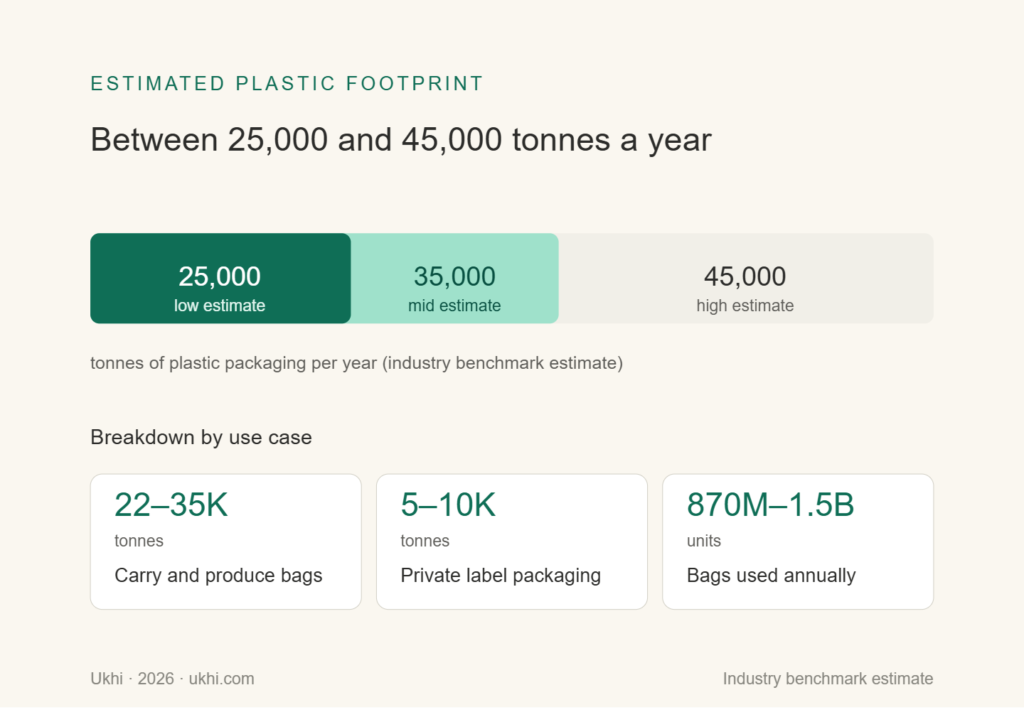
- Between 870 million and 1.5 billion bags per year across carry and produce use
- An estimated 22,000 to 35,000 tonnes of plastic for bags alone
- Another 5,000 to 10,000 tonnes in private label packaging
This means DMart’s total plastic packaging footprint sits in the range of 25,000 to 45,000 tonnes annually, making it one of the largest single-company plastic packaging footprints in Indian organised retail.
DMart's Packaging Transition So Far
DMart files mandatory BRSR (Business Responsibility and Sustainability Report) disclosures with SEBI, and these reports are independently assured by Grant Thornton Bharat LLP.
The FY25 BRSR shows real, measurable action in several areas.
Disclosed FY25 Actions
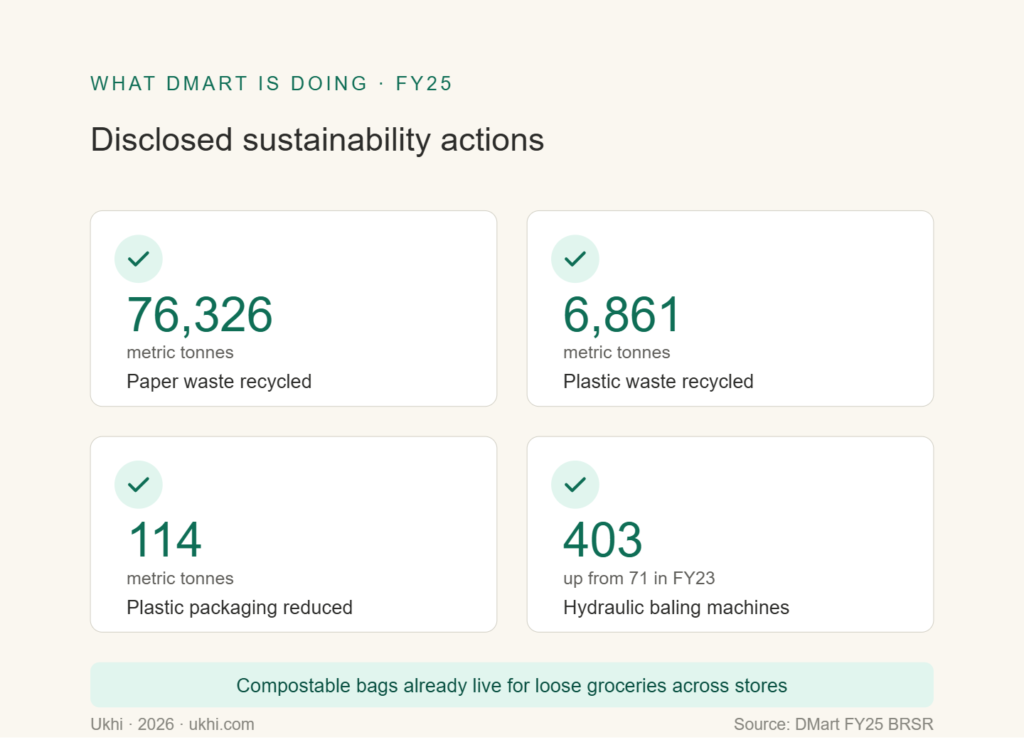
- 76,326 metric tonnes of paper waste recycled through authorized channels
- 6,861 metric tonnes of plastic waste recycled
- 114 metric tonnes of plastic packaging reduced through elimination of non-essential packaging and use of recycled content
- 403 hydraulic baling machines installed across stores (up from 71 in FY23 and 255 in FY24) to compact plastic waste for recycling
- EPR registration completed on the CPCB’s centralized portal
The Compostable Mention
The FY25 BRSR contains one specific line that matters for this study: DMart has “implemented the use of compostable plastic bags for loose groceries at our stores as permitted by regulations.” This is an important starting point. Compostable bags are already operationally live inside DMart’s store systems.
Additional Initiatives
DMart’s existing efforts have produced verifiable results. 6,861 tonnes of plastic recycled in a single year is a meaningful number. It diverts real waste from landfills and reduces fresh plastic demand through recovery.
That said, the numbers also reveal where the opportunity sits.
- Source reduction stands at 114 tonnes, against an estimated footprint of 25,000 to 45,000 tonnes
- The current focus is largely end-of-pipe recycling rather than upstream material substitution
- There are no disclosed targets for compostable packaging in India adoption, recycled content percentages, or plastic reduction timelines
This is not unusual. Most Indian retailers are at similar stages. But it highlights where the next phase of progress will come from.
Why DMart's Packaging Opportunity Is Now
Three forces are converging that make the next three years the right window for DMart to expand its sustainable packaging programme.
| Deadline | Requirement |
|---|---|
| FY 2025-26 | 30% recycled content in rigid plastic packaging, 10% in flexible, 5% in multi-layered |
| 1 July 2025 | QR code or barcode traceability mandatory on all plastic packaging |
| 1 April 2026 | EPR framework extends to paper, glass, and metal packaging |
| FY 2026-27 | Mandatory BRSR Core assurance plus full value chain ESG disclosure for top 1,000 listed companies |
| FY 2028-29 | Recycled content targets rise to 60% rigid, 20% flexible, 10% multi-layered |
| 2030 | National goal of 100% recyclable or compostable packaging |
2. Quantified Impact Potential
If DMart expanded compostable use from loose groceries to its full carry bag and produce bag volume, the environmental gain would be substantial.
- Approximately 630 million carry bags per year could switch to compostable carry bags
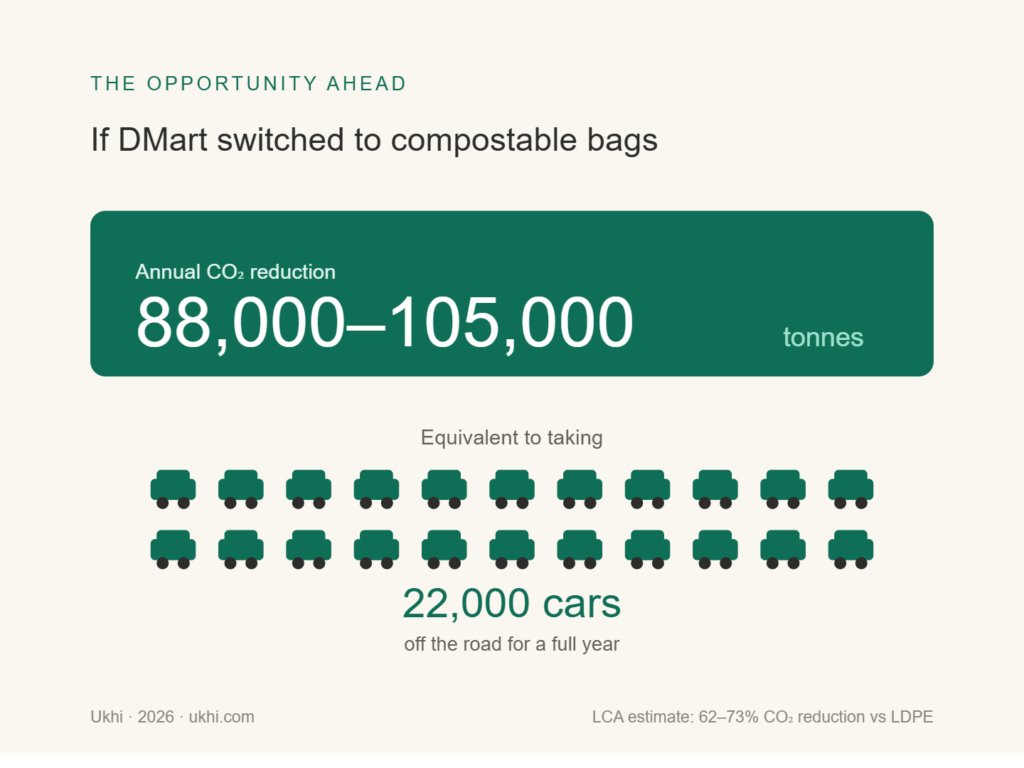
- Life cycle assessments show compostable bags generate 62 to 73 percent lower CO2 emissions than conventional LDPE bags
- Estimated annual CO2 reduction: 88,000 to 105,000 tonnes
- That is roughly equivalent to taking 22,000 cars off the road for a year
3. The Economics Are Workable
- Compostable bags currently cost ₹140 to 180 per kg versus ₹70 to 90 per kg for conventional plastic
- For DMart’s estimated ~27,500 tonnes of annual bag consumption, the incremental cost sits at ₹175 to 220 crore per year
- This represents only 0.3 to 0.4 percent of annual revenue
- A portion is recoverable through existing bag charges
- A domestic 80,000-tonne PLA plant is under construction in India, which will narrow the price gap within three years
Market tailwind: India’s green packaging market is projected to grow from USD 9 billion in 2024 to USD 57.2 billion by 2033 at a 22.5% CAGR. Early movers secure supply and lock in better pricing.
4. Leadership Signal
Anshul Asawa took over as CEO in March 2025, joining from Unilever, a company with one of the most comprehensive global sustainability frameworks. This brings fresh sustainability experience into DMart’s senior leadership at exactly the moment when regulatory and market conditions are shifting.
DMart already uses compostable bags for loose groceries. The operational proof of concept exists inside its own stores. The next natural step is scaling that experience across all carry bags, produce bags, and eventually private label packaging.
About Ukhi
Ukhi manufactures CPCB-certified compostable granules (EcoGran) and finished compostable packaging including carry bags, produce bags, garment bags, courier bags, and food packaging. We supply retailers, FMCG brands, and packaging converters transitioning away from conventional plastic. If your organisation is exploring compostable alternatives at any scale, please write to us at info@ukhi.com.