

How Indian Railways Replaced Plastic Bedroll Bags with Compostable Bioplastic on 25 Trains
Northeast Frontier Railway became India’s first railway zone to deploy compostable bioplastic bags, replacing 40,000 plastic bedroll bags across 25 trains with IIT Guwahati-developed IS/ISO 17088 certified material.
On August 15, 2025, something small but important changed on the Brahmaputra Mail. Passengers boarding the train at Kamakhya Junction for the 1,800-km journey to New Delhi received their bedrolls packed in a new kind of bag. It looked like the usual plastic. It felt like the usual plastic. But it was not plastic.
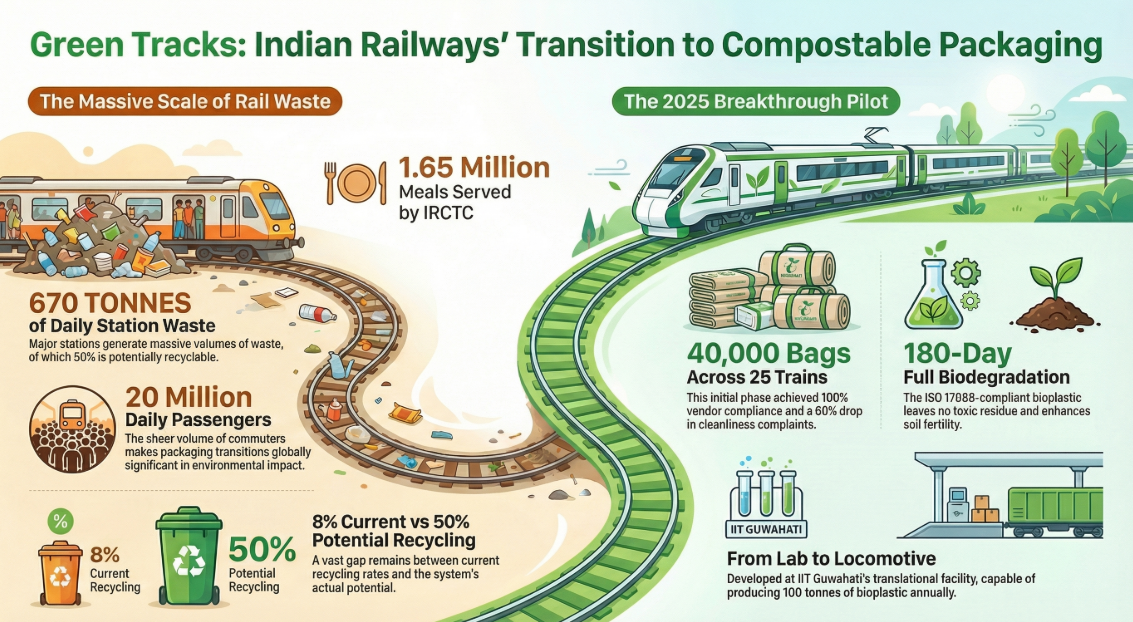
The bag was made from a compostable biopolymer developed at IIT Guwahati. It was certified to IS/ISO 17088, the Indian standard for compostable plastics. In composting conditions, it breaks down completely within 180 days. It leaves behind no toxic residue. According to the researchers who made it, the material actually improves soil quality as it degrades.
With this, Northeast Frontier Railway became the first zone in Indian Railways’ 17-zone network to replace plastic bedroll bags with compostable packaging at operational scale.
40,000
Bags Distributed
25
Trains
60%
Complaint Drop
180
Days Degradation
The rollout was fast. It started with one train on Independence Day. Within a month, it had expanded to all originating trains across the NFR network. By September 17, during the Swachhata Hi Seva 2025 campaign, around 40,000 compostable bags had been given to passengers across 25 trains. By early October, NFR reported two results: 100% vendor compliance, and a 60% drop in passenger cleanliness complaints on platforms and tracks.
One important clarification. Some early reports described this as an Eastern Railway project. It was not. The pilot was run entirely by Northeast Frontier Railway, which is headquartered in Maligaon, Guwahati, and operates trains across Assam, West Bengal, Bihar, Tripura, and Arunachal Pradesh.
The problem the pilot addressed
To understand why this pilot matters, you need to understand the scale of Indian Railways.
The system carries roughly 20 million passengers every day. IRCTC serves approximately 1.65 million meals daily. There are 13,198 passenger trains running across 7,325 stations, and the network employs 1.25 million people.
Every passenger in an AC coach receives a sealed bedroll — a linen set with a sheet, blanket, pillow, and towel, all wrapped in a single-use polythene bag. Across thousands of AC coaches running every night, this adds up to an enormous number of plastic bags discarded every single day. Indian Railways has never published a specific count for bedroll bags alone, but the broader plastic waste numbers are well documented.
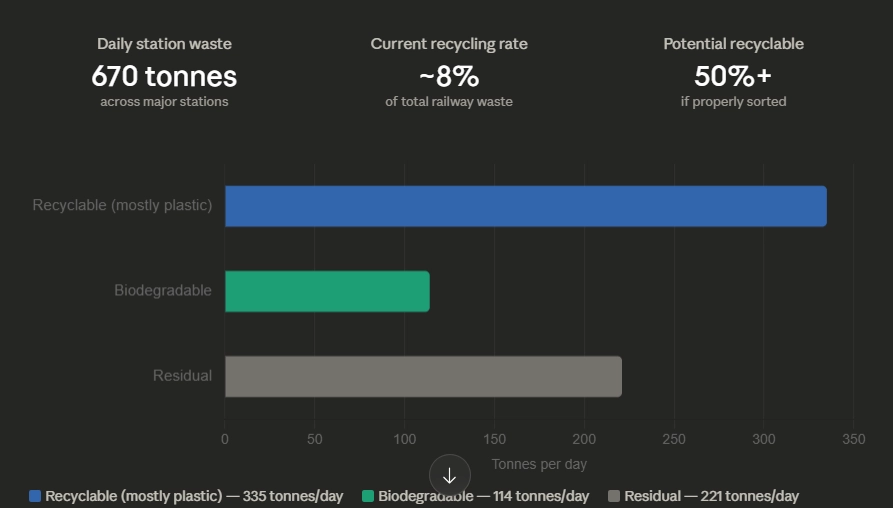
A CPCB assessment found that just three Delhi stations — New Delhi, Old Delhi, and Hazrat Nizamuddin — together produced 6,758 kg of plastic waste daily. A CEEW study on waste management estimated that major railway stations across India generate about 670 tonnes of solid waste per day. Of this, half is recyclable material, mostly plastic. About 17% is biodegradable. The rest — roughly a third — is residual waste that goes to landfill.
The CAG has separately reported approximately 6,289 tonnes of plastic lying along India’s railway tracks.
The recycling rate across the railway system today is roughly 8%. The potential, according to the same studies, is over 50%.
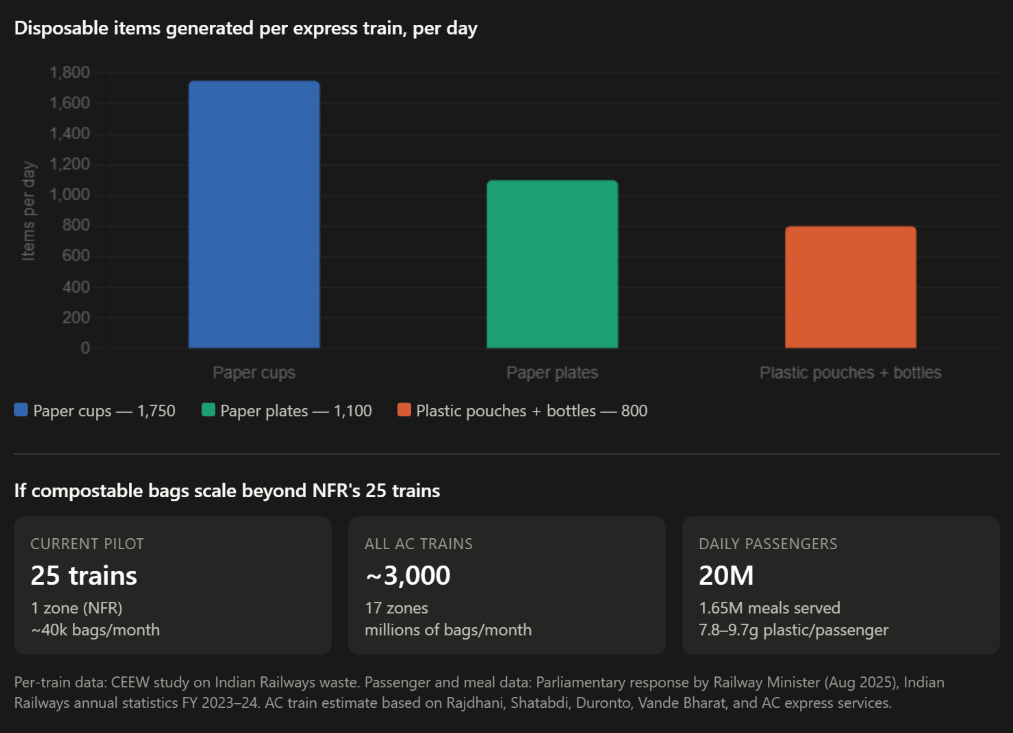
A single express train generates around 800 plastic items (pouches and bottles), 1,100 paper plates, and 1,750 paper cups per day. Multiply that across 13,000 trains and you begin to see the size of the opportunity.
How the pilot was developed
The compostable bioplastic bags were developed at IIT Guwahati’s Centre of Excellence for Sustainable Polymers, known as CoE-SusPol. The centre is led by Prof. Vimal Katiyar, Professor of Chemical Engineering. His research group has been working on bioplastics since 2011 and has published over 305 papers with more than 8,649 citations. They hold patents in India, the US, Canada, Europe, and Japan, covering areas like PLA bioplastics, cellulose nanocrystal films, and thermoplastic starch formulations.
The research is backed by serious infrastructure. In May 2023, IIT Guwahati opened the NRL-Centre of Excellence for Sustainable Materials Translational Facility on campus. This was funded by Numaligarh Refinery Limited through an initial ₹4 crore grant signed in September 2019. The facility has India’s first 100-litre biodegradable polymer synthesis plant. It also has blown film extruders, cast film extruders, injection moulding machines, and thermoforming equipment. This means CoE-SusPol can produce not just lab samples but pilot-scale quantities of compostable bags, cutlery, and containers — using bamboo, cellulose, chitosan, and agro-industrial waste as raw materials.
The formal partnership with NFR moved quickly. On August 1, 2025, two MoUs were signed at NFR headquarters in Maligaon, Guwahati. The first was a three-way agreement between NFR, the Pollution Control Board of Assam, and M/s Kusum Udyog (an authorised recycler). Its goal was to turn Guwahati Railway Station into India’s first 100% plastic-recyclable station. The second MoU, between NFR and IIT Guwahati, set up the framework for deploying compostable bedroll bags.
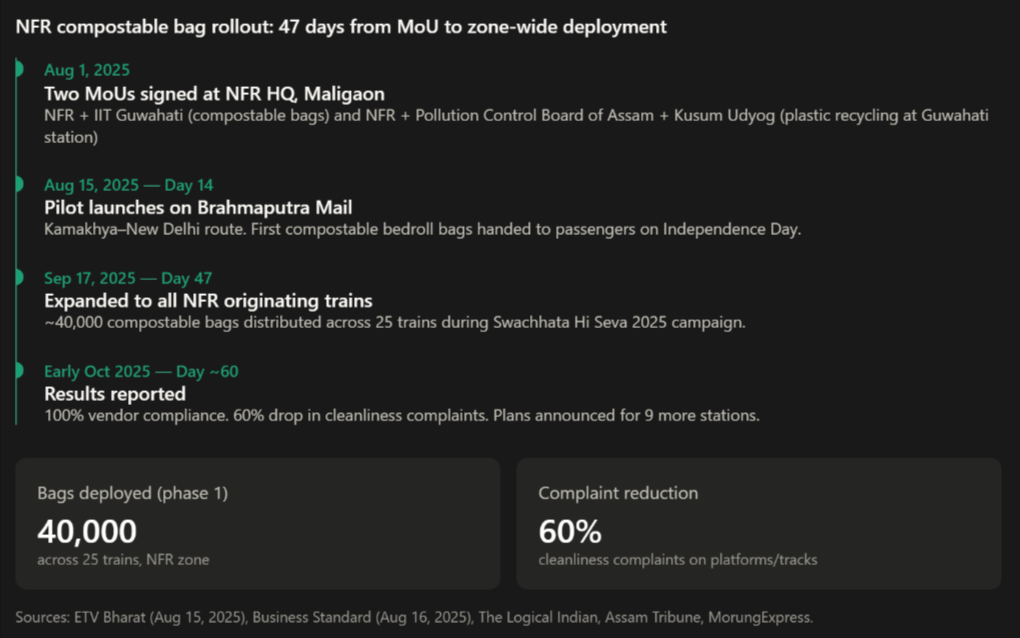
Fourteen days later, the bags were on trains.
NFR General Manager Chetan Kumar Shrivastava called it “a practical, scalable approach towards greener railway operations.” Prof. Katiyar told ETV Bharat that the bags “enhance the fertility of the soil” upon degradation — a detail that matters because much of the waste discarded from trains ends up alongside farmland.
This did not happen overnight: IRCTC's packaging journey since 2018
The NFR pilot builds on years of smaller steps.
- June 5, 2018 — World Environment Day —IRCTC ran its first trial of bagasse-based compostable food containers on 8 Rajdhani and Shatabdi trains from New Delhi.
Bagasse is the fibrous waste left over after sugarcane juice is extracted. The supplier was Ecoware, a Greater Noida company that makes 125 million pieces of compostable tableware per year. The cost was only 10–15% more than regular plastic containers. The New Delhi base kitchen also replaced aluminium foil with bagasse plates and switched from polythene to jute bags for carrying food to trains. - October 2, 2019 — The Railway Board directed all railway units to ban single-use plastic materials under 50 microns. It ordered 1,853 plastic bottle crushing machines for 360 major stations. As of mid-2025, 531 of these have been installed. Around 400 stations started serving tea in kulhads (earthen cups).
- July 1, 2022 — India’s national single-use plastic ban came into effect, covering 19 categories of items including plates, cups, cutlery, straws, and trays. Importantly, compostable products meeting the IS/ISO 17088 standard were explicitly exempted from the ban. This created a protected market category for certified compostable packaging.
- 2026 IRCTC Catering Policy — The policy is clear: “Single-use plastic is totally banned; only biodegradable packaging allowed” for all railway canteen licensees.
Despite all this policy progress over seven years, the NFR pilot was the first time any railway zone actually deployed a compostable alternative for a high-volume, passenger-facing product like bedroll packaging.
The gap between policy and execution is the real story here.
The gap between policy and execution is the real story here.
What comes next: from 25 trains to 13,000
NFR has said it will extend compostable bedroll bags to all trains starting from Guwahati and Kamakhya, and then across the full zone. The plastic-recyclable station model tested at Guwahati is planned for 9 more NFR stations. A senior railway official told ETV Bharat that if the initiative works, it will be rolled out to other zones.
The numbers make the scaling opportunity clear. Indian Railways runs approximately 3,000 AC trains daily across 17 zones. If compostable bedroll bags were adopted system-wide, the monthly procurement would run into millions of units — enough to sustain dedicated manufacturing capacity across multiple suppliers. India already has 287 CPCB-certified compostable plastic manufacturers and sellers, and testing infrastructure through CIPET labs across the country.
The distance between 25 trains and 13,000 trains is large. But the NFR pilot has proved something that no amount of policy could prove on its own: that compostable packaging works on Indian trains, at Indian temperatures, through Indian supply chains, and with measurable results in passenger satisfaction.
This case study has been brought to you by the research team at Ukhi.
About Ukhi
Ukhi manufactures EcoGran™, a compostable biopolymer granule made from agricultural waste — the raw material that manufacturers use to produce finished compostable products like bags, films, and packaging. We publish these case studies to document India’s shift to compostable packaging. If your organisation is evaluating compostable packaging alternatives, our team can help connect you with the right manufacturing partner or supply certified compostable granules directly.
Ukhi was not involved in the NFR–IIT Guwahati pilot. This case study is based entirely on publicly available information. Contact info@ukhi.com to request corrections.
Sources: ETV Bharat (Aug 15, 2025), Business Standard (Aug 16, 2025), The Logical Indian, Assam Tribune, MorungExpress, PIB (June 2018, Oct 2019), CEEW railway waste study, CPCB plastic waste assessment.