

How ITC Limited Replaced 76,000 Tonnes of Plastic with Sustainable Packaging — A Case Study

Disclaimer: This case study is compiled from publicly available sources including ITC’s corporate disclosures, sustainability reports, press releases, and independent media coverage. Ukhi is not affiliated with ITC Limited.
Contact us at info@ukhi.com to request corrections or removal of any information.
ITC Limited is one of India’s largest conglomerates. It operates across FMCG, hotels, paperboards, agri-business, and IT. Its consumer brands such as Aashirvaad, Sunfeast, Bingo, Yippee!, Fiama, Vivel, Engage, Mangaldeep, and Classmate are household names found in practically every Indian home.
What makes ITC unusual in the sustainable packaging conversation is an advantage no other Indian FMCG company has.
ITC owns both the brands that use packaging and one of India’s largest paperboard manufacturing businesses. This means when ITC decides to replace plastic with paper, it does not have to depend on an outside supplier for the alternative material. It can develop, test, and manufacture the replacement in-house.
This vertical integration is the engine behind what has become India’s most comprehensive plastic-free packaging programme in the FMCG sector.
The Framework: "No Plastic, Better Plastic, Less Plastic"
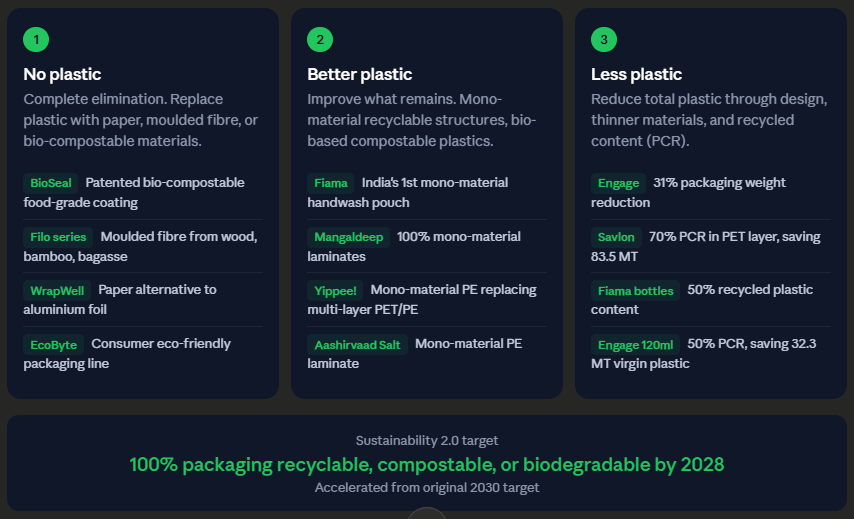
ITC’s packaging strategy is built on three pillars, formally branded as “No Plastic, Better Plastic, Less Plastic” and announced on World Environment Day 2025.
No Plastic
No Plastic means complete elimination, that is, replacing plastic packaging with paper, moulded fibre, or other non-plastic materials. ITC’s Paperboards and Specialty Papers Division (PSPD) has developed a range of proprietary products for this purpose, including:
Better Plastic
Better Plastic means improving the plastics that remain. This involves switching from multi-layer laminates which are extremely difficult to recycle to mono-material structures that can actually enter the recycling stream. It also includes exploring compostable packaging made from bio-based plastics.
Less Plastic
Less Plastic means reducing the total amount of plastic. This is done through design changes, thinner materials, and using post-consumer recycled (PCR) content wherever possible.
ITC’s overarching target under its Sustainability 2.0 Vision is to make 100% of its packaging reusable, recyclable, compostable, or biodegradable by 2028.
The Impact of ITC Limited’s "No Plastic, Better Plastic, Less Plastic” Programs
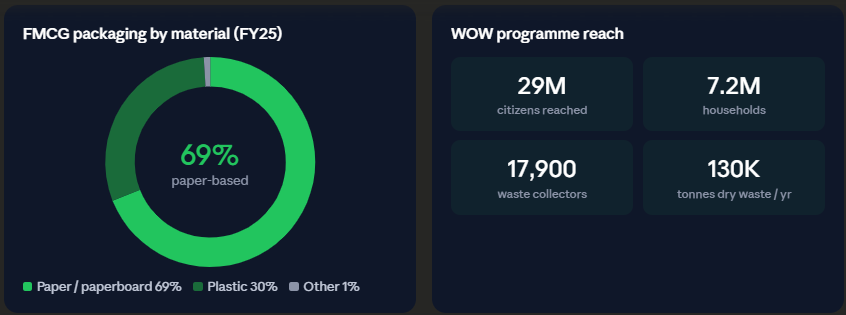
Aashirvaad Organic Atta launched in paper-based packaging on World Earth Day, April 22, 2023. The product was initially available at select retail outlets and e-commerce platforms in Bangalore.
The shift was from a 100% plastic PET/PE laminate to paper packaging sourced from ITC’s own Paperboards Division. Each pack carries a QR code that enables consumers to trace the raw materials back to the farming source.
Other Aashirvaad variants followed soon after. For example, Aashirvaad Khapli Atta features an eco-friendly dual-layer “bag in bag” design with a 100% paper outer pack and recyclable inner pouch.
Aashirvaad Namma Chakki Customized Atta uses a premium paper-based pack that replaces over 70% of its plastic content.
Fiama’s 350ml handwash pouch transitioned from a hard-to-recycle multi-layered spouted stand-up pouch to a recyclable mono-material pouch. This makes ITC the first company in India to launch this in the liquid personal wash category.
This innovation won a Special Award at the 35th Dow Packaging Innovation Awards at Tokyo Pack 2024, judged by 18 international packaging experts.
Beyond the pouch, Fiama and Vivel PET bottles now contain 50% recycled plastic. The entire carton soap portfolio for both brands has fully migrated to recyclable paperboard.
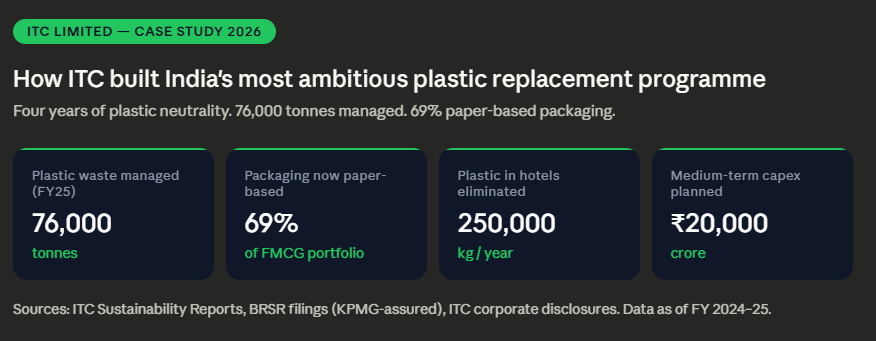
ITC Hotels identified 350 distinct plastic items across its luxury collection properties, of which 160 were single-use plastic items. The chain eliminated approximately 250,000 kg of plastic per year from around 150 touchpoints across its hotels.
Specific replacements included:
Front-of-house operations went single-use plastic free by October 2019, with back-of-house following by December 2019.
Mangaldeep’s 3-in-1 agarbatti portfolio shifted to 100% mono-material laminates, with Ziplock packs incorporating 20% post-consumer recyclate. This is a first in the agarbatti industry.
Engage deodorant spray cans achieved a 31% reduction in packaging weight. Engage Perfume Spray 120ml PET bottles launched with 50% PCR content, which reduces virgin plastic by 32.3 metric tonnes.
Sunfeast Farmlite Core Digestive (800g) became available in a 100% paper outer bag and has won a Gold Award at the Dow Packaging Innovation Awards 2024.
The Numbers: Plastic Waste Managed Year by Year
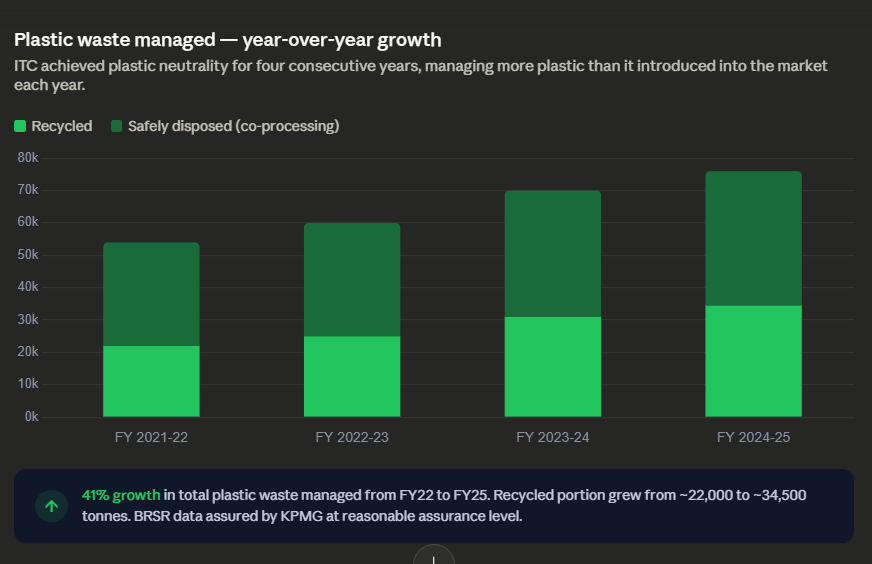
ITC’s plastic waste management data, which is verified through its BRSR filings with KPMG assurance, shows an upward trajectory:
ITC Limited: Investment Into Sustainability
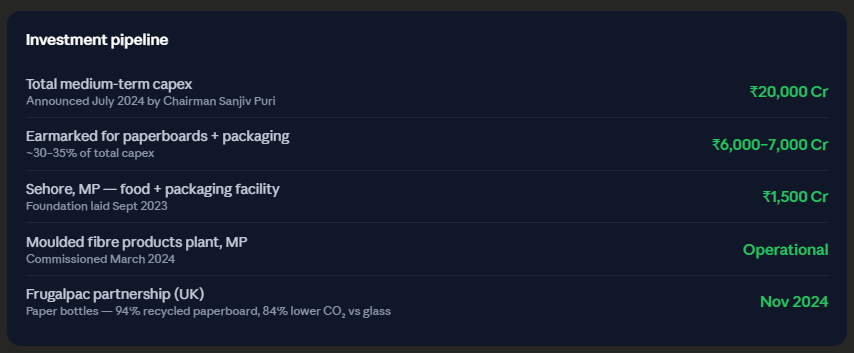
In July 2024, ITC Chairman Sanjiv Puri announced a ₹20,000 crore medium-term capital expenditure plan.
A significant portion of this (approximately 30–35%) is earmarked for paperboards and packaging businesses. Separately, ITC is also investing ₹1,500 crore in an integrated food manufacturing and sustainable packaging facility in Sehore, Madhya Pradesh.
ITC’s sustainable packaging product portfolio, including the Filo, Omega, BioSeal, and EcoByte ranges, recorded approximately 2x revenue growth in FY23.
In November 2024, ITC signed a partnership with UK-based Frugalpac to bring sustainable paper bottles made from 94% recycled paperboard with an 84% smaller carbon footprint than glass, to India and South Asia.
ITC is also a founding member of the India Plastics Pact, launched in 2021 with CII, WRAP, and WWF India — the first Plastics Pact in Asia.
The Bigger Opportunity: What ITC's Journey Signals for the Industry
ITC’s programme demonstrates what is possible when a large company commits resources and R&D to plastic reduction. But it also highlights a wider reality: India’s regulatory environment is tightening rapidly.
Mandatory recycled content targets took effect in April 2025 — 30% for rigid plastics, 10% for flexible, and 5% for multi-layer packaging.
Comprehensive new EPR rules covering all packaging materials come into force in April 2026.
The transition from conventional plastic to compostable packaging and paper-based materials is no longer optional. It is becoming a regulatory requirement. And it creates a growing demand for certified compostable raw materials, particularly compostable granules that converters and manufacturers can process on existing equipment.
About Ukhi
Ukhi is India’s largest directory for compostable packaging materials and suppliers.
EcoGran, Ukhi’s certified compostable granule, is now available through DCGpac. So whether you are a brand exploring your first compostable SKU or a converter looking to offer biodegradable packaging alternatives to your clients, Ukhi can find you the right material at the right scale.
Explore compostable granules and packaging materials at Ukhi or ask your DCGpac partner about EcoGran.