

How Pakka's Chuk Brand Replaced 2,000+ Tonnes of Plastic with Compostable Sugarcane Tableware
Disclaimer: This case study is compiled from publicly available sources for educational purposes. Ukhi is not affiliated with Pakka Limited. Contact us at info@ukhi.com to request corrections or removal.
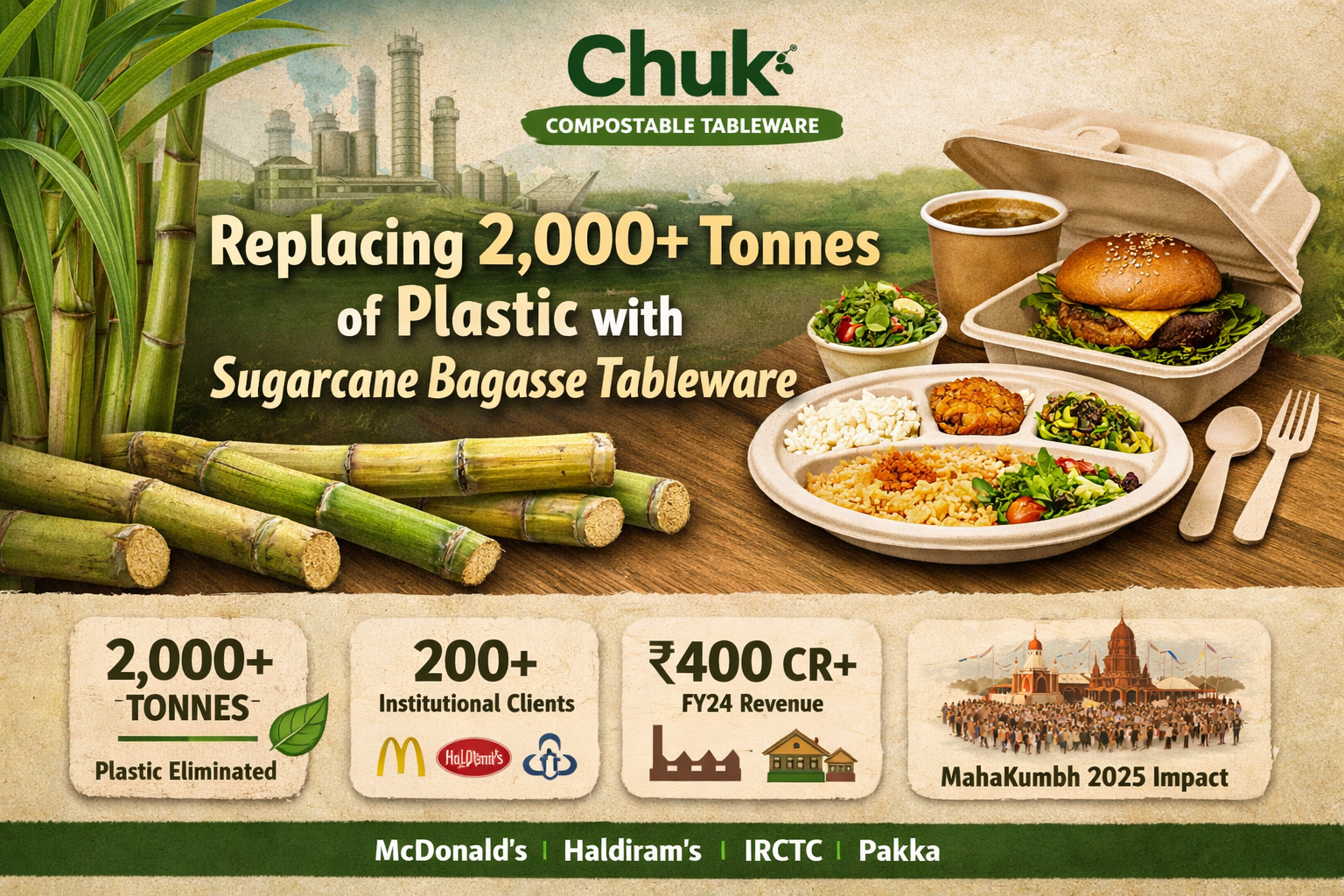
Pakka Limited, a 40-year-old manufacturer based in Ayodhya, Uttar Pradesh, has built India’s largest vertically integrated compostable tableware operation.
Their consumer brand Chuk now produces over 200 product types from sugarcane bagasse, supplies McDonald’s India, Haldiram’s, Bikanervala, Wow Momos, and IRCTC among 200+ institutional clients, and played a visible role at MahaKumbh 2025, one of the largest gatherings in human history.
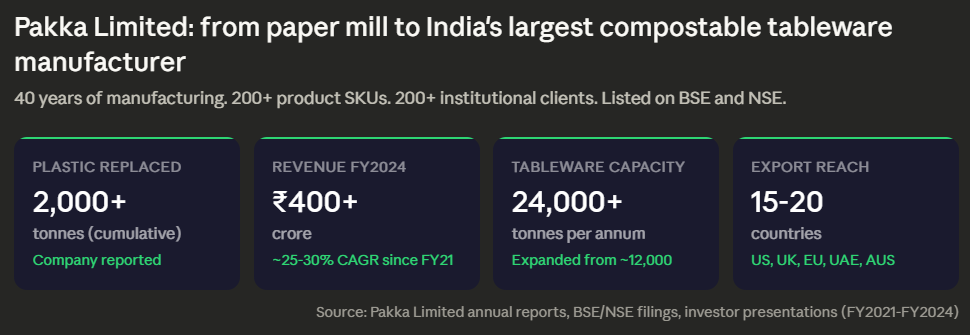
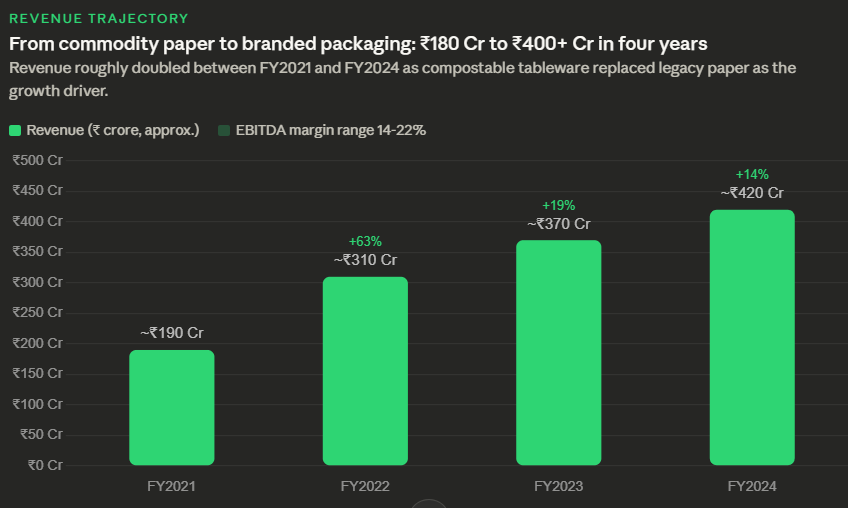
The company reports replacing over 2,000 tonnes of single-use plastic with compostable alternatives. Revenue has grown from roughly ₹180 crore in FY2021 to over ₹400 crore by FY2024. Pakka is listed on both BSE and NSE.
2,000+ T
Plastic replaced
200+
Institutional clients
24,000+
TPA Manufacturing capacity
400 Cr+
FY24 revenue
What Pakka was before Chuk
The company’s journey from a traditional paper mill to a sustainable packaging leader reflects a strategic long-term transformation.
The problem Pakka set out to solve
India generates over 25,000 tonnes of plastic waste every day.
Disposable tableware, the plates, cups, bowls, and cutlery used at street food stalls, weddings, railway stations, quick-service restaurants, and large events, accounts for a significant share of this waste.
Before India’s single-use plastic ban took effect on July 1, 2022, cheap polystyrene and plastic plates were the default across the country. Price was the only factor that mattered, and compostable alternatives were seen as expensive, unreliable, and hard to source at scale.
The Ministry of Environment, Forest and Climate Change banned 19 categories of single-use plastics under the Plastic Waste Management Amendment Rules, 2022, including plates, cups, glasses, cutlery, straws, trays, and polystyrene for decoration.
These banned categories map almost exactly to the products Pakka was already manufacturing. The regulation created demand. What Pakka had done in the years before the ban was build the supply.
What Chuk actually makes and how
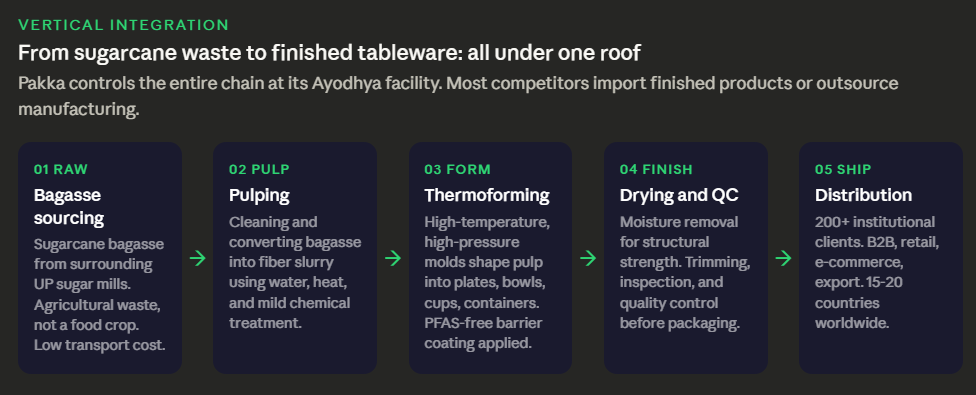
Chuk products are made from sugarcane bagasse, which is an agricultural waste product.
This is an important distinction. The raw material does not compete with food production and does not require dedicated farmland.
Pakka sources bagasse from sugar mills surrounding its Ayodhya facility, which keeps transportation costs low and supply consistent year-round.
The manufacturing process involves four stages:
The entire process, from raw bagasse to finished tableware, happens under one roof at the Ayodhya plant. This vertical integration is one of Pakka’s most significant advantages, whereas most competitors in this space either import finished products or outsource manufacturing.
The product range now covers over 200 SKUs:
A technical detail worth noting: Pakka uses a proprietary PFAS-free barrier coating for grease and water resistance. PFAS, sometimes called “forever chemicals”, are commonly used in compostable packaging globally to provide oil resistance, but they do not break down in the environment. Pakka achieves the same functional performance without them.
All Chuk products are marketed as microwave-safe, refrigerator-safe, and grease-resistant. They compost within 90 to 180 days under industrial composting conditions.
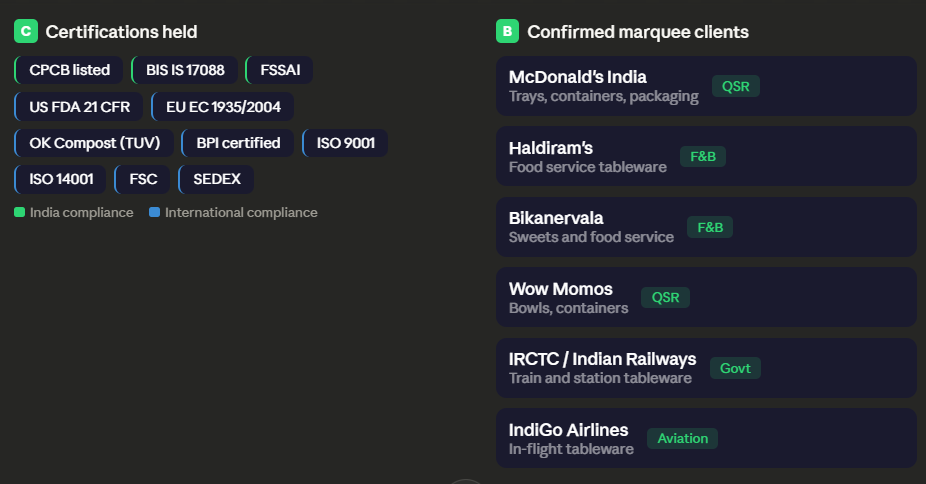
Pakka (Chuk) Certifications: why they matter for institutional buyers
A McDonald’s or an IRCTC cannot switch to an uncertified alternative. Certifications are the trust layer that unlocks large institutional contracts. This is where Pakka holds an unusually comprehensive set:
This certification stack allows Pakka to serve both domestic institutional clients and export to 15 to 20 countries, including the US, UK, Germany, France, UAE, and Australia.
Exports have historically contributed 30% to 45% of revenue, though the domestic share has been growing rapidly since the 2022 ban.
Who uses Chuk products
A McDonald’s or an IRCTC cannot switch to an uncertified alternative. Certifications are the trust layer that unlocks large institutional contracts. This is where Pakka holds an unusually comprehensive set:
This certification stack allows Pakka to serve both domestic institutional clients and export to 15 to 20 countries, including the US, UK, Germany, France, UAE, and Australia.
Exports have historically contributed 30% to 45% of revenue, though the domestic share has been growing rapidly since the 2022 ban.
MahaKumbh 2025: compostable packaging at civilizational scale
MahaKumbh Mela 2025 took place in Prayagraj, Uttar Pradesh, from January 13 to February 26, 2025.
Over 400 million visitors attended across 45 days. The Uttar Pradesh state government designated it a plastic-free event, banning single-use plastics across the entire Mela area.
Pakka’s Ayodhya manufacturing facility sits roughly 160 km from Prayagraj.
This proximity, combined with its production capacity, made the company a natural supplier for the event.
The company ramped up production in late 2024 in anticipation, and Chuk products were reported at food stalls and distribution points throughout the Mela.
The volumes involved were substantial, potentially running into millions of individual tableware units over the event’s duration. Pakka’s management highlighted MahaKumbh as a significant demand driver in investor communications during Q2 and Q3 of FY2025.
The numbers
Over 2,000 tonnes of single-use plastic replaced with compostable alternatives (cumulative, as reported in company communications).
Revenue growth from approximately ₹180 crore in FY2021 to over ₹400 crore by FY2024, a CAGR of roughly 25 to 30 percent.
Manufacturing capacity expanded from approximately 12,000 tonnes per annum to 24,000+ TPA of molded tableware through a capex program of ₹150 to 250 crore. T
The company is listed on both BSE and NSE, with a market capitalization that has ranged between ₹800 crore and ₹2,500 crore.
What comes next for Pakka
If you are exploring the switch
Pakka’s journey shows that compostable packaging in India has moved well past the pilot stage. The question for most brands, converters, and manufacturers today is not whether to switch, but how to start and who supplies the raw material.
Ukhi works with businesses exploring compostable packaging materials, particularly compostable granules (EcoGran) that serve as the base raw material for producing compostable films, bags, and flexible packaging. If you are a packaging converter, brand, or manufacturer evaluating compostable alternatives for your supply chain, we can help you understand material options, sourcing, and certification pathways.
Talk to us at ukhi.com, or ask your DCGpac partner about Ukhi’s EcoGran range.
Sources: Pakka Limited annual reports and BSE/NSE filings (FY2021 through FY2024), investor presentations available at pakka.com, Ministry of Environment, Forest and Climate Change notification on single-use plastic ban (July 2022), Plastic Waste Management Amendment Rules 2021 and 2022, and press coverage from Economic Times, Business Standard, and MoneyControl.