

JioMart Packaging: How 1.6 Million Daily Orders Can Go Compostable
Disclaimer: This is an independent analysis by Ukhi, based on information available in the public domain as of April 2026. JioMart is not a Ukhi customer, and this case study is not affiliated with or endorsed by JioMart or Reliance Retail. If you represent the company and would like any information corrected or updated, please contact us at info@ukhi.com.
45,174 MT
Plastic used in FY25
47,000 MT
Plastic processed
79%
Recyclable packaging
2030
Bio-based target
A Packaging Story Waiting to Be Written at JioMart
JioMart is now the second-largest quick commerce platform in India by daily order volume. It processes around 1.6 million orders every single day as of December 2025.
Its growth has been stunning at 360% year-on-year jump, built across 1,000+ cities and 5,000+ pin codes. Yet in all this scale and speed, one chapter of the story is still unwritten: its compostable packaging journey.
Almost every other major e-commerce player in India has taken a public position on sustainable packaging. Amazon India, Flipkart, BigBasket, Zepto, and Blinkit have all announced specific plastic-reduction steps. For JioMart, that story is still ahead of it, and that is exactly what makes this an interesting moment to look at.
Understanding JioMart's Scale
Before we look at packaging, it helps to understand just how large JioMart’s footprint has become.
| Metric | Figure | Period |
|---|---|---|
| Daily orders | ~1.6 million | Q3 FY26 (Dec 2025) |
| Quarterly transactions | 524 million | Q3 FY26 |
| Year-on-year order growth | 360%+ | Q3 FY26 |
| New customers added in a quarter | 5.9 million | Q3 FY26 |
| Cities served | 1,000+ | 2025 |
| Pin codes served | 5,000+ | 2025 |
| Fulfillment stores / dark stores | ~3,000 | 2025 |
At this scale, JioMart processes roughly 48 million orders a month and close to 584 million orders a year.
Quick commerce now contributes about 20% of Reliance Retail’s quarterly revenue of ₹97,605 crore, which works out to around ₹19,500 crore in annualised quick commerce GMV.
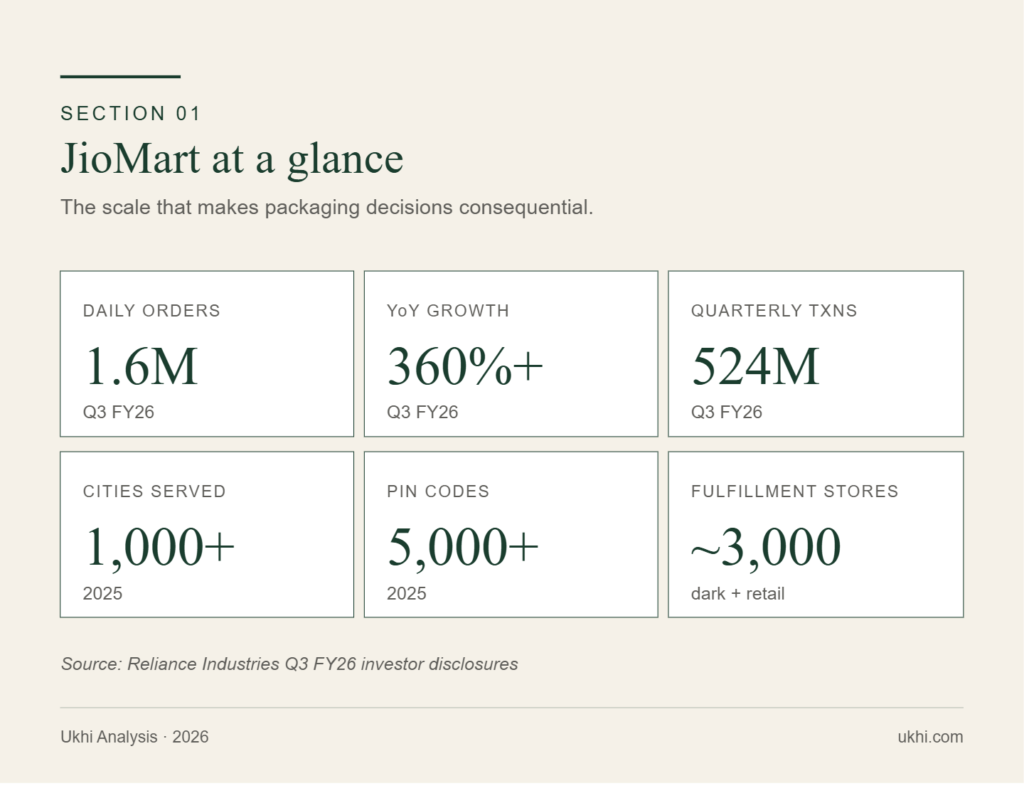
These numbers are drawn from Reliance Industries’ own investor disclosures for Q3 FY26.
JioMart's Packaging Footprint: What We Know and What We Can Estimate
JioMart has not publicly disclosed the weight, type, or volume of packaging material it uses. What is visible from the public domain is the following:
- Corrugated cardboard boxes are used for some deliveries. JioMart even sells its own branded 3-ply corrugated boxes on its platform.
- Plastic carry bags are still part of grocery delivery, based on customer reviews and delivery images circulating publicly.
- A single line in RIL’s Integrated Annual Report 2024-25 mentions that “Reliance Retail continues to drive sustainability through energy-efficient infrastructure, responsible operations and eco-friendly packaging across operations.” No further specifics are provided for JioMart.
Because direct disclosures are limited, we can estimate JioMart’s plastic footprint using industry benchmarks.
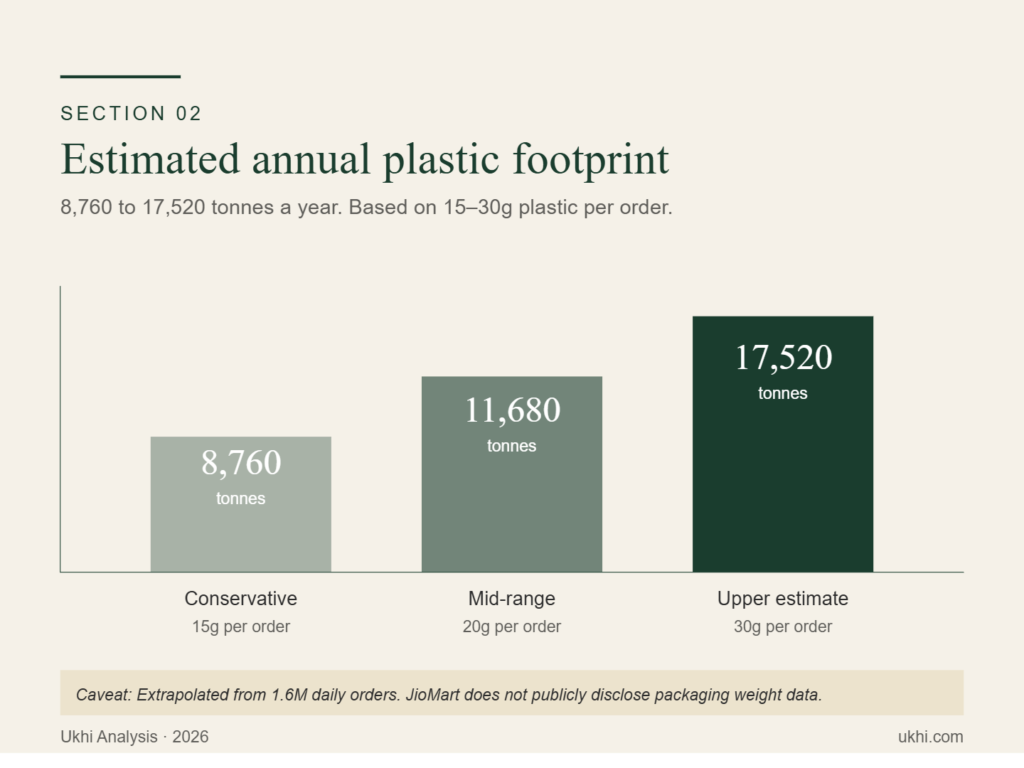
A typical Indian quick commerce order uses somewhere between 15 and 30 grams of plastic in the form of carry bags, inner produce bags, tape, and stickers.
| Scenario | Plastic per Order | Annual Plastic Use |
|---|---|---|
| Conservative | 15g | ~8,760 tonnes |
| Mid-range | 20g | ~11,680 tonnes |
| Upper estimate | 30g | ~17,520 tonnes |
Caveat: These are extrapolated estimates, not official figures from JioMart. They are meant to give a sense of scale, not to make precise claims about the company’s actual consumption.
If JioMart continues growing at even half its current pace, this footprint could roughly double by FY27, reaching 20,000 to 35,000 tonnes a year.
That is the scale at which the compostable packaging opportunity for JioMart becomes a genuinely national-impact story.
JioMart's Packaging Transition: A Clean Slate to Build From
Here is a useful way to think about JioMart’s current position. Many of its peers started their sustainability journeys at a time when compostable options were fewer, costlier, and harder to source. JioMart is entering this conversation at a better moment.
How Peers Have Moved on Packaging
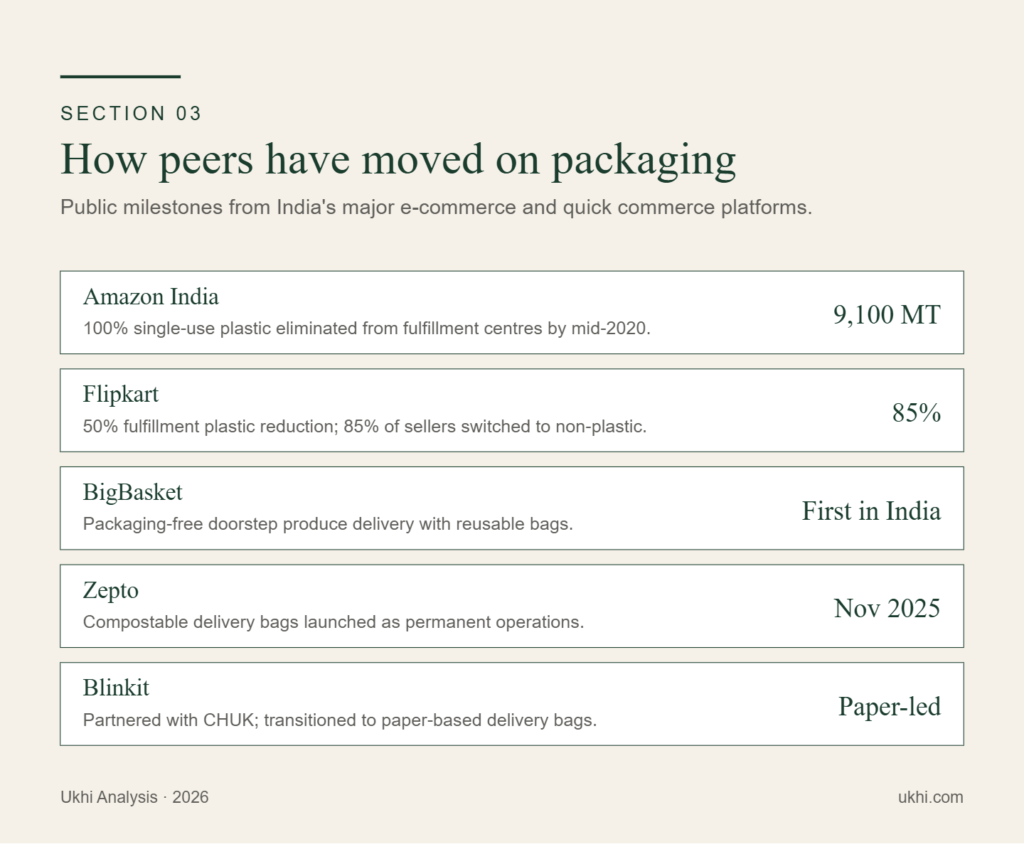
- Amazon India removed 100% single-use plastic from its fulfillment centres by mid-2020, avoiding 9,100 metric tonnes of plastic since 2019.
- Flipkart cut fulfillment plastic by 50%, with 85% of sellers switching to non-plastic packaging.
- BigBasket pioneered packaging-free doorstep delivery of fresh produce using reusable bags and cornstarch material.
- Zepto launched compostable delivery bags in November 2025 as a permanent part of operations.
- Blinkit partnered with CHUK and moved to paper-based delivery bags.
Where JioMart's Packaging Transition Stands Today
JioMart’s marketplace already sells a wide range of certified compostable products from brands like EcoBharat, Ecoware, and Biogreen. This signals that the company understands the category and has supplier networks in place.
The next step, using compostable packaging for its own fulfillment, is a natural extension of what it is already comfortable stocking.
Even more interestingly, Reliance Industries has one of the largest circular polymer capabilities in the country. It recycles around 2 billion PET bottles a year and produces ISCC Plus certified circular polymers under brand names like CircuRepol™ and CircuRelene™.
This means JioMart has something most competitors do not: a fully vertically integrated sustainable packaging pathway available within its own parent group.
The Packaging Impact Waiting to Be Unlocked at JioMart
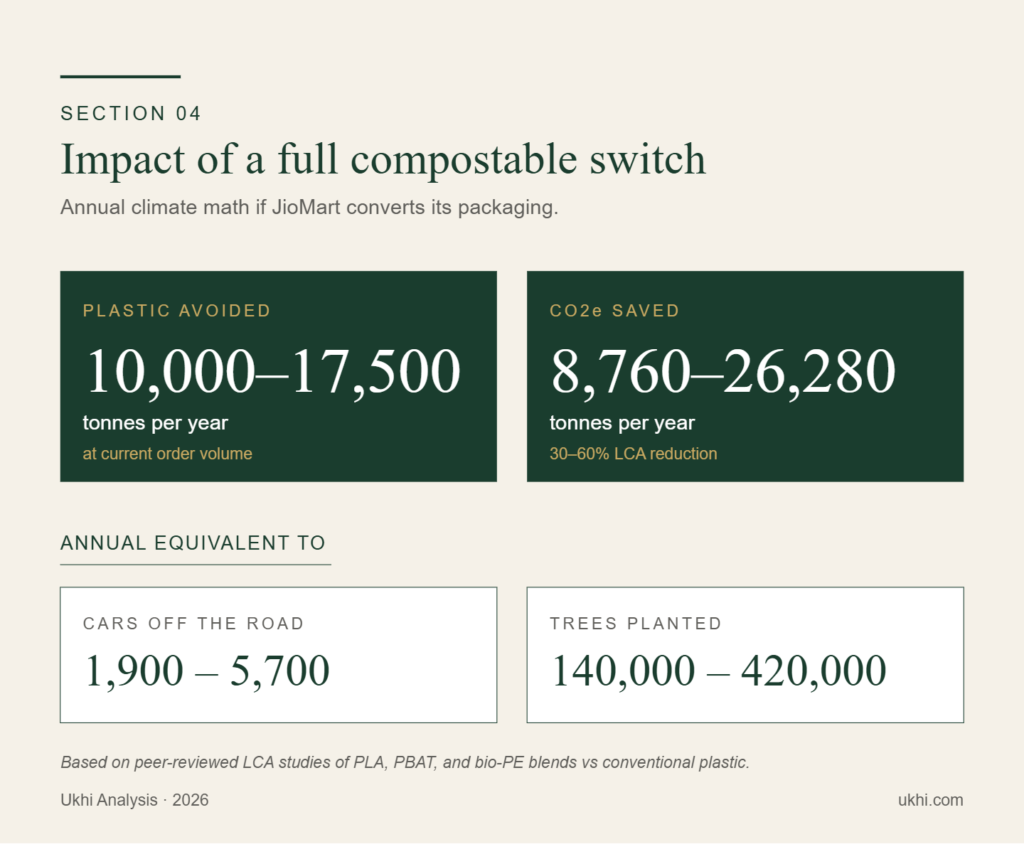
If JioMart were to fully transition to compostable packaging across its fulfillment network, the impact would be immediate and measurable.
| Impact Metric | Conservative (30% CO₂ reduction) | Optimistic (60% CO₂ reduction) |
|---|---|---|
| Annual plastic avoided | 10,000–17,500 tonnes | 10,000–17,500 tonnes |
| Annual CO₂e saved | 8,760–13,140 tonnes | 17,520–26,280 tonnes |
| Cars off the road equivalent | 1,900–2,800 | 3,800–5,700 |
| Trees planted equivalent | 140,000–210,000 | 280,000–420,000 |
These figures are based on peer-reviewed lifecycle assessments showing compostable materials like PLA, PBAT, and bio-PE blends reduce carbon emissions by 25% to 60% compared to conventional plastics.
Insight: Because JioMart operates in 1,000+ cities, its switch would carry compostable packaging into tier-2 and tier-3 India in a way no other platform currently does.
The Economics of JioMart Switching Its Packaging
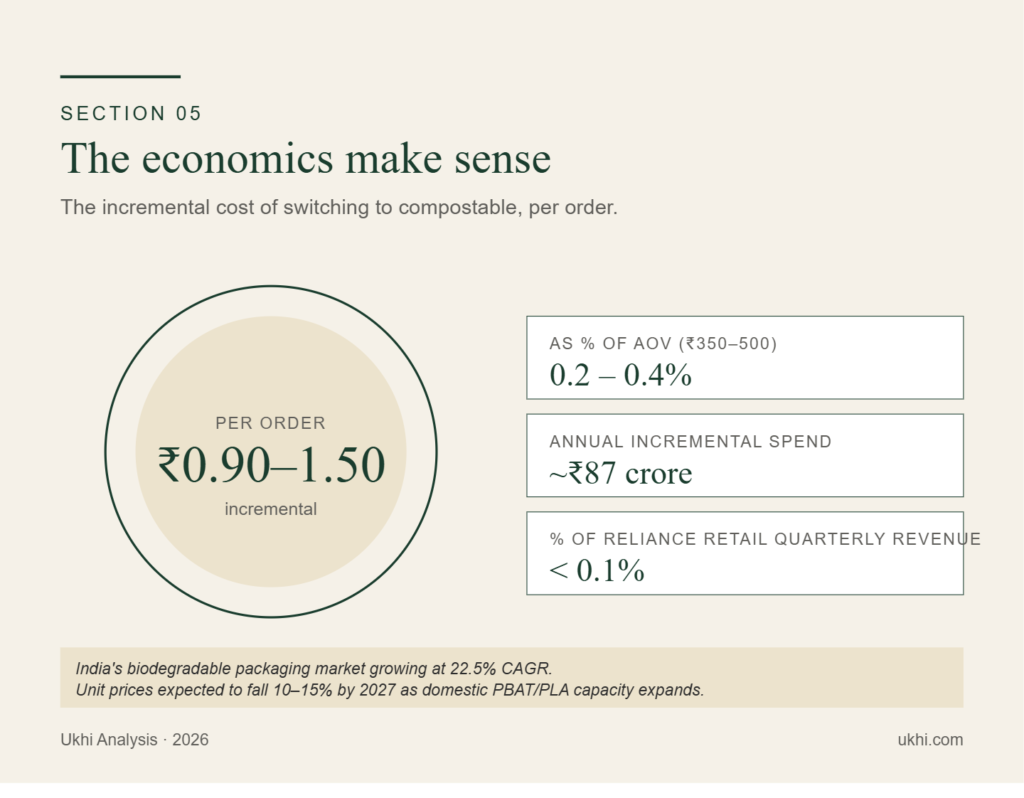
A common assumption is that compostable packaging is too expensive at scale. The real numbers tell a different story.
- Compostable carry bags in India cost around ₹140–190 per kg in bulk, compared to ₹80–130 per kg for conventional plastic.
- Per order, this works out to an incremental cost of just ₹0.90 to ₹1.50.
- At JioMart’s scale, that is an additional spend of roughly ₹87 crore a year.
- This is less than 0.1% of Reliance Retail’s quarterly revenue.
- India’s biodegradable packaging market is growing at 22.5% CAGR, and unit prices are expected to drop 10–15% by 2027 as domestic PBAT and PLA capacity expands.
Insight: Because JioMart operates in 1,000+ cities, its switch would carry compostable packaging into tier-2 and tier-3 India in a way no other platform currently does.
Why Regulation Favours a JioMart Packaging Switch
India’s Plastic Waste Management Rules and EPR framework are tightening steadily. E-commerce platforms are classified as Brand Owners and must register on CPCB’s EPR portal, meet rising recycled content targets (30% in FY25-26, rising to 60% by FY28-29), and comply with QR code traceability requirements from July 2025. As of March 2026, over 20.7 million tonnes of plastic packaging waste has been recycled under this framework.
For a company of JioMart’s scale, an early move on compostable packaging aligns perfectly with these obligations and gets ahead of future tightening.
The Road Ahead for JioMart Packaging
Put simply, JioMart is sitting on one of the largest compostable packaging adoption opportunities in Indian e-commerce today. A phased roadmap could look like this:
- Start with outer carry bags (highest visibility, easiest switch)
- Move to inner produce and wet-item bags (biggest volume)
- Convert tape, stickers, and fillers (closes the loop)
With Reliance’s circular polymer infrastructure, JioMart’s 1,000+ city reach, and the pre-IPO moment for Reliance Retail creating natural space for ESG disclosures, the timing is excellent.
About Ukhi
Ukhi is an Indian compostable packaging company producing certified compostable granules and finished packaging under the EcoGran brand. Our materials meet CPCB compostability norms and IS 17088 standards. We supply to brands that are transitioning from conventional plastics to compostable alternatives, from small pilots to full fulfillment conversions. For platforms operating at JioMart’s scale, we offer bulk compostable granule supply for in-house bag manufacturing, as well as finished compostable carry bags and mailers.
If your team is exploring compostable packaging, reach out to us at info@ukhi.com.