

What Hindustan Unilever's Packaging Problem Reveals About the Road to Compostable
Disclaimer: This case study draws entirely on publicly available sources. Hindustan Unilever Limited was not contacted for this analysis and has had no involvement in its preparation or review. If you spot something that needs correcting, or if HUL or anyone else has information that would improve the accuracy of this piece, please write to us at info@ukhi.com.
HUL’s plastic footprint, sachet problem, and sustainability targets — examined honestly. Plus what a switch to compostable packaging would actually mean for HUL.
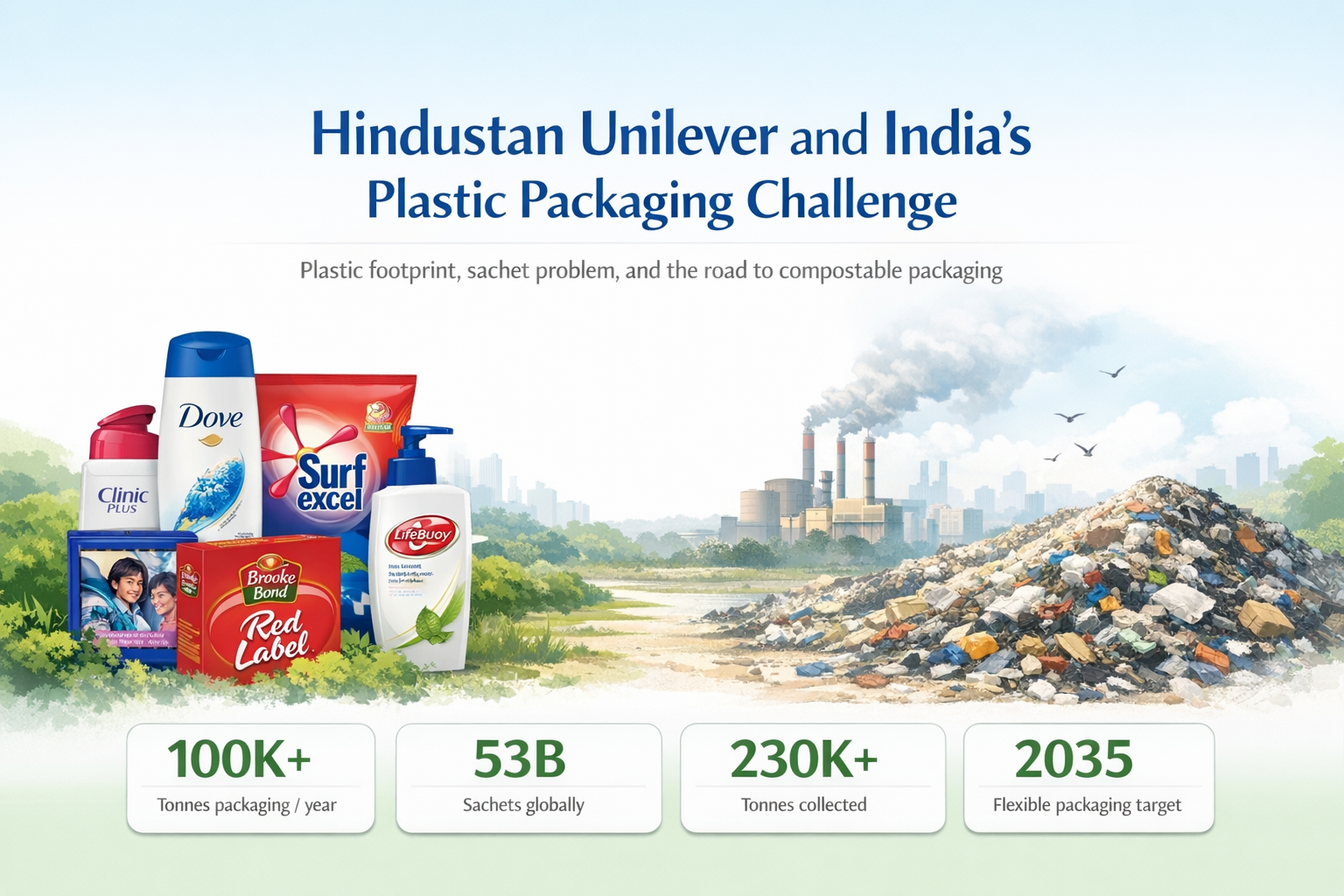
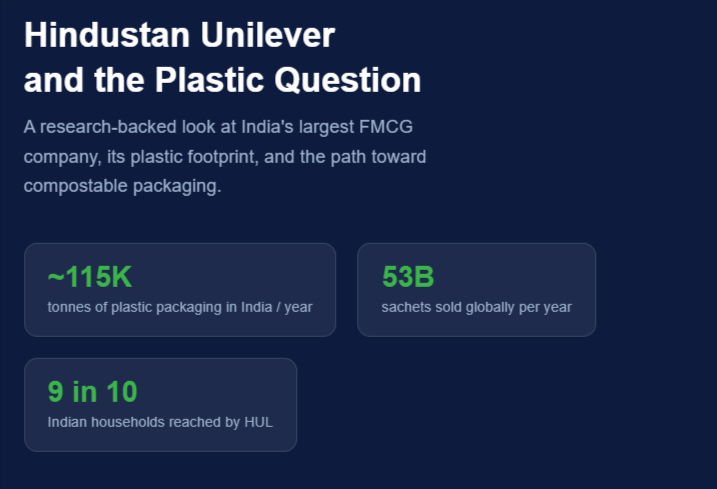
Hindustan Unilever Limited’s products reach 9 out of 10 Indian households. That reach is through brands like Dove, Surf Excel, Lifebuoy, Clinic Plus, and Brooke Bond, and it has made HUL one of the most studied companies in Indian business.
It has also made HUL one of the most consequential actors in India’s plastic packaging story.
This case study looks at what HUL’s plastic footprint actually looks like, what the company has done so far, where the gaps remain, and what a realistic path forward looks like.
100K+
Tonnes packaging / year
53B
Sachets globally
230K+
Tonnes collected
2035
Flexible packaging target
How Much Plastic Does HUL Actually Use — and Where Does It Go?
HUL does not publicly disclose its India-specific plastic packaging volume. However, based on EPR compliance data, analyst estimates, and company disclosures, researchers estimate that HUL produces approximately 100,000 to 120,000 tonnes of plastic packaging in India every year.
Paper bags, compostable polybags, recycled cardboard: what Zara India uses now
To put that in context: India generates between 4 million tonnes (CPCB official figures) and 18.5 million tonnes (OECD estimate) of plastic waste annually. HUL accounts for a small percentage of that total, but its share of the hardest-to-manage category, which is multilayer flexible packaging, is disproportionately large.
The packaging breaks down roughly as follows:
That second category is where the environmental difficulty sits.
Multilayer flexible packaging cannot be separated back into its component materials by any commercially available recycling process. Once used, it has no economic value for waste collectors. It ends up in landfills, drains, rivers, or is burned openly.
Globally, Unilever’s total plastic packaging volume has remained essentially flat for nearly a decade: approximately 610,000 tonnes in 2017, rising to 713,000 tonnes in 2021, and settling at around 698,000 tonnes in 2022.
The ₹1 Sachet That Changed India — and the Waste Problem That Came With It
No part of HUL’s packaging story is more complex than the sachet.
HUL pioneered the single-use sachet in India in the 1980s, which made products like shampoo affordable at price points of ₹1 to ₹2.
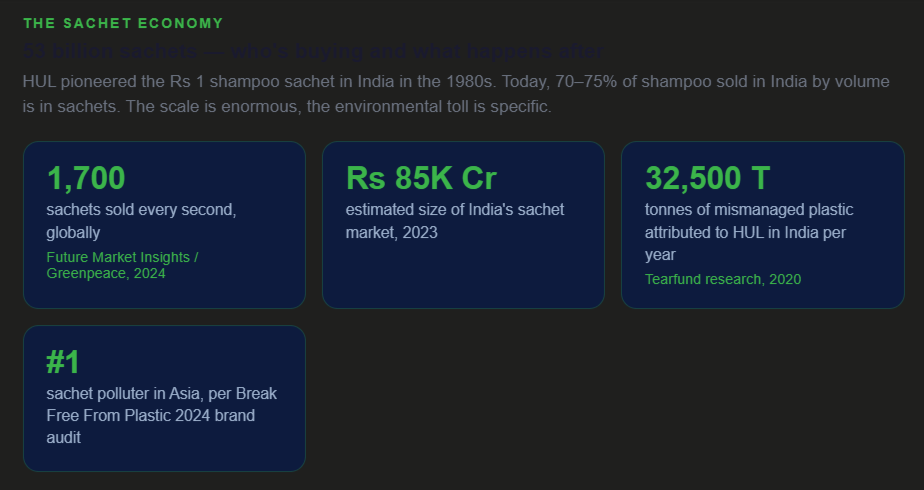
Globally, Unilever sells an estimated 53 billion sachets per year, or roughly 1,700 every second.
Brands that contribute significantly to this figure include Dove, Sunsilk, Clinic Plus, and Lifebuoy.
The Break Free From Plastic brand audit (Asia, 2024) identified Unilever as the largest sachet polluter across India, Indonesia, the Philippines, and Vietnam.
Sachets have near-zero value for informal waste collectors who sort plastic by economic worth. Unlike PET bottles, which can be sold to recyclers, a used sachet earns nothing.
As a result, it is rarely collected, never recycled at scale, and almost always mismanaged.
A 2020 Tearfund study estimated that HUL is responsible for approximately 32,500 tonnes of mismanaged plastic waste in India each year, the highest country-level figure in their study.
The 2024 Himalayan Cleanup audit found that 84.2% of plastic waste collected in mountain areas was single-use FMCG packaging, with 71% of it being non-recyclable.
This is the core tension: sachets provide real access for real people, while also creating a waste stream that no current system can effectively handle.
A Decade of Targets: What HUL Promised, What It Achieved, and What Got Pushed Back
India’s own regulations have created an independent compliance floor that reinforces Inditex’s voluntary commitments. Three frameworks are directly relevant to Zara India’s packaging.
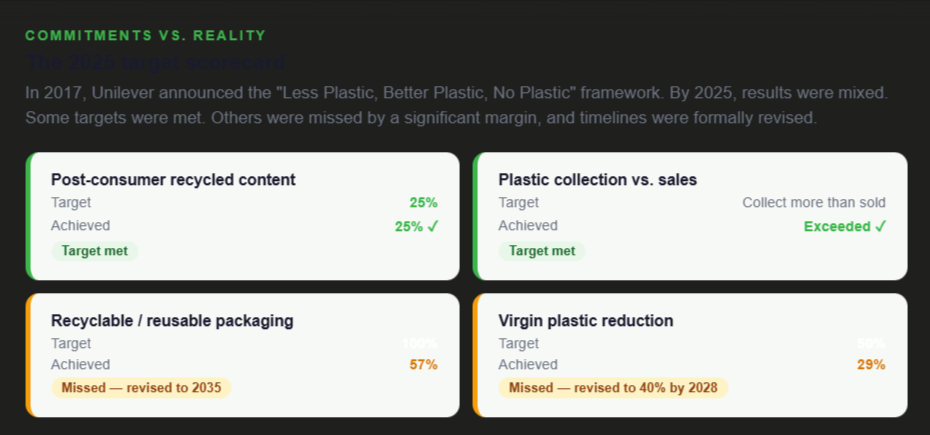
Unilever’s Global Head of Packaging acknowledged publicly: “We’ve fallen short against some of our most ambitious goals.”
In India specifically, HUL has built one of the country’s most extensive plastic waste collection systems.
On recycled content within HUL’s own packaging in India, the figure stood at approximately 3% as of 2024, with a stated target of 15% by 2025.
The India Plastics Pact reported that member companies, including HUL, placed 788,027 tonnes of plastic on the Indian market, with only 1% containing recycled content.
Where Do Bioplastics Stand in HUL’s Transition
HUL has not launched any bioplastic packaging pilots in India as of the time of writing. The company’s India strategy has focused on collection infrastructure, recycled content integration, and packaging redesign rather than bio-based material substitution.
This work is still ongoing and has not yet produced a commercial large-scale replacement for multilayer sachets.
The company is also a founding member of the Bioplastic Feedstock Alliance, established in 2013 with WWF, Coca-Cola, and Danone, to evaluate responsible sourcing of plant-based feedstocks such as sugarcane and corn starch.
Five Barriers Standing Between Good Intentions and Actual Change for HUL
Five factors explain why the shift to compostable packaging has not happened faster.
If HUL Switched to Compostable Packaging…
Lifecycle assessment research suggests that switching from fossil-based to bioplastic packaging reduces carbon emissions by 13 to 62% per unit, depending on the material and what happens to it at end of life (ScienceDirect, 2023).
Applied to HUL’s India footprint of roughly 100,000 tonnes, a full transition to compostable alternatives could avoid an estimated 20,000 to 60,000 tonnes of CO2 equivalent per year from packaging production alone. That is before accounting for the reduction in plastic waste entering rivers, landfills, and open burning.
The Road Ahead
India’s regulatory environment is clearly moving in one direction.
The UN Global Plastics Treaty remains unresolved. Negotiations at INC-5.2 in Geneva (August 2025) adjourned without consensus.
Until a binding global agreement exists, progress on plastic reduction depends almost entirely on voluntary corporate action and national regulation.
Unilever’s innovation pipeline includes enzymatic recycling partnerships, concentrated product formats, and refill station pilots. The Wild acquisition signals that compostable packaging is now part of the company’s strategic direction.
For brands already making the switch, certified compostable packaging that meets IS/ISO 17088 is available today. The materials exist, the certification standards exist, and what is building now is the supply chain confidence and composting infrastructure required for a durable transition.
About Ukhi
UKHI is an Indian biomaterials company focused on replacing single-use plastic with compostable alternatives made from agricultural waste. Its core product, EcoGran, is a biodegradable and compostable polymer compound certified to IS/ISO 17088 — the Indian and international standard for compostable plastics. EcoGran is designed as a practical, drop-in material for flexible packaging, including the formats that FMCG brands use most heavily.
UKHI works with brands, manufacturers, and packaging converters to make the material transition workable: from sourcing and processing compatibility to EPR registration support under India’s Plastic Waste Management Rules.
The barriers to switching are real, and this case study has tried to present them honestly. What UKHI offers is the material, the certification, and the supply chain experience to help brands take a concrete first step.
For brands ready to move from intention to action, UKHI is a starting point.
Learn more at ukhi.com