
Short Answer: How Do You Source Sustainable Packaging in India?
Sourcing sustainable packaging in India follows a clear sequence. It is not complicated, but skipping steps is expensive.
The process works like this:
- Define your product requirements precisely, including heat exposure, humidity, transport distance, and shelf life
- Shortlist materials that are technically suited to those requirements
- Identify manufacturers, not resellers, in the relevant production hubs
- Evaluate them against a defined checklist covering certifications, lab capability, and EPR compliance
- Request and verify documents before placing any order
- Compare price, MOQ, and lead time with total cost of ownership in mind, not unit price alone
The whole process, from initial research to finalised supplier partnership, typically takes four weeks for a focused buyer.
Which Sustainable Packaging Materials Should You Shortlist First?
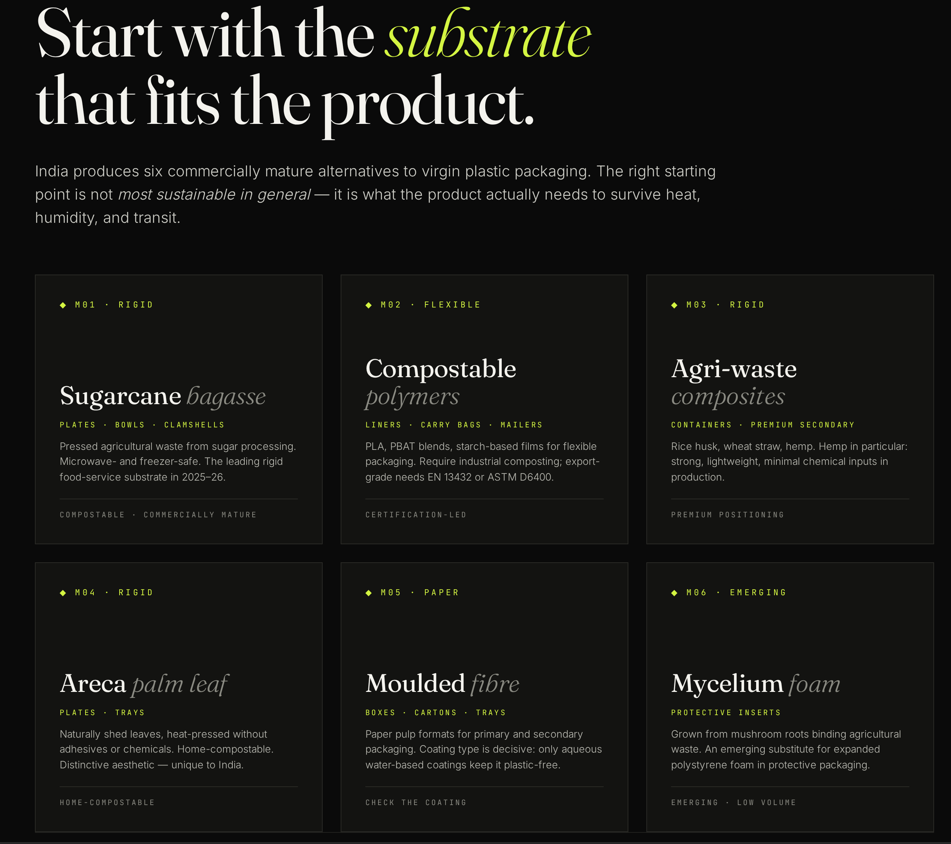
India’s material landscape for eco-friendly packaging is broader than most buyers realize. The right starting point is not “what is most sustainable in general” but “what is technically suited to my product.”
Here are the main options:
- Sugarcane bagasse is the most commercially mature option for rigid formats. It is agricultural waste from sugar processing, pressed into plates, bowls, clamshells, and trays. It is microwave-safe, freezer-safe, and compostable. It is widely considered the leading material for food service packaging in 2025.
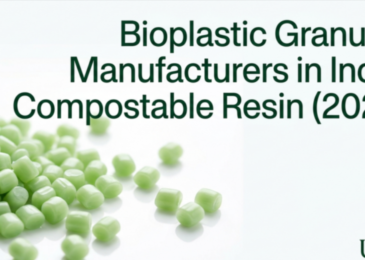
- Compostable polymers, including PLA, PBAT blends, and starch-based films, are used for flexible packaging: liners, carry bags, garment bags, and courier mailers. They require industrial composting to break down properly and should carry either EN 13432 or ASTM D6400 certification for export markets.
- Agri-waste composites, made from rice husk, wheat straw, or hemp, are used for rigid containers and premium secondary packaging. Hemp in particular is strong, lightweight, and produced with minimal chemical inputs.
- Areca palm leaf products are unique to India. Naturally shed leaves are heat-pressed into plates and trays without any adhesive or chemical treatment. They are fully home-compostable and carry a strong aesthetic appeal for premium brands.
- Moulded fibre and paper formats cover boxes, cartons, and secondary packaging. The important detail here is the coating. Paper packaging with a PE laminate is not recyclable and not compostable. Only water-based aqueous coatings make paper packaging genuinely plastic-free.
- Mycelium packaging, grown from mushroom roots around agricultural waste, is an emerging format for protective foam replacement.
How Do You Evaluate Sustainable Packaging Companies in India?
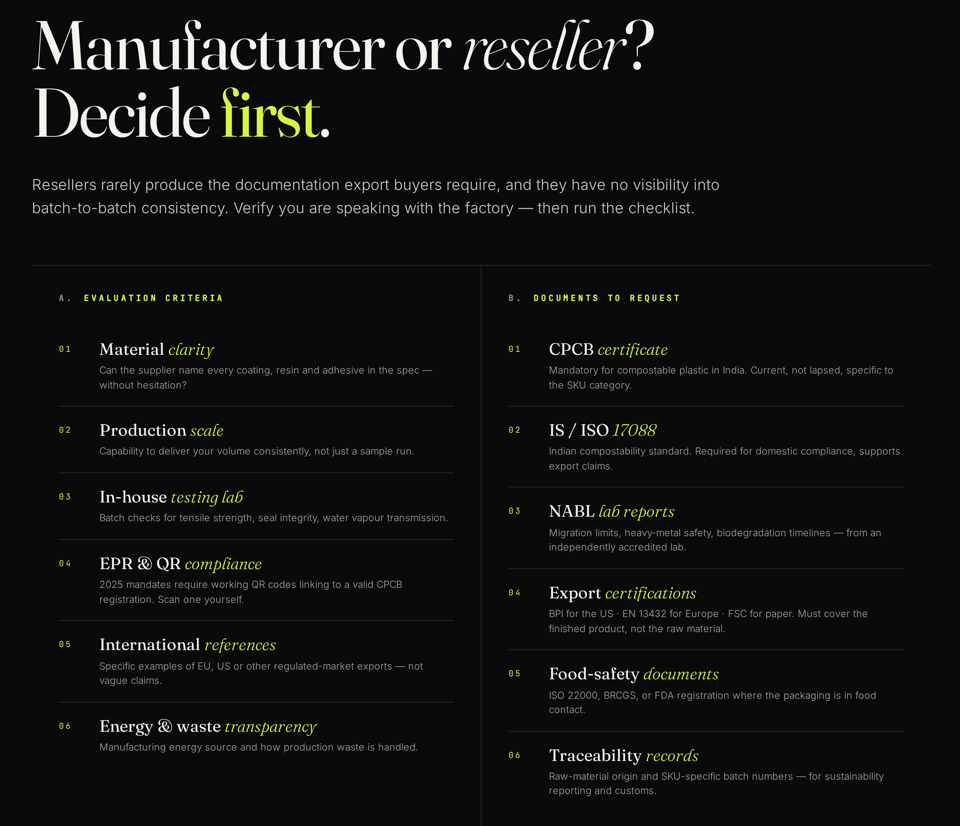
The single most important distinction to make early is manufacturer versus reseller. Resellers can rarely provide the documentation that export buyers require, and they have no visibility into batch-to-batch consistency. Always verify that you are speaking with the factory.
Beyond that, use this checklist when evaluating sustainable packaging companies in India:
- Material clarity. Can the supplier explain precisely what the packaging is made of, including every coating, resin, and adhesive?
- Production scale. Is the factory capable of producing at the volume you need consistently?
- In-house testing lab. Does the supplier have their own laboratory for batch testing? This covers tensile strength, seal integrity, and water vapour transmission.
- EPR and QR compliance. For plastic-based alternatives sold in India, suppliers are required under 2025 mandates to integrate QR codes that link to valid CPCB registrations. Ask to see a working example. Scan it yourself.
- International client references. Has the supplier exported to the EU, US, or other regulated markets? Ask for specific examples.
- Energy and waste transparency. What is the manufacturing energy source? How is production waste managed?
What Documents Should You Ask from a Sustainable Packaging Supplier?
Request the following from every supplier you are seriously evaluating:
- CPCB Certificate. This is mandatory for any supplier manufacturing or selling compostable plastic products in India. It should be current, not lapsed, and specific to the product category you are buying.
- IS/ISO 17088 alignment. This is the Indian standard for compostability. Verification that the product meets this standard is required for domestic compliance and supports export certification claims.
- NABL accredited lab reports. These should cover migration limits, heavy metal safety, and biodegradation timelines. NABL accreditation means the lab itself is independently verified.
- International certifications for export. Depending on your target market: BPI certification for the US, EN 13432 for Europe, and FSC for paper products. These must cover the finished product, not just the raw material.
- Food safety certificates. If the packaging is for food contact, you need ISO 22000, BRCGS, or FDA registration documentation confirming the materials are non-toxic and food-safe.
- Traceability records. Documentation showing the origin of raw materials and batch numbers for the specific SKU you are purchasing. This matters for your own sustainability reporting and for customs documentation in regulated markets.
How Do You Compare Price, MOQ, Lead Time, and Compliance Before Buying?
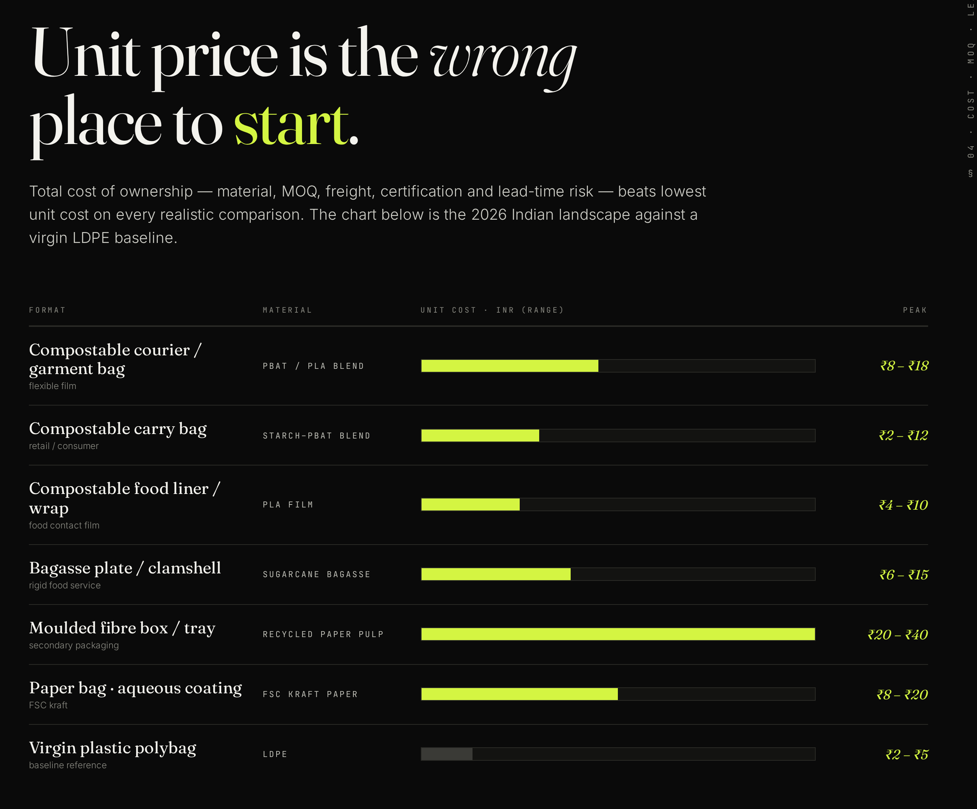
The instinct is to lead with unit price. That is usually the wrong starting point when evaluating eco-friendly packaging wholesale in India.
Here is the sustainable packaging cost landscape:
| Format | Material | Approximate Unit Cost (India) |
| Compostable courier / garment bag | PBAT or PLA blend film | Rs. 8 to Rs. 18 per unit |
| Compostable carry bag | Starch-PBAT blend | Rs. 2 to Rs. 12 per unit |
| Compostable food liner or wrap | PLA film | Rs. 4 to Rs. 10 per unit |
| Bagasse plate or clamshell | Sugarcane bagasse | Rs. 6 to Rs. 15 per unit |
| Moulded fibre box or tray | Recycled paper pulp | Rs. 20 to Rs. 40 per unit |
| Paper bag with aqueous coating | FSC kraft paper | Rs. 8 to Rs. 20 per unit |
| Virgin plastic polybag (baseline) | LDPE | Rs. 2 to Rs. 5 per unit |
On MOQ: local manufacturers for paper formats often offer tiered starting quantities at 100, 250, or 500 pieces. For eco-friendly packaging boxes in export volumes, a 20-foot container is typically the minimum to make freight viable.
On lead time: standard production for bulk orders takes three to four weeks. Simple unprinted items can be dispatched within seven to twenty-one days domestically.
FAQs: Sourcing Sustainable Packaging in India
Where can I buy eco-friendly packaging wholesale in India?
Leading manufacturers include KB Overseas in Gujarat for bagasse tableware, RudraX Eco Kraft in Karnataka for paper bags, and Murth for compostable flexible packaging including courier and garment bags. For biopolymer-based materials, Ukhi manufactures EcoGran and a range of waste-free alternatives.
How do I test sustainable packaging before placing a bulk order?
Request a sample kit and test it against your actual use conditions: heat, humidity, compression, and any food contact requirements. Ask for NABL accredited lab reports covering tensile strength, bursting strength, and water vapour transmission.
Are eco-friendly packaging boxes from India suitable for exports?
Yes, provided the supplier holds the right certifications for your target market. Top Indian exporters carry BPI for the US, EN 13432 for Europe, and FSC for paper products. Leading suppliers also offer shelf-ready customisation including food-grade vegetable-based inks, custom branding, and retail-ready formats.