
Europe is not asking merely exporters to simply “use sustainable packaging.”
It is asking a harder question. Can your packaging do the needful and survive a documentation check?
For this reason, it is important to understand the rules and regulations that govern compostable packaging for EU export compliance.
For Indian exporters, the safe answer is not “switch everything to compostable.” It is better to use certified compostable packaging in formats where it makes sense. This has to be followed up with the right certification, label, and buyer documentation.
In this article, we look at compostable packaging exports to Europe. We shall delve into every detail and discuss how to stay compliant with EU compostable packaging regulations.
Short answer: What compostable packaging should exporters use for Europe?
If you are exporting to Europe, the packaging must be compliant with the EN 13432 standard. Common materials include (but are not limited to) PLA, PBAT, and compostable packaging films made from cellulose.
The most practical starting point is inner packaging – garment bags, product sleeves, food-service wraps, liners, and more. These allow you to reduce conventional plastic use without changing the entire export pack.
As mentioned above, the packaging has to comply with EN 13432 certification. This means:
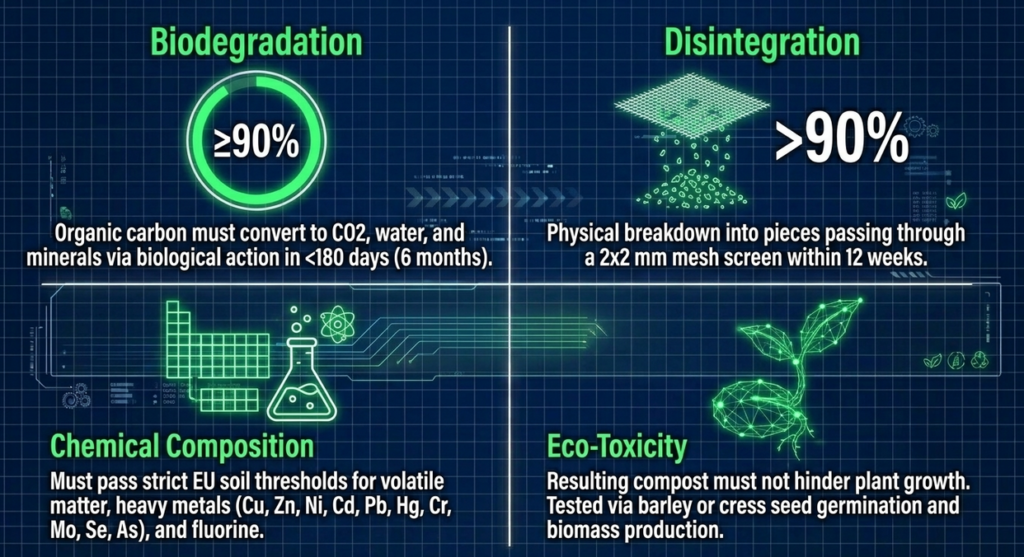
- It has to biodegrade into carbon dioxide and biomass.
- 90% of this conversion must happen within 180 days.
- After 12 weeks in organic compost, no more than 10% should remain.
- The fragments must not exceed 2mm in diameter.
- There must be no emission of heavy metals or ecotoxicity.
Note that if the resin from which the compostable packaging is made is certified, the finished product does not automatically qualify. The final packaging has to pass the requisite tests for EN 13432. Most exporters fail this criterion due to a misunderstanding of the legal provisions.
Once this is clear, the next question is format.
Packaging formats that fit EU export use cases
Not every export product needs the same packaging. A garment and a jewellery box face different risks. So, EU packaging compliance for exporters should begin with use cases.
Compostable garment bags for fashion and textile exports
Garments need inner bags that protect from dust, moisture, and warehouse handling. Compostable garment bags made from PLA and PBAT are a strong fit. They can replace conventional LDPE polybags without changing the workflow.
Compostable courier bags for lightweight e-commerce shipments
Courier and mailer bags are useful for lightweight D2C and retail shipments. In this case, opacity, tear strength, and return handling matter. Compostable mailers can have self-adhesive strips and a tamper-proof closure. These details matter because buyers not only evaluate the material but also check whether the pack works well in real life.
Compostable food-service packaging, liners, and wraps
Food-service packaging has a different reason to use compostable formats. The residue of food materials makes it difficult to recycle them. Compostable liners, wraps, sleeves, trays, and PLA-lined paper can make more sense. Sugarcane bagasse is widely used for trays, bowls, and clamshells because it is fibre-rich and rigid.
Compostable coated paper and clear film
Some brands prefer a paper-led format. Compostable coated paper works for paper bags, wraps, cups, and sleeves, where a compostable barrier replaces conventional PE lining. Others prefer transparent packaging because for garments and fashion accessories, visibility matters.
Next, the format choice needs to become a buying decision.
Decision matrix: Which EU export packaging format should you choose?
A good export packaging decision balances many factors. These include product fit, buyer expectation, and compliance risk.
| Export Use Case | Better Compostable Format | Why It Fits | What to Check Before Approval |
| Fashion and textiles | Compostable garment bag | Protects from dust, rubbing, and light moisture | EN 13432 scope, micron, sealing, clarity |
| Lightweight D2C | Compostable courier bag | Works for flexible, low-weight shipments | Tear strength, adhesive, return seal, print ink |
| Food-service | Bagasse, compostable wraps, and liners | Useful where food contamination limits recycling | Food-contact report, PFAS declaration, compostability certificate |
| Premium retail | Compostable coated paper | Gives paper feel with barrier function | Coating, window, adhesive, local disposal label |
| Visible product packaging | Clear compostable film | Allows barcode, product, and tag visibility | Industrial compostability, thickness, and heat sensitivity |
A commercial check is as important as a compliance check.
Exporters should confirm the MOQ, micron, sealing temperature, printing method, and lead time before promising any pack to a buyer. Certification can also depend on thickness. Some materials are certified only up to a specific micron. A thicker custom version may need separate approval.
Proper printing is also important. Water-based or non-toxic inks are usually preferred. The final printed pack has to remain within the scope of compostable packaging certification in Europe.
Compliance fit for compostable packaging export to Europe
The main compliance question is not whether a material sounds sustainable. It is whether the finished pack can have a legal and credible compostable packaging certification in Europe.
EN 13432 compostable packaging certification proves industrial compostability. As mentioned before, 90% of the material has to decompose into carbon dioxide and biomass within 180 days.
But even with EN 13432, exporters still need to consider wider EU compostable packaging regulations.
The EU Packaging and Packaging Waste Regulation is pushing packaging toward recyclability, traceability, and stronger producer responsibility. Even compostable packaging has to fit inside the wider packaging compliance norms.
Major European countries such as Germany, France, Belgium, Austria, and Italy each have different operational expectations.
European buyers may ask for:
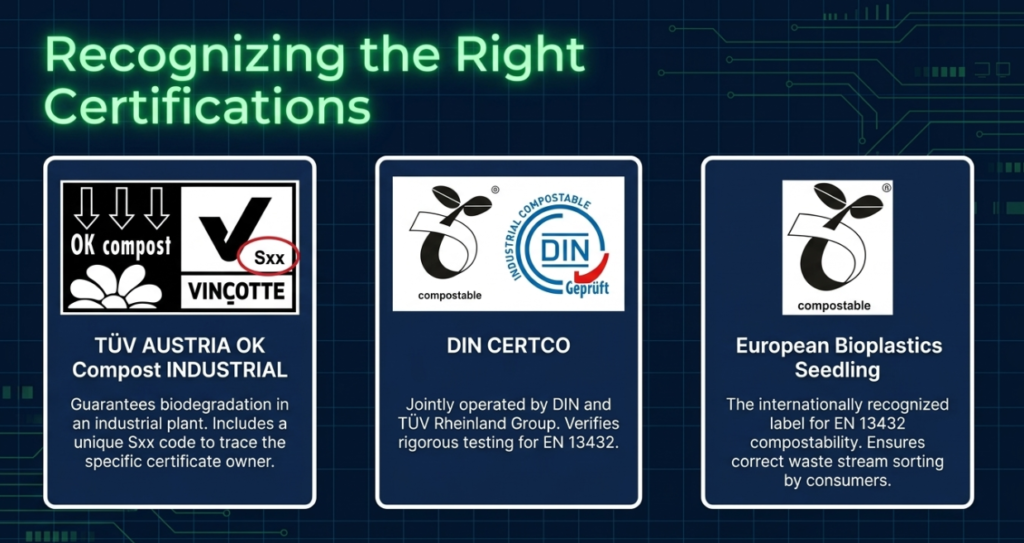
- EN 13432 or OK compost INDUSTRIAL certificate
- License number linked to the finished format
- Technical data sheet
- Safety data sheet
- Food-contact declaration where relevant
- Migration test report for food packaging
- PFAS-free declaration for food-service items
- Artwork proof with disposal instructions
- Certificate validity and scope
There are other aspects to be aware of – some European composting facilities have short treatment cycles. Because of this, they may send industrially compostable packaging to residual waste or incineration instead of accepting it in biowaste.
Thus, never assume that a single label works for all of Europe. The destination market and disposal route matter.
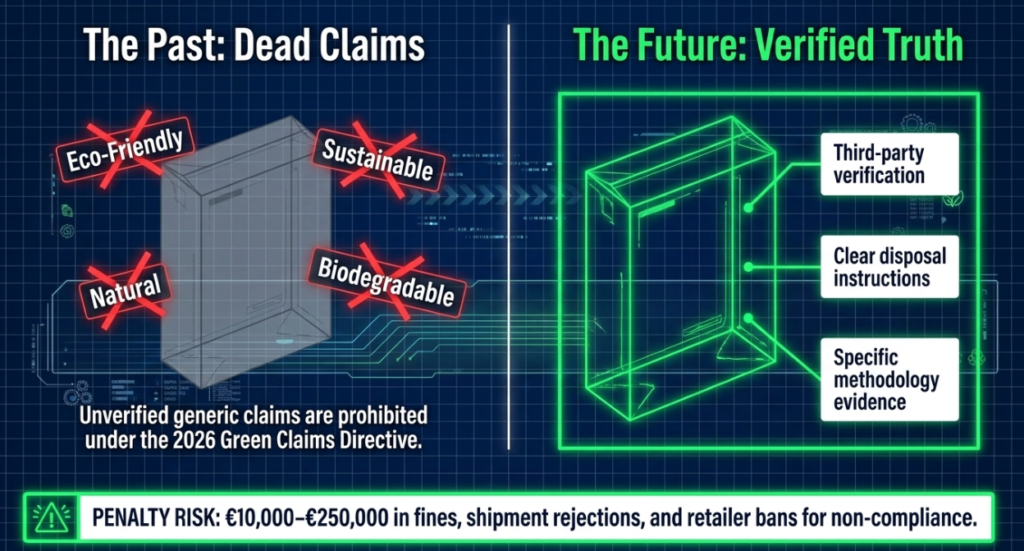
Also, avoid vague claims. Terms such as “eco-friendly,” “green plastic,” or “biodegradable” are risky because they do not explain time, temperature, and other parameters.
Now the compliance logic is clear. The final question is where this actually works.
Proof or real-world fit: where compostable packaging works best
Compostable packaging works best when the disposal story is believable.
A garment exporter replacing LDPE inner polybags with certified compostable garment bags can reduce conventional plastic use while keeping the same packing flow. This works when the bag protects the garment, seals properly, carries the right certification reference, and matches the European buyer’s packaging policy.
For food-service exports, bagasse trays, compostable sleeves, PLA-lined paper, and certified liners can support event, catering, takeaway, campus, stadium, and office systems where food and packaging are collected together.
For premium retail, compostable coated paper can work for cosmetics, gifting, lifestyle products, stationery, and dry retail items. The key check is whether the coating, window, adhesive, and print system are covered by certification.
Compostable packaging is not always the best EU export choice.
If the buyer’s market has strong mechanical recycling but weak composting acceptance, recyclable paper or mono-material plastic may be safer. For example, a mono-material PE mailer with recycled content may be easier to justify in some channels than a compostable mailer that will not be accepted in biowaste.
The best packaging decision is not the one with the nicest claim. It is the one that works across product protection, buyer approval, waste infrastructure, and documentation.
“For EU exports, compostable packaging should not be chosen only because it sounds sustainable. The right approach is to match the format to the product, confirm the EN 13432 scope, check the buyer’s disposal route, and keep the documents ready before bulk production. That is what reduces risk for exporters.” Vishal, Founder, Ukhi
Get EU-ready compostable packaging support from Ukhi
Ukhi offers a wide array of packaging formats that perfectly meet EU compostable packaging regulations.
Our range includes compostable garment bags, courier bags, clear films, coated paper formats, liners, sleeves, and more. We also manufacture state-of-the-art biopolymer granules.
To navigate shifting EU compostable packaging regulations, exporters must validate format, material grade, micron, sealing performance, printing requirement, certification scope, and buyer documents.
For compostable packaging export to Europe, this is the practical route.
Choose the right format. Verify the claim. Keep the documents ready. Then move to sampling, buyer approval, and RFQ with fewer surprises.
Frequently Asked Questions
Is EN 13432 mandatory for compostable packaging export to Europe?
Yes, it is mandatory. To market your product as compostable, it has to meet the EN 13432 standard. Remember, it is the baseline, and a particular country might have additional requirements.
Can Indian exporters use ASTM D6400 certification for Europe?
Though ASTM D6400 and the European EN 13432 are very similar, they are not interchangeable. To meet EU compostable packaging regulations, it is best to have products tested at reputed European labs like TÜV Austria or TÜV SÜD to meet European directives.
What documents do EU buyers ask for before approving compostable packaging?
To prove compostable packaging certification in Europe, you will have to provide:
- Compostability certificate
- License number
- Technical data sheet
- Safety data sheet
- PFAS-free declaration
Other documents might be necessary depending on the use case.
Can compostable packaging carry the same label in every EU country?
No, each country needs custom labels. This is because the different destination markets have varied disposal routes. For example, some might choose to incinerate instead of compost.
Is compostable packaging better than recyclable packaging for EU exports?
Compostable packaging works best where food contamination is an issue and buyer policy supports composting. If there are better facilities for recycling instead of composting recyclable paper might be a better option.