
Amazon sellers do not just need packaging that looks sustainable. They need packaging that survives warehouse handling, keeps products clean, passes Amazon checks, and still supports a credible environmental claim.
That is where compostable packaging gets interesting.
The best choice is rarely “the greenest sounding material.” It is the format that fits the product, the fulfilment route, and the approval rules. Once those three pieces line up, compostable packaging for Amazon sellers becomes a practical system, not a gamble.
Short answer: What compostable packaging should Amazon sellers use?
Amazon sellers have to use compostable packaging that matches both the fulfilment route and the product’s handling risk.
Match the packaging to the fulfilment route
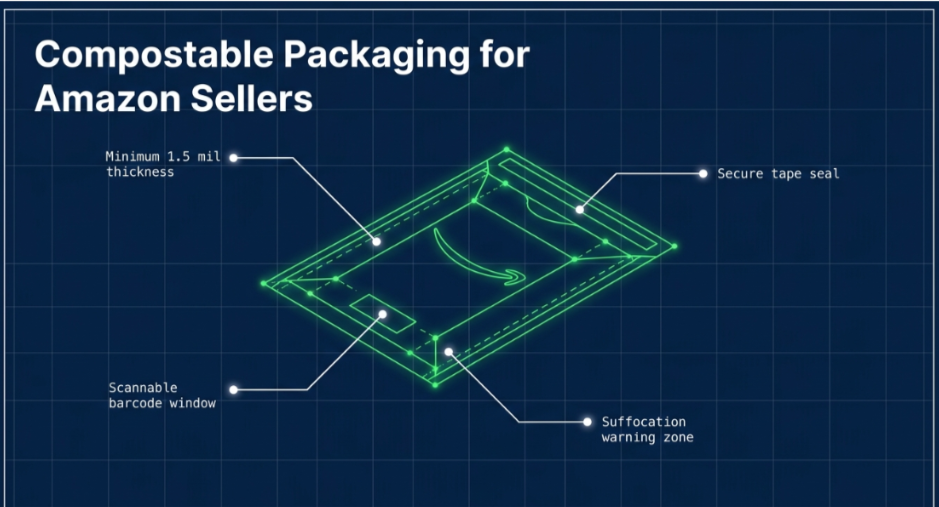
If the order is going through FBA, the packaging has to work inside Amazon’s warehouse process, not just on the customer’s doorstep. That means transparency for barcode reading, enough thickness to avoid tears, and clean sealing that holds during sorting and storage. Amazon guidance and seller references commonly point to a minimum thickness of 1.5 mil for poly bag style packaging, plus clear barcode visibility and proper sealing.
If the order is fulfilled by the merchant, there is usually more freedom in format. Even then, the packaging still has to protect the item across the full transit route. A package that looks good but fails in shipment is not sustainable. It is a waste.
Start with the product’s handling risk
The next question is simple. What can go wrong with the product in transit?
A soft garment does not need the same protection as a glass jar or a refill pouch. This is why compostable courier bags and compostable mailers for Amazon FBA are often the first formats sellers test. They can handle dust, moisture, and routine scuffing while staying lightweight and operationally simple. In many cases, bioplastic blends using PBAT and starch are used because they combine flexibility with puncture resistance.
Check Amazon requirements before final approval
The Amazon layer matters because even a good material can fail if the format breaks the rules.
Bags with an opening of 5 inches or larger need a suffocation warning. Packages also need to survive a basic drop test without bursting or damaging the contents. For sellers, this means that the claim on the material sheet is only the beginning. The real test is whether the finished pack works in the actual fulfilment flow.
Ukhi for Amazon seller packaging
This is where the buying logic becomes sharper. Ukhi looks at packaging as a complete system.
That means the exact format, the film grade, the seal structure, the print system, and the market claim all have to match. A package is only truly compostable if the finished item, not just the resin, is proven for the intended use. That is the standard sellers should hold themselves to.
Packaging formats that fit this use case
Once the basic rule is clear, the next step is choosing the right format. Different products need different structures, and that is where zero-waste packaging supplies for e-commerce become more useful than a single all-purpose option.
Compostable courier bags
These work well for apparel, soft goods, and routine D2C shipping. They are flexible, light, and easy to store. For Amazon sellers, they are useful when the goal is clean transit protection without excess weight. They are often made from compostable film blends that balance strength and flexibility.
Compostable mailers for Amazon FBA
These are a strong option when you need a bag-style format that still fits FBA handling. They help with SKU separation, product cleanliness, and simple prep workflows. The key is to ensure the bag is sealed properly, readable by barcode scanners, and sized so it does not create approval problems.
Compostable inner bags, sleeves, and garment bags
These are especially useful for apparel and textile products. They keep dust off the item, help with presentation, and can work as inner protection inside a larger shipper. For fashion sellers, this is often the most operationally sensible starting point.
Compostable pouches and sachets
For small items, refills, and sample packs, compostable pouches can be a clean solution. They are compact, easy to brand, and suitable for controlled content. In this category, the seller should pay close attention to seal strength and the final barrier performance.
Compostable wraps and coated paper formats
When the product needs wrapping rather than bagging, coated paper formats can do the job well. They give a more natural unboxing feel and can work alongside paper tape for a more complete zero-waste setup.
Compostable trays, inserts, and thermoformed packs
Rigid or semi-rigid formats are useful when the product needs structure. Molded fiber inserts or compostable trays hold items in place and reduce movement inside the box. That matters for premium packaging and fragile products alike.
Biodegradable bubble mailers and padded formats
Padded formats are often requested for fragile or semi-fragile items. But this is one area where language matters. Biodegradable bubble mailers are not automatically the same as compostable padded mailers. The seller has to verify what the cushioning layer is made from, how the whole structure breaks down, and whether the finished item supports the claim being made.
Compostable tapes, labels, and void fill
A compostable pack is only as strong as its supporting materials. Tapes, labels, and internal fill should be considered part of the system. Water-activated tape, paper labels, and starch-based void fill can help sellers build a cleaner packaging stack without creating a mixed-material problem.
To make this easier to compare, here is the decision logic in practical form.
| Amazon seller needs | Better compostable format | Why it fits | What to verify |
| Apparel and soft goods | Compostable courier bags or sleeves | Protects against dust and handling | Tear strength, barcode visibility, suffocation warning |
| FBA prep | Compostable mailers for Amazon FBA | Helps with SKU separation and prep | Amazon poly bag requirements, label placement |
| Cosmetics and wellness | Pouches, sleeves, inserts, or padded mailers | Balances presentation and protection | Seal strength, cushioning, and claim documents |
| Dry food or refills | Pouches or coated paper formats | Works for controlled dry-product packaging | Food-contact status and barrier needs |
| Fragile products | Padded mailers, inserts, trays, void fill | Adds cushioning and internal support | Drop test, puncture risk, mixed-material claims |
| Branded e-commerce orders | Printed mailers, sleeves, wraps, inserts | Supports unboxing and recall | Ink compatibility, MOQ, and compostability wording |
Compliance fit for Compostable Packaging
This is the section that prevents expensive mistakes. Good packaging is not enough if the claims are weak.
Amazon prep and poly bag checks
Never assume that a compostable bag can behave like a standard poly bag without any further checks. Sellers need to confirm thickness, sealing method, and fit. For Amazon, eco-friendly poly bags requirements still revolve around the same operational realities: the bag must protect the item, remain scannable, and not fail in transit.
Barcode readability, scannability, and label placement
Barcodes need a flat, readable surface. If the code is distorted, covered, or printed in a weak location, the package can be flagged. This is why transparency and layout matter as much as material choice. A compostable pack should make scanning easier, not harder.
Suffocation warning and product identification requirements
If the bag opening is 5 inches or more, the warning must be visible and properly placed. This is a small detail with a big operational impact. It is exactly the kind of thing that separates professional packaging from risky packaging.
Compostability certificates and supplier declarations
The claim has to be supported by proof for the finished item. Sellers should ask for certificate registry numbers, finished-item certification, and supplier declarations that cover thickness, ink, and adhesive. A resin certificate alone is not enough.
Difference between compostable, biodegradable, recyclable, and eco-friendly claims
These words are not interchangeable.
- Compostable means the material is intended to break down under defined conditions.
- Biodegradable is much broader and can often be misleading if used without context.
- Recyclable depends on actual collection and processing access.
- Eco-friendly is too broad to carry much weight on its own.
For sellers, the safest route is to use the most specific claim they can substantiate.
Proof or real-world fit for Compostable Packaging
Imagine an Amazon apparel seller switching from generic poly bags to compostable courier bags. The first pilot should not only test appearance. It should test seal strength, barcode scannability, warehouse handling, and customer unboxing.
If the pilot succeeds, the signs are practical:
- Fewer transit issues
- No prep surprises
- Clean storage in the warehouse
- No confusion around the claim
That is when the seller moves from samples to repeat procurement. Not because the packaging is trendy, but because it is stable, compliant, and easier to operate.
“Amazon sellers should not choose compostable packaging by material name alone. The right question is whether the format, film grade, thickness, ink system, fulfilment route, and claim documents all work together. A compostable courier bag, mailer, pouch, or sleeve only becomes a good choice when it performs in the real packing and delivery environment.”
Vishal, Founder, UKHI
Amazon sellers can start with a sample kit before moving to bulk procurement.
Share your product type, current packaging, SKU count, fulfilment route, target market, and monthly order volume. UKHI can help recommend the right grade and format across compostable mailers for Amazon FBA, compostable courier bags, sleeves, wraps, pouches, inserts, trays, and other zero-waste packaging supplies for e-commerce.
For faster procurement, use WhatsApp to discuss:
- Sample kit
- Grade recommendation
- MOQ
- Custom size
- Printing
- Lead time
- Certification documents
- Pilot order planning
Frequently asked questions
Are compostable courier bags more expensive than plastic mailers?
Usually, compostable courier bags are more expensive than plain plastic mailers. But the higher price is justified since many states in India have banned the use of thin plastics for packaging. Customers also prefer a brand that is sustainable.
Can Amazon sellers use compostable packaging for returns?
It is possible, but first you need to test the product. Return packaging needs to be sturdier since the product is unboxed and has expanded in volume. It also usually has stronger seals.
Are biodegradable bubble mailers suitable for premium products?
Biodegradable bubble mailers are perfect for lightweight, fragile products such as USB drives and similar small devices. But premium goods such as watches and perfume may still need inserts, trays, or box protection.
What should sellers tell customers about disposal?
Keep the instructions straightforward. Simply state whether the packaging is home compostable, industrial compostable, recyclable, or paper-based.
Can one supplier cover zero-waste packaging supplies for e-commerce?
Of course. A capable supplier can provide mailers, sleeves, labels, wraps, pouches, and void fill materials, thus giving you an end-to-end solution.