
Every order you ship is also a piece of your brand landing in someone’s hands.
It is often the only physical touchpoint most D2C brands ever get with their customer. And if what lands at their door is a thick, crinkly plastic mailer with no story to tell, that is a missed opportunity. That’s why it makes sense for Indian D2C brands to switch to sustainable courier bags. In fact, 64% of consumers say sustainability influences repeat purchase decisions.
Which leads us to…
Which is the right sustainable courier bag for your D2C brand
The short answer: Most D2C brands shipping soft goods, apparel, beauty products, or gifting items in India should be using either a compostable courier bag made from PBAT or a kraft paper mailer. Both the options are plastic-free, tamper-proof (when made well!) and compliant with India’s current plastic waste management rules. The choice comes down to the product weight and brand aesthetic.
Who this page is for
If you are shipping products in India and want to move away from conventional options without disrupting packing operations, this one is for you.
Specifically, this applies to:
- Fashion and apparel brands
Anyone shipping soft goods like T-shirts, co-ords, sarees, or accessories. If the product is light, the bag needs to be flexible and a premium look matters. Sustainable apparel packaging is one of the fastest-growing segments in Indian ecommerce right now.
- Beauty, wellness, and lifestyle brands
The customers are already thinking about ingredients, ethics, and environmental impact. Your packaging needs to match the brand promise.
- Subscription box and gifting brands
The unboxing moment is the product experience and eco-conscious brand packaging adds a layer of intentionality that customers share on social media.
Shipping heavy items above 3 kg, fragile goods, or liquids? The considerations are slightly different and you may need a hybrid solution. But for the typical D2C shipment, this guide covers the ground.
Sustainable courier bag formats that fit D2C courier needs
There are three formats worth knowing about. Each has a different material, a different performance profile, and a different ideal use case.
Option 1: Compostable PBAT mailers
They are the most widely used sustainable courier bags for Indian ecommerce. PBAT (Polybutylene Adipate Terephthalate) is a plant-derived polymer that behaves very much like conventional plastic film. It is flexible, tear-resistant, and waterproof. When blended with PLA (polylactic acid), it becomes slightly more rigid and easier to print on. These bags decompose in 90 to 180 days under industrial composting conditions. In normal landfill or soil conditions decomposition takes 12 to 18 months. They carry IS 17088 or EN 13432 certifications, which makes them legally compliant alternatives to plastic poly mailers under India’s Plastic Waste Management Rules. For most D2C brands, this is the default choice.
Option 2: Kraft paper mailers
They are fully plastic-free shipping bags made from virgin or recycled kraft paper. They are biodegradable, recyclable, and have a natural, premium look. This works well for fashion and gifting brands. The trade-off, however, is moisture resistance. A standard kraft paper mailer is not waterproof, so it is not suitable for monsoon shipping. Nor for products that cannot tolerate even minor humidity. Some manufacturers add a thin PE liner for water resistance, but that technically reintroduces plastic into the structure, which defeats the purpose. If you want a true plastic-free option, confirm with your supplier that the bag is unlined or uses a compostable inner coating.
Option 3: Tamper-proof paper courier bags
They are a variant of kraft mailers with a reinforced self-seal strip and sometimes a double adhesive flap. These are useful for brands where security at the last mile is a concern. It is especially useful for higher-value items like jewellery accessories or branded cosmetics. The tamper-evident seal shows visible damage if the bag is opened during transit, which reduces customer complaints about missing items.
How to choose the right plastic-free shipping bags: A format and material decision matrix
Choosing the right type of sustainable courier bag starts with understanding the strengths of each option. The quick comparison below will help you pick the right format for your needs.
| Feature | PBAT Compostable Mailer | Kraft Paper Mailer | Tamper-Proof Paper Bag |
| Water resistance | High | Low to medium | Low to medium |
| Tear resistance | High | Medium | Medium to high |
| Tamper-proof | Yes | Yes (with seal) | Yes (reinforced) |
| Custom print | Yes | Yes | Yes |
| Composting end-of-life | Industrial compostable | Biodegradable/Recyclable | Biodegradable/Recyclable |
| IS 17088 / CPCB compliant | Yes | Yes | Yes |
| Best for | Apparel, beauty, and most soft goods | Light fashion, gifting | Jewellery, accessories, and high-value soft goods |
| Typical thickness/weight | 50 to 80 microns | 100 to 120 GSM | 120 to 150 GSM |
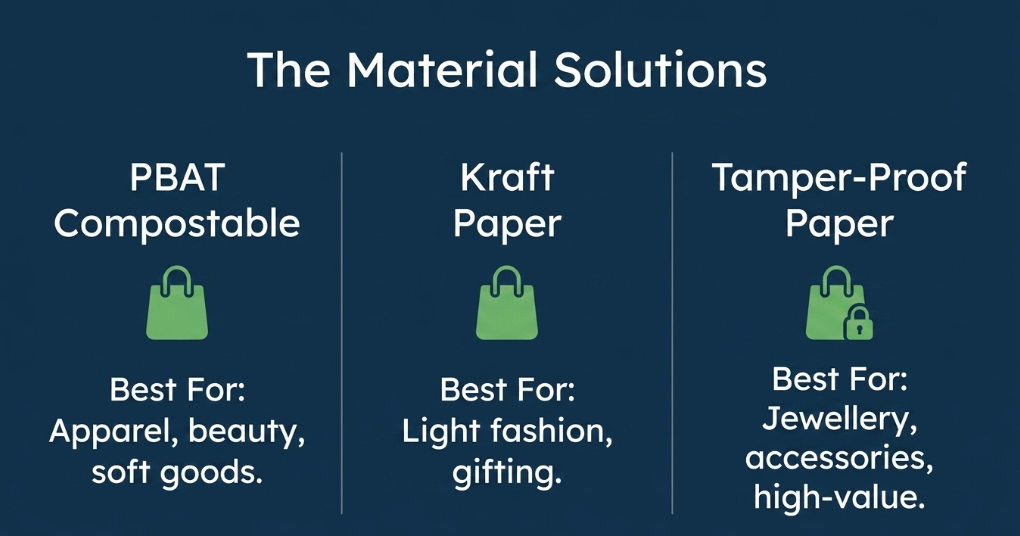
For most D2C brands,
- PBAT compostable mailer covers 80 to 90 percent of use cases.
- Kraft makes sense when your brand story is built around a natural, paper-first aesthetic.
- Tamper-proof paper variant is a niche pick for specific product types.
Before you make a decision, you should understand the compliance considerations too. It directly affects which of these options you can use and what claims you can make.
Compliance fit for Indian D2C brands
Sustainable ecommerce packaging is not just a marketing choice in India anymore. The Plastic Waste Management Rules restrict the use of single-use plastic packaging below 120 microns. Most conventional LDPE poly mailers fall below this threshold and are therefore non-compliant. As Vishal Vishal, Founder of UKHI, explains, “Compliance is becoming just as important as cost. Brands that switch to certified compostable packaging are not only making a sustainability choice, they are reducing future regulatory risk.“
That is why certification matters. IS 17088 is the Bureau of Indian Standards certification for compostable plastics. It is the primary standard the CPCB (Central Pollution Control Board) recognises. If your supplier’s biodegradable mailers carry this certification, you are on solid ground legally. EN 13432 is the European equivalent and is also widely accepted in India.
EPR, or Extended Producer Responsibility, is a separate obligation. Brand owners using plastic packaging above certain volumes need to register on the CPCB portal and meet annual collection targets. If you switch to certified compostable packaging, your EPR obligation reduces significantly. This is a real operational and financial benefit.
Making the switch to biodegradable mailers
When you switch from standard LDPE poly mailers to PBAT compostable courier bags, your per-unit cost is expected to go up by Re. 1 per bag.
However, here’s what else changes:
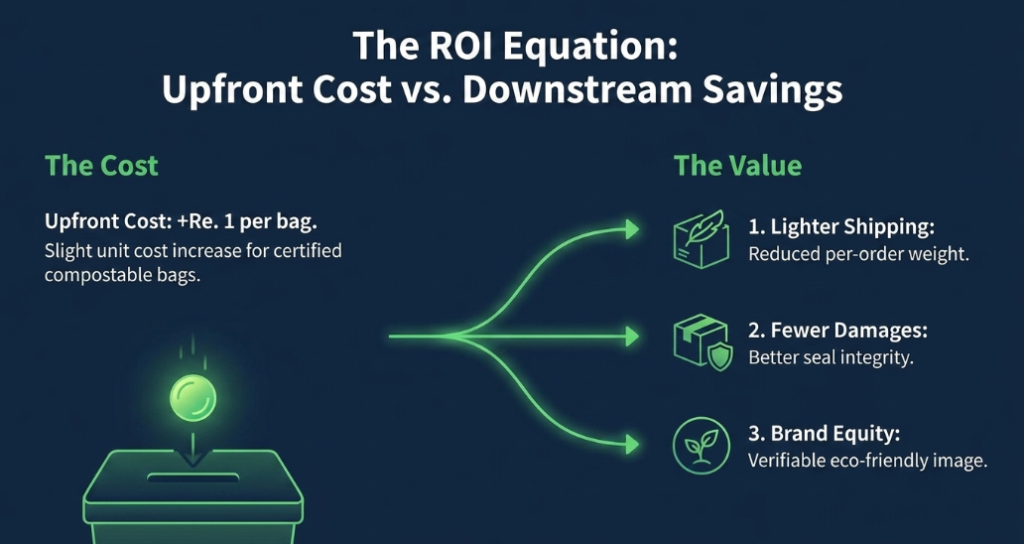
- Your shipping weight/order drops because PBAT bags are marginally lighter than LDPE
- Over six months, you see a reduction in customer complaints about packaging damage. That’s because the supplier-grade PBAT bags have better seal integrity than the generic poly mailers.
- Plus, compostable courier bags help you build an eco-friendly image for your brand.
So while it is not a dramatic overhaul, a well-executed switch to sustainable apparel packaging compounds into brand equity over time.
Want to know which grade and format is right for your order volume and product type? Talk to the UKHI team for a material recommendation or request a sample kit so you can make a well-informed switch.
FAQs
Do sustainable courier bags degrade on the shelf before I use them?
No. Sustainable and biodegradable delivery bags have a shelf life of 12-24 months in cool, dry storage conditions. Degradation is triggered by moisture, heat, and microbes which most warehouses prevent against.
Can compostable courier bags run through automated packing lines and conveyor systems without jamming?
Yes, in most cases. PBAT-based compostable courier bags have a similar surface finish and flexibility to conventional poly mailers. This means they run on standard packing equipment without modification. But make sure you request a sample and test it on your specific line before placing a bulk order.
What is the minimum order quantity for custom-printed sustainable courier bags?
MOQs vary by manufacturer, but typically range from 500 to 2,000 bags per size variant for standard orders. For fully custom-printed runs it might be 250 to 300 kg. Some manufacturers also do smaller sample runs at a higher per-unit cost.
Can I make a compostable packaging claim on my website and social media if I use these bags?
You can, provided your bags carry a valid IS 17088 or EN 13432 certification. Saying your packaging is “certified compostable” is accurate and defensible. Saying it is “home compostable” is only accurate if the certification covers home composting conditions. Eco-conscious brand packaging claims that are accurate and certification-backed are increasingly valuable as marketplace platforms begin auditing sustainability claims more carefully.