
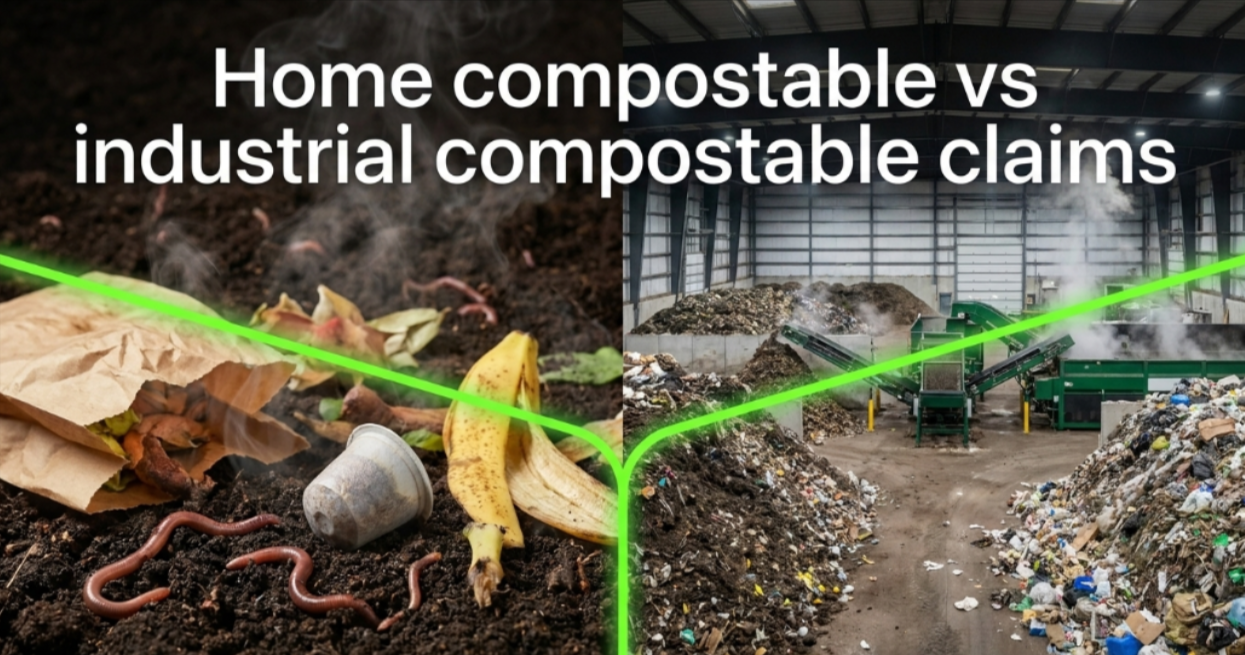
Pick up almost any piece of packaging today and there is a good chance it says “compostable.” The problem: two products can carry that word and need different conditions to break down. One works in a backyard bin. The other needs a managed industrial facility running at 60 degrees Celsius. Put the wrong one in the wrong place and it will sit there for years. Also, incorrect eco-friendly compostable packaging claim leads to a legal and commercial liability.
Understanding home compostable vs industrial compostable is essential for brands making packaging decisions.
What these claims actually mean?
“Compostable” tells you a material will break down into CO2, water, and biomass without toxic residue. But it does not tell you: where, at what temperature, and over what timeframe.
That’s why understanding the difference between home and industrial composting is important.
Home compostable
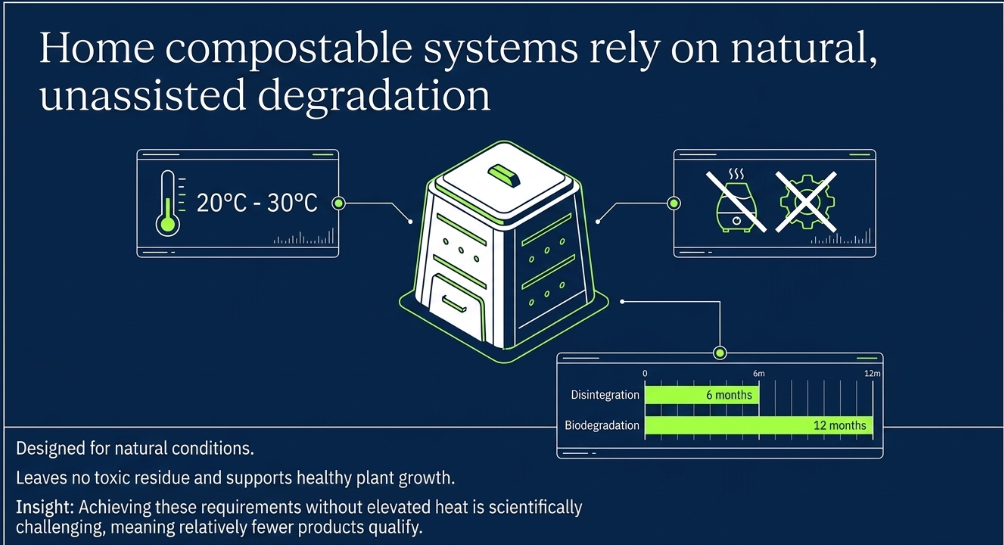
Home compostable packaging is designed to break down under natural composting conditions. These environments operate between 20°C – 30°C with no controlled humidity, forced aeration, or industrial machinery.
To earn home compostable certification, products must:
- Disintegrate within six months
- Biodegrade within twelve months
- Leave no toxic residue
- Produce compost that supports healthy plant growth
Achieving these requirements is challenging because the material must decompose without elevated temperatures. This is why relatively fewer products qualify for home composting certification.
Industrial compostable
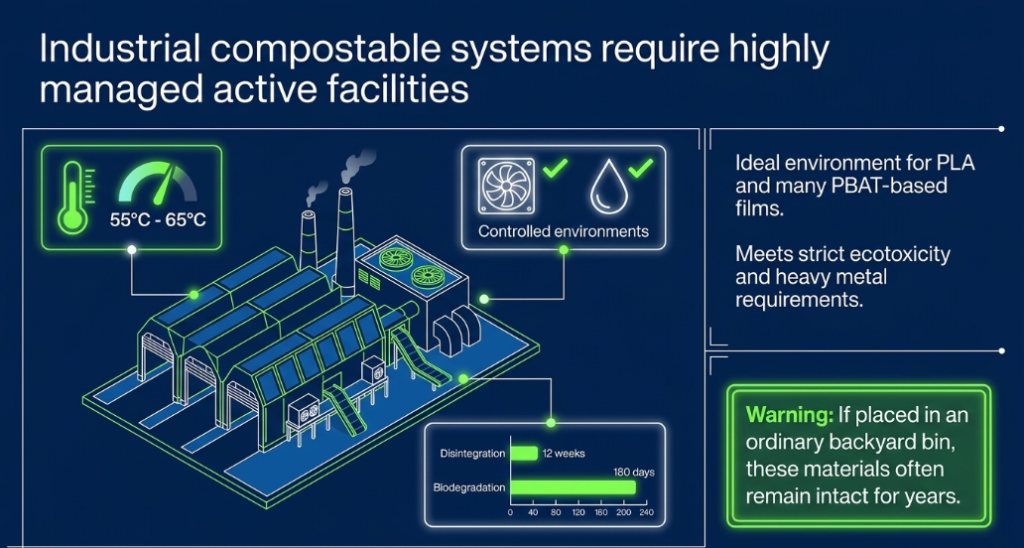
Industrial compostable packaging is designed for commercial composting facilities that maintain controlled conditions. That includes temperatures of 55°C – 65°C, consistent moisture levels, and mechanical aeration.
Under these conditions, certified materials must:
- Disintegrate within approximately twelve weeks.
- Reach at least 90% biodegradation within 180 days.
- Meet strict ecotoxicity and heavy metal requirements.
Materials such as PLA and many PBAT-based films perform well in industrial systems. But if put in ordinary backyard compost bins, industrial compostable packaging materials often remain intact for years.
Home compostable vs industrial compostable at a glance
Here’s a quick roundup of the difference between home and industrial composting
| Feature | Home Compostable | Industrial Compostable |
| Temperature | 20–30°C | 55–65°C |
| Disintegration | Within 6 months | Within 12 weeks |
| Biodegradation | Within 12 months | Within 180 days |
| Primary Certifications | OK Compost HOME, AS 5810 | EN 13432, ASTM D6400, BPI |
| Required Infrastructure | Home compost bins | Commercial composting facilities |
Certifications and testing standards
Rather than relying on marketing language, certifications verify whether compostable packaging performs under specific composting conditions.
The two most recognised certifications from TÜV Austria are:
- OK Compost HOME certifies products that break down under home composting conditions.
- OK Compost INDUSTRIAL certifies products intended for commercial composting facilities.
A product carrying only the industrial certification cannot be promoted as home compostable.
Several international standards also govern compostable packaging.
- EN 13432 is the European benchmark for industrial compostability
- ASTM D6400 is widely used throughout North America
- ISO 17088 establishes international specifications for compostable plastics
- AS 5810 is Australia’s recognised home compostability standard
- BPI Certification verifies compliance with ASTM standards while also screening for PFAS limits
Although the standards differ slightly, most evaluate the same technical criteria:
- Biodegradation
- Disintegration
- Ecotoxicity
- Heavy metal content
Labs verify that at least 90% of the material converts into carbon dioxide within the prescribed timeframe. Remaining fragments must become smaller than 2 mm. And the finished compost must remain safe for plant growth without exceeding heavy metal limits.
However, certification alone is not enough.
As Vishal Vivek, Co-founder of Ukhi explains,
“Certification demonstrates that packaging performs under the conditions it was tested for. It does not guarantee positive environmental outcomes if composting infrastructure does not exist. You should, therefore, check both certification and destination market before making sustainability claims.”
Infrastructure makes all the difference
Packaging certified under EN 13432 performs well where industrial composting facilities are available. But it may deliver little environmental benefit in markets with limited composting infrastructure. Likewise, home compostable packaging offers little value if customers dispose of waste through municipal collection systems that send everything to landfill.
This is why selecting certified compostable packaging requires understanding the disposal systems too.
What certification do you need?
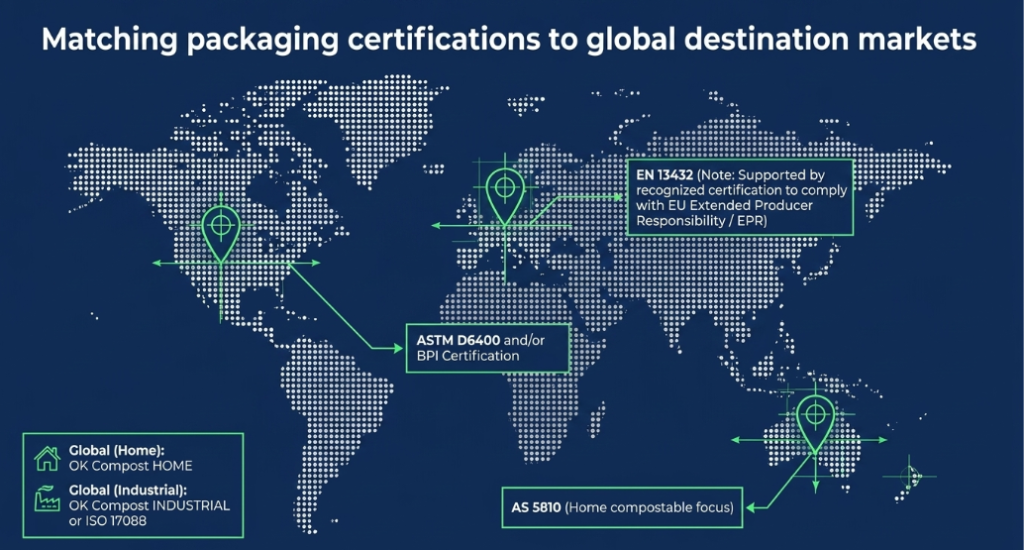
The right compostability certification depends on where your packaging will be sold. There is no single certification accepted worldwide.
| Market or Situation | Recommended Certification |
|---|---|
| Selling within the European Union | EN 13432 |
| Selling in the United States | ASTM D6400 and/or BPI Certification |
| Selling in Canada | ASTM D6400 and BPI Certification |
| Selling in Australia or New Zealand (home compostable products) | AS 5810 |
| Products marketed as home compostable globally | OK Compost HOME |
| Products marketed as industrial compostable globally | OK Compost INDUSTRIAL or ISO 17088 (where applicable) |
| Exporting to multiple regions | Dual certification (e.g., EN 13432 + ASTM D6400/BPI) |
For businesses selling into Europe, certification is only one part of compliance. Under the EU’s Extended Producer Responsibility (EPR) regulations, producers must
- Register in every country where they place packaging on the market
- Contribute towards the management of packaging waste.
In several member states, compostable packaging qualifies for preferential treatment. But only when the claim is supported by recognised certification. Uncertified or unverifiable compostability claims attract regulatory scrutiny or allegations of greenwashing.
How to avoid accidental greenwashing
Businesses often assume that every compostable product performs the same way. Or that certification automatically guarantees environmental benefit. That leads to greenwashing which can be detrimental for your brand and business.
The safest approach is to:
- Request documentation that identifies the product you are purchasing.
- Ensure the certificate lists the formulation, thickness range, and applicable certification standard.
- Verify if your eco-friendly compostable packaging matches your intended market.
Finally, avoid broad sustainability claims unless they can be verified.
Choose the right compostable packaging for your market
Getting compostable packaging right requires more than a green label. You need certified material and verified infrastructure in your target market. That’s what gives you the confidence that the claim will actually hold up. At Ukhi, we help buyers and brands navigate this landscape. Request certified compostable packaging samples by reaching out to us on WhatsApp. Plus, get recommendations from our experts to ensure your packaging is compliant. The wrong decision costs you in liability and brand reputation. The right one differentiates your product and demonstrates genuine commitment to sustainability.
Sources and References
- TÜV Austria: OK Compost HOME and OK Compost INDUSTRIAL certification programs
- European Bioplastics: EN 13432 standard
- ASTM International: ASTM D6400 standard specification
- Biodegradable Products Institute (BPI): certification program and PFAS policy
- ISO 17088: specifications for compostable plastics
- FTC Green Guides: environmental marketing guidance
- California AB 1201: compostable and biodegradable labeling restrictions
- EU Green Claims Directive: environmental marketing substantiation
- Standards Australia: AS 5810 home composting standard
FAQs
Does compostable packaging break down in a landfill?
No. This is one of the most persistent misconceptions around certified compostable claims. Landfills are anaerobic (no oxygen), while composting requires aerobic conditions. In a landfill, most compostable materials degrade extremely slowly. They can also produce methane in the process, which is harmful for the environment.
Is a supplier’s compostability certificate tied to the factory or to the specific product?
It is tied to the specific product. Compostable packaging suppliers sometimes present factory-level certificates. But EN 13432 and ASTM D6400 certifications are issued to a defined product, a specific formulation, thickness range, and print coverage. If a buyer changes the gauge, adds a coating, or adjusts the blend, the certificate no longer applies. Always request a certificate that names the exact product you are ordering.
If a supplier shows a TÜV Austria certificate, how do I verify it is current and applies to my product?
Every TÜV AUSTRIA OK Compost certificate carries a unique license number. Check it directly in the TÜV Austria certification database. Verify three things:
- The license number matches the product you are ordering,
- The certificate has not expired (most run for three years and require renewal), and
- The mark shown (HOME or INDUSTRIAL) matches the actual claim being made.
A certificate on a brochure is not the same as a certificate issued for your exact item.