
Quick Answer
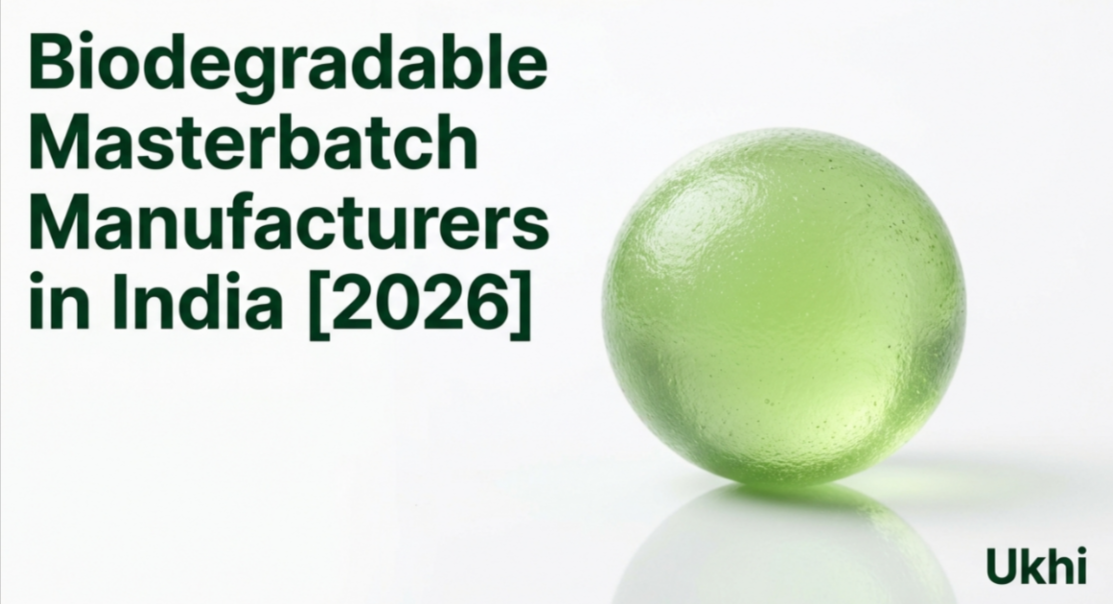
Biodegradable masterbatch is a concentrated blend of pigments or functional additives dispersed in a compostable carrier resin such as PLA or PBAT. Converters in India use biodegradable masterbatch to manufacture carry bags, food trays, cutlery, garment covers, mulch films, and other compostable end products. When sourcing biodegradable and compostable masterbatch manufacturers in India, procurement teams should verify CPCB certification, IS/ISO 17088 test reports from CIPET, carrier resin compatibility with their base polymer, and whether the biodegradable and compostable masterbatch supplier manufactures resin in-house or trades third-party material. UKHI manufactures its compostable biopolymer resin, EcoGran, in-house at our facility in Faridabad, Haryana, and supplies masterbatch grades for blown film, injection moulding, thermoforming, profile extrusion, cast film, and extrusion coating.
What to Look for in a Biodegradable Masterbatch Supplier in India
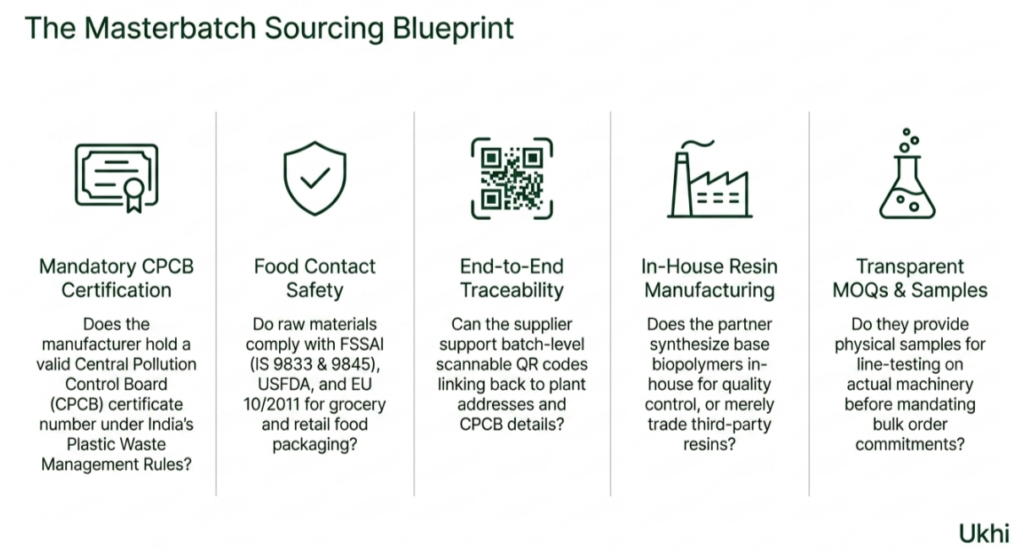
Procurement teams sourcing biodegradable and compostable masterbatch in India need to check five things before shortlisting a supplier.
CPCB certificate
Under India’s Plastic Waste Management Rules, any company manufacturing or selling compostable or biodegradable plastics in India must hold a valid certificate from the Central Pollution Control Board. Buyers should ask for the certificate number and verify it on the CPCB public portal.
Lab test reports for compostability
The supplier’s masterbatch must be tested and certified under IS/ISO 17088, which is the Indian standard for compostable plastics. The test reports should come from CIPET or another NABL-accredited laboratory. Buyers sourcing biodegradable masterbatch for packaging that will also be exported should check whether the supplier holds EN 13432 (Europe) or ASTM D6400 (USA) certifications for those specific grades.
Food-contact safety
If the masterbatch will be used to manufacture grocery bags, food trays, cutlery, or any product that touches food, the raw materials must comply with FSSAI standards (IS 9833 for colorants and IS 9845 for migration safety). International buyers may also require USFDA or EU 10/2011 compliance.
In-house resin manufacturing.
Many biodegradable and compostable masterbatch suppliers in India purchase base biopolymers from third parties and only compound or convert them. A supplier that manufactures its own resin controls batch-to-batch consistency, can customise formulations for specific machinery, and provides full traceability from granule to finished product. We at UKHI manufacture our EcoGran resin in-house, which is why we can offer custom grades across six processing methods.
Samples before bulk orders
Biodegradable resins behave differently from conventional plastics on the processing line. A credible biodegradable masterbatch supplier in India should ship physical samples so the converter can trial them on actual machinery before committing to a bulk order.
Key Specifications When Buying Biodegradable Masterbatch
Converters evaluating biodegradable and compostable masterbatch need to verify several physical and chemical properties before placing an order.
Carrier resin compatibility
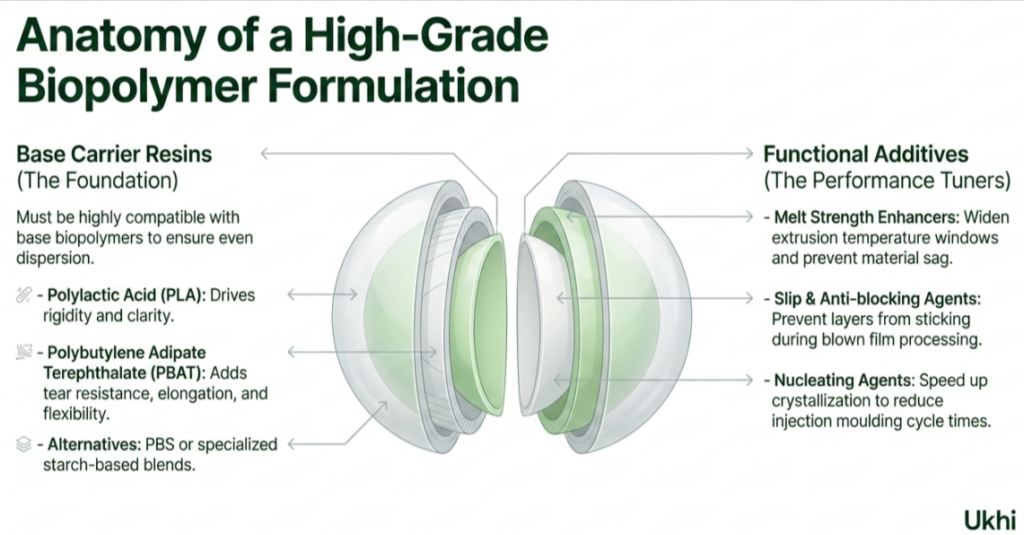
A biodegradable masterbatch is a concentrated mixture of pigments or additives dispersed in a carrier resin. The carrier resin (commonly PLA) must be compatible with the converter’s base biopolymer, whether that is PLA, PBAT, PBS, or a starch-based blend.
PLA and PBAT blend ratio
For blown film applications, blends of Polylactic Acid (PLA) and Polybutylene Adipate Terephthalate (PBAT) are standard. PLA contributes rigidity and optical clarity. PBAT adds tear resistance, elongation, and flexibility. Common blend ratios are 60/40 or 70/30 PBAT to PLA.
Tensile strength and elongation
Buyers should target a tensile strength of 15 to 35 MPa and elongation at break of 500% to 800%. These ranges ensure that compostable masterbatch for blown film applications will resist tearing under normal handling and packing loads.
Moisture sensitivity
Biodegradable resins are highly moisture-sensitive. Granules must be pre-dried at around 80 degrees C for several hours to bring moisture content below 250 ppm before processing. Failure to dry properly causes viscosity degradation during extrusion.
Functional additives
Depending on the end product, converters may need masterbatches containing melt strength enhancers (to widen the extrusion temperature window), slip and anti-blocking agents, optical brighteners, antistatic agents, or nucleating agents to speed up injection moulding cycle times.
Manufacturing Processes That Use Biodegradable Masterbatch
Biodegradable and compostable masterbatch granules are designed to run on standard thermoplastic processing machinery. Converters do not need to purchase new equipment. The table below maps each process to the end products it produces.
| Manufacturing Process | End Products Made with Biodegradable Masterbatch |
| Blown film extrusion | Retail carry bags, garment covers, garbage bags, mulch films, courier bags, shrink wrap |
| Cast film extrusion | Cling film, shrink wrap, heat-seal film, lamination coatings |
| Injection moulding | Cups, spoons, forks, knives, plates, closures |
| Thermoforming | Meal trays, food trays, clamshell containers, disposable glasses, lids |
| Profile extrusion | Drinking straws (straight and bendable), tubes, clips |
| Extrusion coating | Coated paper cups, sandwich wraps, snack pouches |
Converters sourcing PLA PBAT masterbatch in India for blown film lines should note that this is the highest-volume process for biodegradable masterbatch. Injection moulding formulations require higher melt-flow properties and nucleating masterbatches to reduce cycle times. Thermoforming applications frequently use melt strength enhancing masterbatches to keep thin sheets stable during forming.
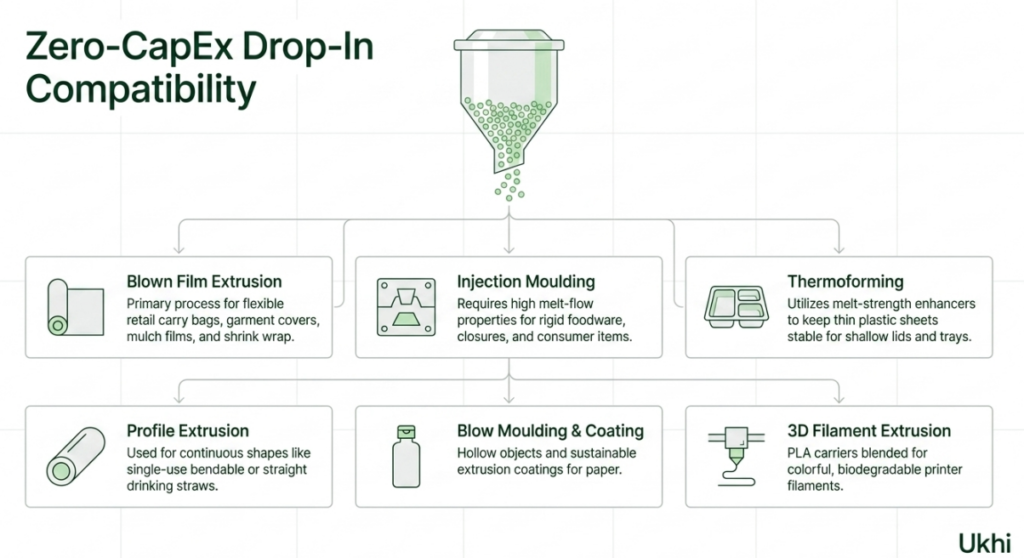
Our EcoGran resin is compatible with all six processes listed above, and we supply grades specifically formulated for each one.
Certifications and Compliance for Biodegradable Masterbatch Manufacturers in India
Any biodegradable masterbatch manufacturer in India must clear a defined regulatory stack.
CPCB registration
Manufacturers apply via Form-A (for production facilities with state SPCB/PCC consent for air and water operations). Authorised sellers and traders apply via Form-B. The CPCB certificate number should be verifiable on the board’s public portal.
IS/ISO 17088:2021
This is the core Indian standard for compostable plastics.
IS 17899 T:2022
This is the standard for biodegradable plastics specifically and it covers environmental breakdown parameters distinct from industrial composting.
QR code traceability
Every compliant compostable end product sold in India must carry a scannable QR code linking to the manufacturer’s name, plant address, and CPCB certificate details.
UKHI holds IS/ISO 17088 certification, CIPET test reports, FSSAI certification for food-contact products, ISO 9001 (quality management), ISO 14001 (environmental management), and GMP certification. We are MSME registered and Halal certified.
How Much Does Biodegradable Masterbatch Cost in India?
The price of biodegradable masterbatch in India varies widely depending on the type, composition, and order volume. The table below shows the main pricing segments as of 2026.
| Masterbatch Category | Price Range (₹ per kg) | Typical Use |
| Basic biodegradable fillers and concentrates | ₹50 to ₹120 | Starch-based or calcium carbonate filler grades used to reduce material cost |
| Standard PBAT/PLA filler masterbatches | ₹120 to ₹250 | PBAT-based or standard compostable masterbatch granules for general-purpose film and moulding |
| Colour masterbatch for biodegradable plastics | ₹200 to ₹350 | Food-safe, compostable pigments in PLA or PBAT carriers |
| Standard white and black PLA masterbatches | ₹180 to ₹320 | Coated TiO2 or carbon black dispersed in a PLA carrier for films and moulded products |
| High-performance additive masterbatches | ₹300 to ₹450 | Melt strength enhancers, impact modifiers, optical brighteners, slip and anti-blocking agents |
| Custom biodegradable masterbatch formulations | ₹500 and above | Tailored multi-functional formulations developed for specific machinery and product specs |
Why Buy Biodegradable and Compostable Masterbatch from UKHI
We manufacture the resin in-house
UKHI is a material science company, not a trader. Our EcoGran resin is designed, compounded, and manufactured within our own facility in Faridabad, Haryana. This gives us full control over batch consistency and formulation customisation.
EcoGran runs on existing machinery
Our compostable masterbatch granules are drop-in compatible with standard blown film, cast film, profile extrusion, injection moulding, thermoforming, and extrusion coating lines. Converters do not need to invest in new equipment or modify existing setups.
We hold the certifications that matter
UKHI is certified under IS/ISO 17088, tested by CIPET, FSSAI certified for food-contact applications, and operates under ISO 9001, ISO 14001, and GMP standards.
Our pricing works at the finished-product level
EcoGran is formulated to be cost-competitive with conventional plastics.
Procurement teams and converters who want to evaluate EcoGran biodegradable and compostable masterbatch on their own processing lines can request a free sample. We ship within 7 days at no cost.
FAQs
1. What is the minimum order quantity for biodegradable masterbatch in India?
Most biodegradable masterbatch manufacturers in India set minimum order quantities between 25 kg and 100 kg per grade.
2. Can biodegradable masterbatch be used for 3D printing filaments?
Yes. Biodegradable masterbatch with a PLA carrier resin can be blended into PLA filament during extrusion to produce coloured, compostable 3D printing filaments suitable for prototyping and consumer products.
3. How should biodegradable masterbatch granules be stored?
Biodegradable masterbatch granules should be stored in sealed, moisture-proof packaging in a cool, dry area away from direct sunlight. Shelf life under proper storage is typically 6 to 12 months.
4. Does biodegradable masterbatch affect the colour or clarity of finished compostable products?
Colour masterbatch for biodegradable plastics is available in a full range of shades without affecting compostability.
5. What is the difference between biodegradable masterbatch and compostable masterbatch?
Biodegradable masterbatch breaks down naturally over time, but the timeframe and conditions are not always defined. Compostable masterbatch certified under IS/ISO 17088 must fully biodegrade within 180 days under controlled industrial composting conditions and pass ecotoxicity limits.