
![Biodegradable and Compostable Garbage Bags — Manufacturers in India [2026]](https://ukhi.com/wp-content/uploads/2026/09/Biodegradable-and-Compostable-Garbage-Bags-—-Manufacturers-in-India-2026.png)
Quick Answer
UKHI manufactures compostable and biodegradable garbage bags in India for home kitchens, offices, retail chains, hotels, and industrial use. The bags are made from an in-house PLA, PBAT, and corn starch blend called EcoGran, in thicknesses from 15 to 60 microns depending on load. All bags are CPCB certified and tested under IS/ISO 17088 at CIPET. Wholesale rates run ₹125 to ₹350 per kg. Existing buyers include Reliance Retail, Amazon, Aditya Birla Group, and V-Mart. Free samples of bags or granules ship within 7 days.
What to Look for in a Compostable Garbage Bag Supplier in India
Buyers evaluating biodegradable and compostable garbage bags manufacturers in India should check five things before placing an order.
CPCB certification
The first is CPCB certification. Under the Plastic Waste Management Rules, every biodegradable and compostable garbage bags manufacturer in India must hold a valid certificate from the Central Pollution Control Board.
Quality Control
Biopolymers are more sensitive to processing conditions than conventional plastics, so film thickness, seal strength, and roll winding can drift between batches if the manufacturer is not testing every run. Ask what the compostable garbage bag supplier measures per batch and whether they share the QC report.
Production capacity and resin supply
A compostable garbage bag supplier who buys resin from a third party is exposed to price and availability shocks. Ask where the resin comes from and what monthly capacity the plant runs at.
Customisation
Biodegradable and compostable garbage bags manufacturers in India should be able to adjust bag size, thickness, colour, and printing to fit the buyer’s bin dimensions and brand. This matters more for retail and hospitality buyers than for institutional buyers, but it is worth confirming upfront.
Pre-production samples
Any compostable garbage bag supplier should send physical samples before an order is confirmed. At UKHI, we ship samples of both EcoGran resin and finished bags within 7 days at no cost, so the buyer can check the feel, seal, and load capacity before committing to volume.
Specifications That Matter When Buying Biodegradable Garbage Bags
The specifications a buyer needs to check depend on where the bag will be used. Biodegradable garbage bags for home use in kitchens need a different thickness from industrial compostable garbage bags in India used in hotels, factories, and municipal collection.
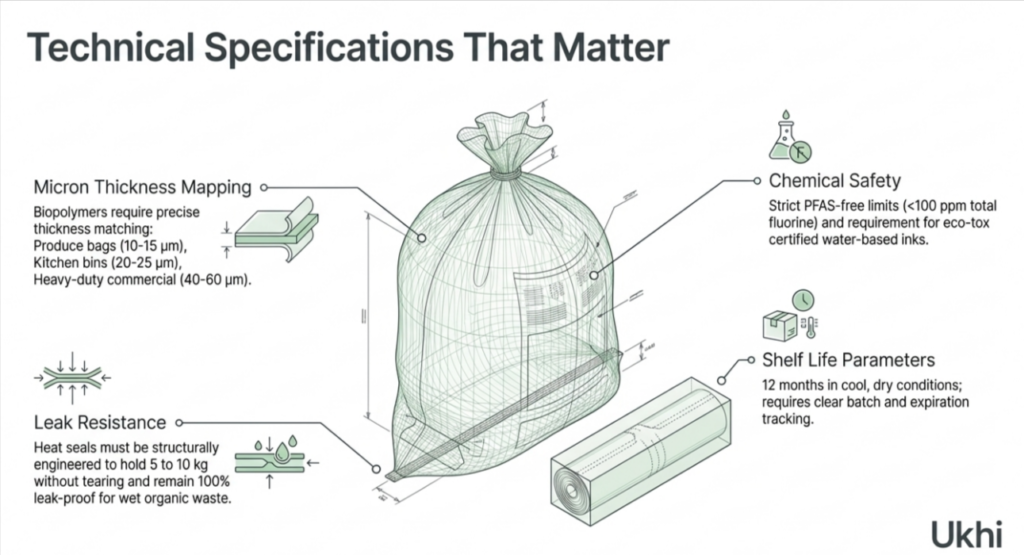
Thickness
Compostable film is slightly less strong per micron than conventional polyethylene, so a like-for-like replacement usually needs a small increase in gauge. The table below covers the common ranges.
| Application | Thickness Range | Typical Load Capacity |
| Small caddy liners (home kitchen) | 15 to 20 microns | 3 to 5 kg |
| Standard kitchen bin liners | 20 to 25 microns | 5 to 8 kg |
| Medium garbage bags (office, retail) | 25 to 35 microns | 8 to 12 kg |
| Heavy-duty industrial bags | 40 to 60 microns | 15 to 25 kg |
Seal strength
The bottom seal is where most bag failures happen, especially when the bag holds wet food waste. The seal must hold without splitting when the bag is filled and lifted.
Shelf life
Compostable bags are organic and slowly degrade even in storage. The usual shelf life is about 12 months when the bags are kept cool, dry, and out of direct sunlight. Batch numbers and manufacture dates should be printed on the packaging.
Chemical safety
It matters most for buyers whose bags will contact food waste. The inks should be water based and free of heavy metals, and the compostable garbage bag supplier should be able to declare the bags PFAS-free.
Materials and Manufacturing Process Used for Biodegradable Garbage Bags
Materials
Biodegradable and compostable garbage bags manufacturers in India in Indiain India almost never usesuse a single raw material. The finished bag is a blend, because each biopolymer contributes something the others cannot.
- The three main ingredients are PLA, PBAT, and starch. PLA (polylactic acid) is made by fermenting plant sugars from corn starch, sugarcane, or cassava. It gives the bag its stiffness and body.
- PBAT is a flexible polymer that gives the bag its stretch, tear resistance, and load-bearing strength.
- Starch, usually from corn, is added as a filler to speed up composting and reduce material cost. A typical formulation for garbage bags is roughly 60 to 80 percent PBAT, 15 to 30 percent PLA, and up to 20 percent starch.
Process
The manufacturing process has four steps.
- Compounding is where the raw granules are melted, mixed with additives, and pelletised into a uniform resin. At UKHI, this step happens in-house and the resulting resin is sold under the brand name EcoGran.
- Blown film extrusion melts the resin and blows it into a continuous tube of film. The thickness is controlled by the die gap, the blow-up ratio, and the cooling rate. This is the step where the final gauge of the bag is set.
- Flexographic printing adds any branding, batch codes, and the compostable logo onto the film. Water-based inks are used so nothing toxic leaches into the compost.
- Cutting and sealing converts the printed film into finished bags. The bottom seam is heat-sealed and this is the quality control checkpoint that decides whether the bag will leak.
EcoGran is designed to run on the same blown film machinery that converters already use for conventional plastic, so converters do not need to buy new equipment.
Certifications and Compliance to Look for in a Biodegradable Garbage Bag Manufacturer
Certifications separate a genuine biodegradable and compostable garbage bags manufacturer in India from a supplier making unverified claims.
- CPCB certification is mandatory. Without it, the manufacturer is not legally allowed to sell compostable plastic products in India.
- IS/ISO 17088 is the Indian national standard for compostable plastics. It tests four things: chemical safety, biodegradation of at least 90 percent within 180 days, physical disintegration within 12 weeks, and ecotoxicity on plants and earthworms.
- IS 17899 T:2022 is the Indian standard for biodegradable plastics.
- CIPET testing is what most Indian buyers ask for as proof. CIPET is a government body and is one of the NABL-accredited labs that Indian regulators recognise.
- State Pollution Control Board consent confirms the factory is legally allowed to operate.
UKHI holds CPCB certification, is tested under IS/ISO 17088 at CIPET, and also holds ISO 9001, ISO 14001, GMP, and FSSAI certification for food-contact applications.
How Much Do Biodegradable Garbage Bags Cost in India
The wholesale biodegradable garbage bags price per kg in India generally ranges from ₹125 to ₹350, depending on formulation, thickness, and order volume. On a per-piece basis, that works out to roughly ₹0.50 to ₹10 per bag. The wide range is not because some compostable garbage bag suppliers are cheap and some are expensive. It is because a garbage bag is priced by weight, and a heavier bag naturally costs more per piece even if the per-kg rate is lower.
This is the calculation buyers should insist on:
Cost per bag = Cost per kg ÷ Bags per kg
The table below shows how the same rupee-per-kg rate produces very different per-bag costs at different thicknesses.
| Bag Size | Thickness | Bags per Kg | Approx. Price per Kg | Cost per Bag |
| 10 x 15 inch (small caddy) | 20 microns | ~250 | ₹150 | ₹0.60 |
| 19 x 21 inch (kitchen) | 20 microns | ~76 | ₹180 | ₹2.37 |
| 24 x 30 inch (medium) | 30 microns | ~28 | ₹200 | ₹7.14 |
| 38 x 50 inch (heavy-duty) | 40 microns | ~8 | ₹250 | ₹31.25 |
At UKHI, a standard 12 x 15 inch biodegradable dustbin bag wholesale in India works out cheaper per piece than the equivalent conventional plastic bag, because our film is thinner. A 20-micron EcoGran bag weighs 7 grams against a 120-micron conventional bag at 32 grams. Even though EcoGran resin costs more per kg (₹300 versus ₹150), the finished bag costs about ₹2.28 against ₹5.70 for the plastic equivalent, roughly 60 percent lower per piece.
Why Buy Biodegradable Garbage Bags from UKHI
UKHI manufactures the resin (EcoGran) and the finished bag in the same company. Most compostable garbage bag suppliers in this category buy resin from a third party and only convert it. In-house resin means we control the material from molecular design to finished bag, and we can adjust the formulation when a buyer needs a specific property.
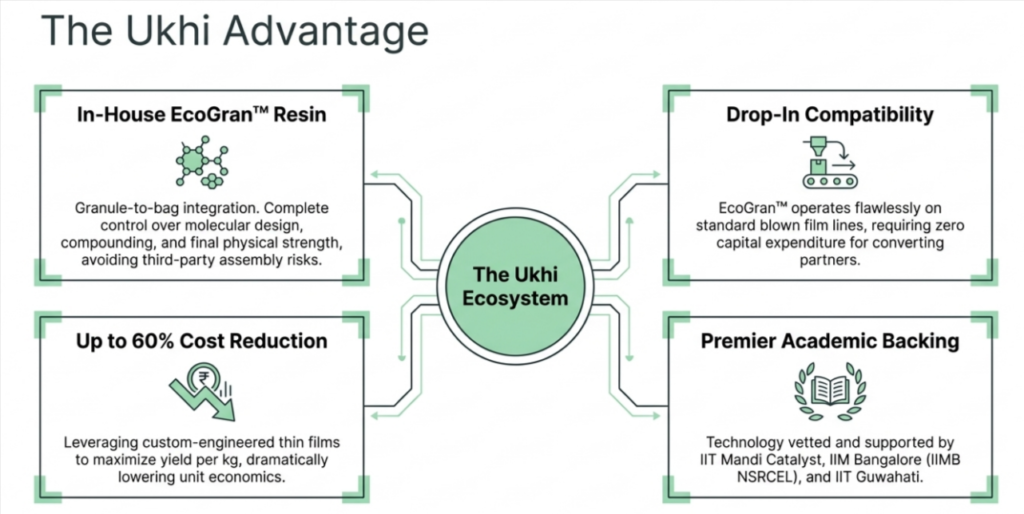
Our EcoGran capacity is 3,000 tonnes per year, which is enough to support monthly orders in the multi-tonne range without lead-time slippage. EcoGran is drop-in compatible with standard blown film machinery, so our converter network can add production without new capital equipment.
Our bags are CPCB certified, tested at CIPET under IS/ISO 17088, and covered by ISO 9001, ISO 14001, GMP, and FSSAI. Existing buyers include Reliance Retail, Amazon, Aditya Birla Group, V-Mart, Good Earth, and Dohful.
Buyers evaluating us can request a free sample of finished bags or EcoGran resin. Samples ship within 7 days at no cost.
FAQs
What is the difference between biodegradable and compostable garbage bags?
Biodegradable is the broader term and means the material eventually breaks down through microbial action. Compostable is stricter and means the bag breaks down into non-toxic compost within a set time under defined conditions. Every compostable bag is biodegradable, but not the other way around.
Where is UKHI’s manufacturing plant located?
UKHI is headquartered and manufactures in IMT Faridabad, Haryana. The plant produces EcoGran resin and finished bags in the same facility, and dispatches across India through road freight. Export orders are handled through the Faridabad plant as well.
How can a buyer verify a manufacturer’s CPCB certification?
The buyer should ask the manufacturer for the CPCB registration number and then check it directly on the CPCB compostable products portal. The name of the supplier, the GST number, and the list of certified products should all match what the supplier has stated in writing.
Are UKHI’s biodegradable garbage bags safe for food waste?
Yes. UKHI’s bags are made with water-based inks and food-safe additives, and the company holds FSSAI certification. The bags are suitable for wet kitchen waste, hotel food scraps, and municipal organic waste collection.
What is the shelf life of a biodegradable garbage bag?
About 12 months from the date of manufacture, when the bags are stored in a cool, dry place away from direct sunlight and humidity. Every UKHI carton is printed with the batch number and manufacture date so buyers can track stock rotation.
![PHA Granules Manufacturers in India [2026]](https://ukhi.com/wp-content/uploads/2026/09/PHA-Granules-Manufacturers-in-India-2026-365x260.png)