
Quick Answer
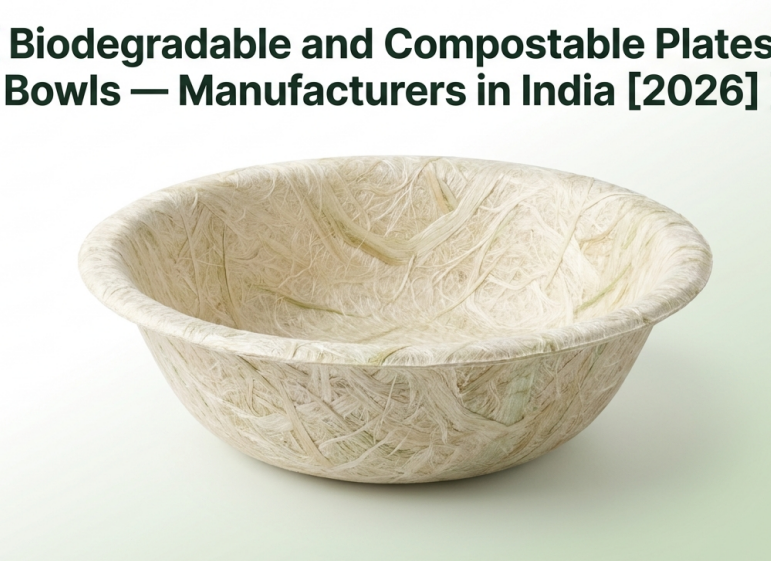
Compostable plates and bowls in India are made mainly from sugarcane bagasse, areca palm leaf, corn starch, or PLA and PBAT biopolymer compounds. Wholesale prices range from about ₹0.92 for a small bagasse bowl to ₹10.50 for a large areca plate. Any supplier must hold a valid CPCB certificate and, for food service, FSSAI. UKHI is one of India’s few compostable and biodegradable plates and bowls manufacturers in India that makes both the resin (EcoGran) and the finished tableware in-house.
What to Look for in a Compostable Plates and Bowls Supplier
Before comparing prices or samples, buyers need to check whether a supplier is set up to deliver reliably and legally.
CPCB certification is mandatory in India
Every manufacturer and seller of compostable tableware must hold a valid Central Pollution Control Board certificate under the Plastic Waste Management Rules. Buyers should always ask for the CPCB certificate number and check that the specific product, material, and thickness match the order.
Direct manufacturers give better outcomes than trading companies
A direct manufacturer controls production, pricing, and lead times. A trader depends on whoever they are sourcing from that week. Direct manufacturers can also customise sizes, prints, and pack formats, which most traders cannot.
Documented quality control matters
A compostable platers and bowls supplier will have written incoming, in-process, and final inspection procedures. They will also have a written claims procedure for defective batches. Buyers should ask to see these documents rather than trust verbal assurances.
MOQ transparency prevents surprises
For standard compostable and biodegradable plates and bowls manufacturers in India, wholesale buyers typically get MOQs of 500 to 5,000 units per SKU. Custom-printed or branded orders usually start at 10,000 units. Buyers should confirm MOQ tiers before requesting a quote.
At UKHI, we manufacture our compostable resin (EcoGran) in-house and also make finished plates and bowls, which removes the trader layer from the buying process.
Technical Specifications That Matter When Buying Compostable Plates and Bowls
Compostable tableware fails in real kitchens for predictable reasons: it softens under hot food, it warps in the microwave, or it collapses under gravy. The specifications below help buyers avoid those failures.
Heat tolerance
Bagasse plates and bowls hold their shape up to 120°C, which covers boiling water, hot dals, and curries. Standard PLA-only products soften at 55 to 60°C and are not suitable for hot Indian food. Buyers ordering tableware for hot service should specify the working temperature clearly in the PO.
PFAS-free sourcing
Some low-cost compostable products use fluorinated chemicals (PFAS) to add oil and water resistance. These chemicals are harmful and are being phased out globally. Buyers should ask for written PFAS-free confirmation and, where relevant, a BIS mark for food-contact safety.
Weight, GSM, and structural design
For paperboard soup bowls, the material should be between 250 and 350 GSM to hold shape. Bowls with rolled edges and fluted bottoms are up to 30% stronger than flat-bottomed designs and handle heavier loads without collapsing.
Shelf life and storage
Good plant-based tableware has a shelf life of 12 to 24 months. Storage conditions matter: relative humidity should stay below 80%, cartons should sit on pallets at least 10 cm off the ground and 45 cm away from walls, and products should stay in their original wrap until use.
Which Materials and Manufacturing Processes Are Used to Make Compostable Plates and Bowls
Buyers comparing quotes from different biodegradable and compostable tableware manufacturers in India will see very different materials. Each has a distinct manufacturing route and different performance in real use.
Sugarcane bagasse
Bagasse is the fibre left after juice is pressed from sugarcane. It is turned into food-grade pulp, then hot-pressed at 180 to 200°C in thermoforming machines. The heat and pressure dry the pulp to below 6% moisture and form a smooth, sealed surface. The finished product handles hot oil and boiling water without any plastic lining. Bagasse is the workhorse of the Indian market for compostable and biodegradable disposable plates manufacturers in India.
Areca palm leaf
Areca plates are made from naturally fallen palm sheaths, mostly in Karnataka. Sheaths are dried, cleaned in freshwater, heat-pressed at 60 to 80°C into shape, trimmed, sanded, and UV-cured. No chemicals, resins, or glues are used at any stage.
Corn starch, PLA, and PBAT
Corn starch is fermented into lactic acid and polymerised into PLA. PLA is blended with PBAT for flexibility, then shaped through compression or injection moulding. Standard PLA deforms above 55°C. Crystallised PLA (CPLA) handles up to 95°C but still cannot cope with very hot food.
Wheat bran and rice husk
A smaller set of manufacturers press plates from wheat bran, rice husk, or spent agri-powder. These are edible in principle and can be fed to livestock at the end of life.
Compostable biopolymer compounds
Our own EcoGran family is a PLA and PBAT-based compostable compound engineered for thermoforming and injection moulding. It gives converters a drop-in material that runs on standard machines and produces plates and bowls that meet food-contact requirements.
Certifications and Compliance to Look for in a Compostable Plates and Bowls Manufacturer in India
The table below sets out what each certification actually verifies.
| Certification | What It Covers | Why It Matters for Buyers |
| CPCB Certificate | Mandatory registration under Plastic Waste Management Rules | Legal requirement for anyone selling compostable products in India |
| IS/ISO 17088 | Indian standard for compostable plastics | Proves 90% of organic carbon converts to CO₂ within 180 days |
| FSSAI | Food-contact material safety | Required for any tableware that touches food |
| BIS IS 18267:2023 | Agri by-product tableware standard | Applies to areca, leaf, and husk-based utensils |
| SPCB Consent | State-level factory clearance | Confirms the plant meets air and water emission rules |
| EPR Registration | Extended Producer Responsibility on CPCB portal | Compostable plastics fall under Category IV packaging |
For export orders, buyers should also ask for BPI certification (US, aligned with ASTM D6400) and TUV OK Compost (Europe, aligned with EN 13432). Foreign certifications do not replace CPCB approval inside India.
Our own materials at UKHI are CIPET-tested and certified under IS/ISO 17088. We hold FSSAI, GMP, ISO 9001, and ISO 14001 for our facilities.
How Much Do Compostable Plates and Bowls Cost in India
Prices vary by material, size, and order volume. The ranges below are typical wholesale rates in the Indian market for compostable and biodegradable plates and bowls.
| Product | Size | Typical Wholesale Price |
| Bagasse plate | 5 to 6 inch round | ₹1.41 to ₹2.40 per piece |
| Bagasse plate | 7 to 9 inch round | ₹1.70 to ₹4.00 per piece |
| Bagasse plate | 10 to 12 inch, single compartment | ₹4.00 to ₹6.00 per piece |
| Bagasse plate | Multi-compartment (3 or 4) | ₹4.14 to ₹9.40 per piece |
| Bagasse bowl | 180 to 250 ml | ₹0.92 to ₹3.00 per piece |
| Bagasse bowl | 300 to 360 ml | ₹1.35 to ₹2.00 per piece |
| Bagasse bowl | 500 to 1000 ml | ₹4.36 to ₹15.40 per piece |
| Areca plate | 6 to 8 inch | ₹4.00 to ₹8.00 per piece |
| Areca plate | 9 to 12 inch | ₹9.50 to ₹10.50 per piece |
| Corn starch plate | 9 inch | ₹3.00 to ₹5.55 per piece |
| Corn starch bowl | 180 ml | ₹3.00 per piece |
Bagasse tableware runs 15 to 30% higher than conventional plastic, while corn starch and PLA products can run 50 to 150% higher. The GST Council recently reduced the tax on biodegradable and compostable packaging from 18% to 5%, which has narrowed this gap. Print, custom sizes, and small MOQs push prices up. Larger orders push them down.
Our EcoGran compounds are engineered to keep the finished product close to conventional plastic pricing, so buyers switching from plastic tableware to compostable and biodegradable plates and bowls manufacturers in India do not face a heavy green premium.
Why Buy Compostable Plates and Bowls from UKHI
UKHI is a material science company based in IMT Faridabad, Haryana. We are one of India’s few integrated biodegradable and compostable tableware manufacturers in India that make both the raw compostable resin and the finished product.
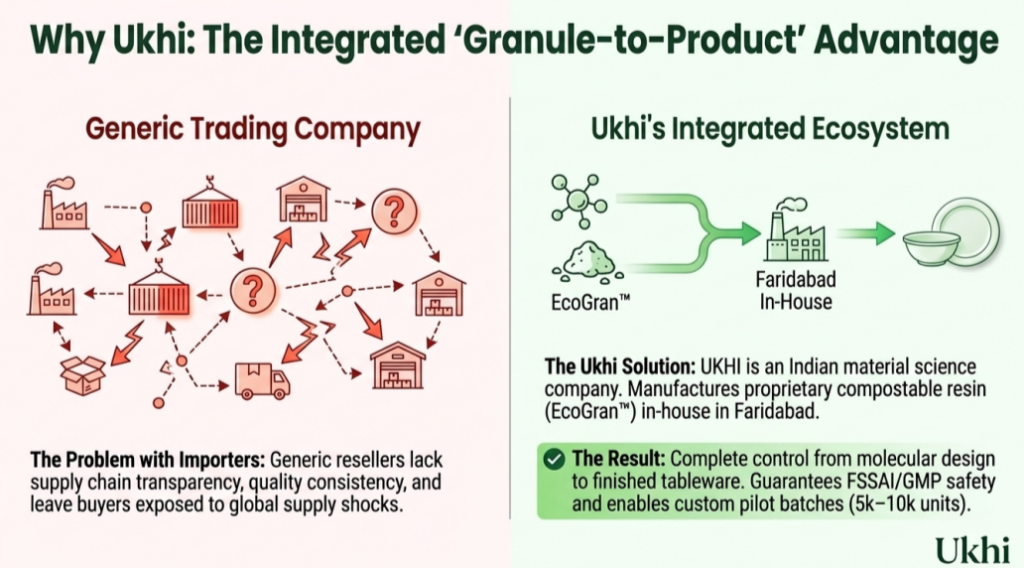
Five things are worth knowing:
- In-house resin manufacturing. We produce our EcoGran resin ourselves and control the material from molecular design to the finished plate or bowl. This removes the quality gap that appears when a converter buys resin from one source and moulds it separately.
- Food-contact and compostability certifications. Our facilities and materials hold FSSAI, GMP, IS/ISO 17088, ISO 9001, and ISO 14001. All materials are CIPET-tested.
- Converter network and pilot support. Through our EcoGran Approved Converter network, we can coordinate the manufacturing of custom plates and bowls. We recommend a pilot batch of 5,000 to 10,000 units so buyers can test performance across shifts, operators, and real food loads before scaling up.
- End-of-life support. Our EcoGran Circular Care Programme helps buyers map their tableware waste, arrange collection, and route used product to verified industrial composting facilities. This turns a compostability claim into a documented outcome.
- Existing client base. We currently supply Reliance Retail, Good Earth, V-Mart, Amazon, and the Aditya Birla Group, among others. We are also developing EDHA, a next-generation PHA-based material that will biodegrade in soil, freshwater, and marine environments once launched.
FAQs
1. Which companies in India manufacture compostable and biodegradable tableware?
India has a mixed base of compostable and biodegradable tableware manufacturers, ranging from small areca leaf units in Karnataka to large bagasse plants and integrated biopolymer companies like UKHI that produce both the resin and finished plates and bowls in-house.
2. What is the difference between biodegradable and compostable plates?
All compostable plates are biodegradable, but not all biodegradable plates are compostable. Compostable products break down into non-toxic compost within a set time under defined conditions. Biodegradable is a looser term with no fixed timeline in Indian regulation.
3. Are corn starch plates manufactured in India suitable for hot food?
Standard corn starch and PLA plates soften above 55°C, so they are not safe for hot Indian meals. Crystallised PLA handles up to 95°C. Buyers serving hot food should choose bagasse or a heat-stable biopolymer compound instead.
4. What is the minimum order quantity from compostable plates and bowls manufacturers in india wholesale?
Standard SKUs usually start at 500 to 5,000 units per size. Custom-printed or branded orders typically start at 10,000 units. MOQs depend on the material, the mould, and whether the compostable platers and bowls supplier is a direct manufacturer or a trader.
5. Are sugarcane bagasse plates manufactured in India safe for microwave use?
Yes, most bagasse plates from certified Indian manufacturers are microwave-safe for one to two minutes at standard power, or up to three minutes on low heat. Buyers should still ask the compostable platers and bowls supplier for the specific microwave rating on their SKU.