
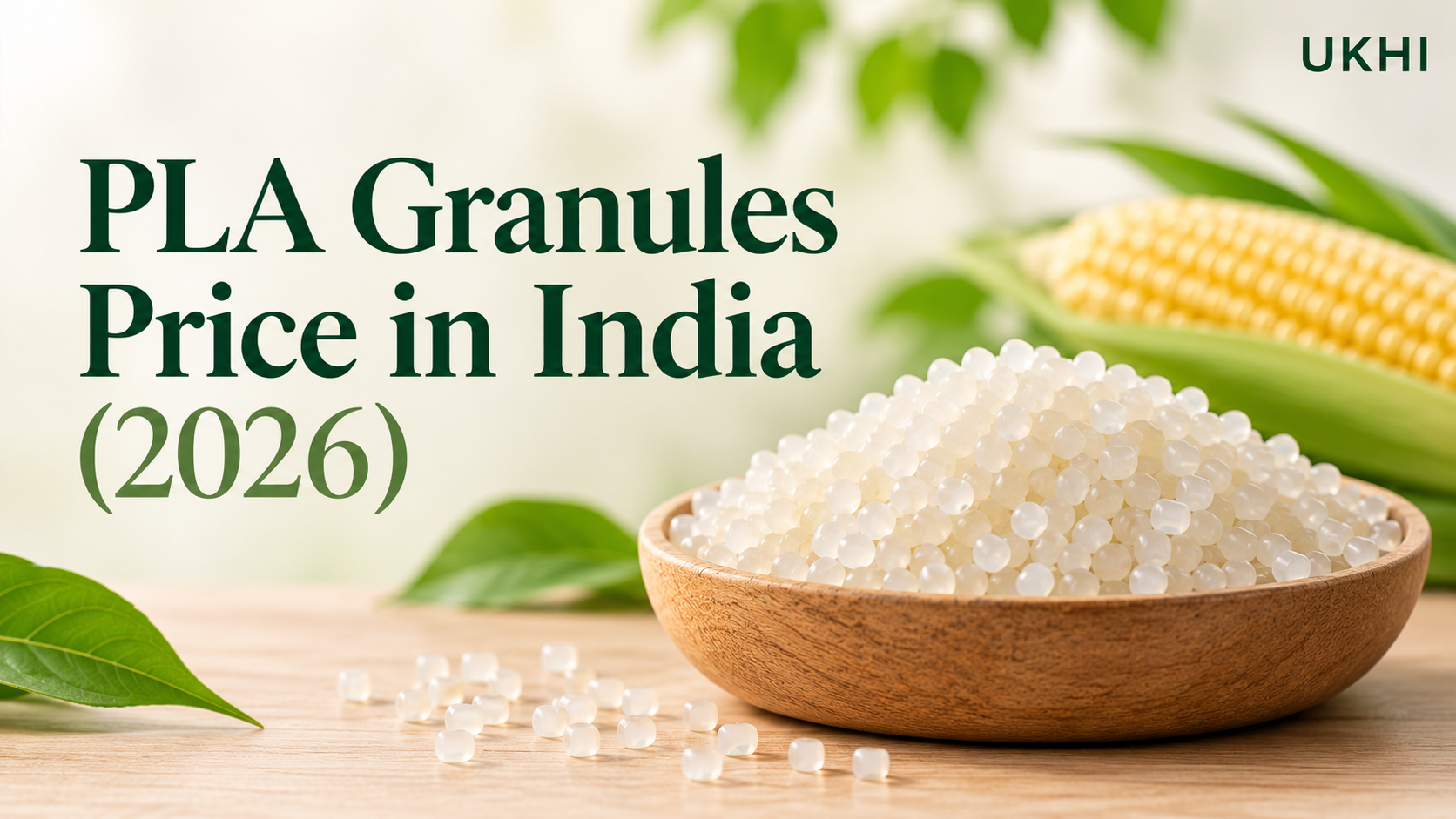
PLA granules price in India in 2026 ranges from ₹225 to ₹300 per kg for standard commercial grades. Film-grade compostable and biodegradable PLA granules used for carry bags and packaging are priced at the lower end, around ₹225 to ₹240 per kg. Standard industrial and injection-moulding grades are priced at between ₹250 and ₹300 per kg. Specialty and laboratory-grade PLA pellets can be priced well above ₹495 per kg.
We are UKHI, a material science company, and we manufacture compostable biopolymer granules under the EcoGran brand at our facility in IMT Faridabad, Haryana. In this guide, we lay out PLA granule pricing in India as it stands today, explain the factors that make the price up or down, and inform procurement teams on the facts they should verify before placing an order.
PLA Granules Price in India by Grade and Application
The table below breaks down PLA granules price per kg across the grades most commonly traded in India in 2026.
| Grade Category | Typical Applications | Price Range (₹/kg) | Notes |
| Film-grade PLA/PBAT compound | Carry bags, courier bags, garment bags, mulch film | ₹225 to ₹240 | Compounded with PBAT for flexibility. This is what most packaging converters buy. |
| Standard industrial PLA resin | General packaging, disposables, thermoforming | ₹250 to ₹300 | Bulk commercial benchmark for domestic supply. |
| Imported uncompounded PLA resin (CIF India) | Base resin for domestic compounders | ₹185 to ₹250 | Before import duties, GST and handling. Tracks global spot at $2.19 to $2.92/kg. |
| High-performance and technical grades | High-heat containers, 3D printing filament, precision parts | ₹350 to ₹600+ | Requires tight molecular weight control, nucleation additives and strict purity. |
| Laboratory and small-pack pellets | R&D, prototyping, academic testing | ₹800+ | Sold in 500 g to 5 kg packs. Not relevant for commercial production. |
A few things to note. The prices above are indicative market ranges. Actual quotes will differ based on order volume, delivery location, GST structure and whether the granules are pure PLA or a compounded PLA/PBAT blend.
Why PLA Granule Prices Vary So Much
Four factors explain most of the price spread in biodegradable PLA granules across the Indian market.
1. Grade and performance specification
General packaging grades of compostable PLA granules are designed for short-life products like carry bags. The price per kg for these grades is at the lower end of the price band explained earlier. Some technical grades are specifically engineered for high heat resistance, tight dimensional tolerance or food-contact compliance. The price per kg of these grades is significantly more because of stricter purity requirements and specialised additives.
2. Import dependence
India currently imports roughly 70% of its high-performance bioplastic resin from Thailand, China and South Korea. Because of this, the domestic PLA granules price per kg moves up or down with international freight rates, USD/INR exchange rates and customs duties. Buyers who source from a domestic compounder are not exposed to this volatility.
3. Compounding and blending
Pure PLA on its own is rigid and brittle. It cannot produce flexible films or carry bags without modification. For flexible packaging applications, PLA is compounded with PBAT (Polybutylene Adipate Terephthalate) or thermoplastic starch to add flexibility. The cost of these co-resins gets added to the final price. This is why PBAT granules price in India is relevant to anyone buying PLA-based compounds. A higher PBAT ratio in the blend will push the compostable granules price in India in one direction or the other, depending on market conditions for each resin.
4. Storage and processing overhead
PLA is hygroscopic, which means it absorbs moisture from the air. If PLA granules are stored without humidity control, the material degrades before it even reaches the extruder. Manufacturers who handle PLA properly need dehumidifying dryers, humidity-controlled warehousing and strict first-in-first-out inventory rotation. PLA also takes 15 to 20% longer to process than conventional plastics. All of these costs get built into the per-kg selling price.
PLA Granules vs Conventional Plastic Granules: Cost per Kg Comparison
Procurement teams who are evaluating bioplastic granules price per kg against conventional polymers will notice a clear premium on the raw material side.
| Polymer | Category | Average Price in India (₹/kg) |
| PLA (Polylactic Acid) | Bio-based, compostable | ₹250 to ₹280 |
| LDPE (Low-Density Polyethylene) | Fossil-based | ~₹120 |
| PP (Polypropylene) | Fossil-based | ~₹120 |
| PET (Polyethylene Terephthalate) | Fossil-based | ~₹140 |
On a per-kg basis, compostable and biodegradable PLA granules cost roughly 2x to 2.3x more than conventional PE or PP. That is the number most buyers see first, and it can look like a dealbreaker.
But per-kg comparison may not always tell the full story when it comes to finished products. This is because compostable films can be made much thinner than conventional plastic films. Because of this, the cost per finished product can actually come out lower because more finished compostable packaging product units can be made per kilogram of material.
Here is an example from our own production, for a standard 12″ x 15″ garment bag:
| Specification | Conventional plastic bag | UKHI compostable bag |
| Thickness | 120 micron | 20 micron |
| Weight per bag | 32 grams | 7 grams |
| Cost per kg | ₹150 | ₹300 |
| Bags per kg | 30 | 150 |
| Cost per bag | ₹5.70 | ₹2.28 |
The example above shows that compostable bag costs 60% less per unit than the conventional plastic bag of the same size. The reason is straightforward. The compostable film is much thinner (20 micron vs 120 micron), so each bag weighs far less (7 grams vs 32 grams). Even though the resin costs more per kg, a buyer gets 150 bags from one kg instead of 30. The per-bag cost ends up significantly lower.
Two additional factors are narrowing the raw-material gap as well.
- India’s Extended Producer Responsibility (EPR) mandates and single-use plastic bans are adding compliance costs to fossil plastics that did not exist a few years ago.
- GST on certified compostable bags has been reduced to 5%, down from the earlier 18%.
How Bulk and Wholesale Pricing Works for PLA Granules in India
PLA granules wholesale price in India depends on how much a buyer orders.
Machine trial lots typically start at 100 to 500 kg. This is enough material to stabilise a blown film or injection moulding line and run a meaningful production test over 2 to 4 hours. Custom grade pilot runs can be done at 500 kg. Regular commercial supply generally starts at 10 tonnes per grade, and scales up from there for large-volume buyers.
Per-kg pricing improves with volume, but the improvement is not linear. The biggest price drop happens when a buyer moves from trial quantities to the first commercial order. After that, each additional volume increment gives a smaller per-kg reduction.
One more thing to keep in mind. Buyers who source imported PLA resin should account for an additional 30 to 40% on top of the base resin cost. This markup comes from ocean freight, currency fluctuation and import duties. Domestic compounders who manufacture compostable and biodegradable granules in India are able to eliminate this markup entirely.
When requesting a quote, share the following upfront: the target application (blown film, injection moulding, thermoforming, etc.), monthly or annual volume, required thickness or MFI range, and delivery location.
What Buyers Should Compare Before Choosing the Lowest PLA Granules Price
The lowest PLA granules price per kg on a quote sheet does not mean the lowest cost once the material is on the production line. Converters who have run compostable materials know that five technical checkpoints separate a reliable supply from one that causes stoppages and rejections.
Moisture content of PLA granules must stay below 0.025%. If moisture is not controlled, the polymer breaks down during extrusion. The result is brittle, yellowed finished goods that cannot be sold.
Melt Flow Index (MFI) must be consistent from batch to batch, and it must match the processing method. Blown film needs an MFI around 1 to 4 g/10 min. Injection moulding runs at 15 to 30 g/10 min. If MFI varies across shipments, the converter will see uneven wall thickness or nozzle clogging on the line.
Resin composition should be clearly stated by the supplier. Pure PLA cannot produce flexible films on its own. Buyers need to confirm whether they are getting neat PLA or a properly formulated PLA/PBAT compound that is suited to their target application.
Certification stack is non-negotiable for any manufacturer of compostable and biodegradable products in India. The material must be certified under IS/ISO 17088, tested at CIPET or a NABL-accredited laboratory. The manufacturer must hold a valid CPCB registration. Food-contact applications require FSSAI clearance on top of this.
Certificate of Analysis (CoA) should come with every shipment. A reliable supplier will provide batch-specific documentation verifying MFI, density, pellet uniformity and moisture content.
Why Buy Compostable PLA Granules from UKHI
UKHI compounds EcoGran resin in-house from locally sourced agricultural residue feedstock. Our raw material cost is not tied to international oil prices or import freight. This also gives us direct control over batch-to-batch consistency.
EcoGran grades are engineered to run on standard blown film, cast film, injection moulding, thermoforming, profile extrusion and extrusion coating lines.
Our certification stack covers IS/ISO 17088 (CIPET-tested), CPCB registration, FSSAI food-contact approval, ISO 9001, ISO 14001, GMP and Halal certification.
Our material science work is backed by IIT Mandi Catalyst, IIT Guwahati and IIM Bangalore NSRCEL.
Procurement teams who want to test EcoGran on their own line can request a free sample kit. We ship these within 7 days at no cost.
Frequently Asked Questions
What is the current PLA granules price per kg in India?
The price of standard commercial grades of PLA granules in India range from ₹225 to ₹300 per kg in 2026. Film-grade PLA/PBAT compounds for packaging applications sit at ₹225 to ₹240 per kg. Specialty and technical grades go above ₹350 per kg.
What is the difference in price between PLA and PBAT granules in India?
PBAT granules price in India typically falls in the ₹220 to ₹280 per kg range for standard grades. The final compound price depends on the PLA-to-PBAT ratio in the blend, which varies by application.
What is the minimum order quantity for compostable PLA granules?
Machine trial lots start at 100 to 500 kg. Commercial orders typically begin at 10 tonnes per grade.
Are compostable PLA granules suitable for food-contact packaging?
Yes, provided the granules and the finished product carry FSSAI clearance and meet the required migration limits for food-contact use. Buyers should confirm this certification with the supplier before starting production.
Can we get a free sample of EcoGran compostable granules?
Yes. UKHI ships free EcoGran sample kits within 7 days.