
Quick Answer
For a buyer evaluating any manufacturer of biodegradable and compostable shrink film in India, three facts can help identify the best option. The shrink film must be made from PLA and PBAT compostable biopolymers. The supplier must hold a valid CPCB certificate. The material from which the shrink film is made must have been tested and validated for compliance to IS/ISO 17088 standards by CIPET or another NABL-accredited lab. UKHI manufactures compostable shrink film from our own EcoGran resin, which we compound in-house at our Faridabad plant. Buyers can request a free sample of finished compostable shrink film, which we can ship within seven days at no cost.
What to Look for in a Supplier of Biodegradable and Compostable Shrink Film in India
A procurement team choosing a supplier of biodegradable and compostable shrink film in India must perform these five checks before they select one.
1. CPCB Certificate and SPCB Registration
Under Rule 4(h) of the Plastic Waste Management Rules, 2016, any manufacturer of biodegradable and compostable plastics (including shrink films) in India must hold a Central Pollution Control Board certificate before marketing the product. Any buyer can ask for the certificate number and verify it on the CPCB’s public register. The supplier must also hold a State Pollution Control Board registration.
2. IS/ISO 17088 Lab Reports
A buyer should ask the biodegradable shrink films supplier for lab reports from CIPET or another NABL-accredited, CPCB-recognised laboratory. These reports must cover disintegration, ultimate aerobic biodegradation, ecotoxicity, and heavy metal content.
3. Direct Manufacturer Rather Than Reseller
A company that manufactures the biodegradable resin itself can offer batch-to-batch consistency, direct access to technical documentation, and one point of accountability.
4. Printing and QR Code Capability
Every certified compostable pack sold in India must carry the word “compostable”, the manufacturer’s name, the CPCB certificate number, and a scannable QR code that links to the compliance record.
5. Willingness to Run a Machine Trial
A supplier of biodegradable and compostable shrink film in India should be able to run a trial on the buyer’s own line before it begins the commercial supply.
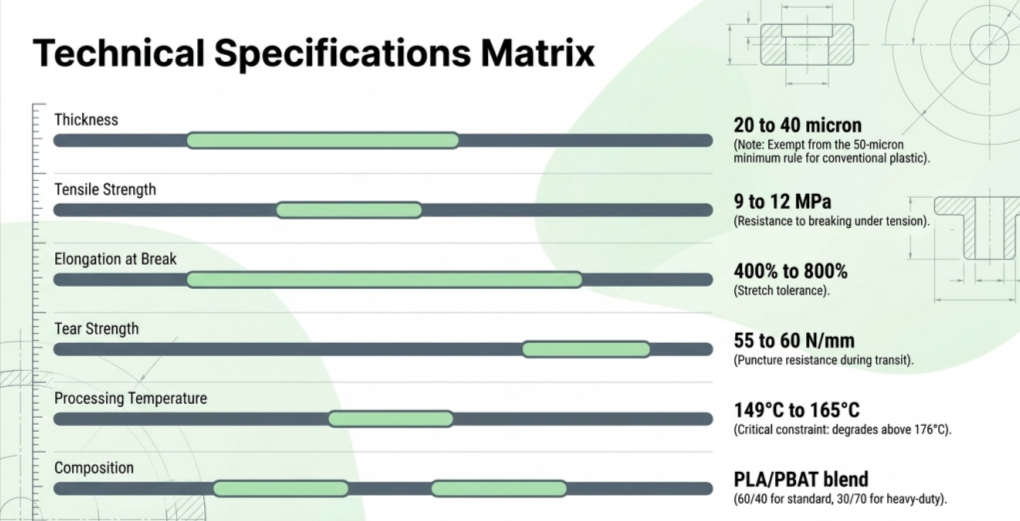
What Specifications Matter When Buying Compostable Shrink Film in India
The parameters below matter most.
| Specification | Typical Range for Compostable Shrink Film | Why It Matters for a Buyer |
| Material composition | PLA and PBAT blend, 60/40 for standard use, 30/70 for heavy-duty | Determines strength, clarity, and shrink behaviour |
| Thickness | 20 to 40 micron | The 50-micron minimum thickness rule for conventional plastic does not apply to certified compostable film |
| Tensile strength | 9 to 12 MPa for standard grades | Resistance to breaking under tension during bundling |
| Elongation at break | 400% to 800% depending on blend | Stretch tolerance before the film snaps |
| Tear strength | 55 to 60 N/mm | Resistance to punctures during transit |
| Processing temperature | 149°C to 165°C, never above 176°C | Above this range the resin degrades and film quality drops |
One warning for any buyer approaching a supplier of biodegradable and compostable shrink film in India: oxo-degradable and oxo-biodegradable films are conventional plastic with a fragmenting additive. These are banned in India and cannot legally be marketed as compostable.
Materials and Processes Used for Biodegradable and Compostable Shrink Film
Materials
- Polylactic Acid (PLA) is a plant-based polymer made from fermented corn starch or sugarcane. PLA gives the film its stiffness and optical clarity but is brittle on its own.
- Polybutylene Adipate Terephthalate (PBAT) is a fossil-derived but fully compostable co-polyester. PBAT provides elasticity, tear resistance, and the melt strength needed to form a stable bubble during extrusion.
Most manufacturers of biodegradable and compostable shrink film in India blend these two resins in ratios tuned to the end application.
Process
Most compostable shrink film sold in India is produced through blown film extrusion. Cast film extrusion is used for some flat shrink applications, but blown film remains the dominant route.
Certifications and Compliance to Look for in a Shrink Film Manufacturer in India
For a buyer running a procurement audit, the certification stack can be the difference between legal supply and legal risk.
The essential certifications for any manufacturer of biodegradable and compostable shrink film in India are:
- A CPCB certificate, with a certificate number verifiable on the public register.
- An SPCB or PCC registration in the manufacturer’s home state.
- IS/ISO 17088 compliance, tested by CIPET or another NABL-accredited lab.
- FSSAI certification if the shrink film will be used to pack food, beverages, or FMCG products.
- ISO 9001 for quality, ISO 14001 for environment, and GMP for good manufacturing practice.
UKHI holds CPCB certification, SPCB registration, IS/ISO 17088 compliance verified by CIPET, FSSAI, Halal, ISO 9001, ISO 14001, and GMP.
How Much Does Compostable Shrink Film Cost in India
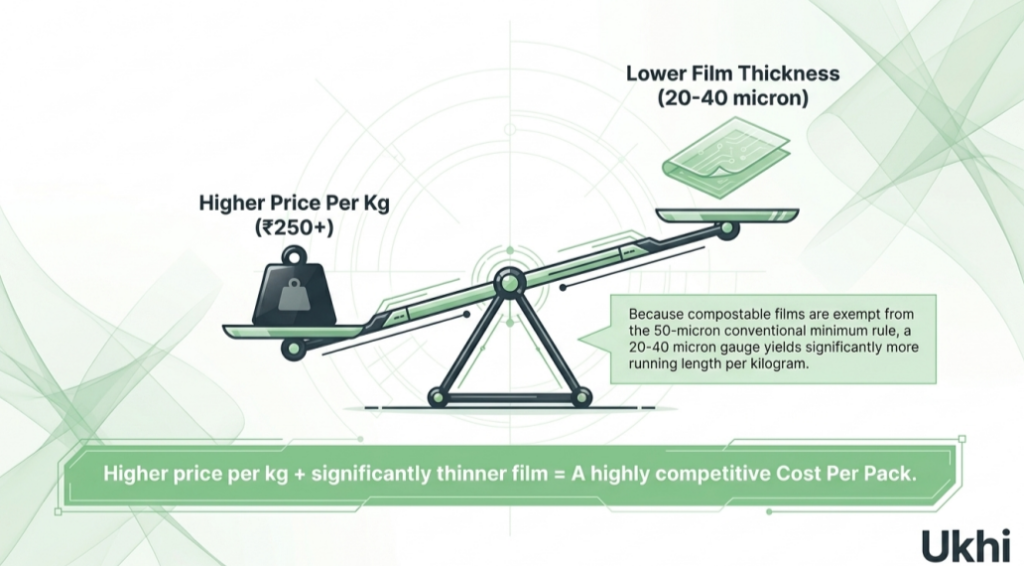
Any buyer approaching a supplier of biodegradable and compostable shrink film in India will find the per-kilogram price higher than conventional PVC or LDPE shrink film. Typical wholesale ranges are shown below.
| Film Type | Typical Wholesale Range |
| Compostable shrink film, general blend | ₹250 to ₹400 per kg |
| Conventional PVC heat shrink film | ₹135 to ₹185 per kg |
| Conventional LDPE shrink film | ₹95 to ₹130 per kg |
Still, the per-kilogram figure hides an important fact for any buyer.
Why?
- Compostable shrink film can run at 20 to 40 micron, well below the 50-micron minimum that applies to many conventional plastic products.
- A thinner film means more running length per kilogram, which means more packs per kilogram.
- More packs per kilogram brings the cost per pack much closer to conventional shrink film than the per-kilogram number suggests.
Three factors affect the price of compostable and biodegradable shrink films: film width, film thickness, and order volume.
Why a Buyer Should Consider Ukhi
For a buyer choosing between suppliers of biodegradable and compostable shrink film in India, five facts about Ukhi are worth weighing.
- Ukhi is a material science company that manufactures its own compostable resin, EcoGran, and uses it to produce finished compostable shrink film.
- Ukhi’s EcoGran granules are drop-in compatible with standard blown film lines. A converter switching from conventional plastic to Ukhi compostable film does not need to invest in new machinery.
- Ukhi’s thin-gauge film design lowers material weight per pack, which narrows the traditional cost gap between compostable and conventional shrink film on a per-unit basis.
- Ukhi holds CPCB, SPCB, IS/ISO 17088, FSSAI, GMP, ISO 9001, and ISO 14001 certifications.
- Reliance Retail, Amazon, Good Earth, V-Mart, and Aditya Birla Group are among the brands that already buy from Ukhi.
Any buyer who wants to evaluate Ukhi compostable shrink film on their own shrink line can request a free sample, which we will ship within seven days at no cost.
FAQs
1. Is compostable shrink film the same as biodegradable shrink film?
For a buyer, the two terms are related but not identical. All compostable shrink film is biodegradable, but not all biodegradable shrink wrap is compostable. Compostable shrink film must break down within a defined time frame under composting conditions and meet IS/ISO 17088.
2. Can compostable shrink film be composted in a home compost bin?
Industrial compostable shrink film needs sustained temperatures above 50 to 58°C and microbial activity found only in industrial composting facilities. Home compost heaps rarely reach these conditions. Any biodegradable shrink wrap marketed as home compostable should carry separate certification proving the claim.
3. Does compostable shrink film run on standard heat shrink tunnels?
Yes. Compostable heat shrinkable film based on PLA and PBAT runs on standard shrink tunnels and L-sealers. A converter usually lowers tunnel temperature to between 130°C and 160°C. Line speed and dwell time may need small adjustments during the first trial.
4. What is the shelf life of compostable shrink film in a buyer’s warehouse?
Compostable shrink film stays stable for roughly 9 to 12 months in a cool, dry, sealed environment away from direct sunlight. A buyer should store rolls in climate-controlled conditions and follow FIFO stock rotation to avoid moisture damage.
5. Is compostable shrink film safe for direct food contact?
Compostable shrink film is safe for food contact only when the specific grade is FSSAI certified. Ukhi’s food-contact EcoGran grades meet FSSAI requirements for direct contact with food and beverages.