
Quick Answer
Compostable stretch and pallet wraps are made from PLA-PBAT biopolymer blends and are certified under IS/ISO 17088 for industrial composting. These wraps can replace conventional LLDPE stretch film in pallet wrapping, bundling and load securing. Procurement teams on the lookout for biodegradable stretch wrap manufacturers in India should verify CPCB registration, finished-film test reports and drop-in compatibility with existing wrapping machines before they make a purchase decision. UKHI manufactures its compostable biopolymer resin, EcoGran, in-house and supplies both resin and finished stretch wrap products to brands and converters across India.
What to Look for in a Biodegradable Stretch Wrap Supplier in India
Procurement teams sourcing compostable stretch wrap in India need to verify a few things before they shortlist a vendor.
CPCB registration
Under the Plastic Waste Management Rules, any company manufacturing or selling compostable plastics in India must hold a valid Central Pollution Control Board certificate. The supplier should be able to share the certificate along with its expiry date. The supplier must also hold consent orders from the relevant State Pollution Control Board for air and water emissions.
Lab reports for the finished film, not just the resin
A common gap in this market is suppliers who hold a compostability certificate for their raw biopolymer resin and present it as proof that the finished stretch wrap is also compostable. The finished film can fail compostability testing because of cling agents, slip additives or printing inks added during conversion. Buyers should ask for IS/ISO 17088 test reports conducted on the actual finished wrap by a CPCB-recognised laboratory such as CIPET.
Labelling and traceability
The finished wrap must carry the manufacturer’s CPCB registration number, the word “Compostable” printed in English, and a QR code linked to the CPCB traceability system. These markings are legally required on every roll.
Vertical integration
India still imports a large share of raw biopolymer resins like PLA and PBAT. Suppliers who manufacture their own compostable resin in-house offer better batch consistency, more stable pricing and shorter lead times than traders who buy resin from a third party and get it converted elsewhere. At UKHI, we manufacture our biopolymer resin, EcoGran, in-house at our facility in IMT Faridabad, which gives us direct control over formulation, quality and supply timelines.
Storage guidance
Compostable films are hygroscopic. It means they absorb moisture from the air and can degrade prematurely if stored in hot, humid conditions. A supplier should provide warehouse guidelines covering humidity-controlled storage, FIFO inventory rotation and a target turnover rate of 8 to 10 times per year.
What Specifications Matter When Buying Compostable Stretch Film and Pallet Film Wrap
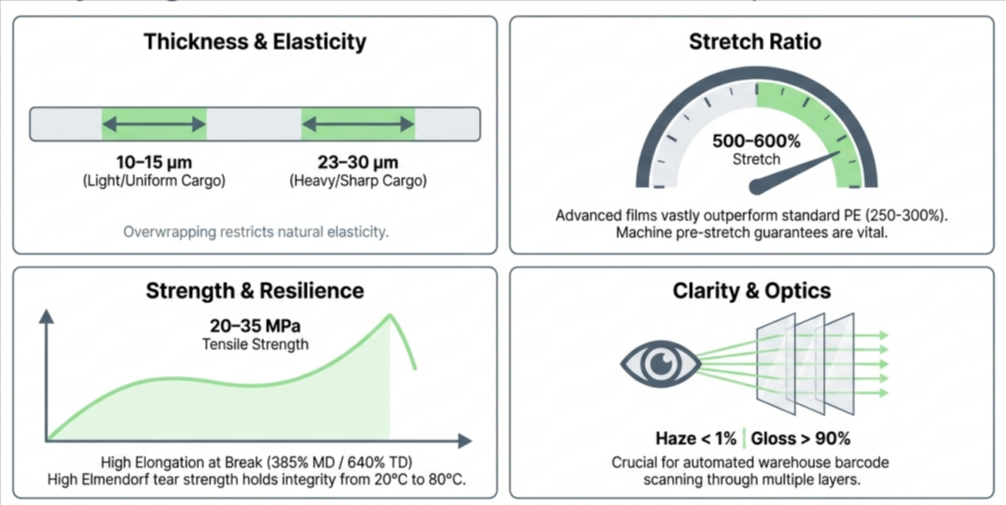
Buyers evaluating biodegradable stretch film manufacturers in India should compare products on the physical parameters that determine whether a wrap will perform as expected during transit, scanning and storage.
| Specification | What it means | Typical range for compostable stretch wrap |
| Thickness | Film gauge in microns. Thicker films suit heavy or sharp-edged cargo. Thinner films reduce material use on lighter loads. | 10 to 30 microns |
| Stretch ratio | How far the film stretches before application. Higher stretch means less film per pallet. | 500% to 600% for advanced compostable films, compared to 250% to 300% for conventional PE |
| Tensile strength (MD) | The force the film can withstand in the machine direction before breaking | 20 to 25 MPa (specialised grades reach 35 MPa) |
| Elongation at break | How far the film stretches before it tears | 385% (MD) and 640% (TD) as industrial benchmarks |
| Puncture and tear resistance | Ability to resist sharp box corners, wooden splinters and pallet edges | Elmendorf tear: 198 gm (MD) / 381 gm (TD) |
| Clarity and haze | Determines whether barcodes and shipping labels remain scannable through the wrap | Haze below 1%, gloss above 90% at 45 degrees |
| Temperature resistance | The range within which the film holds its structure during Indian summers and monsoon humidity | 20 to 80 degrees C |
Note: Compostable stretch wraps certified under IS/ISO 17088 break down fully into water, carbon dioxide and biomass under industrial composting conditions. Oxo-biodegradable wraps, made from conventional LLDPE with pro-degradant additives, only fragment into smaller plastic particles and are not legally compostable under Indian standards. Buyers who need compostable stretch film wraps should confirm IS/ISO 17088 certification specifically.
Materials and Manufacturing Processes Used for Compostable Stretch Film Wrap
Materials
A compostable packaging film for stretch and pallet wrapping is made from a small set of raw materials.
- PLA — A rigid, plant-based polymer derived from fermented starch sourced from corn, sugarcane or sugar beet.
- PBAT — A flexible, fully biodegradable co-polyester that provides the stretchability and toughness a pallet wrap needs.
On its own, PLA is too brittle for a stretch film, and PBAT alone is too soft to hold a pallet load, so the two are blended in precise ratios to balance clarity, stiffness and elongation.
Process
Two manufacturing processes are used in India by manufacturers of compostable stretch wraps. Cast film extrusion — In this process, the molten resin is pushed through a flat die onto a chilled roller, to produce film with high clarity, uniform thickness and consistent gauge control. Cast film is the preferred format for producing shrink film wraps for automatic pallet wrapping machines used in high-speed logistics operations.
Blown film extrusion — In this process, the molten resin is pushed through a circular die and inflated it into a bubble, to stretch the material in both directions. Blown film extrusion offers stronger puncture resistance and balanced tear strength, which makes the shrink film suitable for manual hand rolls and heavy-duty load securing.
At UKHI, our EcoGran resin is compounded in-house and is engineered for both cast and blown film extrusion. EcoGran granules are drop-in compatible with existing plastic processing machinery, which means converters can run them on their current blown film or cast film lines without the need to invest in new equipment.
Certifications and Compliance for Compostable Stretch Wrap Manufacturers in India
IS/ISO 17088 is the legally mandated Indian standard for compostable plastics. A manufacturer can prove compliance to the same by submitting samples of the finished film to a CPCB-recognised laboratory, where the material is tested across four parameters:
- disintegration (90% or more of the film must fragment below 2 mm within 84 days),
- aerobic biodegradation (90% or more of organic carbon must convert to CO2 within 180 days),
- ecotoxicity (the resulting compost must not harm soil quality or plant germination), and
- heavy metal content (concentrations must fall below national safety limits).
CPCB registration is mandatory before any manufacturer can sell compostable stretch wrap in India. A provisional CPCB certificate is valid for six months, and the final certificate, granted after a complete 180-day test cycle, is valid for up to three years.
Manufacturers must also submit six-monthly compliance reports through the CPCB’s online portal.
UKHI’s compostable stretch wrap materials conform to IS/ISO 17088 and are tested by CIPET. Our manufacturing operations are certified under ISO 9001 for quality management, ISO 14001 for environmental management and GMP for good manufacturing practice.
How Much Does Compostable Stretch and Pallet Wrap Cost in India
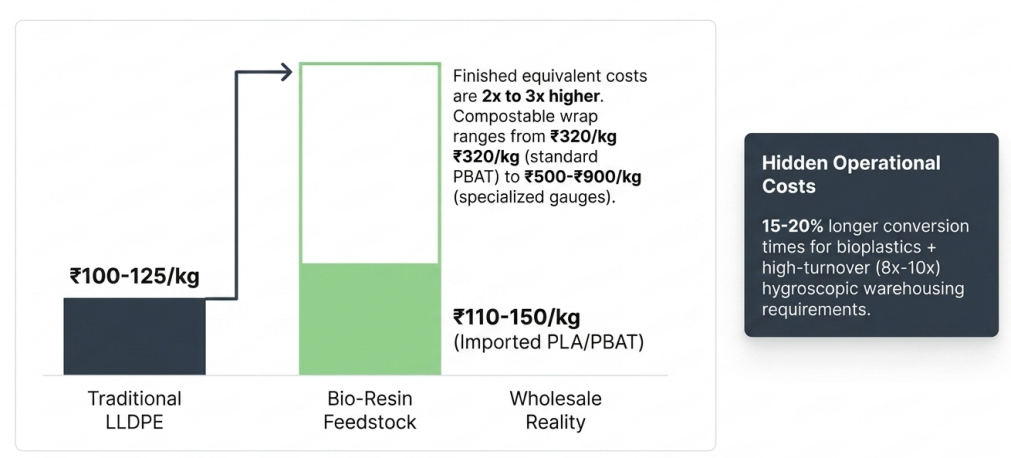
The cost of biodegradable stretch wrap in India depends on the material grade, film thickness, stretch performance and order volume. The table below gives current wholesale price benchmarks for the Indian B2B market.
| Product type | Indicative price (per kg) | Typical MOQ |
| Plain biodegradable packaging film (PBAT-based) | Around ₹180 | 200 kg |
| Compostable stretch wrap roll (500 mm wide, 300% stretch) | Around ₹320 | 500 kg |
| Compostable hand wrap roll (25 micron, 1,000 m) | Around ₹320 | 500 kg |
| High-performance compostable stretch film (marketplace range) | ₹500 to ₹900 | Varies |
Cost drivers:
- Thicker films use more resin per metre and cost more.
- Films with higher stretch ratios (500% to 600%) cost more per kg but use 40% to 50% less material per pallet, which can bring the effective cost per pallet close to conventional LLDPE wrap.
- Larger order volumes typically also mean a discounted bulk pricing.
For specific pricing based on volume, thickness and application, procurement teams can request a quote directly from UKHI.
Why Buy Compostable Stretch and Pallet Wrap from UKHI
We manufacture the resin
UKHI compounds EcoGran, our compostable biopolymer resin, in-house at our facility in Faridabad. This means we control formulation, quality and pricing from the granule to the finished film.
No machinery investment needed
EcoGran granules are drop-in compatible with standard blown film and cast film extrusion lines. Converters and packaging manufacturers can process them on existing equipment without retrofitting or purchasing new machinery.
Cost-competitive with conventional plastics
EcoGran is engineered to be price-competitive with petroleum-based resins.
Certified and compliant
Our materials conform to IS/ISO 17088, are CIPET tested, and our operations are backed by ISO 9001, ISO 14001 and GMP certifications.
Commercially proven
UKHI achieved 23x year-on-year revenue growth between Q1 FY26 and Q1 FY27. Our materials and finished products are used by Reliance Retail, Aditya Birla Group, Amazon, Good Earth and V-Mart. We also work with a network of converter partners across India who process EcoGran into finished packaging products.
Next-generation material in development
Beyond EcoGran, UKHI is piloting EDHA, a PHA-based biomaterial produced through precision fermentation. EDHA is designed to be home-compostable and to biodegrade in soil, freshwater and marine environments.
Request a free sample. We ship compostable stretch and pallet wrap samples within 7 days at no cost.
FAQs
1. Can compostable stretch wrap be used on automatic pallet wrapping machines?
Yes. Compostable stretch wrap produced through cast film extrusion is designed for automatic wrapping machines. EcoGran-based cast film runs on standard equipment without modifications to the machine or the pre-stretch carriage.
2. What is the shelf life of biodegradable pallet wrap?
Compostable pallet wrap typically lasts 12 to 18 months when stored in a cool, dry environment. Buyers should follow FIFO inventory rotation and store rolls away from direct heat and humidity.
3. Is compostable stretch wrap legal for export packaging from India?
Yes, provided the wrap is certified under internationally recognised standards. IS/ISO 17088 aligns with EN 13432 (Europe) and ASTM D6400 (US). Buyers should confirm that the specific product holds the certification required by the destination country.
4. What is the difference between biodegradable and compostable stretch wrap?
Biodegradable means the material breaks down over time, but there is no defined timeframe or safety standard. Compostable means the material fully converts into water, CO2 and biomass within 180 days under controlled composting, with no toxic residue. IS/ISO 17088 certifies compostability, not just biodegradability.
5. Does compostable stretch film work in cold storage and refrigerated warehouses?
Compostable stretch films are generally rated for use between 20 and 80 degrees C. For cold storage below 20 degrees C, buyers should request a specific grade engineered for low-temperature flexibility and confirm performance through a trial run.