
Quick Answer
Bioplastic granules manufacturers in India supply compostable resin in four main polymer types: PBAT for flexible films, PLA for rigid moulding, starch-based compounds for carry bags, and PHA for marine-biodegradable applications. Prices of biodegradable granules range from Rs 130 per kg for film-grade PBAT compounds to Rs 3,500 per kg for PHA. All manufacturers of bioplastic granules must hold a CPCB certificate and IS/ISO 17088 test reports to sell their granules legally. At UKHI, we manufacture EcoGran, a certified compostable and biodegradable polymer that runs on existing plastic processing machinery without equipment changes.
What to Look for in a Biodegradable and Compostable Plastic Granules Supplier in India
Procurement teams buying bioplastic granules in India need to evaluate a compostable plastic granule supplier on five things before placing an order.
CPCB certificate
Under the Plastic Waste Management (PWM) Rules, any company that manufactures or sells compostable resin in India must hold a valid Central Pollution Control Board certificate. This certificate can be provisional (valid for six months, based on interim test reports) or final (issued after full compliance is demonstrated).
State Pollution Control Board registration
The supplier of bioplastic granules must be registered with the concerned State Pollution Control Board (SPCB) or Pollution Control Committee (PCC) under Rule 13(2) of the PWM Rules. The supplier should also hold valid Consent Orders for air and water operations as per Rule 13(5). Buyers should ask for copies of both documents before finalising a vendor.
Laboratory testing at CIPET or a recognised lab
The raw materials and finished granules should have been tested at the Central Institute of Petrochemicals Engineering and Technology (CIPET) or another CPCB-recognised government laboratory. The test report is the only proof that the granules meet the IS/ISO 17088 compostability standard. Without it, the product cannot legally be labelled as compostable.
Formulation and processing support
A reliable biodegradable polymer manufacturer in India should share recommended formulations and the temperature profiles needed for extrusion or moulding. Buyers who do not receive this technical guidance upfront will likely face trial-and-error costs on the production floor.
Raw material traceability
Buyers should ask whether the feedstock is bio-based or petroleum-derived, and request Technical Datasheets (TDS) along with safety declarations.
What Specifications Matter When Buying Bioplastic and Compostable Plastic Granules
The properties of compostable granules must match the buyer’s machinery and the end product being manufactured. The table below lists the critical specifications a procurement team should verify before ordering.
| Specification | PBAT-Based Granules (Film Grade) | PLA Granules (Rigid/Injection Moulding Grade) |
| Melt Flow Rate (MFR) | 4.22 to 5.5 g/10 min at 190°C / 2.16 kg | 5 to 30 g/10 min at 210°C / 2.16 kg (varies by grade) |
| Density | Around 0.95 g/cc for PBAT80 compounds | 1.24 to 1.40 g/cm³ |
| Melting Point | 105°C to 115°C | 160°C to 170°C |
| Moisture Limit | Below 1 percent | Below 200 ppm |
| Heat Deflection Temperature (HDT) | Not typically a concern for flexible films | 60°C for standard PLA; 105°C to 110°C for heat-resistant grades |
| Tensile Strength | Lower, suited for flexible packaging | 45 to 65 MPa |
| Flexural Modulus | Not applicable for films | 2,400 to 6,000 MPa |
PBAT granules are flexible and suited for blown film applications such as carry bags, garbage liners, and agricultural mulch films. PLA granules are rigid and suited for injection moulding applications such as cutlery, cups, trays, and food containers.
Certifications and Compliance to Look for in a Compostable Plastic Granules Manufacturer in India
CPCB Registration
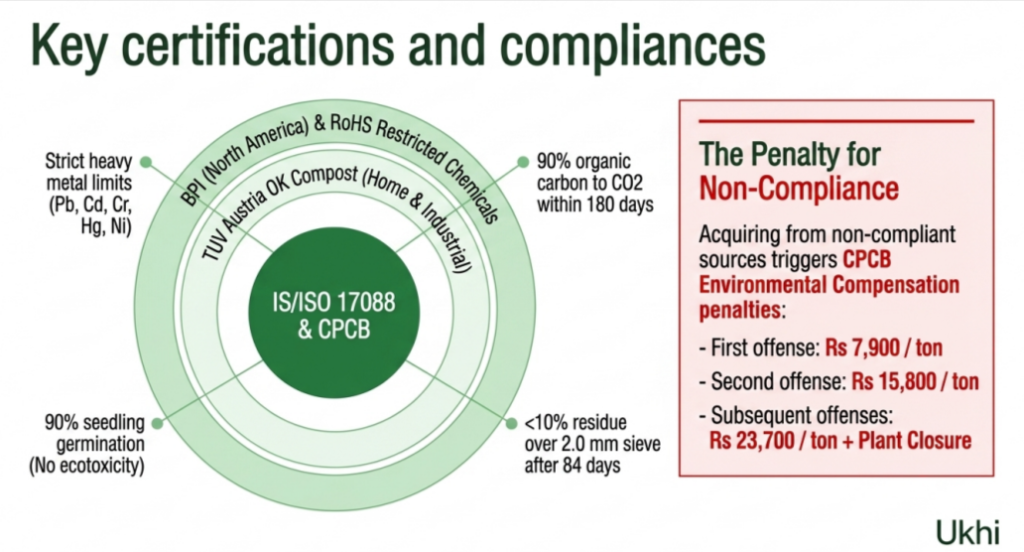
Buying biodegradable granules from a non-compliant source in India carries financial and legal consequences. The CPCB’s revised guidelines impose an Environmental Compensation penalty of Rs 7,900 per ton for a first offence, Rs 15,800 per ton for a second offence, and Rs 23,700 per ton for a third offence. Goods can be seized and plants can be closed.
IS/ISO 17088 conformity
This is the Indian standard for compostable plastics, and it requires four things to be proven through laboratory testing:
| Test Requirement | What It Means |
| Ultimate Aerobic Biodegradation | At least 90 percent of organic carbon must convert to CO2 within 180 days |
| Disintegration | No more than 10 percent residue should remain on a 2.0 mm sieve after 84 days of composting |
| Heavy Metals and Regulated Toxins | Strict limits on lead, cadmium, chromium, mercury, and nickel |
| Ecotoxicity (OECD 208 Plant Growth Test) | Finished compost must allow at least 90 percent seedling germination and plant biomass compared to control soil |
SPCB or PCC registration
Valid registration under Rule 13(2) of the PWM Rules and up-to-date consent orders under the Air and Water Acts are mandatory for every manufacturing facility.
Export certifications
Buyers who plan to export finished products made from these granules should confirm that the compostable plastic granule supplier holds TÜV Austria OK Compost (Home or Industrial), BPI certification for North American markets, and RoHS or SVHC compliance for chemical safety.
How Much Do Bioplastic Granules Cost in India
The price of bioplastic granules in India depends on the polymer type, grade, and end application. The ranges below are based on listed prices from Indian manufacturers and distributors (excluding taxes).
| Category | Typical Price Range (Rs per kg) | Common Applications |
| Starch-based and PBAT compounds (film grade) | Rs 130 to Rs 220 | Compostable carry bags, garbage liners, grocery packaging |
| PLA and rigid or specialised grades | Rs 220 to Rs 365 | Thermoforming, straw extrusion, injection moulding for cups, cutlery, food containers |
| Biodegradable masterbatches and fillers | Rs 55 to Rs 180 | Blended with carrier resins to lower cost or improve properties |
| PHA granules (advanced biopolymer) | Around Rs 3,500 | Marine-biodegradable applications, high-performance packaging |
For comparison, conventional petroleum-based plastic granules such as recycled polypropylene cost Rs 42 to Rs 80 per kg, and virgin polypropylene costs Rs 69 to Rs 142 per kg.
A manufacturer transitioning from conventional plastics to certified compostable plastic raw material should budget Rs 150 to Rs 250 per kg for standard flexible film packaging grades, and Rs 350 or more per kg for specialised injection moulding compounds.
Why Buy Biodegradable and Compostable Plastic Granules from UKHI
At UKHI, we manufacture our biopolymer resins in-house rather than trading or assembling someone else’s material. This means batch-to-batch consistency is controlled from molecular design through to the finished pellet.
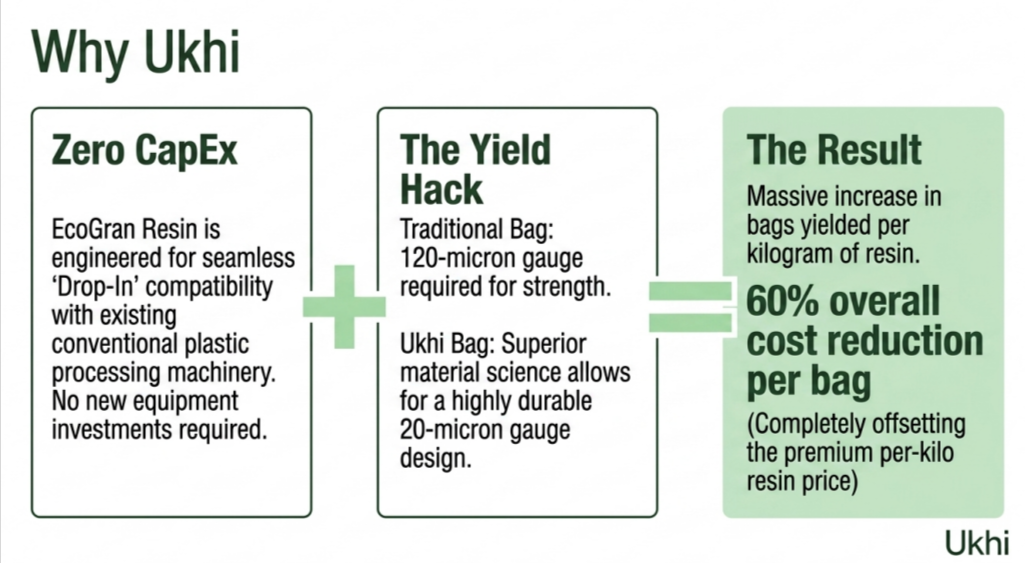
Our commercially available resin, EcoGran, is designed as a drop-in replacement for conventional plastic granules. EcoGran runs on existing blown film, cast film, profile extrusion, injection moulding, thermoforming, and extrusion coating lines. Buyers do not need to invest in new equipment or modify current setups.
On cost, EcoGran is engineered to compete with petroleum-based plastics. When used for applications like garment bags, the material allows for significantly thinner and lighter films (20 microns compared to 120 microns with traditional plastic), which increases the number of bags produced per kilogram and reduces per-bag cost by up to 60 percent.
On compliance, UKHI holds IS/ISO 17088 certification, CIPET testing clearance, FSSAI certification for food-contact safety, and ISO 9001, ISO 14001, and GMP certifications.
Beyond EcoGran, we are piloting EDHA, a 100 percent bio-based PHA resin produced through precision fermentation of agricultural waste. EDHA biodegrades naturally in open air, soil, freshwater, and marine environments.
UKHI’s technology is backed by IIT Guwahati, IIT Mandi Catalyst, and IIM Bangalore (NSRCEL), and our R&D is led by a PhD from IIT Madras with specialised expertise in PHAs and bioprocessing.
Our EcoGran resins are already used by converters to manufacture finished products for Reliance Retail, Aditya Birla Group, Amazon, Good Earth, and V-Mart.
FAQs
1. What raw materials are used to make bioplastic granules in India?
Most biodegradable plastic granules in India are made from corn starch, sugarcane, cassava, or agricultural waste. These feedstocks are fermented or processed into polymers such as PLA, PBAT, or PHA, which are then compounded into pellets.
2. Can compostable plastic granules run on standard plastic processing machines?
Yes. Most compostable resin grades, including UKHI’s EcoGran, are designed as drop-in materials for blown film, injection moulding, and thermoforming lines.
3. What is the minimum order quantity for bioplastic granules from Indian manufacturers?
Most bioplastic granules manufacturers in India set minimum orders between 500 kg and 1,000 kg.
4. Is FSSAI certification required for compostable food packaging granules?
Yes. Any compostable plastic raw material used to manufacture cups, trays, straws, or food wrapping in India must carry FSSAI approval in addition to CPCB certification.
5. Are biodegradable plastic granules banned under India’s single-use plastic rules?
No. India’s 2022 single-use plastic ban applies to conventional plastic items. Certified biodegradable and compostable products that hold valid CPCB certificates and IS/ISO 17088 compliance are exempt from the ban and can be manufactured and sold legally.