
Every year, Indian apparel exporters pack millions of garments into thin plastic sleeves. This packaging outlives the garments inside them by centuries. That mismatch- a garment meant to last a season wrapped in plastic that lasts forever- is exactly the problem export buyers in the EU and the US are now refusing to accept.
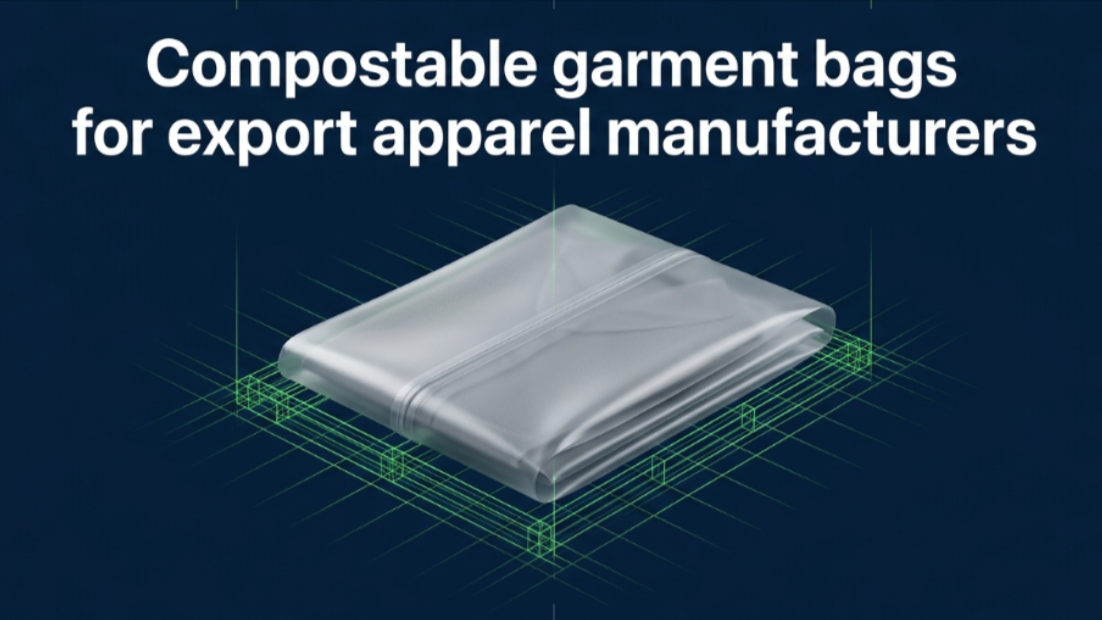
Compostable garment bags are the direct fix.
But anything with a green leaf and eco-friendly label won’t work.
So, which compostable garment bags are the right for export apparel manufacturers?
Quick answer: If you export apparel to the EU, UK, or increasingly the US, compostable garment bags made from PBAT, PLA, or cornstarch blends are the safer default. They protect folded garments the same way plastic does. Yet they also meet compostability standards like EN 13432 and ASTM D6400. For an exporter, that means fewer compliance flags at the buyer’s end and an eco-friendly brand image that’s great for business.
That’s the short version. Now let’s get into what actually goes into choosing the right one.
Packaging formats that fit export garment packing
Not every compostable garment bag looks or behaves the same way. The format you pick depends entirely on what you’re shipping and how.
Some commonly used options for biodegradable garment bags for export apparel manufacturers are:
1. Self-adhesive flap bags (folded shirts, knitwear, basics)
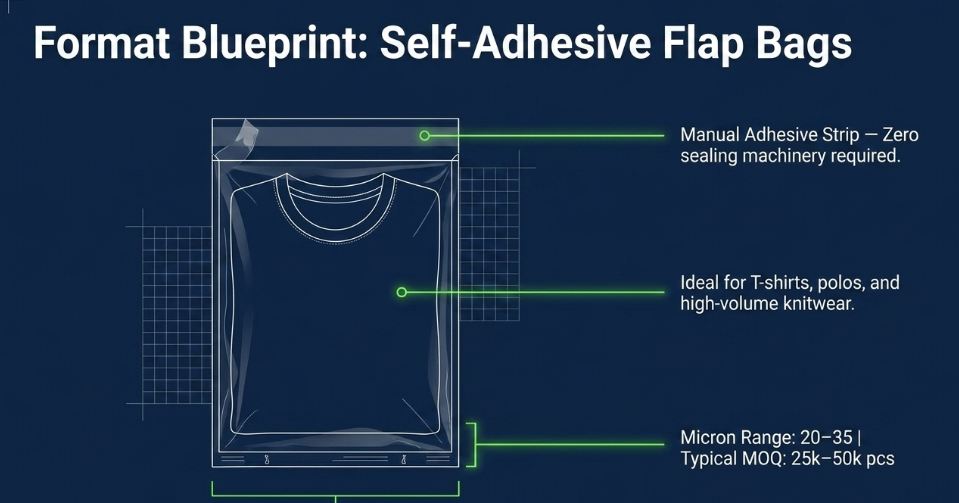
A lot of factories running compostable trials assume they’ll need new equipment. Self-adhesive format removes that barrier entirely. It is the workhorse format for most garment bags for clothing manufacturers dealing in high-volume basics. Think folded T-shirts, polos, and knitwear.
The bag has an adhesive strip on the flap, so factory floor staff can seal it by hand without any sealing machine.
- Side-seal / open-top bags (bulk factory packing)
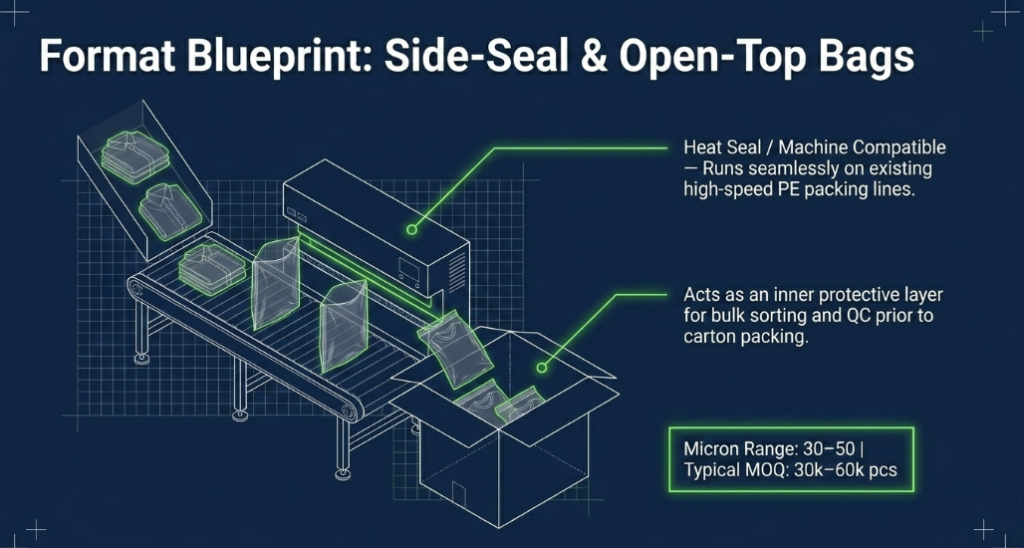
For heavier bulk packing, where garments move through sorting and QC before final packaging, open-top or side-seal bags work better. They’re also faster to load in high-speed lines. They are commonly used when the bag isn’t the final consumer-facing pack, just an inner protective layer before the shipping carton.
3. Zip-lock / resealable bags (premium garments and QC-heavy orders)
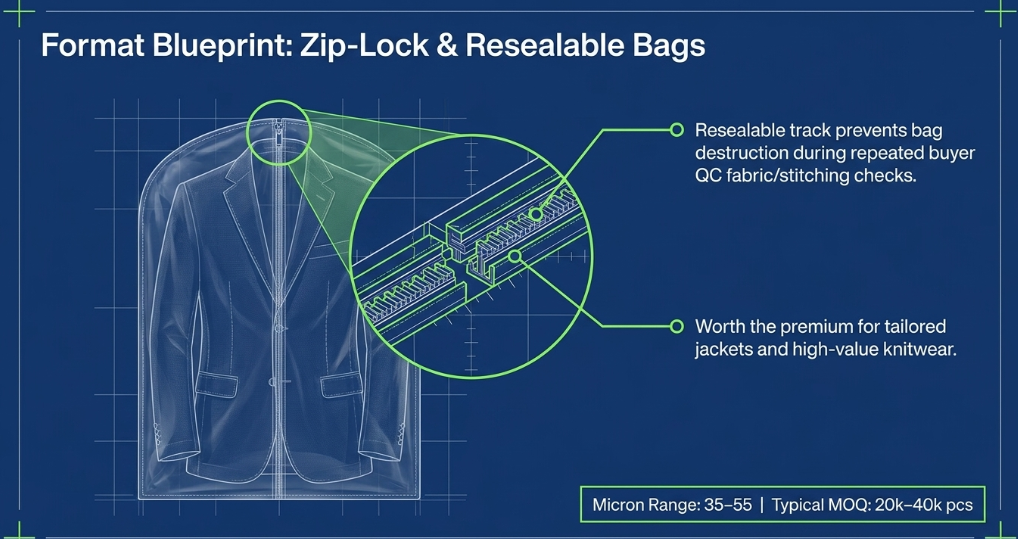
For higher-value garments, (tailored jackets, premium knitwear, or anything that goes through repeated quality checks before it ships) a plain adhesive flap isn’t enough. Once a buyer’s QC team opens the bag to inspect stitching or fabric, an adhesive seal can’t be reused cleanly.
Zip-lock style compostable garment bags solve this. It costs a little more than a basic flap bag, but for premium export lines, it’s usually worth the difference.
4. Heavy-duty compostable poly bags (winter wear and heavier fabrics)
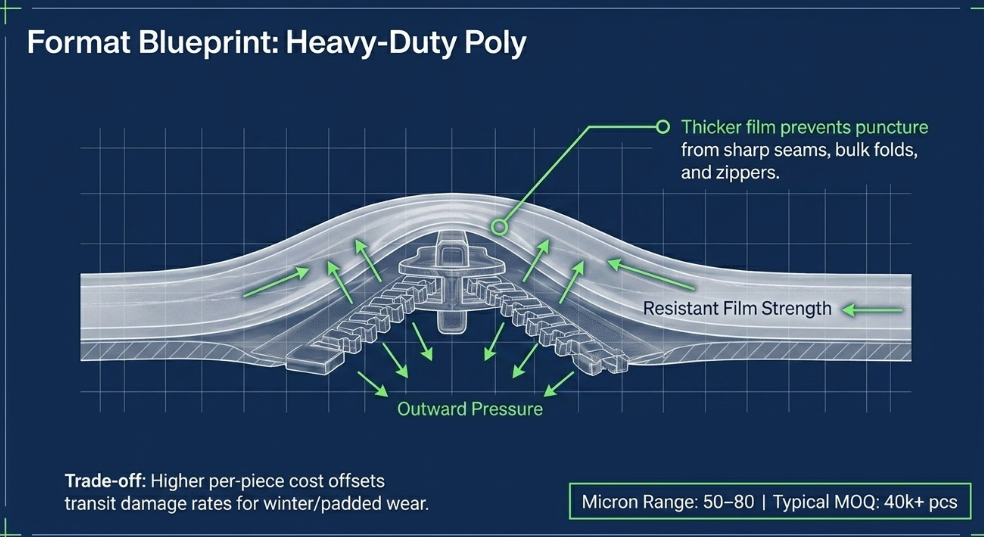
Jackets, padded wear, and heavier woven fabrics put more strain on a bag than a folded T-shirt ever will. Sharp seams, zippers, and bulkier folds can puncture a thin film during packing or transit. That’s why instead of lighter grades, heavy-duty biodegradable garment bags are the right fit here.
The thicker film holds up under the extra weight and rougher edges of winter wear. The trade-off is cost. At this thickness, per-piece pricing is higher, and some cost-sensitive buyers might push back. But that’s usually a short conversation once they see the puncture and damage-rate difference compared to a lighter grade.
Size and micron range by garment type and freight mode (sea vs air)
Most exporters pick one micron thickness and use it for every order. That’s usually a mistake. The right thickness depends on two things that change from order to order:
- How delicate the garment is,
- how long the bag has to survive before it reaches the buyer’s warehouse.
Here’s what thickness of compostable garment bags work best based on garment type and freight more:
- Lightweight garments (T-shirts, innerwear): 20 to 30 microns is usually enough.
- Folded knitwear or denim: 35 to 50 microns for added puncture resistance.
- Sea freight shipments (30 to 45 days in transit, more handling): lean toward the higher end of the range.
- Air freight shipments (faster transit, less handling stress): the lower end works fine and saves cost.
Once you’ve settled on format and thickness, the next question is simple: how do you compare these choices side by side before committing to a grade?
Below is a decision matrix that can help you decide:
Choosing the right format and grade
| Format | Micron range | Best for | MOQ | Sealing method | Export suitability |
| Self-adhesive flap bag | 20-35 microns | T-shirts, knitwear, basics | 25,000-50,000 pcs | Manual adhesive strip | High, no line changes needed |
| Side-seal / open-top | 30-50 microns | Bulk factory packing, denim | 30,000-60,000 pcs | Heat seal / machine | High, suited to high-volume lines |
| Zip-lock / resealable bag | 35-55 microns | Premium garments, QC-heavy orders | 20,000-40,000 pcs | Zip-lock, resealable | High, best for repeated inspection cycles |
| Heavy-duty compostable poly | 50-80 microns | Winter wear, heavier fabrics | 40,000+ pcs | Heat seal | Moderate, cost-sensitive buyers may push back |
Important: A compostable apparel packaging grade that works for a T-shirt exporter shipping to Germany will look completely different from one that works for a jacket exporter shipping to the US. That’s why the next filter isn’t technical. It’s regulatory, and it’s where a lot of export orders quietly get stuck.
Compliance fit for exporters
This is the decision that dictates whether your shipment clears without friction or gets flagged at the buyer’s compliance desk.
What EU buyers check (EN 13432, PPWR)
EU buyers look for EN 13432 certification, which confirms the material breaks down under industrial composting conditions within a defined timeframe. On top of that, the EU’s Packaging and Packaging Waste Regulation (PPWR) is tightening restrictions on single-use plastic packaging formats. This is why demand for export apparel packaging made from compostable film has grown among EU-facing exporters.
What US buyers check (ASTM D6400)
US buyers typically ask for ASTM D6400 certification. It’s functionally similar to EN 13432 but uses US testing protocols. That means a bag certified under one standard doesn’t automatically satisfy the other. Exporters selling into both markets often need dual-certified material.
What Indian export documentation requires
On the Indian side, the Central Pollution Control Board (CPCB) requires manufacturers to be registered. Also, the CPCB registration number needs to be printed directly on the bag. Customs and buyer audits both check for this.
The absence of proper certifications is the most common reason compostable packaging shipments get held up at the port. As UKHI’s founder Vishal explains, “Most exporters don’t lose the order because their material is wrong. They lose time because the certificate on paper doesn’t match what’s printed on the bag itself.” This mismatch is more common, and more avoidable, than most first-time buyers expect.
Compliance gets you past the gate. What actually convinces a factory owner to switch is money, so let’s talk about that.
Getting started and understanding the economics of compostable apparel packaging
A mid-sized knitwear exporter in Tiruppur was quoting garments to a German buyer who insisted on compostable inner packaging. The compostable garment bags cost about 18 to 22 per cent more per piece than their existing PE bags.
On a 50,000-unit order, that looked like a real number on paper. But the buyer’s compliance team fast-tracked the shipment. They also skipped a packaging audit that had delayed the previous order by nine days. Moreover, they even placed a repeat order the following quarter specifically because the packaging matched their sustainability reporting needs.
The extra cost per bag was recovered many times over in reduced delays and retained buyer relationships.
This isn’t a one-off story. It’s the same pattern playing out across apparel export packaging decisions right now. The packaging line item is small but its downstream effect on order continuity is not.
If you’re evaluating compostable apparel packaging for your own export line, the easiest next step is a sample kit. Drop our team at UKHI a message on WhatsApp to get a grade recommendation based on your garment type and freight mode. Then get a sample kit and see what the right fit is before you commit to a bulk order.
FAQ
Is there a minimum order quantity for a new exporter testing compostable garment bags for the first time?
Most suppliers offer smaller trial batches before committing to full compostable garment bags bulk MOQs. This helps first-time exporters validate fit, sealing, and buyer feedback before scaling up.
Can biodegradable garment bags run on existing PE packing lines without changing machines?
Yes, in most cases. Self-adhesive biodegradable garment bags, for example, are designed to work with manual sealing. Also, side-seal formats run on standard heat-seal equipment already used for PE bags. So compostable apparel packaging rarely requires new machinery.
What’s the price difference between compostable garment bags and regular poly garment bags at export volumes?
Compostable garment bags typically cost 15-25% more per piece than regular alternatives. Though this gap narrows as order volumes scale and most export apparel packaging suppliers offer bulk pricing. The cost difference also vanishes when you consider export and sustainability compliance.