
According to recent industry surveys, more than half of Indian retail brands cite “high material cost” as the primary barrier to switching from traditional polybags to sustainable alternatives.
For years, the narrative has been simple. Traditional plastic is dirt cheap. Bioplastics are a luxury for the ultra-premium niche. While that might have been the reality in 2020, in 2026, that assumption is outdated and financially inaccurate.
Sure, traditional plastic carry bags are “perceived” as the low-cost leader. But this “cheapness” is an illusion created by ignoring the rising costs of regulatory compliance and the massive shift in domestic manufacturing.
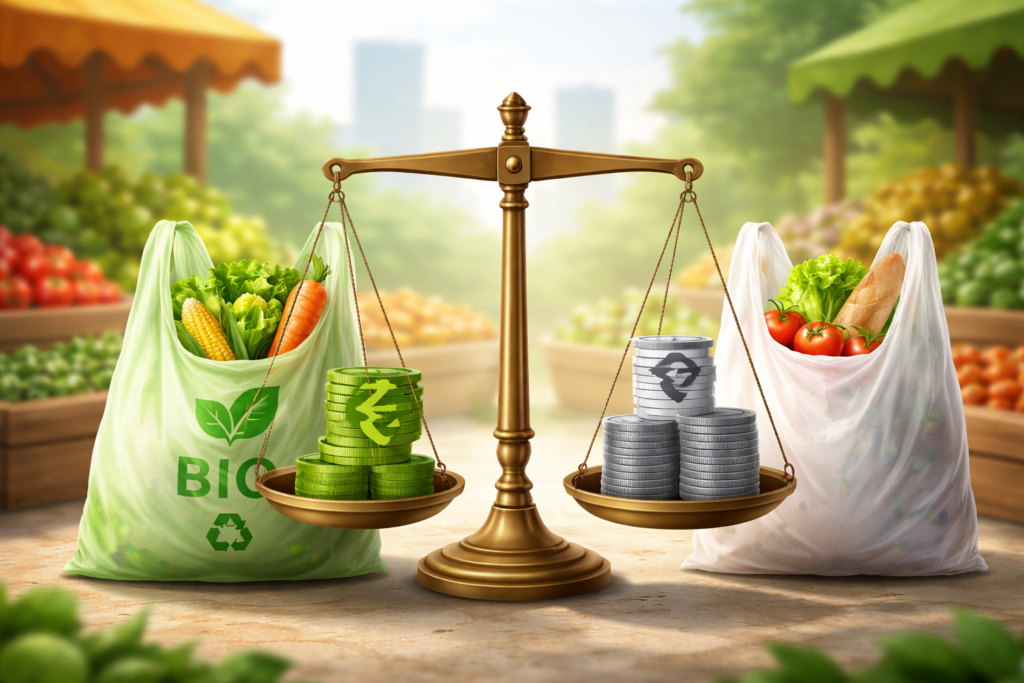
So, below, I am going to break down the real compostable bags price today versus half a decade ago. We will analyze the true cost of switching to bioplastic carry bags and, more importantly, the hidden cost of sticking to traditional plastic.
The Cost of Bioplastic Carry Bags: Then vs. Now
Four to five years ago, the price gap was a chasm. In 2021, imported bioplastic resins were priced at roughly 4x to 5x the cost of virgin PE (Polyethylene). Bioplastic packaging was a novelty. It often costs upwards of ₹350–₹400 per kg. Today, that gap has shrunk to a fraction. Domestic resins like Ukhi’s Ecogran are now available at ₹190/kg, which brings down the cost of bioplastic carry bags too.
So, with that, the cost of biodegradable packaging in India has dropped to a range where the per-piece difference is measured in paisa, not rupees.
How This Price Gap Has Closed
- Domestic Feedstock Revolution
Previously, India relied on imported PLA or PBAT resins. Today, sustainable packaging companies in India are leveraging local agricultural waste. By using “Agro-residues” as a primary filler, we have decoupled the price of bioplastics from global shipping rates and import duties. - Manufacturing Scale
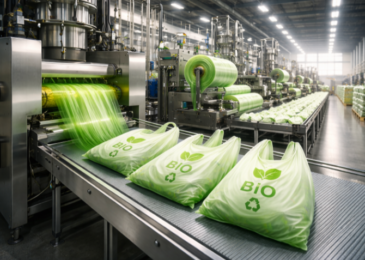
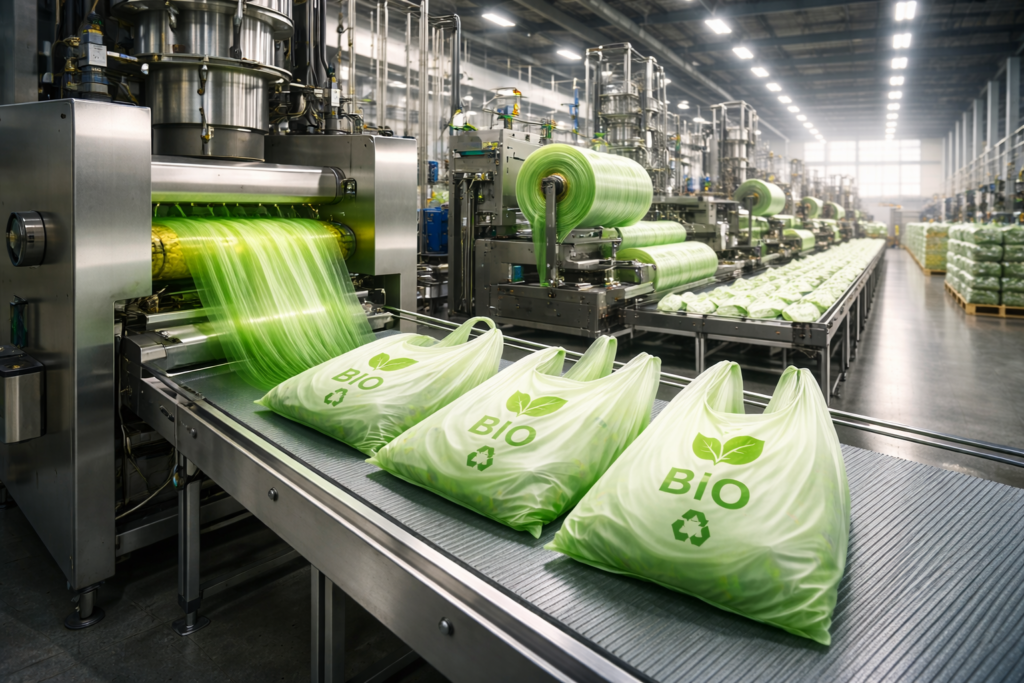
As demand has increased, the “batch processing” of the past has been replaced by continuous industrial extrusion. This scale allows bioplastic carry bags to be produced with the same efficiency as traditional plastic. This spreads fixed costs over millions of units.
- The 120-Micron Mandate
The Indian government’s ban on plastic bags thinner than 120 microns has been a massive equalizer. To be “legal” in plastic, you now need a very thick, heavy bag. Bioplastic packaging is legal at 25–30 microns. While the price per kg of bioplastic is higher, you get significantly more bags per kg because the material is thinner and more efficient. - Incentivized Supply Chains
State-level subsidies for sustainable packaging companies in India have lowered the barrier to entry for local manufacturers. These incentives are directly passed down to the buyer. This results in stabilizing the compostable bags price even with fluctuating global oil prices. - Indigenous Compounding
We no longer just “import and sell.” Indian scientists are compounding resins specifically for our climate. This local R&D has eliminated the “foreign technology premium.” This makes biodegradable packaging in India a home-grown, cost-effective reality.
Understand the Total Cost of Ownership (TCO)
If you are only looking at the “unit price” on a proforma invoice, you are missing the bigger picture. In a modern business environment, the unit cost of a bag shouldn’t be your only deciding factor. Instead, you must understand the Total Cost of Ownership (TCO).
TCO for Bioplastic Carry Bags
- Zero Regulatory Liability
When you use CPCB-approved bioplastic carry bags, you have 0 risk of store closures. No inventory seizures and no environmental fines. This “peace of mind” has a tangible financial value. - Brand Equity and Customer Retention
Modern Indian consumers (especially Gen Z and Millennials!) are actively avoiding brands that use single-use plastic. The “marketing value” of bioplastic packaging often offsets the slight price increase. Plus, it also improves customer loyalty. - Ease of Export
For any brand looking to sell in the EU, North America, or other global destinations, bio-based materials are becoming mandatory. Using biodegradable packaging in India ensures your supply chain is ready for global expansion. Without costly repackaging required for export.
TCO for Traditional Carry Bags
- Escalating EPR Costs
Under Extended Producer Responsibility (EPR) rules, businesses are now financially responsible for the collection and processing of the plastic waste they generate. These “hidden” credits add a significant layer to the real cost of traditional plastic. - The “Legal” Thickness Cost
To stay legal, a 13″x16″ plastic bag must be 120 microns thick. This bag weighs significantly more than a 25-micron compostable bag. As a result, your “price per piece” for a legal plastic bag is often higher than the compostable bags price for a thinner, high-performance bio-alternative. - Reputation Risk
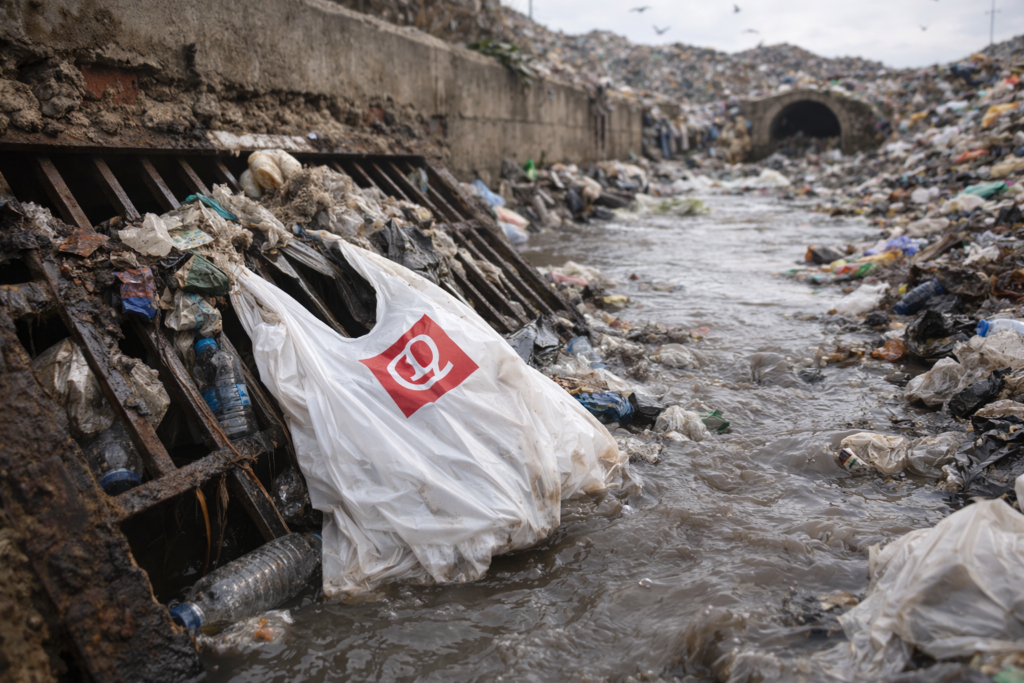
The cost of a single viral video showing your branded plastic bag in a clogged drain or a landfill? Well, that’s a “brand tax” that most companies cannot afford to pay.
Important: Imported vs. Indian Bioplastic
For a long time, the high cost of bioplastic packaging was due to its “foreign” status. Imported resins are subject to currency fluctuations, high ocean freight, and custom duties that can add 30–40% to the base cost.
By choosing sustainable packaging companies in India, you are cutting out the middleman and the logistics overhead. Indian-made bioplastic carry bags use local labor and local biomass. This ensures the compostable bag’s price stays shielded from global economic shocks.
Furthermore, local manufacturers understand the specific tensile strength requirements of the Indian market. Thus, they provide a more “fit-for-purpose” product than generic global imports.
When Does it Really Make Sense: The Economies
I am not going to tell you that every small Kirana store should switch to bioplastic carry bags today. For some, the margins are simply too thin.
However, when you hit certain economies of scale, the switch to biodegradable packaging in India becomes a mathematical no-brainer.
The threshold for most retail brands is an order volume of 500kg to 1 ton per month. At this level, the manufacturing efficiencies of Ukhi biogranules allow prices that are strikingly close to traditional premium packaging.
Situations where switching makes immediate sense:
- Retailers in High-Scrutiny Zones
If your stores are in Tier-1 cities where plastic bans are strictly enforced. - eCommerce & D2C Brands
Where the “unboxing experience” is a core part of the product value. - Export-Oriented Units
Where destination country laws mandate bioplastic packaging. - FMCG Premium Tiers
Where the packaging cost is a small fraction of the ₹500+ MRP. - Organizations with ESG Goals
Where carbon-offsetting is a corporate mandate.
If these scenarios don’t match your situation, bioplastic carry bags aren’t the right call right now. That said, make sure you are still finding alternatives to steer away from the plastic carry bags.
Don’t Wait, Start Your Sustainability March Today
I have tried to explain the math. Now it is your turn to act. The era of “expensive sustainability” is over. It is time to protect your business from future plastic bans with CPCB-approved compostable carry bags made using Ukhi biogranules.
Don’t take my word for it though. Run the numbers yourself. Order a sample kit from Ukhi today and see the difference in quality and cost-effectiveness for your brand.
After all, switching to sustainable packaging companies in India is no longer just an ethical choice. It’s the smartest financial move you’ll make this year.
FAQs
1. Is the compostable bags price stable or will it go up?
Unlike oil-based plastics that fluctuate with global conflicts, the price of biodegradable packaging in India is relatively stable. That’s because it relies on local agricultural cycles. As more sustainable packaging companies in India scale up, we actually expect prices to continue trending downward.
2. Can these bioplastic carry bags be reused?
Yes. High-quality bioplastic carry bags made from Ukhi granules are designed for multiple uses. They have high tensile strength and only begin to biodegrade when placed in a compost environment with the right moisture and microbial activity.
3. Do I need new machinery to use bioplastic packaging?
No. One of the reasons the price has dropped is that our granules are “drop-in” solutions. They work on the same extrusion and molding machines used for traditional plastic. So manufacturers don’t have to invest in new, expensive equipment to produce bioplastic carry bags.