
Packaging for food exports has a tough task to achieve. It has to protect food during long transits, maintain its freshness, and also comply with strict food safety regulations.
Now there is a new aspect – reduce environmental impact and meet various bans and restrictions.
Increasingly, exporters are looking at compostable packaging for food exports. However, replacing conventional plastics with new compostable materials is not a simple matter of swapping out one wrapping film for another.
The right decision begins with understanding where compostable food packaging actually works. The next step is to select materials that balance sustainability with protection.
Short answer: what compostable packaging should food exporters use?
Compostable packaging for food exports works best when the pack is chosen around the food first, not around the sustainability claim.
A dry snack pouch, a fresh produce liner, a bakery tray, and a frozen food overwrap do not face the same risks. One needs moisture control. Another needs breathability. A third needs grease resistance. A fourth needs cold-chain flexibility.
So the right question is not, “Can this be compostable?”
The better question is, “Can this protect the food, pass the buyer’s compliance checks, and survive the export route?”
For food exporters, the safest starting point is food-grade compostable packaging for dry foods, snacks, bakery products, produce, and secondary food packs. These applications usually have clearer performance requirements and lower failure risk than oily, frozen, high-moisture, or long shelf-life foods.
More complex foods can also move to compostable food packaging, but only after stronger validation. The final pack must be tested, not just the resin. This matters because a compostable resin certificate does not automatically prove that the printed pouch, zip closure, ink, adhesive, coating, or tray is certified for the destination market.
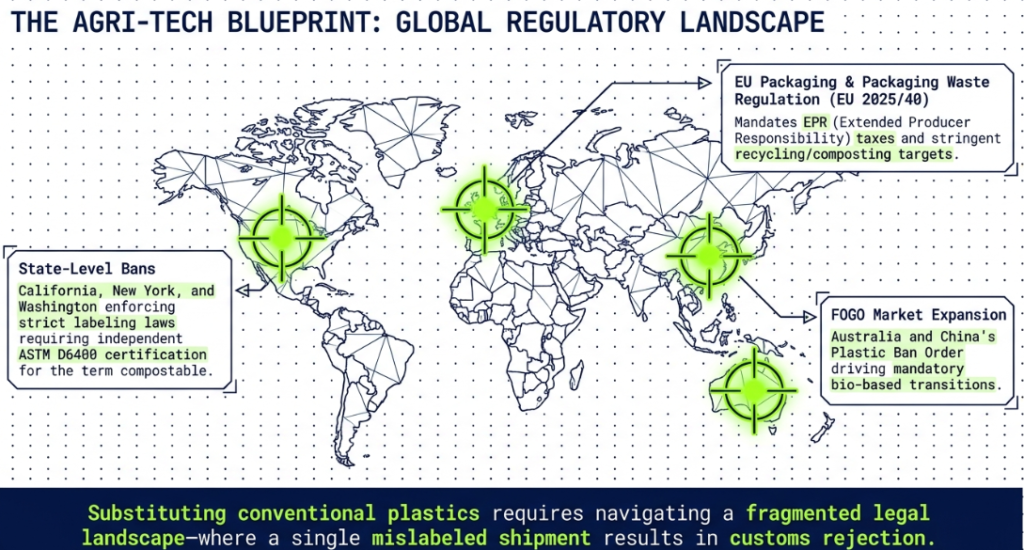
For Europe and the United Kingdom, exporters usually need EN 13432 alignment. For the United States and Canada, ASTM D6400 and buyer-recognised certification such as BPI are more relevant.
Food-contact rules also come first. In the European Union, materials must follow Regulation (EC) No 1935/2004, Commission Regulation (EU) No 10/2011 where plastic components are used, and GMP requirements under Regulation (EC) No 2023/2006. For North America, buyers often look for FDA food-contact compliance under relevant 21 CFR provisions.
Once food safety is clear, compostability can be checked properly.
Ukhi makes biopolymer-based films, coatings, thermoforming, extrusion, injection moulding, additives, and customised grades. This makes our vast array of products more practical for exporters who need different packaging types across food categories.
Packaging formats that fit compostable packaging for food exports
Different food exports need different packaging behaviour. A format that works well for dry snacks may fail on frozen food. A pouch that looks good on a shelf may not provide enough barrier for spices or nuts.
The main export-fit formats are:
| Packaging format | Better fit | What to check before approval |
| Compostable pouches | Dry snacks, nuts, powders, tea, coffee, spices, bakery | OTR, MVTR, seal strength, print adhesion |
| Transparent compostable laminates | Retail-ready food packs where product visibility matters | Clarity, barcode readability, ink and adhesive certification |
| Compostable bags and liners | Produce, ingredient packs, inner protection, food-contaminated liners | Breathability, condensation control, puncture resistance |
| Compostable shrink film and overwrap | Grouped packs, trays, secondary protection | Tear resistance, line speed, transit stability |
| Thermoformed trays and clamshells | Bakery, ready-to-pack foods, foodservice exports | Rigidity, lid fit, heat resistance, leakage |
| Compostable extrusion-coated paper | Wraps, cups, cartons, trays, grease-prone foods | Coating uniformity, grease barrier, compostability certificate |
This is where buyers should slow down. Certified compostable packaging is only useful when the format matches the food’s real behaviour during storage, transport, retail handling, and disposal.
Decision matrix: Match the pack to food type and export risk
Food exporters usually face two questions at the same time. Will the pack protect the product? Will the buyer accept the claim?
This matrix helps connect both.
| Food export use case | Better compostable format | Main requirement | Buyer watch-out |
| Dry snacks | Compostable pouch or laminate | Seal strength, printability, moisture control | MVTR and OTR must match shelf-life target |
| Fresh produce | Produce bag or breathable liner | Water-loss control, ventilation, strength | Condensation can create microbiological risk |
| Bakery | Pouch, tray, or coated paper | Grease resistance and aroma control | Shelf-life testing should happen before bulk order |
| Frozen food | Validated film, tray, or overwrap | Cold flexibility at around minus 20°C | Brittle film and weak seals can fail in transit |
| Oily foods | Coated paper or barrier pouch | High grease resistance | Creases and folds may allow oil strike-through |
| Bulk food export | Liner, bag, or secondary film | Load strength and puncture resistance | Warehouse stacking can create compression failure |
For dry foods, exporters should ask for OTR and MVTR values because oxygen and moisture affect rancidity, crispness, and aroma. For oily foods, grease resistance should be checked through kit-level performance. For frozen food, the pack must stay flexible in the cold chain.
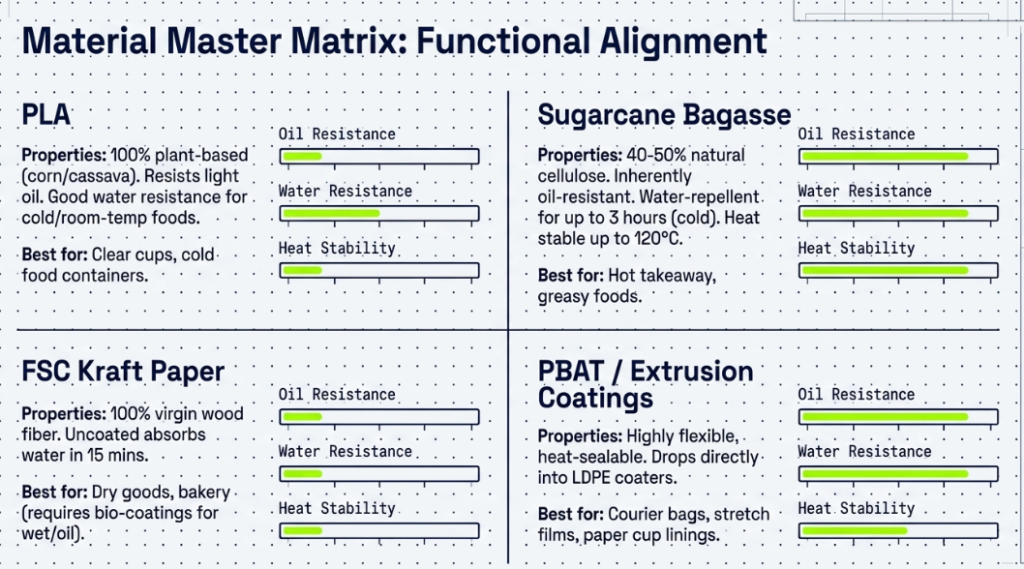
This is why biodegradable food packaging is not a strong enough claim for export buying.
“Biodegradable” does not tell the buyer where the pack breaks down, how long it takes, what residues remain, or whether the finished pack has passed a recognised compostability test.
Compliance fit for food-grade compostable packaging
For food exports, compliance has three layers.
The first layer is food-contact safety. The packaging must not transfer unsafe substances into food. This applies before any compostability claim is discussed.
The second layer is compostability certification. EN 13432, ASTM D6400, TÜV Austria OK compost, DIN CERTCO Seedling, BPI, OK compost HOME, and AS 5810 are not interchangeable labels. Each one points to a specific testing route, geography, or composting condition.
The third layer is claim control. If the pack is industrially compostable, the artwork should not imply home compostability. If only the resin is certified, the final printed pouch should not be marketed as fully certified unless the finished pack is covered.
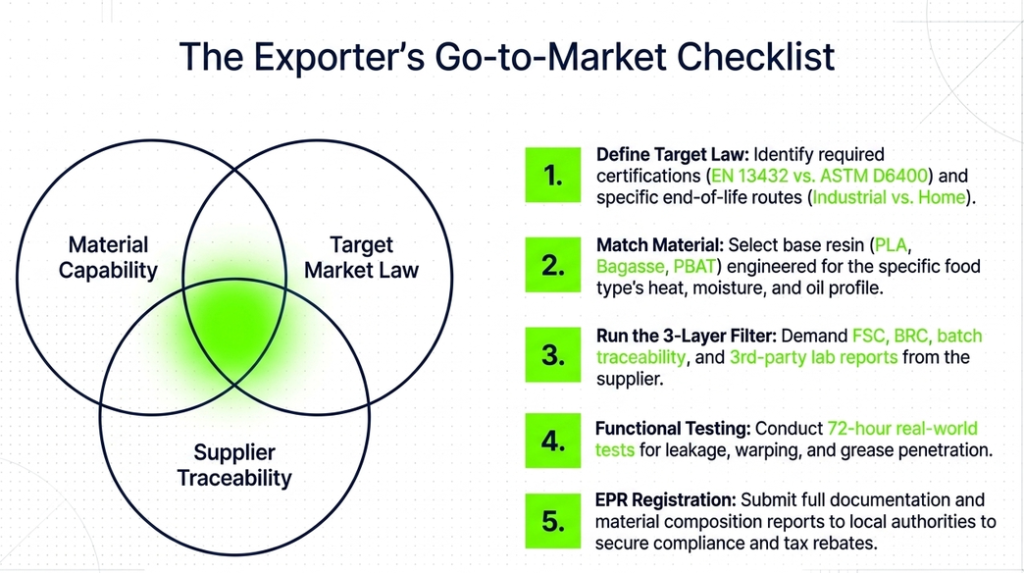
Export buyers may ask for:
- Technical Data Sheet
- Safety Data Sheet
- food-contact or migration test report
- compostability certificate for the finished pack
- PFAS-free declaration, where relevant
- Batch traceability
- Print, ink, and coating confirmation
- Disposal claim proof
This documentation is not paperwork for its own sake. It reduces the risk of buyer rejection, greenwashing disputes, customs issues, and last-minute relabelling.
Proof or real-world fit: How an exporter should approve the pack before RFQ
A dry food exporter shifting from PET or PE packaging to compostable packaging for food exports should not begin with a bulk order.
The better route is a controlled approval process for compostable packaging for food exports.
First, define the food risk. A dry snack may need an oxygen and moisture barrier. A spice mix may need aroma control. A bakery product may need grease resistance. A frozen product may need cold flexibility and seal strength.
Second, run machine and pack tests. The exporter should check sealing temperature, filling-line behaviour, puncture resistance, drop performance, print adhesion, barcode readability, and storage response under humidity and heat.
Third, validate the certification. The finished pack should match the export market’s requirements. The certificate should cover the format, thickness range, ink system, closure, coating, and disposal claim wherever applicable.
Fourth, run a pilot order. A small export-style batch helps identify warping, leakage, seal failure, odour transfer, scuffing, or transit compression before the RFQ moves to scale.
This process is slower than choosing a catalogue pouch, but it is much safer for export buyers.
Frequently asked questions
Is compostable packaging for food exports available from India?
Compostable food packaging is widely available in India. Indian suppliers now offer:
- Compostable pouches
- Bags
- Liners
- Containers
- Coated paper
- Thermoformed formats
Exporters should still check whether the supplier can provide documentation such as food-contact reports and compostability certificates.
How should food-grade compostable packaging be stored before export use?
It is best to store it in a cool, dry, shaded area. It should be protected from direct sunlight, excess humidity, and heat. Compostable films and coated papers can lose performance if stored poorly.
What is the safest first product category for biodegradable food packaging exports?
It is safest to begin with dry foods. Snacks, grains, coffee, and tea are easier to validate than oily, wet, frozen foods. The use of the term “biodegradable” on the label should still be backed by certification.
Can compostable food packs be used for vacuum packaging?
Vacuum-packed food needs strong seals and barrier performance. Certified compostable vacuum bags are made from renewable, plant-based materials such as PLA (Polylactic Acid), PBAT, and corn or sugarcane starch.
What should buyers ask before ordering compostable packaging wholesale?
Buyers should ask for and scrutinize:
- Material grade
- Food-contact proof
- Compostability certificate
- Print compatibility
- MOQ
- Lead time
- Storage conditions
- Sample availability
- Export documentation
Expert quote
“Food export packaging cannot be selected only by material name. The real decision is whether the pack protects the product, runs on the buyer’s line, carries the right certification, and survives the export route. Compostable packaging works best when these four checks happen before scale-up.”
Vishal Vivek, CEO and Founder, UKHI
Get a food export packaging sample kit or grade recommendation
To recommend the right food-grade compostable packaging, Ukhi needs the food details first.
Share the food type, shelf-life target, export market, pack size, current material, filling process, storage temperature, and whether the pack needs barrier, grease resistance, transparency, printing, or heat sealing.
From there, the route is simple.
Define the food export use case.
Choose the material and format.
Check food-contact and compostability compliance.
Test samples on the line.
Move to RFQ with fewer hidden risks.
For exporters, this is the practical way to shift from conventional plastic to certified compostable packaging without risking product quality, buyer confidence, or export documentation.