
Short answer: what is the best alternative to plastic takeaway packaging?
The best compostable packaging for takeaway food depends on the food being packed.
Dry snacks can work well in paperboard or compostable-lined boxes. Oily meals usually need coated fibre trays or lined containers. Curries and gravies need bowls with secure lids, heat resistance, and leak testing. Cold salads may need clear PLA or fibre bowls, while bakery products often work well in Kraft boxes or moulded trays.
So the best alternative is not one universal material. It is a matched system of material, format, barrier, lid, and compostability documentation.
For B2B buyers, the decision for compostable packaging for takeaway food should start with food behaviour, not catalogue appearance.
That starts with understanding the material options.
Overview of compostable alternatives for takeaway food
Most compostable packaging for takeaway food in India falls into two broad families: biopolymer-based packaging and fibre-based packaging.
Both can replace petroleum-based plastic in specific applications, but they behave differently in heat, oil, moisture, sealing, and disposal.
Biopolymer-Based Compostable Packaging
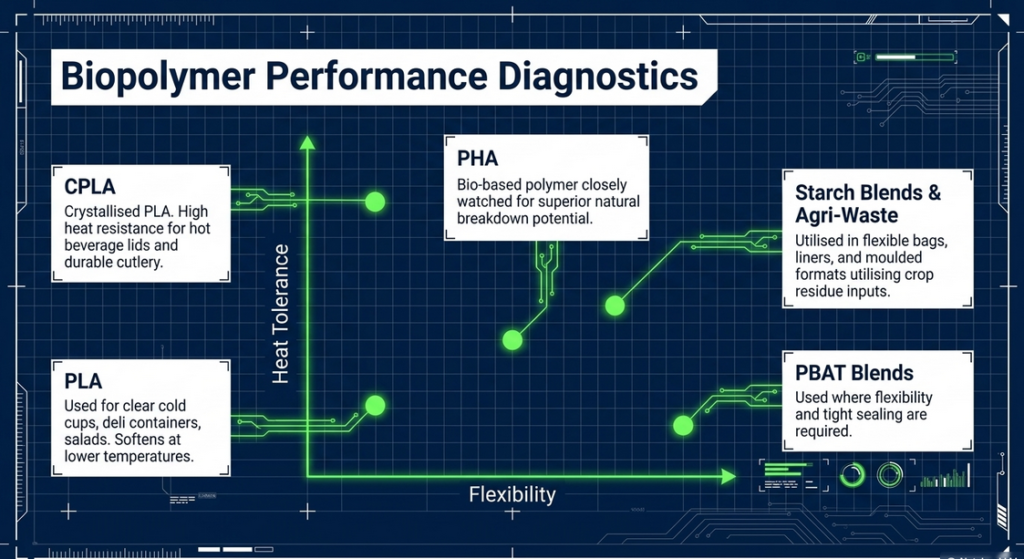
Biopolymers are materials designed to behave like plastic in use, but break down under defined composting conditions.
Common examples include:
- PLA, often used for clear cold cups, deli containers, and lids.
- CPLA, a crystallised form of PLA used for higher-heat lids and cutlery.
- PBAT blends, often used where flexibility and sealing are needed.
- PHA, a bio-based polymer with better breakdown potential in some natural environments.
- Starch blends, used in flexible bags, liners, and certain moulded formats.
- Agri-waste-based biopolymers, which use crop residue as a material input.
PLA is useful when a buyer wants clarity, such as for cold beverages or salads. It is not ideal for hot food unless modified, because standard PLA softens at lower temperatures. CPLA performs better for hot lids and cutlery. PHA is being watched closely because it can offer better compostability profiles than some older bioplastics. (Sources: Eunomia Research & Consulting; Dossier, Bioplastics as Food Contact Materials; NITI Aayog.)
H3: Fibre-based compostable packaging
Fibre-based packaging is made from plant fibres. The most common materials include sugarcane bagasse, bamboo pulp, paperboard, kraft paper, palm leaf, wheat straw, and rice husk.
Bagasse is widely used for plates, bowls, trays, and clamshells because it forms well and has natural rigidity. It is also suitable for many hot-food applications, with some bagasse formats reported to withstand temperatures up to 120°C. (Sources: Eunomia Research & Consulting.)
Paper and paperboard are familiar to food businesses, but they need careful checking. A paper box lined with conventional PE plastic is not the same as a compostable box. If the final pack is sold as compostable, the liner or coating must also be compostable.
That is where many buying mistakes happen.
A box may look natural. A bowl may be brown. A tray may feel like fibre. None of that proves compostability.
H3: Compostable coatings and liners
Takeaway food usually fails packaging through oil, steam, gravy, or condensation.
That is why coatings matter.
A dry sandwich box may only need paperboard strength. A chole rice bowl or biryani tray needs a barrier against oil and moisture. A soup bowl needs heat tolerance, lid fit, and liquid hold. If the coating is made from regular plastic, the final pack cannot honestly be treated as fully compostable.
Buyers should also ask about PFAS. Some older grease-resistant fiber packaging used PFAS chemicals for oil resistance. In 2026, leading certification systems and laws such as California AB 1201 have moved toward PFAS-free compostable packaging and testing for total fluorine. (Sources: BPI; Closed Loop Partners.)
Now that the material choices are clear, the next question is what those materials become in real takeaway operations.
Compostable packaging products used for takeaway food
For restaurants and food brands, packaging is not bought as “PLA” or “bagasse” in isolation. It is bought as a box, bowl, pouch, wrap, tray, or lid.
Boxes, Bowls, Trays, Clamshells, And Containers With Lids
Biodegradable food packaging boxes are used for burgers, fries, rice meals, snacks, bakery items, and combo packs. Fibre clamshells suit many dry and semi-dry foods. Kraft boxes work well for bakery and café takeaway. Bagasse trays are useful for oily or hot meals when the structure and barrier are tested.
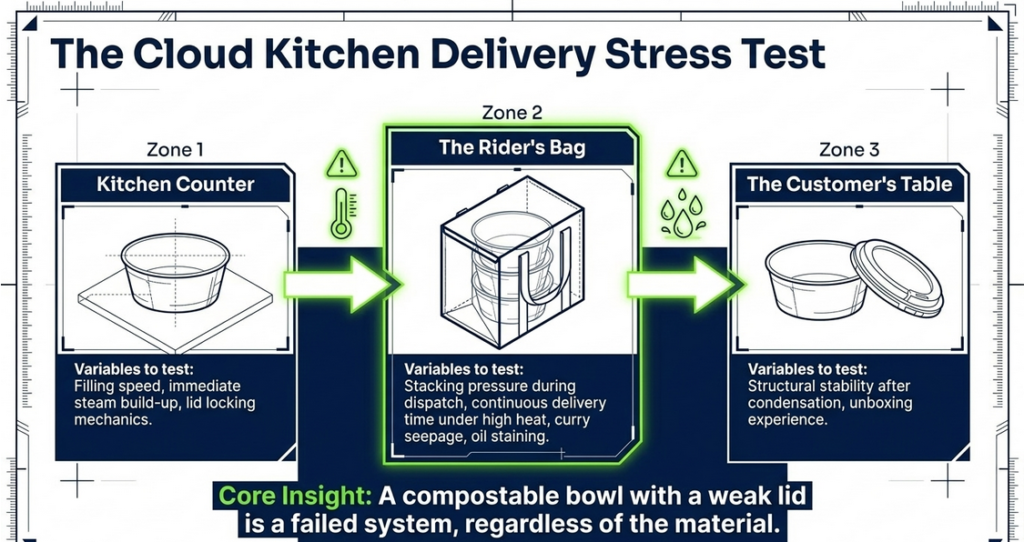
In India, biodegradable containers with lids are especially relevant for cloud kitchens, thali meals, gravies, salads, and subscription food delivery. The lid is not a small detail. A compostable bowl with a weak lid can still fail during delivery.
For Indian food, buyers should test:
- steam build-up
- oil staining
- curry seepage
- lid locking
- stacking during dispatch
- delivery time under heat
A good takeaway pack does not only survive on the kitchen counter. It also survives in the rider’s bag.
Films, Sachets, Wraps, Liners, And Coated Paper Formats
Not every takeaway format is rigid.
Compostable films and coated paper formats can support wraps, liners, dry food bags, portion packs, cutlery sleeves, and branded takeaway sleeves. Cellulose films are used for wraps and dry-food applications. PBAT and starch blends can support flexible formats where sealability is important. Seaweed-based films are emerging for sachets and edible applications, though they are still not the default for most B2B takeaway procurement. (Sources: NITI Aayog; Dossier, Bioplastics as Food Contact Materials.)
A buyer may need a rigid container, a coated liner, and a film-based accessory in the same packaging system. The cleaner the material logic across the system, the stronger the final sustainability claim.
Once formats are shortlisted, the buyer decision becomes practical.
What should B2B buyers check before switching from plastic?
The buying of compostable packaging for takeaway food should not begin with price per piece alone. Unit price matters, but performance failure costs more.
A better switch checklist looks at four things.
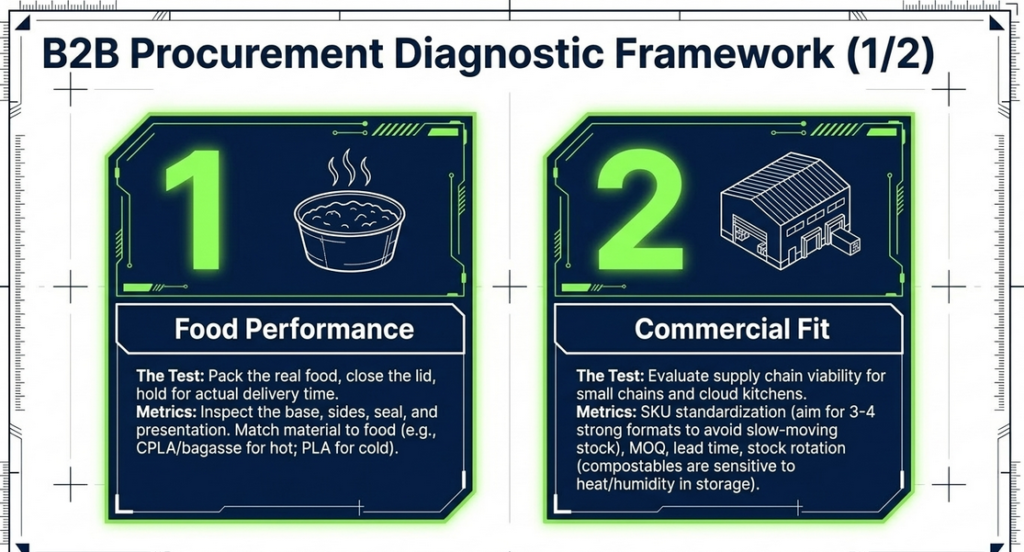
Food Performance
Start with the food.
Hot food needs temperature tolerance. Oily food needs grease resistance. Wet food needs barrier control. Delivery food needs lid security. Steamed food needs structural stability after condensation.
Standard PLA may work for cold applications, but not for hot curries. CPLA, bagasse, coated fibre, and selected heat-stable biopolymer formats may be better for hot food. (Sources: Eunomia Research & Consulting.)
The practical test is simple: pack the real food, close the lid, hold it for the real delivery time, and inspect the base, sides, seal, and customer-facing appearance.
Commercial Fit
A compostable switch has to work commercially.
Buyers should check MOQ, lead time, storage life, custom branding cost, SKU count, and reorder consistency. Compostable materials can be more sensitive to heat and humidity during storage than conventional plastic. That means stock rotation matters.
For small chains and growing cloud kitchens, SKU control is important. It is usually better to standardise three or four strong formats than buy too many specialised packs that move slowly.
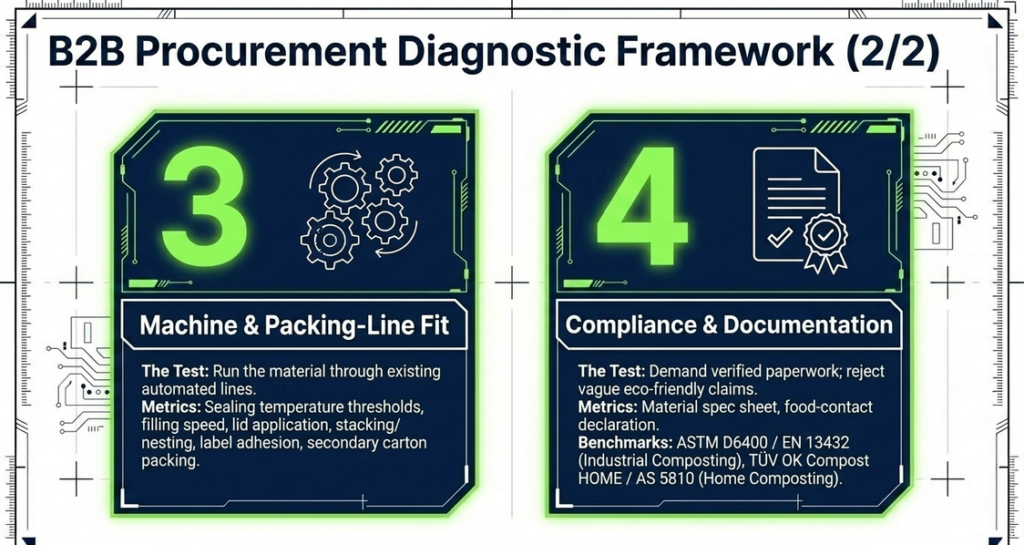
Machine And Packing-Line Fit
If a business uses filling lines, sealing machines, labelling equipment, or heat-sealing stations, the packaging must be tested on those lines.
Check:
- sealing temperature
- filling speed
- lid application
- stacking and nesting
- label adhesion
- secondary carton packing
- film behaviour during sealing
A compostable packaging material for takeaway food that looks good by itself may still fail if it does not match the packing process.
Compliance And Documentation
Buyers should not rely on words like eco-friendly, plant-based, biodegradable, or natural.
Ask for documents.
The minimum set should include the material specification sheet, food-contact declaration, compostability certificate, and migration test where relevant. For industrial compostability, ASTM D6400 and EN 13432 are widely used benchmarks. For home composting, TÜV OK Compost HOME and AS 5810 are common reference points. (Sources: BPI; DIN CERTCO; TÜV Austria; Eunomia Research & Consulting.)
For India-focused buyers, claim discipline is important. If the product is sold as compostable, the documentation should support that claim clearly.
The simplest rule is this: do not build a sustainability message on a supplier claim that cannot be verified.
Decision matrix: which compostable format fits which takeaway use case?
| Takeaway use case | Better compostable format | Why it fits | Buyer watch-out |
| Dry snacks | Paperboard or compostable-lined box | Low moisture load | Check grease barrier for fried snacks |
| Oily meals | Coated fibre tray or lined container | Better oil resistance | Run a seepage test with real food |
| Curries and gravies | Bowl with secure compostable lid | Better containment | Test heat, lid fit, and delivery time |
| Bakery | Kraft box or moulded tray | Good presentation and structure | Watch moisture transfer |
| Cloud kitchens | Standard bowls and boxes with lids | Easier bulk procurement | Control MOQ and SKU count |
| Branded takeaway | Printed compostable box, wrap, or sleeve | Better customer recall | Check ink and coating compatibility |
This table is only a starting point. The final choice should always be validated with actual food, actual packing conditions, and actual delivery timing.
FAQs
- What Is The Best Way To Dispose Of Compostable Packaging For Takeaway Food?
The best route is an industrial composting facility, especially for PLA, CPLA, and many lined formats. Fibre packs may compost more easily, but buyers should still check local waste collection rules before making customer-facing claims.
- Is Reusable Packaging Better Than Compostable Packaging For Food Delivery?
Reusable packaging can work for closed-loop systems such as offices, campuses, and subscription meals. For open takeaway orders, compostable packaging for takeaway food is often easier to scale because collection and return are harder to control.
- What Should Restaurants Print On Compostable Takeaway Packs?
Keep disposal instructions simple. Mention whether the pack is industrially compostable or home compostable, avoid vague “biodegradable” claims, and include certification details where available. Clear labels reduce contamination in recycling and composting streams.
- Can Small Food Businesses Start With Biodegradable Food Packaging Boxes?
Yes. Small restaurants can begin with a few high-volume SKUs such as meal boxes, snack boxes, or bowls. Before scaling, they should test the same food, portion size, delivery time, and storage conditions used daily.
- What Should Buyers Check When Ordering Biodegradable Containers With Lids In India?
Check lid locking, heat tolerance, leak resistance, oil staining, nesting, carton packing, and certification documents. For wholesale orders, ask for samples first, especially if the containers will hold curries, gravies, or oily meals.
Expert quote
“There isn’t a one-size-fits-all solution for sustainability, it has to be taken in the context of what is trying to be accomplished. Compostable foodservice products make sense at a restaurant, since the majority of the waste stream is likely food, and compostables can be collected with that food in one bin, without sorting, and sent to a composting facility. But it’s not just about whether the product is sustainable, it’s the whole system in which it’s used, collected, and processed into compost.”
Rhodes Yepsen, Executive Director of Biodegradable Products Institute (BPI) — USA
“The bill AB 1201 prohibits products containing PFAS from being labeled as compostable. One of the criteria is that the product cannot contain organic fluorine (i.e. perfluoroalkyl and polyfluoroalkyl substances, PFAS) in a concentration more than 100 ppm. And the product needs to comply with relevant ASTM standard or standard adopted by the Department and get the certification from an approved entity.”
California Department of Resources Recycling and Recovery (CalRecycle) — USA (via AB 1201 Law)
“There are crucial differences between recyclable, compostable and biodegradable packaging. Recyclable packaging uses materials that can be reused, typically after processing. Compostable packaging and biodegradable packaging break down naturally in the correct environment. Whilst all compostable packaging is biodegradable, not all biodegradable materials are compostable.”
David Patton, Head of Sustainability at Macfarlane Group (formerly Zero Waste Scotland) — UK/EU
“Switching from plastic to compostable packaging is not just a material change. For takeaway food, the pack has to work with heat, oil, moisture, filling speed, delivery time, and compliance documents. The right grade is the one that passes all of those tests together.”
Vishal, Founder, UKHI
Get a compostable packaging recommendation from UKHI
The best way to choose compostable packaging for takeaway food is to test the right grade before scaling.
Share your food type, temperature range, oil or moisture level, delivery time, order volume, and branding requirement. UKHI can help with a sample kit, grade recommendation, and procurement discussion for compostable packaging for takeaway food in wholesale.
Explore Ukhi bioplastic products.
For food brands moving away from plastic, the goal is not only to look sustainable. The goal is to use packaging that performs in the real world and supports a claim the buyer can stand behind.