
A mailer looks simple until it fails. It can split in transit or create a claim problem in a US state where words like “biodegradable” are restricted. That is why compostable mailers should not be chosen only because they appear sustainable.
For US ecommerce brands, the right mailer has to do three things at once:
- Protect the product
- Support the brand’s sustainability position
- Carry claims that can be defended with documentation
This is where material choice, certification, printing, and disposal instructions have to work together.
Short answer: What compostable mailers should US brands use?
US brands should use compostable mailers that are certified to a recognized standard.
For industrial composting, ASTM D6400 and BPI certification are the most relevant US signals. For backyard disposal, TÜV OK compost HOME is a stronger fit.
Industrial composting remains limited in many US states.
For apparel, accessories, soft goods, and ecommerce returns, compostable poly mailers are ideal. They are lightweight, flexible, strong, and more moisture-resistant than many paper formats.
For some brands, 100% recycled paper mailers or PCR poly mailers may be better because they fit existing recycling systems more easily. Compostable mailers make the most sense when the brand wants to reduce virgin plastic use.
The next decision is the format, because a mailer for folded apparel is not the same as one for books, beauty accessories, or return shipments.
Packaging formats that fit US ecommerce shipping
The main use case for eco-friendly mailers is soft, non-fragile ecommerce shipping. These are products that do not need a rigid box but still need protection from moisture, handling, and surface damage.
Common formats include:
| Format | Best fit | What to check |
| Compostable mailers | Apparel, soft goods, textiles | Thickness, opacity, tear strength |
| Eco-friendly mailers | DTC ecommerce orders | Seal strength, puncture resistance |
| Sustainable packaging for ecommerce | Jewelry, books, small accessories | Cushioning and bending protection |
| Biodegradable shipping bags | Folded apparel | Size, slip, and presentation |
| Plant-based poly mailers | Fashion returns | Dual adhesive strip |
| Zero waste mailer bags | DTC brand packaging | Ink system and claim wording |
Compostable mailers usually use flexible biopolymer films. Padded formats need more care. If the product can bend or dent, a honeycomb-padded mailer, or a corrugated shipper with compostable void fill will be a better choice.
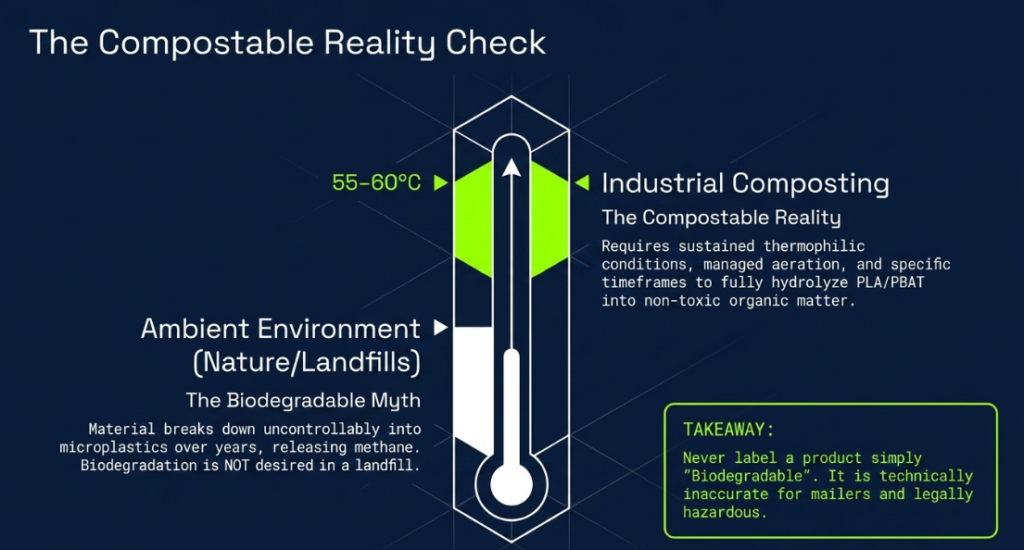
Custom printing is useful, but it should not be treated as decoration. For zero-waste mailer bags, the print has to help the customer understand what to do after delivery.
A strong printed mailer usually includes:
- “Compostable” in large readable text
- Certification mark
- Disposal instructions
- A note not to place the mailer in plastic recycling
This leads directly to the buyer’s selection matrix.
Decision matrix: How should US brands choose compostable mailers?
US brands should choose compostable mailers by product risk first.
| Product type | Recommended mailer | Key requirement |
| Compostable mailers | Compostable poly mailer | Water resistance and tear strength |
| Eco-friendly mailers | Small opaque mailer | Privacy and puncture resistance |
| Sustainable packaging for ecommerce | Padded paper mailer | Bend protection |
| Biodegradable shipping bags | Large gusseted mailer | Capacity and seal strength |
| Plant-based poly mailers | Dual-seal mailer | Reuse for reverse logistics |
| Zero waste mailer bags | Padded compostable mailer | Cushioning and impact absorption |
You also have to consider product weight. A standard 2-mil mailer may work for light ecommerce parcels. But thicker ones will be required for heavier products.
The mailer must survive drops, sorting belts, edge pressure, and customer returns.
For transit durability, compostable films are moisture-resistant, not fully waterproof. Sharp edges, liquid products, and dense items may need inner wrap or a box.
For sealing, brands should check:
- Adhesive strength
- Tamper evidence
- Heat exposure
- Return-strip performance
- Seal failure after storage
For printed mailers, choosing the right ink is important. Water-based or soy-based inks are preferred where compostability claims are being made. Heavy ink coverage can also affect compostability testing. Hence, printing design should be carefully reviewed before you approve.
MOQ and lead time also matter. Small custom orders may work for early-stage brands, but factory-direct sourcing usually needs higher MOQ.
Next, we look at possible material choices behind the mailer.
Material choices for compostable and eco-friendly mailers
Most flexible compostable mailers are made with PLA, PBAT, and starch blends.
PLA is often plant-derived and gives stiffness. PBAT gives flexibility and tear resistance. Starch-based materials are used if home-compostability is important.
This table will help you choose the right material for eco-friendly mailers.
| Material route | Strength | Buyer watch-out |
| PBAT and PLA blend | Flexible and tough | Certification and end-of-life claim |
| Starch-based blend | Good compostability story | Storage and moisture sensitivity |
| Kraft paper | Recyclable and familiar | Lower water resistance |
| PCR poly | Lower plastic footprint | Not compostable |
| Padded paper | Better protection | Higher bulk and shipping space |
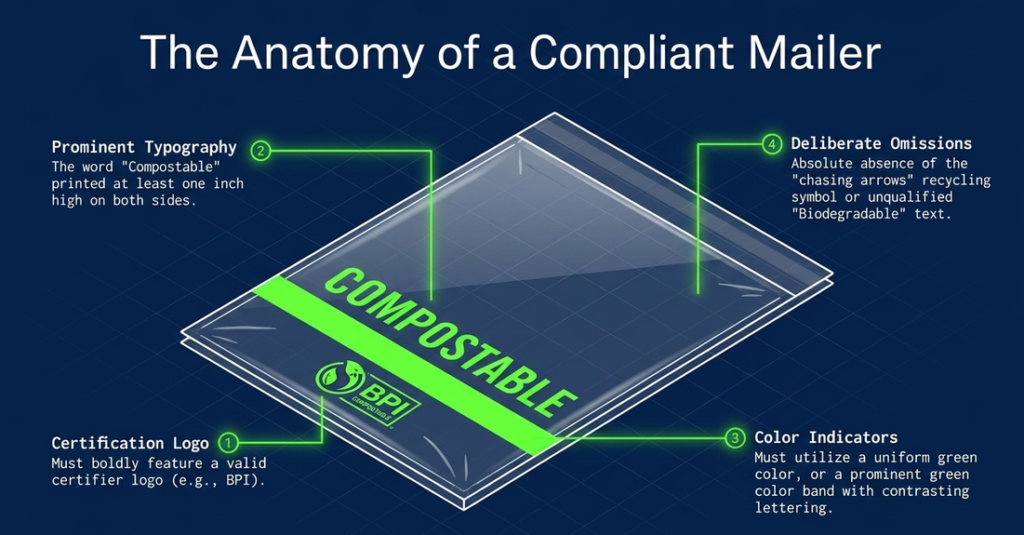
This is also where brands need to be careful with using the “biodegradable” label on their shipping bags. “Biodegradable” is too broad and vague.
Make specific claims that are verifiable. For example:
“This mailer is certified commercially compostable under ASTM D6400.”
Compliance fit for compostable mailers in the US
US compliance is not only about whether the mailer breaks down. It is also about what the brand says on the product, the website, and the shipment insert.
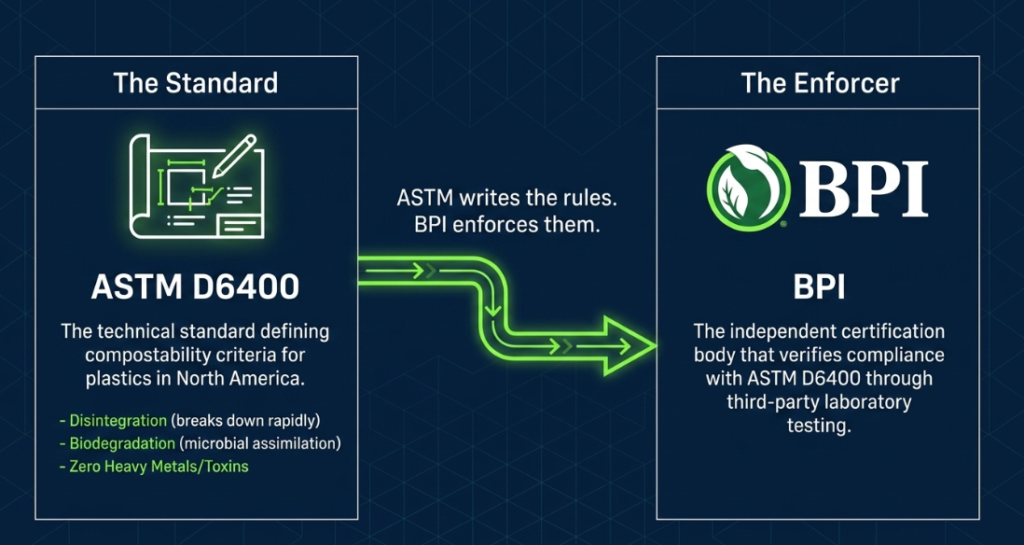
ASTM D6400 is the main US standard for plastics designed for industrial composting. It tests whether a product biodegrades and disintegrates at a sufficient pace.
BPI certification is necessary to prove a product meets ASTM D6400. It is the testing authority.
The FTC Green Guides are important because they restrict broad environmental claims. Words like “green,” “eco-friendly,” and “sustainable” need qualification. Claims should be backed by competent and reliable evidence.
On a state level, there are more restrictions. Many states restrict terms; for example, California and Maryland prohibit the use of “biodegradable ” and ” degradable.”
The safest path is to avoid misleading claim language and use clear disposal wording.
Real-world fit: where compostable mailers make commercial sense
Sustainable packaging for ecommerce works best when the format matches the business model.
For DTC fashion brands, compostable mailers can replace virgin plastic mailers without forcing the brand into heavier boxes. The mailer stays light, printable, and flexible, which helps shipping economics.
For subscription brands, the benefit is storage and weight. A stack of mailers takes less warehouse space than boxes, and branded print can turn the delivery into a visible customer touchpoint.
For returns, dual-seal compostable mailers reduce the need for a second bag. This is a practical sustainability gain because it removes one layer of packaging from the reverse logistics process.
For brands sourcing from India, the opportunity is custom development. India has a growing ecosystem for compostable films, agri-waste materials, coatings, and flexible packaging development. Ukhi’s own material platform includes blown film extrusion biopolymer and compostable cast film extrusion resin capabilities.
That matters because a US brand may not need an off-the-shelf mailer. It may need a grade that fits its product weight, route, print coverage, claim position, and MOQ.
Ukhi helps brands move from “we need sustainable packaging” to a specific mailer structure that can be sampled, tested, documented, and procured. We provide buyers with the technical information required for supplier evaluation, including material specifications, available certifications, quality documentation, and supporting compliance records where applicable.
Frequently asked questions
What are compostable mailers made from?
Most are made from PBAT, PLA, and plant starches. Compostable does not always mean plant-based. They may be made from biodegradable polymers also.
Are eco-friendly mailers always better than plastic mailers?
What matters is the carbon footprint. Recycled plastic mailers can have a lower carbon footprint than biodegradable eco-friendly mailers if the facility for recycling exists. The choice between them depends on the situation, brand, and available disposal routes.
Do compostable mailers protect products from rain?
They are moisture-resistant, but that does not equal waterproof. Extra top-layer packaging is necessary to protect garments, toys, and devices from rainwater seepage.
How long can brands store compostable mailers?
Many compostable mailers have a limited shelf life. It stretches from 6 to 12 months depending on the material. Store them in a cool, dry place away from sunlight, heat, humidity, and pests.
What makes the best sustainable packaging for ecommerce?
It has to be not only compostable or recyclable but also right-sized with minimum layers and weight. PLA and PBAT are ideal materials for zero-waste mailer bags.
Expert quote
“Brands should not choose compostable mailers only because the word sounds right. The better question is: what is the product, where is it shipping, what risk does the mailer carry, and what claim can the brand prove? Once those answers are clear, material selection becomes much easier.”
Vishal, Founder, UKHI
Get compostable mailer samples for US ecommerce shipping
If your brand is evaluating compostable mailers for US ecommerce, UKHI can support the next step with:
- a sample kit
- film-grade recommendation
- print and seal review
- documentation support
- WhatsApp procurement for RFQ discussion
Share your product type, parcel weight, preferred size, printing requirement, destination market, and compostability claim. We can help you choose the right mailer before you move to bulk approval.