
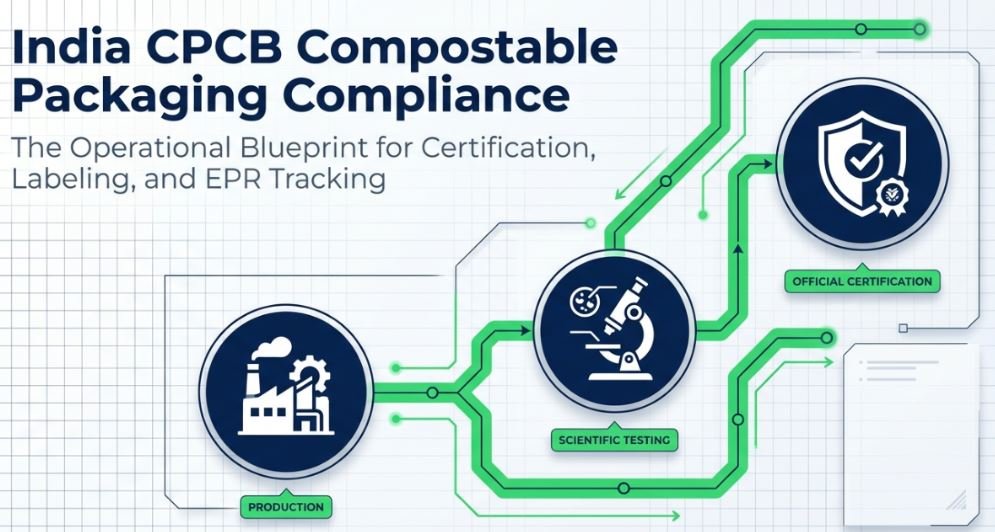
India’s Central Pollution Control Board (CPCB) mandates that compostable packaging must secure official CPCB certification before being sold. The product has to pass through rigorous testing, which proves the claim.
For businesses, a lack of compliance can lead to penalties, EPR issues, and an accusation of greenwashing. Compliance must start before procurement, not after production.
This article explains India’s CPCB compostable packaging compliance framework in the simplest terms.
CPCB compostable packaging compliance in plain terms
CPCB compostable packaging compliance means proving that the packaging breaks down under prescribed composting conditions. The product has to comply with the IS/ISO 17088 standard titled “Specifications for Compostable Plastics.” Successful testing leads to certification provided by the Central Pollution Control Board (CPCB).
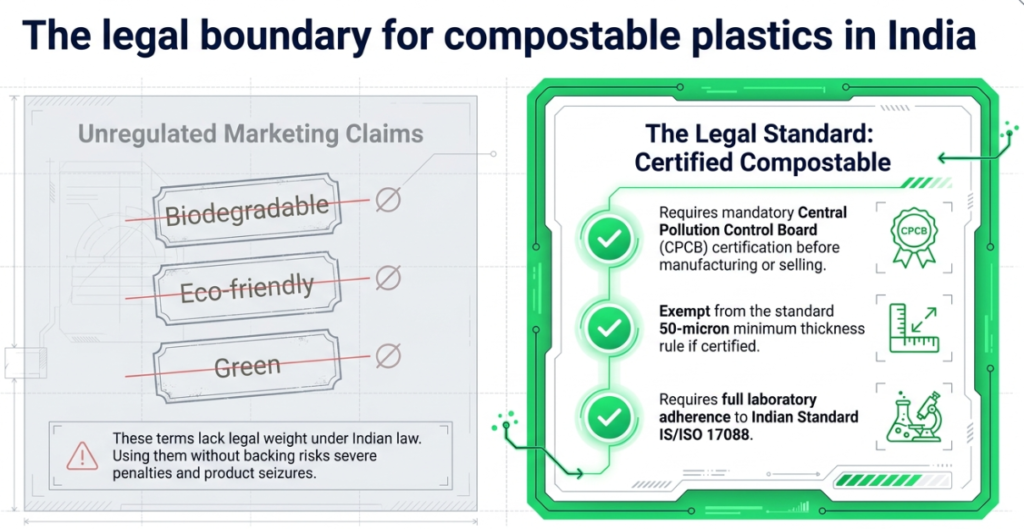
This matters because “compostable” is a claim that must be backed by lab tests. It is absolutely not the same as marketing lingo such as “eco-friendly” and “plant-based.”
A packaging product may be made from PLA, PBAT, and similar chemicals and yet not be marketable as a “compostable” item unless certified. Under the Plastic Waste Management Rules, it is not important how a compostable item is made, but if it meets the criteria for breaking down. Simply because a shopping bag is made of some form of bioplastic, it cannot automatically carry the tag “compostable”.
Key requirements under CPCB and the Plastic Waste Management Rules
The Plastic Waste Management Rules offer a detailed compliance framework that leaves no room for doubt and misinterpretation. Here are the principal requirements:
- The main requirement is a valid certification. Rule 4(h) of the Plastic Waste Management Rules requires that manufacturers and sellers obtain a CPCB certificate.
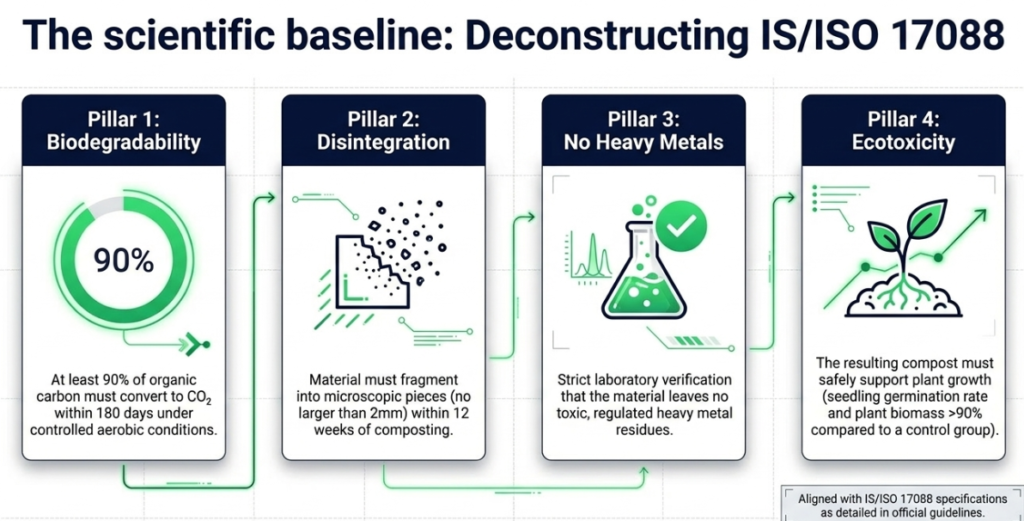
- The second requirement is adherence to the IS/ISO 17088 standard, proven by adequate testing. The standard provides that at least 90% of the organic carbon must convert to CO₂ within a maximum testing window of 180 days.
Testing covers:
- Biodegradation into carbon dioxide, water, and biomass in a defined period.
- Disintegration into small fragments during the composting process
- Eco toxicity and if the compost harms plant growth while decaying
- Heavy metal release that raises concerns of soil poisoning during the process
- The third requirement is that the testing is performed by a CPCB-certified lab. The primary testing authority is CIPET, Central Institute of Petrochemicals Engineering & Technology. CIPET testing is done at Ahmedabad, Chennai, Lucknow, Bhunbansewar, and Kochi. Other labs include those run by BIS, the Bureau of Indian Standards, and a few NABL-accredited labs for polymer biodegradability testing.
- The fourth requirement is proper filing. Applicants must use the CPCB e-certification portal and submit the necessary details. This is done via Compostable Plastic Form A, containing details of the manufacturer, product, supporting documents, and lab reports.
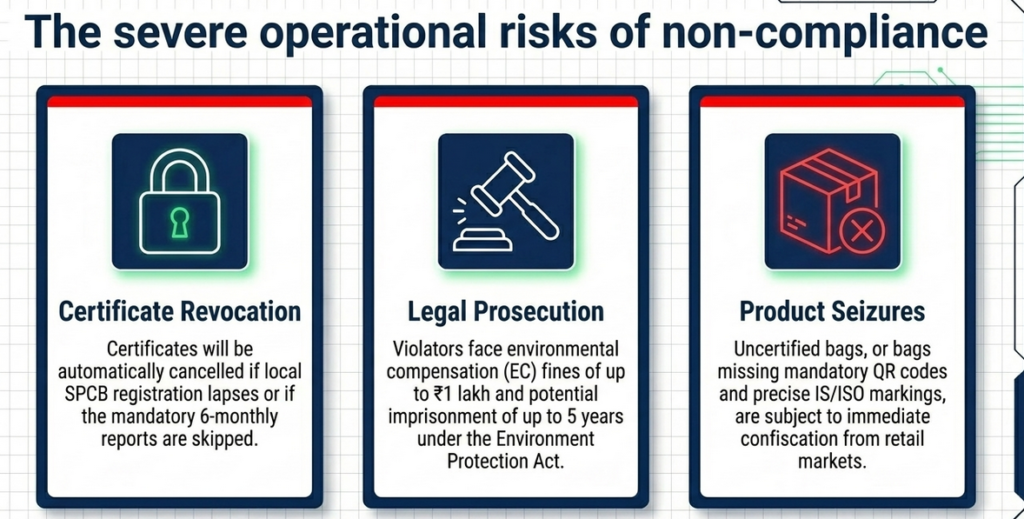
- The last requirement is proper labelling. Certified products must be marked “compostable”. Each item must carry the manufacturer’s details, CPCB certificate number, and EPR registration number.
The process does not end once the certification is issued. Manufacturers and sellers have to maintain detailed records of production and sales. Every six months, a report on the same has to be submitted on the CPCB e-certification portal.
Who does CPCB compostable packaging compliance apply to?
The biggest misconception is that CPCB compostable packaging compliance applies only to packaging manufacturers. It applies to multiple stakeholders across the supply chain. Here is a look at who is affected by CPCB’s compostable packaging compliance.
- Manufacturers – it goes without saying they are directly regulated as they produce “compostable” items.
- Sellers – those who market or distribute compostable products must ensure the product has been made by a CPCB-certified source.
- Importers – they have to ensure that what they import meets the IS/ISO 17088 standards.
- Retailers – those using compostable packaging are responsible for supplier due diligence.
The rules, therefore, affect the entire value chain. It spans from resin suppliers and converters to brands and retailers.
CPCB compliance overview table for compostable packaging
| Compliance item | What it means | Who provides it | What buyers should verify |
| IS/ISO 17088 conformity | Technical compostability standard | Manufacturer/testing lab | Test report and certificate scope |
| CPCB certificate | Permission to market or sell compostable plastic | Manufacturer/seller | Validity and product coverage |
| Form A | Application form for certification | Applicant | Product details and declarations |
| CIPET / lab testing | Compostability verification | Approved lab | Product, grade, and thickness match |
| Industrial composting label | Correct disposal claim | Manufacturer/brand | Artwork and wording |
| Six-monthly reporting | Ongoing compliance record | Certified entity | Procurement and sales records |
| EPR authorization | Plastic packaging compliance requirement, where applicable | Producer/importer/brand owner | Category and obligation fit |
Note an important point at this stage. Compostable packaging compliance is not only technical but also operational. All the stages – procurement, design, supplier choice, documentation, sustainability claims, and EPR report simultaneously.
Common mistakes to avoid before buying CPCB-certified compostable packaging
It is common for many businesses to buy non-compliant packaging because they rely on marketing claims. You have to depend instead on proper and valid certifications. Here are the mistakes to watch out for.
- The biggest error is to accept vague terms as proof of compostability. “Eco-safe”, “eco-friendly,” “biodegradable,” and “plant-based” are not viable proof of CPCB compostable packaging compliance.
- In case of imported products, never assume that EN 13432, ASTM D6400, or other foreign standards automatically replace CPCB approval. You have to seek CPCB certification regardless of the foreign compliance.
- Not all bioplastic blends are legally compostable. A product can be made from biopolymers like PLA, PBAT, starch blends, but that does not automatically make it compostable. A lab test and a certificate are always necessary.
- Another mistake is overlooking industrial composting labeling. It must state when and how to dispose of the item. There should be clarity in labeling the product so that there is no misunderstanding.
Expert note from Vishal, Founder, UKHI:
“Compliance should be checked before procurement, not after production. For compostable packaging in India, the certificate, material grade, label, and actual product format all need to match. Otherwise, the buyer may have a sustainable-looking package that still creates compliance risk.”
Sources and references
This guide is based on the following sources:
- Central Pollution Control Board, SOP for issuing certificates for compostable plastic carry bags and commodities.
- Plastic Waste Management Rules, 2016, and subsequent amendments.
- CPCB Compostable Plastics e-certification framework.
- CPCB certified manufacturers and sellers reference list.
- IS/ISO 17088 standard for compostable plastics.
- CIPET and recognized laboratory compostability testing references.
- CPCB Centralized EPR Portal guidance for plastic packaging and Category IV compostable plastics.
Get CPCB-ready compostable packaging support from UKHI
At Ukhi, we help brands and packaging buyers evaluate the different compostable packaging materials through the lens of technical specifications as well as compliance. We will share with you the latest information about all aspects of evolving procurement requirements under India’s Plastic Waste Management Rules.
If you are looking for compostable packaging that aligns with CPCB requirements, we offer:
- Grade recommendation
- Sample kit support
- Certificate and test document review
- Labeling and compliance guidance
Reach out to us, and we will be happy to guide you.
Frequently Asked Questions
Is CPCB certification mandatory for compostable packaging in India?
Yes. A valid CPCB certification is an absolute must for production, sale, and distribution of compostable packaging in India.
Does EN 13432 or ASTM D6400 replace CPCB approval in India?
While EN 13432 and ASTM D6400 are largely equivalent to the IS/ISO 17088 standards, they are not valid. IS/ISO 17088 standards are calibrated for the Indian conditions, and obtaining a valid CPCB certification is mandatory for imported products.
What is Compostable Plastic Form A used for?
The CPCB e-certification portal requires manufacturers to file the Compostable Plastic Form A. It allows compostable plastic producers to register their manufacturing units. Compostable Plastic Form A is also used to submit technical documentation regarding manufacture and components.
Why is CIPET’s compostability testing important?
CIPET compostability testing is the gold standard for testing biodegradable materials. Key hubs are located at IPT, Institute of Petrochemicals Technology, at Ahmedabad, Chennai, Bhubaneshwar, and Jaipur.
Do brands using compostable packaging still need EPR compliance?
Absolutely. Adapting compostability testing does not absolve a business from Extended Producer Responsibility obligations. Every brand and retailer must still classify packaging correctly and comply with applicable EPR requirements.