
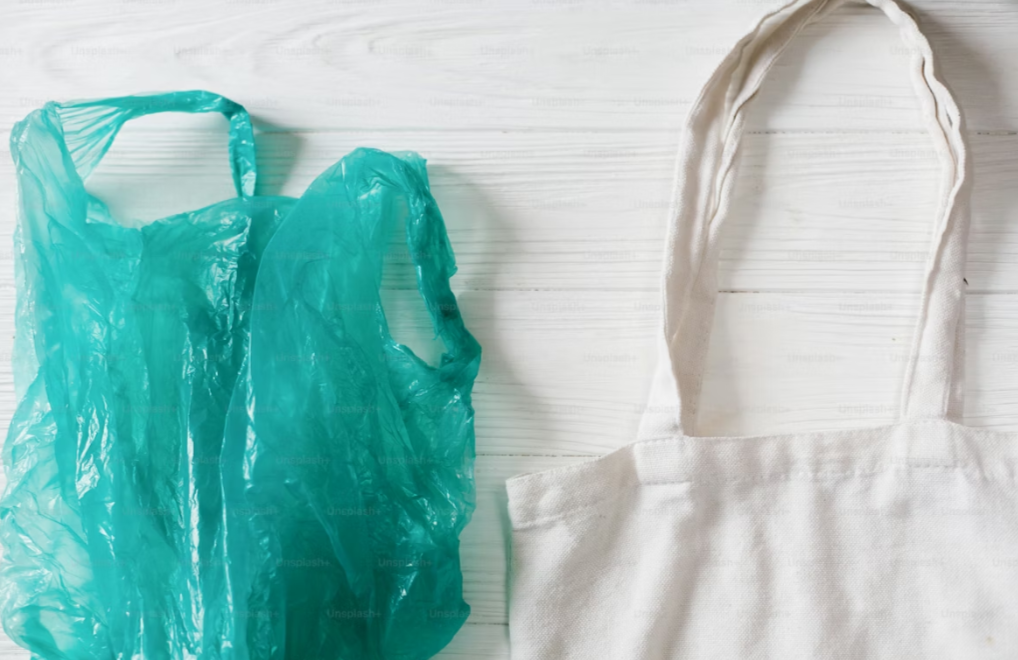
When you compare PBAT vs LDPE cost and performance, you’ll find that LDPE is cheaper per kg, but PBAT-based compostable bags can deliver similar real-world performance at a very insignificant premium price. Bags made from PBAT blends also offer compostability and regulatory advantages that LDPE cannot meet in export-driven or sustainability-focused applications.
What exactly are we comparing here?
Before comparing PBAT versus LDPE, it is important to clarify a few points:
- LDPE is a conventional plastic made from fossil fuels. It is widely used in carry bags, liners, and flexible packaging.
- PBAT is a biodegradable polyester. It is rarely used alone and is typically blended with PLA or starch.
- PBAT-based compostable bags are engineered systems designed to replicate LDPE performance while enabling compostability.
So, buyers are not choosing between two raw polymers. They are choosing between two packaging systems.
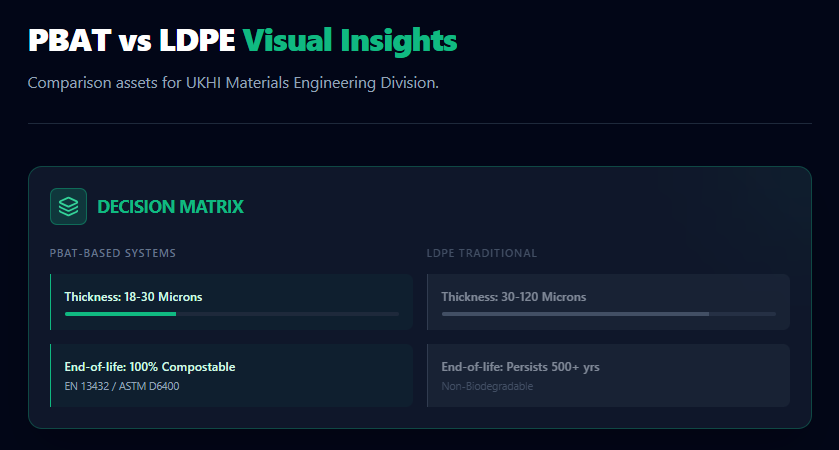
Decision Matrix: PBAT-Based Bags vs LDPE Bags
| Factor | PBAT-Based Compostable Bags | LDPE Bags |
| Cost per kg | Higher. Typically ₹180 to ₹280 per kg | Lower. Typically ₹100 to ₹140 per kg |
| Cost per bag | Comparable at optimized thickness | Stable but depends on higher thickness |
| Micron usage | 18 to 30 microns typical | 30 to 50 microns typical |
| Sealing temperature | 120 to 140°C | 160 to 180°C |
| Line compatibility | Runs on LDPE lines with minor tuning | Native compatibility |
| Flexibility | Excellent. Rubber-like behavior | Excellent |
| Strength | High elongation. Needs blend for stiffness | High strength to weight |
| End-of-life | Compostable under EN 13432 or ASTM D6400 | Non-biodegradable. Persists 500+ years |
| Regulatory fit | Mostly exempt from plastic bans | Increasingly restricted |
So, the conversation is not just about PBAT/LDPE performance, but about how that performance translates into real usage.
Why cost per kg is the wrong way to compare
Most buyers start with PBAT-blend bags’ price per kg and compare it directly with LDPE.
PBAT-based materials are typically 80% to 200% more expensive per kg. On paper, this makes them look unviable.
However, packaging does not operate at the kg level. It operates at the per bag level.
Here is what changes the equation:
- PBAT blends allow lower thickness at similar load capacity
- LDPE requires higher micron to avoid tearing
In practical terms:
- In many cases, 20-micron compostable bag can replace a 120-micron LDPE bag because a country’s plastic ban regulations require LDPE bags to be a minimum of 120 microns
- Material usage drops even if per kg price is higher
- So per bag costs for PBAT-blend based bags can be even less then LDPE bags in some cases
So while PBAT/LDPE costs look significantly higher at resin level, the real cost gap narrows at application level.
Performance: Where PBAT matches LDPE and where it differs
The question most buyers ask is simple. Will it perform the same?
The answer is more nuanced and let’s find out how.
1. Flexibility and Tear Resistance
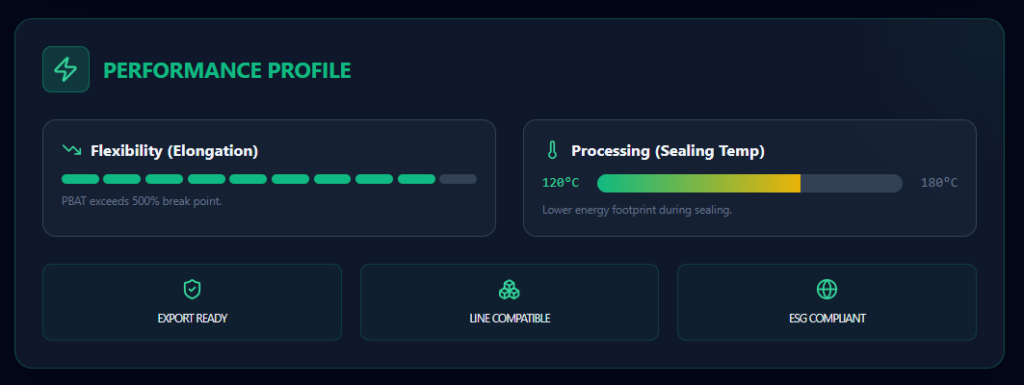
PBAT is known for its high elongation at break. In many cases, it exceeds 500 percent.
This gives it:
- strong resistance to tearing
- flexibility similar to LDPE
- a familiar “feel” at checkout
As one industry insight puts it:
“PBAT is flexible yet tough, making it suitable for a wide range of applications from food packaging to biodegradable shopping bags.”
This is why PBAT-based bags can replace LDPE in most retail applications.
2. Strength and Structural Stability
Pure PBAT is soft. It lacks stiffness.
This is why blends are used.
- PLA adds rigidity
- starch reduces cost and improves bio-content
So performance depends on formulation, not just the base polymer.
3. Processing and Sealing
PBAT-based bags can run on existing LDPE lines.
However, they require:
- tighter temperature control
- optimized sealing conditions
Sealing typically happens at lower temperatures, around 120 to 140°C.
This is not a limitation, but it does require process awareness.
4. Storage and Environmental Sensitivity
This is where PBAT differs from LDPE.
- PBAT is sensitive to long-term humidity
- It has a finite shelf life
- It may crack under extended cold storage conditions
LDPE does not have these constraints.
Expert perspective
At UKHI, we see this decision play out across buyers every day.
“Most buyers focus on per kg pricing. In reality, packaging decisions should be made at per bag performance. Once you evaluate PBAT blends at actual usage thickness, the cost difference is far smaller than expected.”
— Vishal, Founder, UKHI
Wilson Wang (CEO, Million Pack): “Choosing between PLA and PBAT for food packaging is not a binary decision—it is a strategic one… combining them is often the most viable path forward”.
Taylor Sparks (IMI Editor-in-Chief): “Choosing an alternative to plastic… is not as simple as saying we’re going to find something that’s biodegradable. You’ve got to consider performance, feasibility, and sustainability all at once”
Final decision guide: PBAT-Based Bags vs LDPE Bags
If you want a quick way to decide:
- Choose LDPE if your priority is lowest upfront cost
- Choose PBAT blends if your priority is compliance and sustainability
- Compare both at micron and per bag level, not per kg
- Ensure your supplier supports processing and formulation guidance
Because ultimately, the question is not just PBAT versus LDPE.
It is whether your packaging is ready for the next phase of regulation, cost pressure, and environmental accountability.
Move from comparison to real-world validation
If you are evaluating PBAT vs LDPE cost and performance, the next step is not more theory. It is testing what works for your exact application.
At UKHI, we help you move from material comparison to actual decision:
- Get a sample kit of PBAT-based compostable films
- Get a grade recommendation based on your bag type and load requirement
- Run a trial on your existing LDPE line with process guidance
Because the right decision is all about making sure the material performs on your line, at your cost, and for your end use.
Explore Ukhi bioplastic products.
FAQs: PBAT vs LDPE Cost, Performance, and Practical Use
Can PBAT-based bags run on LDPE machines?
Yes. PBAT-based materials can run on existing LDPE machinery with minimal modification. Their processing behavior is similar, even though they require tighter temperature control and a narrower processing window compared to LDPE.
Why is PBAT more expensive than LDPE?
PBAT is typically 80% to 200% more expensive than LDPE. This is due to complex manufacturing processes, higher raw material costs like BDO and adipic acid, and lower global production scale compared to polyethylene.
What is the difference between PBAT and LDPE performance?
Both offer excellent flexibility and elongation. However, PBAT has slightly lower tensile strength and stiffness, sometimes requiring thicker films. It also has a shorter shelf life and is more sensitive to moisture and freezing compared to LDPE.
Are PBAT bags better than LDPE for exports?
Yes. PBAT-based compostable bags meet standards like EN 13432 and ASTM D6400. They help exporters comply with regulations in Europe and North America, where conventional LDPE is increasingly restricted.
Does PBAT survive humidity and storage?
PBAT-based bags require controlled storage conditions. They are sensitive to long-term humidity and microbial exposure, with a typical shelf life of 6 to 12 months, unlike LDPE which is more stable over time.