

![PBAT Granules Manufacturers in India [2026]](https://ukhi.com/wp-content/uploads/2026/09/PBAT-Granules-Manufacturers-in-India-2026.png)
Quick Answer
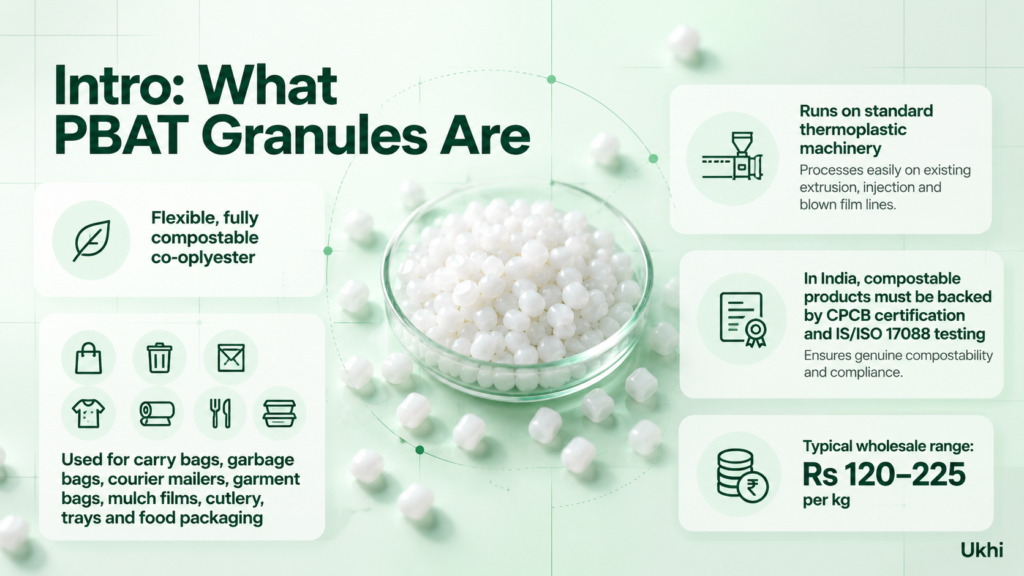
PBAT is a flexible, fully compostable copolyester used as the base polymer in most biodegradable and compostable plastic products manufactured in India. Converters and packaging brands use PBAT granules to produce carry bags, garbage bags, courier mailers, garment bags, mulch films, cutlery, trays and food packaging on standard thermoplastic machinery. Any PBAT granules manufacturer in India must hold a valid CPCB certificate and IS/ISO 17088 test reports before selling compostable products. Wholesale prices of compostable and biodegradable PBAT granules currently range from Rs 120 to Rs 225 per kg, depending on grade, blend ratio and order volume. UKHI manufactures PBAT/PLA blend granules in-house under the EcoGran brand at our facility in IMT Faridabad, Haryana. We ship free trial samples within 7 days.
What To Look for in a PBAT Granules Manufacturer in India
Procurement teams sourcing PBAT biodegradable granules in India should evaluate any manufacturer against five criteria before placing a trial order.
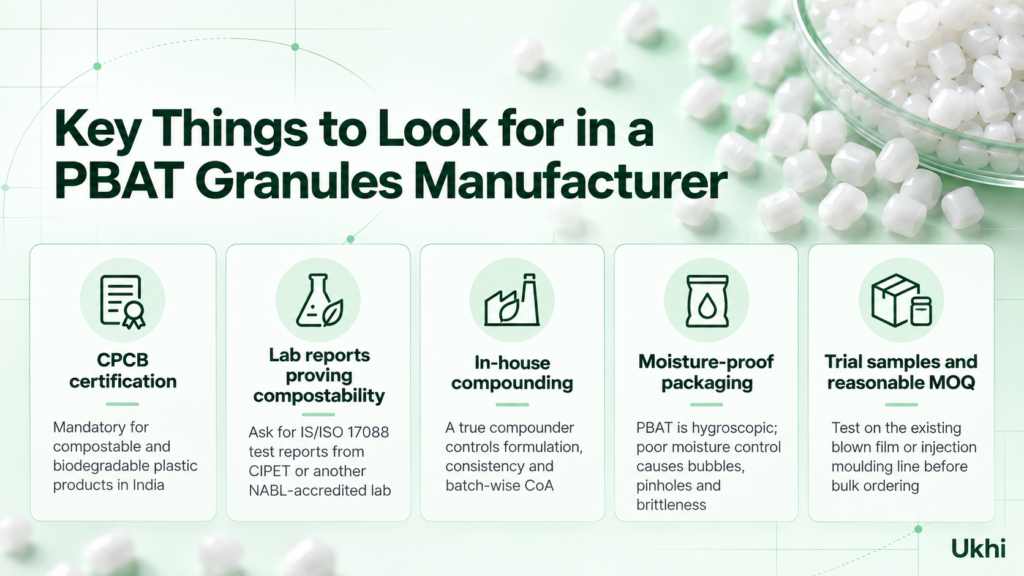
CPCB certification
Under Rule 4(h) of the Plastic Waste Management Rules, any company manufacturing or selling compostable and biodegradable plastic products in India must hold a valid certificate from the Central Pollution Control Board.
Lab reports proving compostability
IS/ISO 17088 is the Indian standard that governs compostability of plastics. A PBAT granules manufacturer in India should be able to share test reports from CIPET or any other laboratory accredited by the National Accreditation Board for Testing and Calibration Laboratories (NABL).
In-house compounding versus trading
Buyers should check whether the PBAT resin supplier actually compounds the granules in-house, or simply resells material purchased from another manufacturer. A compounder controls batch-to-batch consistency, can adjust the formulation for specific end-use applications, and can provide a Certificate of Analysis (CoA) tied to each production batch. At UKHI, our EcoGran resin is compounded in our own facility, which means we control the material from raw polymer input to finished granules.
Moisture-proof packaging
PBAT is hygroscopic, which means the granules absorb moisture from the air. If moisture content exceeds 0.05% at the time of processing, the material undergoes hydrolysis, which causes bubbles, pinholes and brittleness in the finished film. A reliable compostable granules manufacturer in India should ship PBAT granules in hermetically sealed, moisture-proof bags with clear batch, grade and lot identification on each bag.
Trial samples and reasonable MOQ
Before committing to a bulk order, converters should request physical samples of the biodegradable polymer granules to test on their existing blown film or injection moulding line.
What Specifications Matter When Buying PBAT Granules in India
The specifications of PBAT biodegradable granules vary depending on whether the end product is a carry bag, a mulch film, a moulded tray or a food wrapper. The table below covers the parameters that converters and procurement teams should check against the manufacturer’s datasheet before ordering.
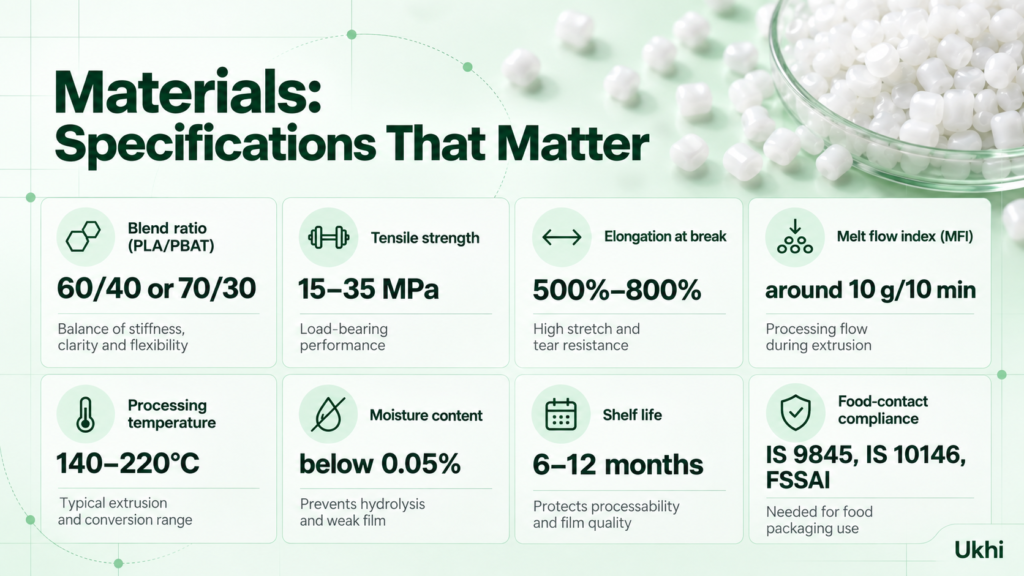
| Specification | Typical range for compostable PBAT granules | Why it matters |
| Blend ratio (PLA to PBAT) | 60/40 or 70/30 | PLA adds stiffness and optical clarity to the finished film. PBAT adds flexibility and tear resistance. The ratio determines how the film behaves on the packing line. |
| Tensile strength | 15 to 35 MPa | Tensile strength determines how much load the finished film or moulded product can bear before breaking. |
| Elongation at break | 500% to 800% | High elongation is a defining property of PBAT. It prevents tearing when films are stretched during bag-filling or wrapping. |
| Melt flow index (MFI) | Around 10 g/10 min (film grade) | MFI measures how easily the polymer flows during extrusion. Too low and the material does not process smoothly. Too high and the film becomes thin and inconsistent. |
| Processing temperature | 140 to 220 degrees C | This is the barrel temperature range at which PBAT granules for blown film and other extrusion processes are typically run. |
| Moisture content (max) | Below 0.05% | PBAT must be dried before processing. Excess moisture causes hydrolysis, which weakens the finished product. |
| Shelf life | 6 to 12 months | Compostable biopolymer resin is moisture-sensitive. Granules should be used within the shelf life window to maintain processability and film quality. |
| Food-contact compliance | IS 9845, IS 10146, FSSAI | If the finished product will touch food, the granules must comply with Indian food-contact safety standards. |
UKHI’s EcoGran range includes PBAT/PLA blend granules formulated for specific applications. Each EcoGran grade comes with a datasheet listing the exact values for the parameters above, so converters can match the grade to their product and processing line.
Which Manufacturing Processes Use PBAT Granules in India
PBAT biodegradable granules can be processed on standard thermoplastic machinery. In most cases, converters do not need to buy new equipment. The granules run on existing lines with adjustments to temperature, drying and line speed.
The six manufacturing processes where compostable PBAT granules are commonly used in India are explained below.
- Blown film extrusion is the most widely used process for PBAT granules. Converters use blown film lines to manufacture compostable and biodegradable carry bags, grocery bags, courier mailers, garment bags and agricultural mulch films. Multi-layer co-extrusion setups (for example, three-layer lines) are also used to place cost-effective fillers in the middle layer while keeping stronger polymer on the outer layers.
- Cast film extrusion is used to manufacture compostable cling films, heat-seal films and lamination-grade films from PBAT granules.
- Injection moulding is used to produce rigid and semi-rigid compostable items such as disposable cutlery, spoons, forks and small consumer products.
- Thermoforming is used to shape heated biopolymer sheets made from PBAT granules into structured trays, cups, bowls and food containers.
- Profile extrusion is used to manufacture continuous cross-section products such as compostable straws, tubes and clips.
- Extrusion coating is used to apply a thin layer of compostable polymer onto paper or board substrates, making them liquid-resistant. Coated paper cups and food wraps are common examples.
At UKHI, our EcoGran granules are formulated to be drop-in compatible across all six of these processes. Converters who switch to EcoGran from conventional polyethylene do not need new extruders, dies or winders.
Certifications and Compliance To Look for in a PBAT Granules Manufacturer in India
Indian regulations around compostable and biodegradable plastics are specific and strictly enforced. Buyers sourcing PBAT granules in India should confirm the following certifications and compliances before finalising a supplier.
CPCB certification
This is the mandatory entry point. No manufacturer or seller of compostable plastic carry bags or commodities can legally market their products without a valid CPCB certificate. Buyers should ask for the certificate number and verify it independently.
IS/ISO 17088 test reports
IS/ISO 17088 is the Indian standard for industrial compostability. The manufacturer’s test report should come from CIPET or an NABL-accredited lab and should cover biodegradation, disintegration, ecotoxicity and heavy metal limits.
SPCB or PCC registration
In addition to the central CPCB certificate, the manufacturer must hold a valid registration from their State Pollution Control Board (SPCB) or Pollution Control Committee (PCC), along with current Air and Water Consent Orders.
Mandatory labelling and QR codes
Every finished compostable product must carry a “COMPOSTABLE” label referencing IS/ISO 17088, in both English and a regional language, along with a scannable QR code linking to the manufacturer’s name, plant address and CPCB licence number.
Six-monthly regulatory reporting
Certified manufacturers are required to file reports every six months on the CPCB’s online portal, declaring raw material procurement, sales volumes and GST details.
Export certifications
Converters and brands who export finished biodegradable and compostable products should check whether their PBAT resin supplier also holds EN 13432 (the European compostability standard) or ASTM D6400 (the American standard).
UKHI holds IS/ISO 17088 compliance with CIPET testing, FSSAI certification for food-contact applications, GMP certification, Halal certification, ISO 9001 for quality management and ISO 14001 for environmental management.
How Much Do PBAT Granules Cost in India
The price of PBAT granules in India depends on the grade, the blend composition, filler content and order volume. In the Indian wholesale market, compostable and biodegradable PBAT granules typically cost between Rs 120 per kg and Rs 225 per kg.
The factors that move the price up or down are:
| Factor | How it affects PBAT granules price |
| Neat PBAT vs compounded blend | Neat (unfilled) PBAT granules cost more per kg. Compounded blends that include PLA, starch or mineral fillers bring the per-kg price down. |
| Filler content | Mineral-filled PBAT compounds (using calcium carbonate, talc or starch) can reduce material cost by up to 40% compared to neat PBAT, while still meeting IS/ISO 17088 compostability requirements. |
| Grade and application | Film-grade PBAT biodegradable granules for blown film extrusion are priced differently from injection-moulding-grade or thermoforming-grade granules. |
| Order volume | Larger order volumes typically attract lower per-kg pricing. Trial quantities of 100 to 250 kg will cost more per kg than a 5-tonne order. |
| Transparency vs milky finish | Transparent film-grade PBAT compounds are generally priced higher than milky or opaque compounds of the same blend. |
One point that matters more than the per-kg price: the cost per finished product.
A compostable PBAT film at Rs 285 per kg may seem expensive compared to conventional LDPE at Rs 150 per kg. But compostable films are thinner and lighter (for example, 20 micron vs 120 micron for a garment bag). This means that each kilogram of compostable resin produces far more bags. The per-bag cost of a compostable bag can end up 60% lower than the per-bag cost of a conventional plastic bag of the same size.
Buyers evaluating PBAT granules price in India should ask the manufacturer for a cost-per-product calculation, not just the Rs-per-kg figure.
Why Buy PBAT Granules from UKHI
UKHI is a material science company that manufactures compostable biopolymer resin in-house under the brand name EcoGran. Here is what we bring to converters and brands sourcing PBAT biodegradable granules in India.
- We compound EcoGran resin in our own facility at IMT Faridabad, Haryana. This means we control the formulation, batch consistency and quality of every granule from raw polymer input to finished pellet. Converters who buy from us are buying directly from the compounder, not from a trader or reseller.
- EcoGran granules are drop-in compatible with standard blown film, cast film, profile extrusion, injection moulding, thermoforming and extrusion coating lines. Converters switching from conventional polyethylene to EcoGran do not need to invest in new machinery.
- EcoGran is formulated to be cost-competitive with conventional petroleum-based plastics. In finished applications such as garment bags, our lightweighting approach allows compostable bags to cost up to 60% less per unit than conventional plastic bags of the same size.
- We hold IS/ISO 17088 compliance tested by CIPET, FSSAI certification for food-contact products, GMP and Halal certifications, ISO 9001 for quality management and ISO 14001 for environmental management. Buyers working with us get the full documentation stack needed for both domestic and export compliance.
Procurement teams who want to evaluate EcoGran PBAT/PLA blend granules on their own processing line can request a free sample. We ship trial samples within 7 days at no cost.
FAQs
1. What is the minimum order quantity for PBAT granules in India?
MOQ for trial orders of compostable PBAT granules typically starts at 100 to 250 kg on smaller blown film lines. Commercial orders usually begin at 500 kg or 1 tonne depending on the manufacturer.
2. Can PBAT granules be used to make home-compostable products?
Standard PLA/PBAT blend granules are industrially compostable, not home-compostable. Home compostability requires different polymer systems such as PHA-based materials, which are tested under separate standards like IS 17899.
3. What is the shelf life of PBAT granules if stored unopened?
Compostable PBAT granules stored in sealed, moisture-proof packaging at ambient temperature typically have a shelf life of 6 to 12 months. Once the bag is opened, granules should be dried before processing.
4. Do PBAT granules require a separate CPCB certificate for each finished product?
The CPCB certificate is issued to the manufacturer for specific product categories. If a converter makes a new product type from PBAT granules, that finished product may need its own certification and IS/ISO 17088 test report.
5. How do PBAT granules compare to starch-based biodegradable granules?
Starch-based granules are cheaper per kg but produce films with lower tensile strength and poor moisture resistance. PBAT-based compostable granules offer higher elongation, better tear resistance and wider processing compatibility on standard blown film lines.
![PHA Granules Manufacturers in India [2026]](https://ukhi.com/wp-content/uploads/2026/09/PHA-Granules-Manufacturers-in-India-2026-365x260.png)
![Biodegradable and Compostable Garbage Bags — Manufacturers in India [2026]](https://ukhi.com/wp-content/uploads/2026/09/Biodegradable-and-Compostable-Garbage-Bags-—-Manufacturers-in-India-2026-365x260.png)