
Plastic waste in India is growing because we are using more plastic in the way we sell, pack, move, and build things.
The problem is also bigger than it looks in many official headlines. In official reporting, India’s annual plastic waste is often put at around 3.9 million tonnes (2022–23).
But the same discussions also point out a basic issue. The current recycling systems aren’t capable of handling the bulk of plastic waste we produce every year.
So what happens to the rest?
A lot of it gets mixed with other waste and ends up in landfills or open dumps. Some of it is burned, which shifts the problem from land to air. And some leaks into drains, rivers, and public spaces because it’s hard to collect and even harder to sort.
That’s why, when researchers try to count plastic from end to end, meaning how much enters the market, how much stays in use, and how much becomes waste, they get a much higher number.
In 2018–19, that estimate was 15.5 million tonnes, with a large share outside formal records.
This gap matters because it tells us where to focus. Demand is concentrated in a few sectors, mainly packaging at 30%, textiles at 17%, and buildings & construction at 16%.
So, in 2026, the fastest way to understand plastic waste generation in India is to track these high-volume uses and how quickly they turn into waste.
Packaging industry: The largest source of plastic waste in India
If you start examining the impact of plastic waste by industry in India, you’ll find that packaging comes at the top. It’s responsible for the highest amount of plastic waste in the country.
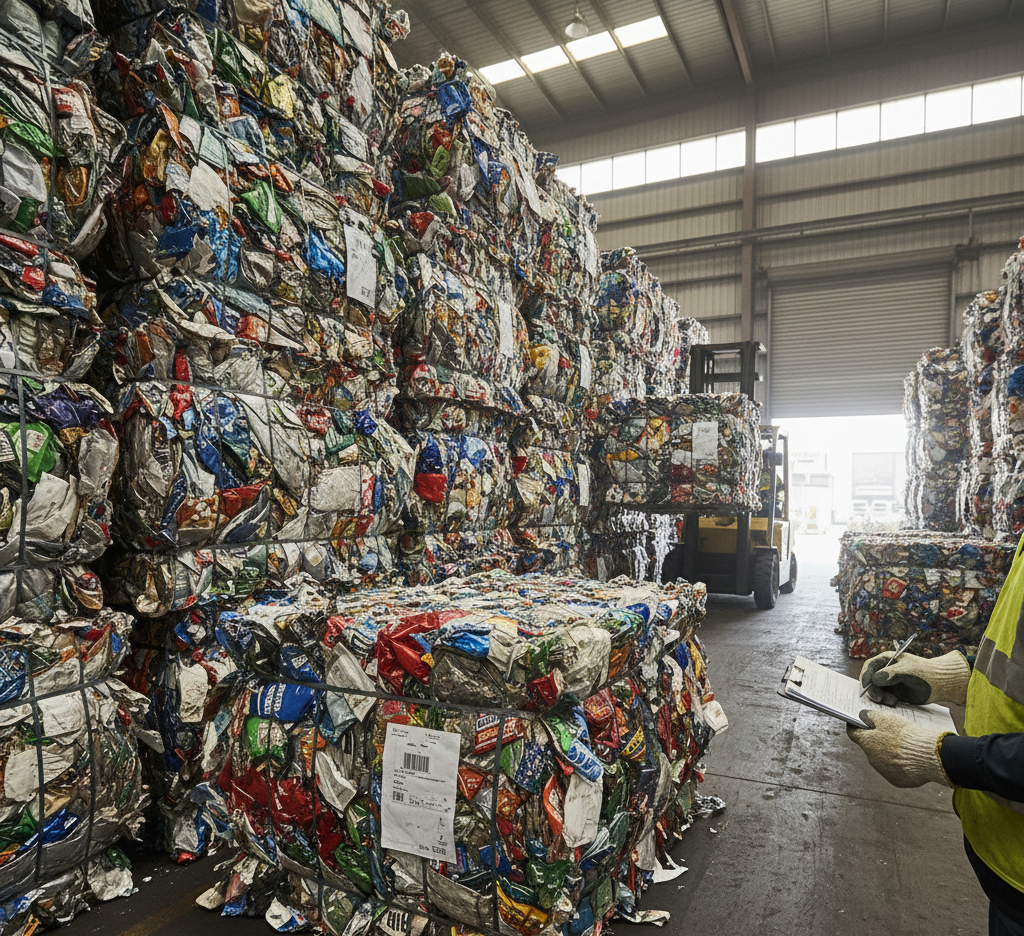
Packaging Accounts for ~30% of India’s Plastic Consumption:
A recent material flow analysis estimates that packaging accounts for about 30% of plastic use in India. That makes it the single largest plastics-using sector.
That share alone explains why plastic waste generation in India keeps rising even when other sectors improve collection or recycling.
Most Flexible Plastic Packaging Becomes Waste within a Short Period of Use:
Inside packaging, the dominant format is flexible plastics. That includes plastic films, pouches, wraps, liners, and carry bags.
Many industry estimates describe flexible plastic packaging as the majority share of packaging waste in India. Some estimates even put it as close to three-quarters of the total volume.
Flexible packaging wins operationally because it’s:
- Light and cheap to transport.
- Moisture-resistant and strong enough for handling.
- Quick to seal, print, and scale across FMCG and retail.
But it loses at the end-of-life because it’s typically used for a few minutes or hours.
What CPCB-linked Numbers Capture and What They Miss:
Most packaging has no second job. A pouch is torn open. A wrap is removed. A carry bag is used once. And the waste stream starts immediately.
That’s why packaging creates more post-consumer waste than other plastics. It’s produced in high volumes, used briefly, and often comes in formats that are difficult to recover, especially contaminated films.
It’s also why figures released by the CPCB related to plastic waste generation in India need context. Official reporting reflects what is recorded through formal systems.
But informal collection, rural gaps, and leakage can shift the real footprint beyond what shows up in annual reporting.
E-commerce and logistics industry: One of the fastest-growing plastic waste sources
Packaging may be the largest base load. But e-commerce is the accelerant. With every order delivered, it adds to the household packaging waste.
E-commerce Packaging Waste Has Increased Rapidly with Online Retail Growth:
India’s e-commerce market is projected to reach roughly USD 200B by 2026. That growth matters for one simple reason. Every shipment creates a standard packaging stack.
It typically includes a courier poly mailer, an inner wrap/pouch, tapes, labels, and sometimes an added outer sleeve for branding.
Even when a brand reduces plastic inside the box, the courier layer still exists. Multiply that by rising shipment counts, and plastic waste generation in India rises through sheer transaction volume.
Then There’s Logistics-Related Packaging Waste
Unlike crates or pallets, most last-mile packaging is not reused. It is made for a single trip and then thrown away.
A study was published in the Journal of Cleaner Production in 2024. It highlighted the hidden impact of e-commerce in India, especially the extra layers of packaging and frequent orders that add to plastic waste.
If you look at how much plastic waste India generates each day, e-commerce helps explain why the flow never stops. Every delivery restarts the cycle.
FMCG and retail industry: Major contributor to continuous plastic waste generation
FMCG and retail keep plastic moving every single day. Even if e-commerce slowed tomorrow, this channel would still add to the total amount of plastic waste generated in India.
A large share of FMCG packaging is built for speed and mass production. It often comes in pouches, films, and sachets. These formats are popular because they are lightweight, low-cost to transport, and protect products well on store shelves.
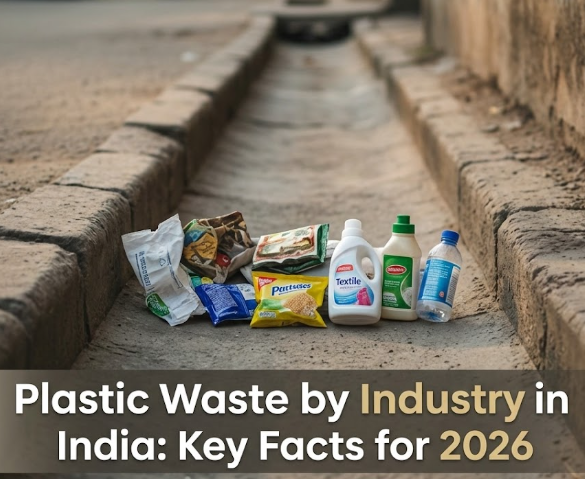
Examples of this type of packaging include shampoo sachets, snack packets, detergent pouches, and multilayer wrappers. These are used once and thrown away.
This is what I mean by “continuous” waste. The disposal doesn’t happen in waves. It happens with every refill and every repeat purchase, across millions of households and stores.
As retail consumption grows, packaging demand grows with it. More packaged goods sold means more individual packs entering the waste stream.
That’s one reason plastic waste by industry in India stays tightly tied to FMCG and retail.
Textile industry: A major industrial consumer of plastic materials
When people hear plastic waste, they usually picture bags and wrappers. Textiles don’t come to mind. But in material terms, textiles are one of the biggest ways plastics enter the economy, just in a less obvious form.
A detailed material-flow analysis estimates that the textile sector accounts for about 17% of plastic consumption in India.
In this context, “plastic” mostly means synthetic fibres, especially polyester and nylon. It’s because these are polymer materials, not natural yarns.
Centre for Science and Environment frames the shift clearly. Over 60% of new fabrics today are made up of plastics, and textile waste has become a serious landfill challenge.
Polyester dominates because it’s cheap, durable, and easy to mass-produce at scale.
This matters because MFA work also notes that plastic waste generation in India is driven primarily by packaging and textiles together.
So, even when we discuss per capita plastic waste generation in India, sector demand is what explains where the volume is really coming from.

Construction and infrastructure industry: A large contributor to long-lifecycle plastic waste
Construction doesn’t create the most visible plastic waste. But it creates one of the largest stocks of plastic that stays embedded in the buildings for years.
The key difference is timing. Packaging becomes waste almost immediately, while construction plastics often become waste only when something is taken apart.
The MFA estimates that buildings and construction account for about 16% of plastic consumption in India.
In this sector, plastics are used as long-life functional materials such as pipes and fittings, wire insulation, insulation sheets, waterproofing layers, and other components. Each of these is meant to last through years of use.
Waste shows up later, and often in bulk, during repairs, renovations, and demolition. When that happens, plastics are typically mixed with concrete dust, adhesives, and composites. That makes separation and recovery difficult.
This matters for 2026 because the infrastructure we build today will become waste in the future. Construction activity also varies by state.
So, state-wise plastic waste generation in India can differ not just by population, but by how fast states are building and redeveloping.
Automotive and electronics Industry: Smaller but significant industrial contributors
Beyond packaging, plastic waste by industry in India also includes smaller but technically important sectors like automobiles and electronics.
These sectors use plastics because they reduce weight, resist corrosion, insulate electricity, and allow tight-tolerance moulding. You see it in dashboards and interior trims, bumpers and covers, appliance housings, cable insulation, and electronic casings.
The good news is that manufacturing scrap from these industries is easier to capture because it is generated in controlled factory settings.
The harder part is end-of-life. India generated nearly 1.5 million tonnes of e-waste, and that stream includes large amounts of plastic alongside metals and glass. Experts quoted in the same reporting suggest the real number could be higher.
Final words
If you step back from the noise and look at the structure, the pattern is clear. Packaging dominates because it takes the largest share of plastic demand and has the shortest working life. So, it turns into waste fast.
E-commerce, FMCG, and retail amplify that effect by multiplying the number of packaged “units” moving through the system.
Textiles and construction add a second layer to the problem. And that’s large volumes of plastic embedded in fibres and infrastructure that surface as waste either continuously, like in textiles, or years later, like in construction.
That’s why the next decade won’t be won only through collection. It will be won upstream by changing what gets put into the market and how.
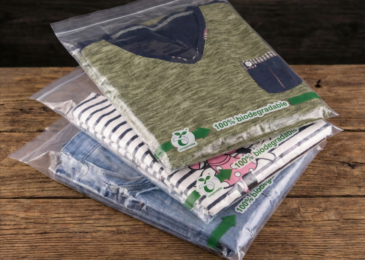
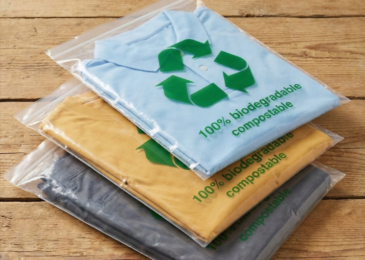
At Ukhi, this is exactly where we focus: helping brands replace short-life plastic packaging with certified compostable alternatives. They perform like regular plastic.
The truth is that the fastest way to reduce plastic waste generation in India is to redesign the highest-volume, fastest-to-waste formats first.