
Short answer: what is the best sustainable packaging alternative for refill pouches?
For buyers comparing sustainable packaging alternatives for refill pouches, the best material is not one single pouch structure. It depends on what goes inside the pouch, how it is filled, how long it must stay stable, and what sustainability claim the brand wants to make.
For flexible refill packs, the strongest starting point is usually one of these:
- compostable or bio-based flexible film
- mono-material PE or PP refill pouch
- paper-based pouch with a barrier coating
- recycled-content pouch for non-food applications
- agri-waste-based biopolymer film or coating
This area is where sustainable refill pouches need a practical view. A dry detergent refill does not need the same barrier as shampoo. A spice refill does not behave like a surface cleaner. A personal care refill may need fragrance retention, seal strength, and compatibility with oily or surfactant-rich formulas.
What makes sustainable alternatives to plastic packaging useful in reality is matching the product with the right film grade, coating route, seal behavior, micron range, and documentation.
Overview of sustainable materials used for refill pouch packaging
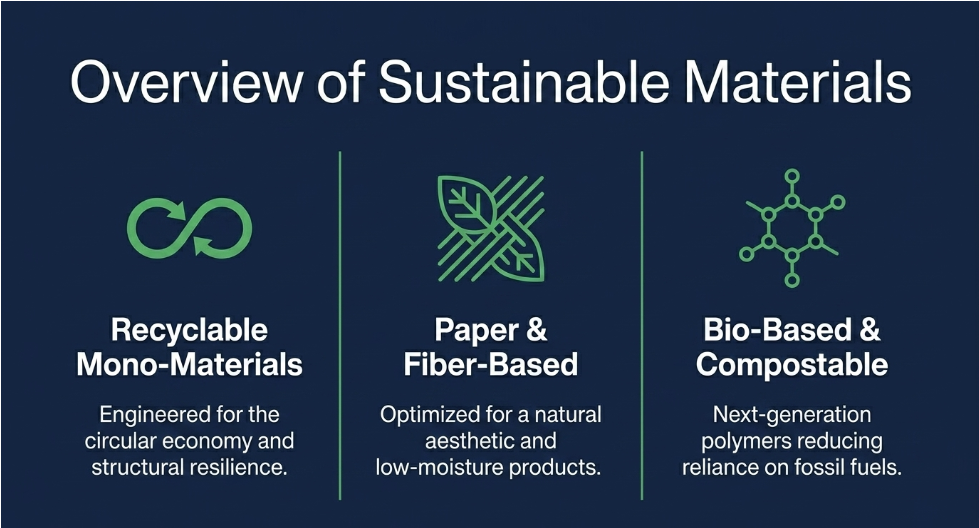
Most sustainable packaging alternatives for refill pouches fall into three broad material groups: recyclable mono-materials, fiber-based structures, and bio-based or compostable materials.
Each one solves a different part of the packaging problem.
Mono-Material PE And PP Pouches
These are designed for recyclability. Instead of mixing PET, PE, foil, nylon, and adhesives in one hard-to-recycle laminate, the pouch is built mostly from one polymer family. Guidance on mono-material flexible packaging commonly treats structures with more than 90 percent of one polymer type as easier to design for recycling (Pathways to Mono-Material Flexible Plastic Packaging).
PE is widely used for flexible refill pouches because it seals well and handles squeeze, drop, and transport stress. MDO-PE, or machine direction oriented PE, improves stiffness and clarity, which helps replace traditional PET/PE laminates in some pouch applications.
PP is useful where higher temperature resistance is needed, especially in certain food and retort formats.
Paper And Fiber-Based Pouches
These are used when the brand wants a natural look and lower fossil-plastic dependence. But paper alone is porous. It often needs a coating or lining to resist moisture, oil, aroma loss, or seal failure. The Ellen MacArthur Foundation notes that paper-based flexible packaging often needs careful design so that fiber content, coatings, and end-of-life routes remain aligned.
Some paper pouches now use bio-based coatings, compostable sealant layers, or water-soluble inner layers for dry products. These are useful eco-friendly alternatives to plastic, especially for powders, tabs, and dry refills.
Bio-Based And Compostable Materials
These include PLA, PBAT blends, PHA, starch blends, sugarcane-based PE, and agri-waste-based biopolymers. These alternative plastic materials reduce reliance on fossil polymers, but they do not all behave the same way.
PLA gives clarity and stiffness but can be heat sensitive. PBAT-rich blends bring flexibility and sealability. PHA is promising for compostable applications but is still emerging on a commercial scale. Starch blends can help with cost-sensitive dry formats. Sugarcane PE is bio-based but recyclable like conventional PE because it is chemically similar.
Agri-waste-based biopolymer materials are especially relevant because they move the conversation beyond simple plastic substitution. The aim is to build packaging materials from renewable residues while keeping conversion performance in view.
Where sustainable refill pouch packaging can be used
Different sustainable packaging alternatives for refill pouches work in different refill categories. Let’s look at the use-case map.
Home Care Refill Pouches
In home care, sustainable refill pouches are used for laundry detergents, surface cleaners, dishwashing liquids, handwash refills, concentrates, tabs, and cleaning powders. Flexible refill formats can reduce plastic use compared with rigid packs when the pouch is designed for the right product and logistics model.
Personal Care Refill Pouches
In personal care, refill pouches are used for shampoo, conditioner, shower gel, lotion, liquid soap, face wash, and fragrance-adjacent products. This category needs more care because formulas may contain oils, surfactants, fragrance compounds, and active ingredients.
Dry Refill Pouches
In dry refills, the fit is often easier. Powders, salts, grains, cereals, spices, detergent powder, and dry mixes usually place lower stress on the pouch than liquids. These are strong eco-friendly packaging examples because lighter materials can often deliver enough protection without heavy multi-layer laminates.
Food Refill Pouches
Food refill pouches need stricter checks. Dry food, spices, cereals, coffee, nuts, seeds, and low-moisture products may work with paper-based, mono-material, or compostable formats. Liquid food, retort food, and infant nutrition need stronger barriers and regulatory validation.
Other Categories
The format can also change by channel. A brand may need stand-up pouches for retail shelves, pillow pouches for cost control, spouted pouches for liquids, sachet-style refill packs for travel and trial, or roll-stock film for automated filling.
Once the category is clear, the real decision is about fit.
Decision matrix: How should B2B buyers choose a sustainable refill pouch material?
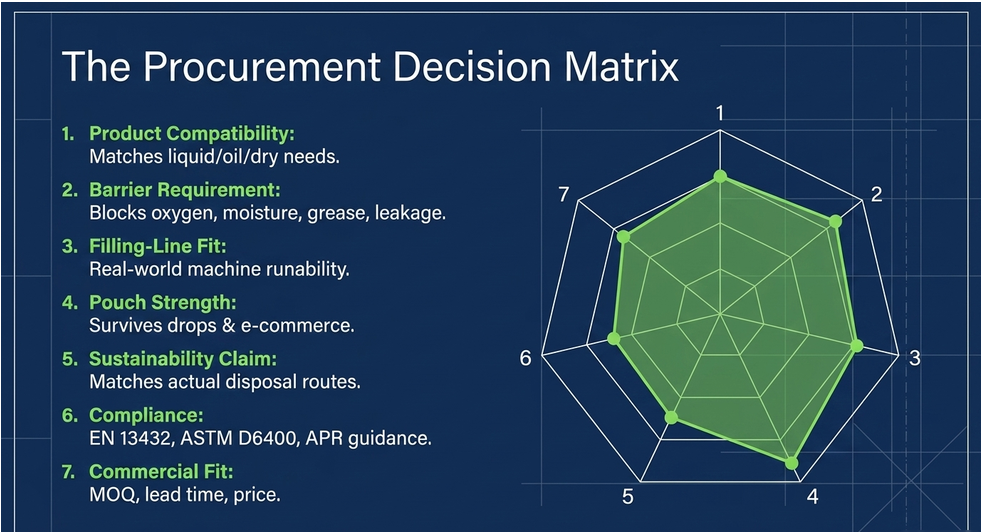
This decision matrix helps buyers compare sustainable packaging alternatives for refill pouches by performance, feasibility, and sustainability. This follows the same logic used in broader packaging frameworks such as the Performance, Feasibility, Sustainability model and WBCSD’s SPHERE framework, where climate impact, circularity, efficiency, end-of-life, and harmful substances are assessed together.
| Buyer decision factor | What to check | Better material direction | Why it matters |
| Product compatibility | Liquid, powder, oil, fragrance, acidity, moisture | Flexible biopolymer blend for liquids; paper or starch blend for dry refills | The product decides the barrier, seal, and chemical resistance needed. |
| Barrier requirement | Oxygen, moisture, aroma, grease, leakage | Coated biopolymer film, mono-material barrier film, or paper laminate with coating | Weak barrier can cause swelling, aroma loss, leakage, or shelf-life failure. |
| Filling-line fit | Heat sealing, spout insertion, filling speed, roll-stock behavior | PBAT-rich compostable blend, PE mono-material, or custom biopolymer grade | A sustainable pouch must run on real machines, not just pass a lab review. |
| Pouch strength | Drop, burst, puncture, compression, e-commerce handling | Tough, flexible blend with validated micron range | Refill pouches are squeezed, stacked, shipped, and sometimes dropped. |
| Sustainability claim | Compostable, recyclable, bio-based, recycled content, plastic reduction | Certified compostable film, mono-material PE or PP, PCR structure, or agri-waste biopolymer | The claim must match the material, certificate, and disposal route. |
| Compliance and documentation | EN 13432, ASTM D6400, APR guidance, food-contact or cosmetic-contact proof | Documented and tested material system | Procurement teams need proof before approval. |
| Commercial fit | MOQ, lead time, price premium, trial cost | Sample-grade material, pilot run, or custom grade route | Buyers need a safe path from sample to scale. |
The key lesson is simple. Alternative plastic materials should not be selected by name alone. PLA, PBAT, PHA, starch, PE, PP, paper, and PCR all need to be judged against the product, line, claim, and market.
How to test sustainable refill pouch packaging before approval
Before approving sustainable packaging alternatives for refill pouches, buyers should test the pouch like a packaging system, not just like a material sample.
Start with material samples or roll-stock film. Check appearance, feel, thickness, seal layer, stiffness, and basic compatibility with the product.
Then run filling and sealing trials. This is where many eco-friendly alternatives to plastic either prove themselves or fail. The trial should check:
- seal temperature window
- sealing speed
- leakage under pressure
- spout or zipper compatibility
- pouch-forming behavior
- product residue near the seal
For liquids and viscous products, test leakage, burst strength, drop resistance, and storage stability.
For recyclable pouches, check sortation and recyclability. APR (Association of Plastic Recyclers) guidance focuses on whether the package can move through recycling systems and produce usable post-consumer resin. Color, size, barrier layer, adhesive, ink, and closures can all affect recyclability.
For food or personal care, chemical safety matters. Migration testing uses simulants, time, and temperature conditions to assess whether substances move from packaging into the product. Recent research on food packaging alternatives highlights the importance of screening both intentionally added and non-intentionally added substances.
For compostable claims, the pack must meet standards such as EN 13432 or ASTM D6400. Compostability testing includes disintegration, biodegradation, heavy metals, and ecotoxicity checks. A pouch should not be called compostable only because one input material is compostable.
Testing creates confidence before procurement. It also prevents the most expensive mistake, which is approving a sustainable-looking pouch that fails on the filling line or in transit.
FAQ
1. What are the best sustainable packaging alternatives for refill pouches?
The best option depends on the refill model. Paper laminates suit dry refills, compostable films suit select low-risk products, and recyclable mono-material pouches suit larger liquid refill systems.
2. Are sustainable refill pouches better than reusable bottles?
They solve different problems. Reusable bottles work well when cleaning and return logistics are strong. Sustainable refill pouches reduce transport weight and help consumers refill at home.
3. What are common eco-friendly packaging examples for refill brands?
Common eco-friendly packaging examples include paper refill packs, compostable pouches, recyclable mono-PE pouches, reusable PET containers, fiber cartons, and water-soluble sachets for concentrates.
4. Are eco-friendly alternatives to plastic always compostable?
No. Eco-friendly alternatives to plastic may be recyclable, reusable, bio-based, recycled-content, compostable, or paper-based. Compostability is only one route, not the default route.
5. Which alternative plastic materials work for refill systems?
Common alternative plastic materials include PLA, PBAT blends, PHA, starch blends, sugarcane PE, mono-PE, mono-PP, and PCR-based films. Buyers should match them to the product and disposal route.