
Last year, one Indian exporter told me a US buyer rejected a full container of bags. The product was fine. The packaging was excessive and mostly plastic.
Across the EU, UK, and USA, buyers do not treat packaging as a minor accessory anymore. The tightening regulations around single use plastic packaging make them legal and brand risk items.
The European Commission found that 40% of plastics used in the EU are in packaging. And new rules now target design, labels, and materials. UK recycled content packaging rules are also increasing. The country’s Plastic Packaging Tax applies if you manufacture or import plastic packaging components with less than 30% recycled plastic.
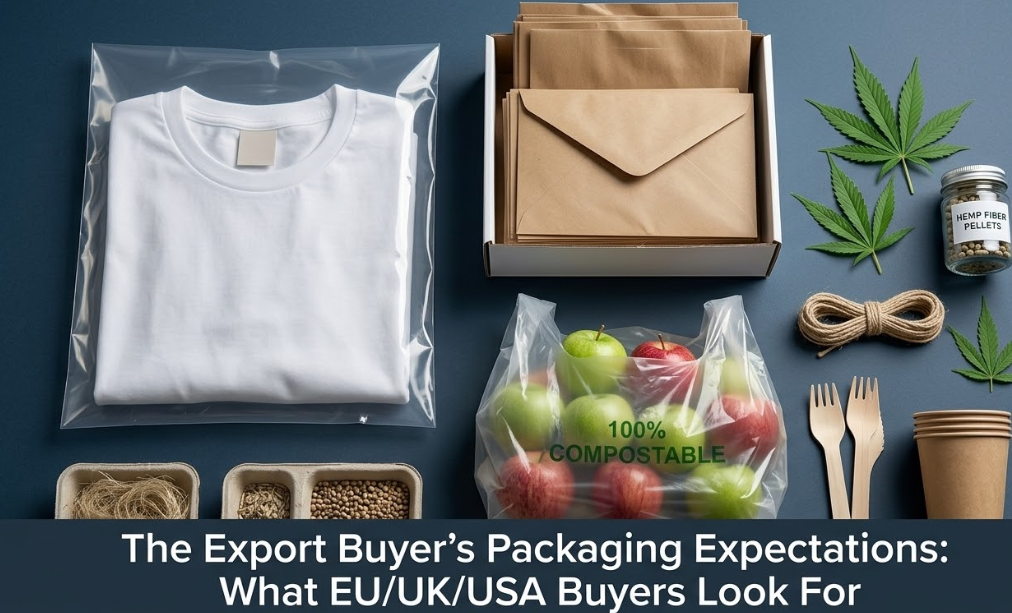
For Indian exporters selling products with virgin plastic packaging, this creates a direct risk. Alternatives like paper and bioplastic are becoming the default expectation. Some formats buyers ask for, include:
- Corrugated export boxes
- Kraft paper sacks
- Agro-waste packaging
- Recyclable cartons
- Bioplastic liners for moisture barrier needs
Bioplastic packaging that meets recognised standards is a safe bet for exports in the long term.
Let’s say you want to export clothes with sustainable packaging that a retail buyer will accept. Here are some expectations in the UK, USA and EU you might want to consider.
What do EU, UK and USA buyers expect in 2026?
Buyers in all major countries want the same outcome, fewer surprises after import.
They check four things:
- Legal fit with local rules
- Clear labels and disposal guidance
- No restricted chemicals
Buyers also want less waste at their warehouse. Fewer layers and fewer mixed materials reduce disposal cost and the risk of “non-recyclable” packaging.
So, here are what most export buyers expect in the EU, UK and USA when they screen sustainable packaging in their respective countries.
EU Packaging Regulations
Packaging waste rules are about to apply in the EU from August 2026. So, EU buyers usually check four things first:
- EU packaging regulations 2026 compliance
- “Designed for recycling” claims that match EU definitions
- Clear material and disposal labelling
- No restricted substances that trigger a recall story
A simple way to think about it is this.
EU buyers want sustainable packaging that creates less waste and keeps more materials in the loop. The European Commission frames the regulation around reducing waste and pushing a circular model
Another point has become non-negotiable. The EU is also targeting PFAS in packaging as part of the broader push to cut harmful chemicals. Buyers do not want to be the brand explaining “forever chemicals” in their packaging.
EU buyers also expect you to supply packaging composition data, since EPR reporting depends on weight and material category.
UK Packaging Rules
The UK has one rule that makes buyers very direct.
If plastic packaging has less than 30% recycled content, someone pays the UK tax. Most of the time, the buyer pushes that cost back to the supplier or chooses a different supplier.
UK Plastic Packaging Tax applies if a company manufactures or imports plastic packaging components that contain less than 30% recycled plastic.
So UK buyers look for:
- A recycled-content declaration, tied to a traceable supply chain
- A sustainable packaging specification sheet that states polymer type and percentage clearly
- Labels and claims that do not trigger green claims scrutiny
The regulations in the USA are different but the buyer mindset is familiar.
USA Import Packaging Standards
There is no single national packaging law that covers everything in the USA. So buyers create their own safety rail.
They use a mix of:
- FTC guidance on environmental claims
- State-level rules, led by California
- Accepted standards such as ASTM for compostability
Start with claims. The FTC’s Green Guides exist to stop misleading environmental marketing, and they push brands to match claims with evidence.
Then look at California, since US buyers often treat it as the strictest benchmark.
California’s SB 54 is positioned as a landmark sustainable packaging law. It sets the direction that by 2032, plastic packaging must meet recyclability or compostability outcomes.
California is also tightening what “compostable” can mean on a label. From June 30, 2027, products labelled “compostable” in California have to meet strict criteria tied to the USDA National Organic Program.
That is why US buyers ask for one thing before they talk about the price.
Here is an overview of the first screening criteria in the three regions.
| Region | What buyers screen for first |
| EU | Packaging waste reduction, harmonised rules on design and labels, tighter substance controls |
| UK | Tax trigger around recycled content in plastic packaging components |
| USA | Claim discipline and state level packaging rules, with California setting the pace |
Good materials are not enough, they want packaging with:
- Fewer layers and fewer mixed materials
- No unnecessary laminations
- Water based inks
Buyers also want the right standards and the right paperwork behind the material.
Bioplastic certifications that buyers recognise
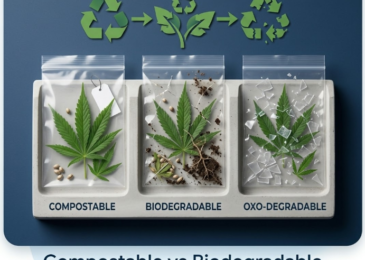
When using bioplastic packaging, certification is the language buyers trust. Compostable only counts when a buyer can verify it.
Most EU and US buyers recognise a short list of standards and marks. A popular reference point for industrial compostability is the EN 13432, which tests disintegration, biodegradation, and toxicity limits under controlled composting conditions.
California’s AB 1201 (enforced 2027) bans the word entirely unless the pack also qualifies for USDA Organic inputs, which effectively wipes out PFAS and heavy metal additives.
Here is an overview of some popular certifications.
| Logo on Your Datasheet | Standard Behind It | Where It Carries Weight |
| Seedling / TÜV OK Compost | EN 13432 (industrial compost) | EU, UK retail, EU customs |
| BPI Compostable | ASTM D6400/D6868 | USA (all states), Canada |
| ISO 17088 (CPCB letter in India) | ISO 17088 / IS 17088 | Mandatory for Indian manufacture, widely accepted abroad |
| Recycled Content Mark | ISO 14021 / EuCertPlast audit | Proves >30 % recycled plastic for UK tax relief |
Using certified bioplastic packaging for your product is a safe bet in multiple markets. It performs similarly to plastic with the added advantage of being compliant.
But isn’t sustainable packaging more expensive?
Not with Ukhi’s biopolymer.
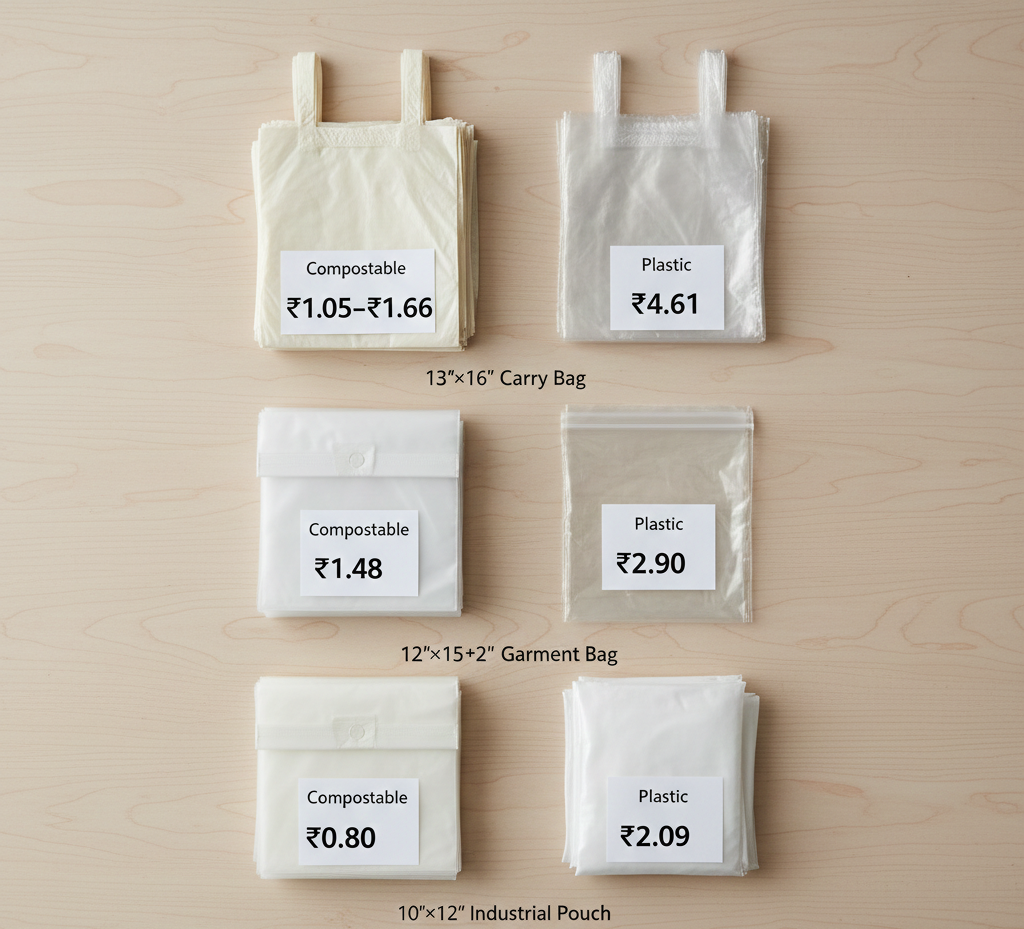
Bioplastic bags like a standard 13″ × 16″ compostable carry bag made with Ukhi’s EcoGran™ granules usually land in the ₹1.05 to ₹1.66 per piece range.
The same cost benefits show up in common garment and industrial packaging.
So if you distribute 1,000 bags a month, a ₹3 per bag saving is over ₹3,000 every month.
You save money without changing your bag size, your packing speed, your staff training, or your machines.
There is a second cost people miss. Cheap plastic gets expensive when it fails to comply to upcoming regulations.
A shipment hold up. A buyer audit failure. A label claim you cannot prove. A procurement team that quietly drops you from the next tender.
This is where Ukhi fits, in a clean and compliant way.
Ukhi focuses on the raw material and compliance architecture. Our EcoGran™ biogranules go into bags manufactured by CPCB-certified partner plants.
Order a sample kit from Ukhi and see the difference.
FAQs
- What materials do EU and UK buyers prefer for export packaging in 2026?
Export buyers expect sustainable packaging with corrugated boxes, kraft sacks, molded fibre, and agro-waste alternatives to plastics. Certified compostable liners over conventional plastic are preferred when a moisture barrier is needed.
- Do EU buyers still accept a generic “biodegradable” label in sustainable packaging?
No. Buyers need EN 13432 certificate, material code, PFAS-free test, and QR link, exactly as EU packaging regulations 2026 demand today.
- What documentation do you need for sustainable packaging?
Recycled content proof, FSC certificate for paper, compostability certificate for bioplastics, and a simple packaging data sheet with weights and material breakdown.