
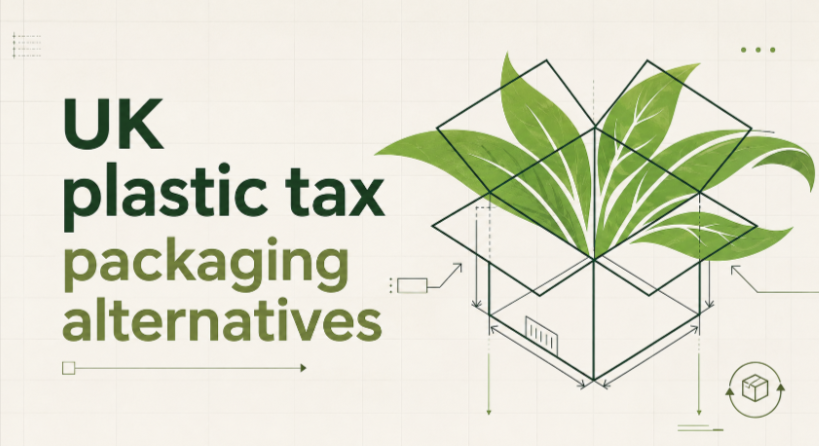
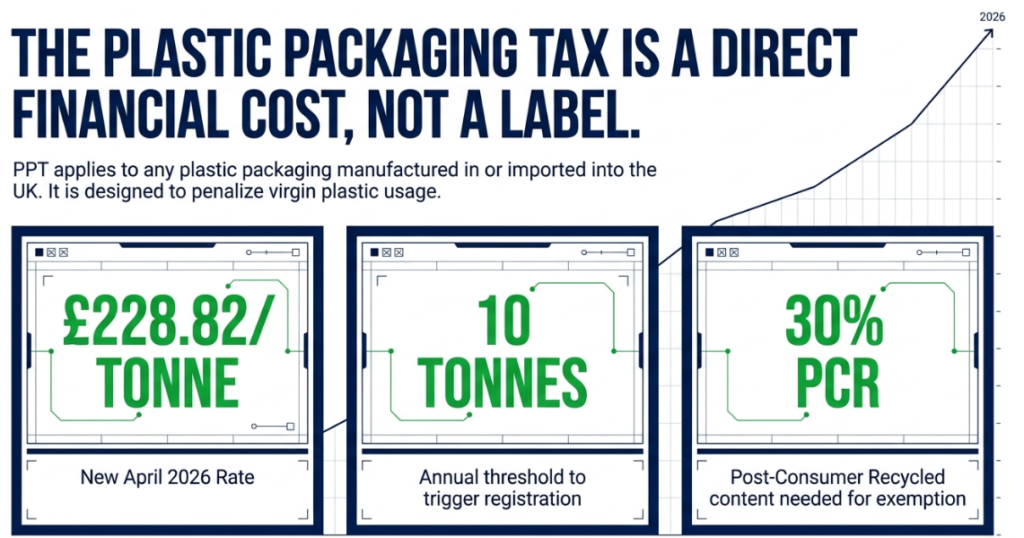
In April 2022, the UK introduced a tax on plastic packaging that didn’t meet a specific recycled content threshold. It was designed to push manufacturers and importers away from virgin plastic. Four years in, it’s still growing, and from April 2026, the rate has gone up again to £228.82 per metric tonne.
If you are supplying the UK market, the tax applies to you. In this guide, we cut through the jargon and tell you exactly what the tax means and the UK plastic tax packaging alternatives you can use.
What the UK plastic packaging tax actually is
The UK’s Plastic Packaging Tax, commonly called PPT, is a charge applied to any plastic packaging that is manufactured in or imported into the UK and contains less than 30% recycled plastic by weight. It is not a ban or a labelling requirement. It is a direct financial cost, applied per metric tonne of qualifying plastic.
Key facts about the UK PPT:
The 30% recycled content rule, explained plainly
The rule is simple on paper. If your packaging contains at least 30% post-consumer recycled plastic by weight, it is exempt from the tax. If it contains less, you pay. The 30% threshold applies to each individual packaging component, not to your product line as an average. So a mailer bag and a liner film are assessed separately.
One important detail: only post-consumer recycled content counts. Pre-consumer waste, the offcuts and factory scrap that get reprocessed before ever reaching a consumer, does not qualify as of 2025 onwards.
Who it applies to, and the supply chain pass-through
The tax is charged to the manufacturer or importer who first places the packaging on the UK market. This matters a lot for Indian exporters. “If your business is the importer of record in the UK, you may be liable for Plastic Packaging Tax. Where a UK customer acts as importer, the tax obligation usually sits with them.
However, the packaging choices made by Indian exporters can still directly affect the customer’s PPT liability and purchasing decisions.
As Vishal Vivek, Founder, UKHI, explains,
“Most Indian exporters we speak to assume that if their packaging says ‘compostable’ or ‘biodegradable,’ they’re clear of the UK plastic tax. That’s not how it works. The PPT looks at material classification and recycled content, not environmental claims. We’ve helped clients avoid significant unexpected tax liabilities by switching from compostable plastic films to bagasse or moulded pulp formats. This helps exit the tax register entirely and costs less in combined compliance fees once you factor in EPR.”
What changed in April 2026, and what is coming in 2027
From 1 April 2026, the plastic packaging tax 2026 rate rose to £228.82 per tonne, up from £223.69 in 2025. The rate is index-linked and will continue rising annually. More significantly, the government has signalled structural reforms for 2027. These include changes to how recycled content is certified. There will also be stronger traceability requirements and a closer alignment with the EU’s Packaging and Packaging Waste Regulation.
So, if you are planning a switch to sustainable alternatives to plastic packaging, planning ahead of 2027 gives you more flexibility and less disruption.
The two paths out of PPT liability
There are two ways to stop paying the Plastic Packaging Tax. You can stay with plastic but hit the recycled content threshold. Or you can switch to sustainable alternatives to plastic packaging. Both are valid. Which one you should choose depends on your use case, your volumes, and your customers’ expectations.
Path 1: Stay in plastic, hit 30%
Source packaging that contains at least 30% post-consumer recycled plastic. There is no tax liability, and your packaging format doesn’t change. But recycled-grade material is harder and more expensive to source reliably.
Path 2: Switch to non-plastic materials
Move to fibre-based, paper, or plant-derived sustainable alternatives to plastic packaging. Remember to ensure that the material is not classified as plastic under PPT. With that, you exit the tax register entirely. These are the UK plastic tax packaging alternatives that also tend to perform better under Extended Producer Responsibility fees.
Common compliance trap
Compostable and biodegradable plastics, including PLA, are still classified as plastics under PPT rules. They are taxable unless they contain 30% or more recycled plastic. The words “compostable” and “biodegradable” carry no weight in the tax framework. What matters is material classification and recycled content. This is the single most common mistake Indian exporters make when assuming their eco-friendly packaging materials or compostable mailer is automatically exempt.
Material alternatives that take you off the PPT register
The eco-friendly packaging materials below are not classified as plastic under UK PPT rules. That means they remove your liability entirely. However, they come with their own performance profiles, certification requirements, and cost implications. So make sure you understand those details and trade-offs before you switch.
| Material | PPT Status | EPR Classification | Food-Safe | Best Use Case | MOQ Range |
| Moulded Pulp | Exempt | Recyclable | Yes | Protective inserts, trays, electronics packaging | 5,000+ |
| Kraft Paper / Glassine | Exempt | Recyclable | Yes | Courier mailers, garment packaging, fashion retail | 10,000+ |
| Bagasse Trays | Exempt | Recyclable | Yes | Food service, takeaway packaging, meal prep containers | 10,000+ |
| PBAT Compostable Film | Taxable* | Hard to recycle | Yes | Courier bags, liners (with caveats) | 25,000+ |
| PLA Containers | Taxable* | Hard to recycle | Yes | Cold food packaging, beverages, deli containers | 10,000+ |
| rPET (30%+ Recycled Content) | Exempt | Recyclable | Yes | Bottles, clamshell packaging, food trays | 10,000+ |
*Taxable unless blended with 30%+ post-consumer recycled content. PPT = Plastic Packaging Tax. EPR = Extended Producer Responsibility.
Switching to these plastic packaging alternatives takes you off the PPT register for sure. But there is a second compliance layer that most sourcing guides don’t explain clearly. That’s the UK’s Extended Producer Responsibility scheme.
How PPT interacts with EPR, and why the distinction matters
PPT and EPR are two separate systems. Switching to plastic packaging alternatives eliminates your PPT liability. But under the UK’s Extended Producer Responsibility framework, you may still owe fees based on how recyclable your packaging is.
These fees are eco-modulated. That means materials that are harder to recycle attract higher charges, even if they are compostable or biodegradable. Compostable packaging like PLA, for example, is currently classified as “hard to recycle” under EPR. That means doubled base fees of approximately £520 per tonne under 2026 rules.
This creates an important decision framework for Indian exporters and UK importers. The materials that perform best across both PPT and EPR are fibre-based formats:
- Moulded pulp
- Kraft paper, and
- Bagasse.
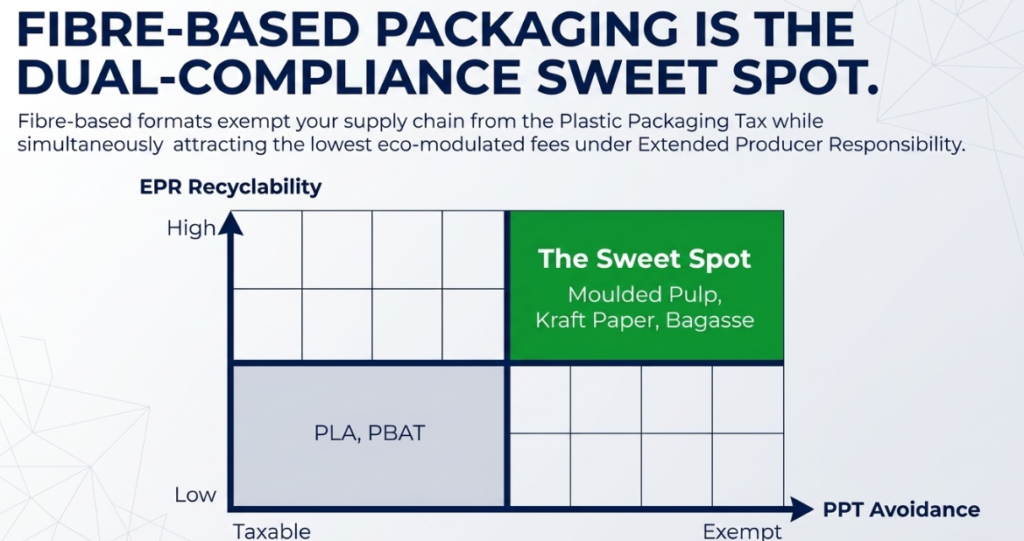
These are exempt from PPT, classified as recyclable under EPR, and attract the lowest combined compliance cost. Compostable plastics like PBAT and PLA, by contrast, can leave you exposed to both the plastic packaging tax and elevated EPR fees.
Sources and References
- Plastic Packaging Tax: steps to take
- UK Finance Act 2021, Schedule 12: Plastic Packaging Tax legislative basis
- ERP Recycling UK: Plastic Packaging Tax Changes in 2026 (January 2026)
- BB-REG-NET: Beyond the Label, UK Public Attitudes and Policy Gaps on Bio-Based, Biodegradable, and Compostable Packaging (2026)
- Flexible Plastic Fund: FPF FlexCollect Report 2025 (September 2025)
Getting started with PPT-compliant packaging
Choosing the right UK plastic tax packaging alternative is not just about avoiding PPT. It’s about setting yourself up so you’re not constantly playing catch-up every time a new regulation lands.
At UKHI, we’ve worked with enough exporters to know that most people don’t need a lecture on policy. They need someone to look at what they’re actually using, flag what might cause problems, and point them toward options that make sense for their business. That’s what we do. Connect with our experts on WhatsApp to get insights and material recommendations today!
FAQs
If I source eco-friendly packaging from India, will it qualify as a PPT alternative in the UK?
That actually depends on the material you choose. Bagasse, moulded pulp, and kraft paper are not classified as plastic, so PPT doesn’t apply. Compostable plastics like PLA or PBAT are still plastic under UK rules, even if they feel like the greener choice,
Are there eco-friendly materials that work across both food and non-food products?
Yes, bagasse, moulded pulp, and kraft paper are genuinely versatile and they’re used across a huge range of product types. If moisture resistance is a concern for your specific product, there are more specialist options worth exploring, and we’re happy to walk you through those depending on what you’re packing.
Can a packaging component be partly exempt if it uses a mix of materials?
Not really. Whichever material accounts for most of the weight determines how the whole component is classified. So if plastic is the heavier portion, the entire piece is treated as plastic packaging, even if there’s a meaningful non-plastic element in there.