

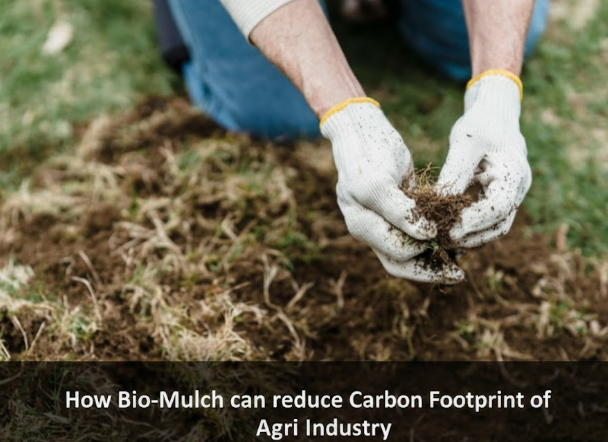
It will be a stretch of imagination, but try this.
Imagine millions of acres of farmland covered in plastic sheeting that will sit in landfills for centuries and break down into microplastics.
Now imagine replacing that with a material that feeds the soil as it disappears.
That’s the promise of bio-mulch.
It’s a simple material choice that can transform entire farming systems.
In the US alone, the agriculture industry contributes to almost 10% of greenhouse gas emissions. With plastic mulching there are additional burdens: soil degradation and plastic pollution.
This is exactly where bio-mulch provides an alternative path to reduce the agriculture carbon footprint and the global plastic crisis.
As someone who has spent years working with hemp and regenerative agriculture, I can vouch for its efficacy.
In this article, I’ll explain what bio-mulch is, why it matters for the climate, and how it can help us transition to more sustainable, low-emission agriculture.
What is bio-mulch and how is it different from regular mulch?
Bio-mulch, also called biodegradable mulch, is a thin film made from plant-based or compostable materials that you lay over the soil.
It looks and behaves like plastic mulch during the crop cycle.
But here’s the difference: when the growing season ends, you don’t need to remove it. You simply till it back into the soil. Over time, microbes break it down into:
- water,
- carbon dioxide, and
- organic matter.
Now contrast that with plastic mulch, which is made from petroleum.
It does the job by suppressing weeds, warming the soil, and keeping the moisture in.
But it’s a nightmare to dispose of.
Most of it ends up in landfills, or worse, scattered in fields as microplastic pollution.
Organic mulch, like straw or wood chips, is great for soil health but doesn’t offer the same weed control or temperature benefits.
Bio-mulch combines the best of both worlds: performance like plastic, but the afterlife of organic.
Let’s look at why this matters for the climate.
Why is reducing agriculture’s carbon footprint so important?
The agriculture industry’s emissions aren’t a side note in the climate story. They’re front and center.
Globally, farming contributes anywhere from 10% to over 20% of greenhouse gas emissions, depending on how land use is counted.
These emissions come from many sources:
- nitrous oxide from fertilizers,
- methane from livestock,
- diesel used by tractors, and
- synthetic materials like plastic mulch.
If we’re serious about climate goals, and ensuring long-term food security, cutting emissions from farming is non-negotiable.
The good news is, small changes in farm practices can have outsized impacts. The use of biodegradable mulch in agriculture is one such change.
To understand how, we first need to see what role mulching plays in farm emissions.
What role does mulching play in farm emissions?
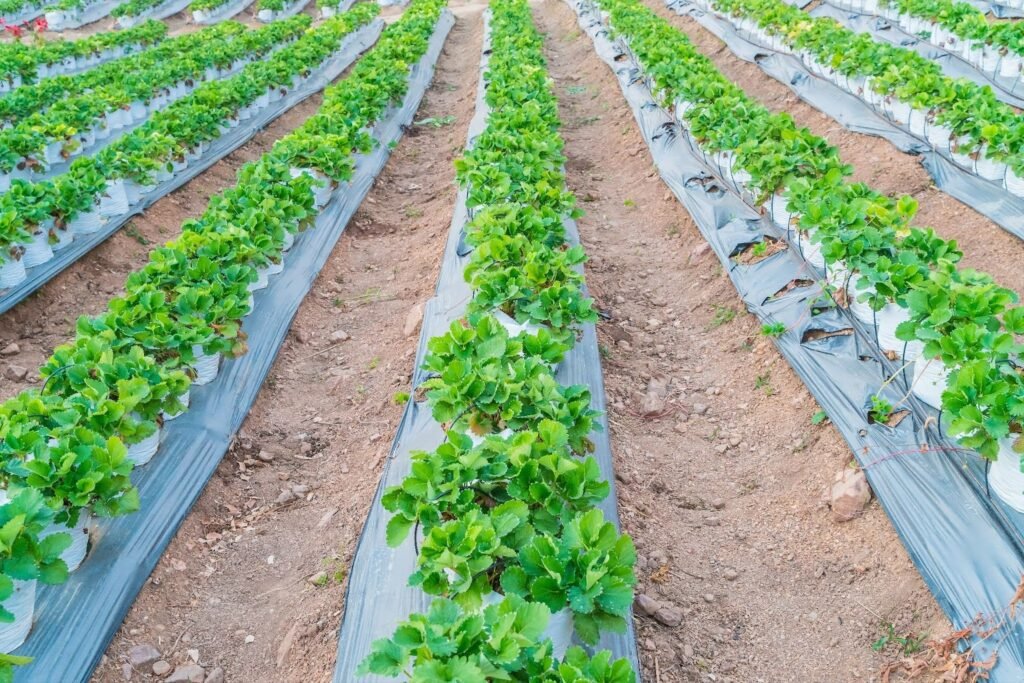
Mulching is one of the most common practices in modern farming. It’s used to:
- block weeds,
- retain moisture,
- prevent erosion, and
- warm the soil.
But it also has a carbon cost.
The most widely used type is the polyethylene (PE) mulch, which is made from fossil fuels.
Is it durable? Yes.
However, it’s energy-intensive to produce and almost impossible to recycle after use.
A study from China found that in a garlic field, PE mulch alone accounted for 17.7% of the field’s total greenhouse gas emissions.
That’s a big chunk for a single input.
Plus, PE mulch needs to be collected, transported, and disposed of, usually through burning or landfilling. Both burning and landfilling release more carbon.
Clearly, what we use to mulch matters.
That’s where bio-mulch comes in to reduce the carbon footprint.
How does bio-mulch help lower emissions?
Bio-mulch reduces emissions in multiple ways:
- Lower fossil fuel use in production: Bio-mulch is partly made from renewable resources like cornstarch or sugarcane. Compared to PE mulch, it requires less energy to manufacture.
- No disposal emissions: At the end of the season, there’s no need to remove and transport the film. It’s tilled directly into the soil.
- Biodegradation: In soil, microbes break down the material into natural components. So it leaves behind no toxic residue or plastic fragments.
A life cycle assessment from a garlic farming study showed that the carbon footprint of bio-mulch was 2.76 times lower than PE mulch.
And here’s the clincher: yields stayed the same.
In other words, you’re getting the same crop output, but with far fewer emissions and no plastic waste.
That’s an easy climate win.
But there’s more.
Bio-mulch isn’t just a great solution for reducing greenhouse gas in agriculture.
It has real-world benefits for farmers and ecosystems.
Does bio-mulch help farmers and the environment?
It definitely does.
In field trials across the U.S. and Asia, biodegradable mulch has consistently matched plastic mulch in performance.
Crops like tomatoes, strawberries, garlic, and melons see comparable yields.
But here’s what farmers also report:
- Better soil moisture retention
- Fewer weeds
- Lower irrigation needs
- No plastic fragments left behind
- No labor needed for cleanup
Take the case of a cut-flower farm in Washington. They switched to a certified bio-mulch and found it performed just as well as plastic. What really tipped the balance? They didn’t have to spend time or money on post-harvest cleanup.
Other growers in Arizona and Nebraska have shared similar feedback.
And from an environmental lens, it gets even better. Bio-mulch:
- avoids adding to microplastic buildup,
- may improve microbial biomass in soil, and
- integrates well into no-till and conservation practices.
This is something we also integrate at Ukhi. Our team works closely with rural farmers experimenting with plant-based mulching and regenerative materials. We’ve seen how even marginal gains at field level can become climate wins at scale.
Our work in sustainable hemp agriculture explores green alternatives from crop residues. That’s why we are upcycling hemp, nettle, and flax into biodegradable alternatives. It’s not just about removing plastic; it’s about creating value from what was once considered waste. That shift in thinking is at the core of everything we do.
Of course, no solution is without its trade-offs.
Let’s talk about those.
What are the main challenges or limitations of bio-mulch adoption?
Bio-mulch is not yet a perfect substitute.
Here are the main concerns:
- Cost: Right now, bio-mulch can cost 1.5 to 3 times more than plastic. For high-value crops, this may be acceptable. For broadacre grains? Less so.
- Durability: Bio-films are slightly less strong than PE mulch. If not laid properly, they may tear during installation.
- Degradation rate: While bio-mulch is certified to degrade, the speed varies. In cooler or drier soils, it might take up to 2–3 years to fully disappear.
- Certification complexity: Not all biodegradable mulches are created equal. Some “oxo-degradable” plastics degrade into microplastics—not ideal. Also, in the U.S., bio-mulch isn’t approved for organic farms yet.
These are genuine hurdles.
But they’re not insurmountable.
With better materials, scale, and policy clarity, we could soon see these challenges fade.
So now the question is, do we see a future with sustainable mulch solutions in farming?
What is the future of bio-mulch in sustainable agriculture?
We’re at an inflection point.
More farmers are demanding alternatives to plastic.
More consumers are demanding plastic-free produce.
And policymakers, from the EU to California, are starting to restrict single-use plastics, even in farming.
The good news? Bio-mulch is evolving.
Newer materials have:
- higher biobased content,
- faster soil degradation,
- better tensile strength.
Global pilot projects, including some in India, are experimenting with hemp- and flax-based biodegradable films.
What excites me most is this: bio-mulch isn’t just a product. It’s a bridge between today’s plastic-heavy farming and a regenerative model where what we put into the soil feeds the soil, not the landfill.
Closing thoughts
If we want to cut emissions from farming, we have to think beyond just tractors and fertilizer.
We have to look at the small things. We are talking of the plastic sheets, the disposal steps, and the soil biology.
Bio-mulch gives us a tangible way to act.
It performs like plastic. It disappears like compost. And it brings down the carbon footprint of fields, one acre at a time.
Yes, there are challenges. But none are bigger than the climate problem we’re trying to solve.
If we get this right, we turn mulch into a climate solution. And we make every layer of soil a little smarter, a little cleaner, and a little more ready for the future.
FAQs
What Is Bio Mulch?
Bio mulch is a biodegradable film made from plant-based polymers. It enriches soil, suppresses weeds, and eliminates plastic waste from farms.
How Does Biodegradable Mulch Reduce Agriculture’s Carbon Footprint?
It replaces fossil-fuel plastics, lowers manufacturing and disposal emissions, and decomposes naturally into CO₂ and water. This helps in overall cutting of the farm greenhouse gas output.
Is Bio Mulch Better Than Plastic Mulch?
Yes. It offers the same yield and soil protection as plastic mulch but leaves no waste behind, reducing long-term soil pollution
What Materials Are Used To Make Biodegradable Mulch Films?
Common materials include starch, PLA, PBAT, and natural fibers like hemp or rice husk, making the mulch strong, compostable, and climate-friendly.
Is Bio Mulch Safe For Soil And Crops?
Yes. Certified biodegradable mulch decomposes completely, leaving no toxins or residues. In this process it keeps soil and crops safe and healthy.