
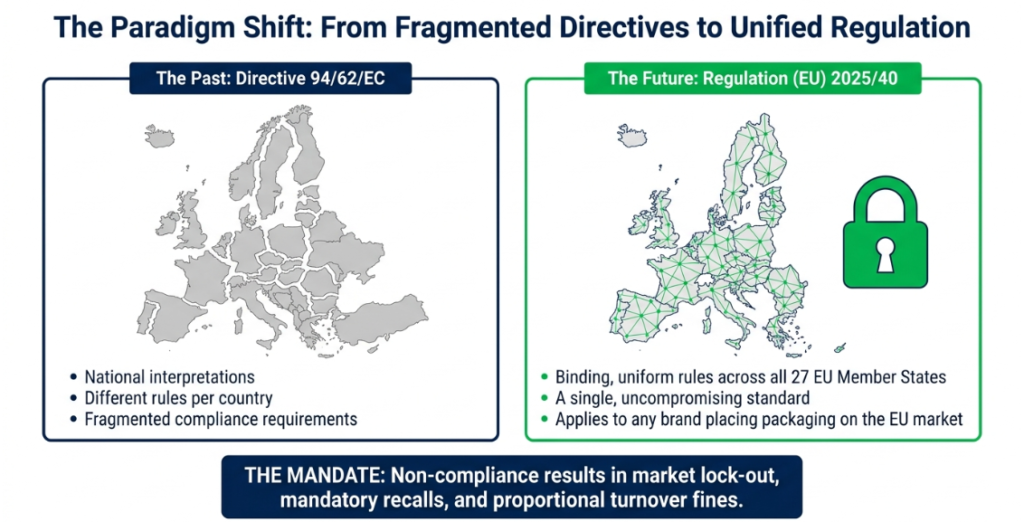
A garment pack used to be a bag, box, sleeve, label, or mailer. Under PPWR, it becomes something more serious: a compliance file.
For EU retailers, PPWR apparel packaging is not only about choosing a more sustainable material. It is about proving:
- What the packaging is made of
- How much material it uses
- Whether it can be recycled
- Whether it contains restricted substances
- What happens to it after use?
This matters because the EU Packaging and Packaging Waste Regulation changes the packaging conversation from “looks sustainable” to “can this be verified?”
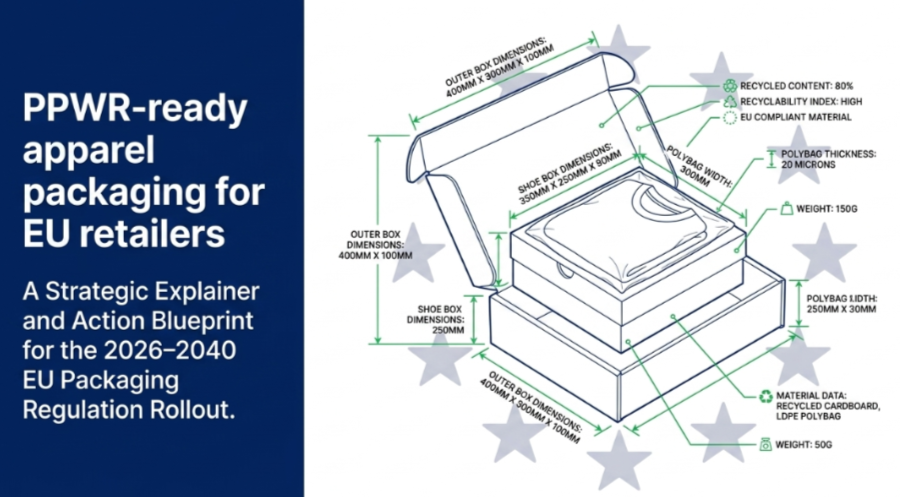
For apparel brands, that includes garment polybags, shoe boxes, ecommerce mailers, return packaging, tags, labels, tapes, void fill, and transport packaging.
Short answer: What is PPWR apparel packaging
PPWR-ready apparel packaging means packaging that is designed to optimize material use and recyclability. It also has to be accompanied by clear documentation.
For fashion buyers, the practical question is simple:
Can this packaging protect the garment, and give the EU buyer the data needed for EU fashion packaging compliance?
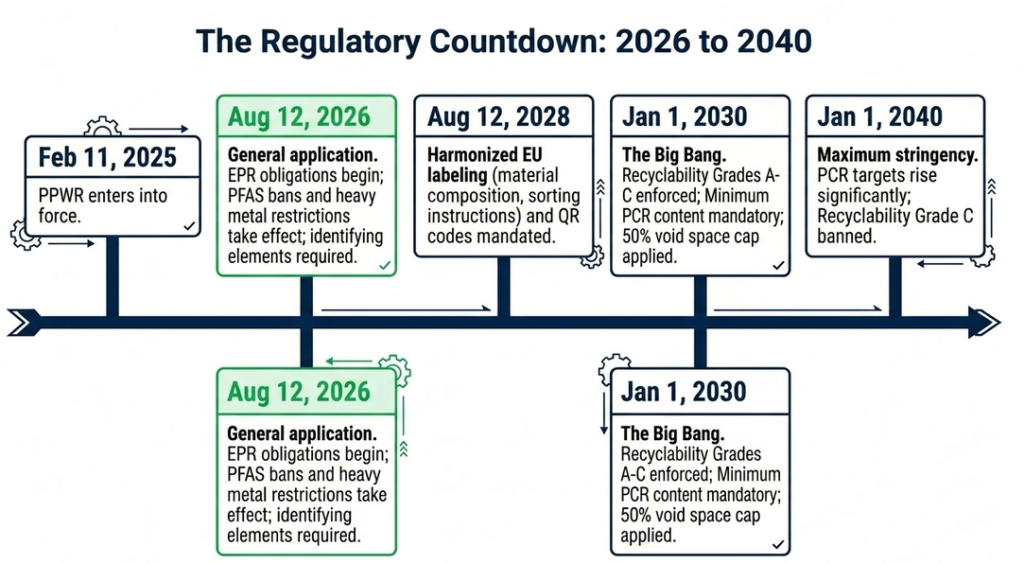
By 2030, packaging placed on the EU market must be recyclable. Plastic packaging will also face a 35% recycled-content target.
So a supplier should not only send samples. They should send proof.
For apparel, the approval pack should include:
- Material composition by layer
- Polymer, ink, adhesive, and additive details
- Recyclability or compostability evidence
- Recycled-content declarations where relevant
- Weight, volume, and packaging dimensions
- PFAS and heavy metal declarations
- Technical data sheets and conformity documentation
Ukhi is an experienced material and packaging support partner for buyers who want sustainable clothing packaging for the EU. Our goal is to help buyers compare film, coated paper, biopolymer, and recyclable formats with the right proof pack.
Which apparel packaging formats need PPWR review?
Most apparel packaging layers need review because PPWR applies to packaging placed on the EU market. This is regardless of whether the product was packed inside or outside the EU.
That is why exporters cannot treat the outer carton as the only compliance issue. The inner bag matters too.
Garment polybags and inner protective bags
Garment polybags are usually primary packaging because they protect the product before sale or fulfilment. For PPWR apparel packaging, these bags should be reviewed for:
- Material composition
- Recyclability grade
- Recycled plastic content
- Print area and ink
- Adhesive or sealing compatibility
Mixed-material films may create recycling problems. Materials like PE or PP are usually easier to assess for recyclability than complex laminates.
E-commerce mailers, courier bags, and return packaging
E-commerce packaging needs special attention because PPWR includes transport and e-commerce packaging. By 2030, e-commerce packaging must meet a maximum 50 percent empty-space ratio.
This affects apparel because garments are often shipped in boxes that are larger than needed. Fillers such as air pillows or paper cuttings can count as empty space.
Therefore, eco-friendly retail packaging for Europe requires better design and right-sizing.
Shoeboxes, wraps, sleeves, and accessory packaging
Shoeboxes, premium boxes, sleeves, paper wraps, and accessory cartons must be designed to use the minimum necessary material. Unnecessary double walls, false bottoms, or extra layers become harder to justify unless they are needed for protection.
Paper can work well here, but only when coatings and inks do not block recycling.
Labels, stickers, tapes, hangtags, and void fill
Small packaging components are easy to ignore. They should not be.
Hangtags, strings, stickers, tapes, and labels can affect sorting and recycling. A recyclable box can become harder to recycle if the label, adhesive, or decorative finish interferes with the waste stream.
EU fashion packaging compliance needs a detailed scrutiny of existing packaging and modifications necessary. The main material is only one part of the decision.
Decision matrix for PPWR-ready apparel packaging
The best packaging choice depends on the layer. A retail polybag, an e-commerce mailer, and a shoe box do not solve the same problem.
| Packaging Layer | Better-fit Options | What to Check Before Approval |
| Garment inner bag | Mono-material PE or PP; suitable biopolymer film where permitted | Recyclability grade, micron, seal strength, print system, PCR target |
| Retail wrap/sleeve | Recyclable paper; coated paper with compatible barrier | Ink coverage, coating type, recyclability evidence, scuff resistance |
| Shoe/accessory box | Right-sized board or paperboard | Weight, empty space, finish, lamination, label compatibility |
| Ecommerce mailer | Right-sized mailer; recyclable courier bag; returnable format | Empty-space ratio, tear resistance, return use, label and tape system |
| Transport packaging | Reusable crates; cartons; pallet wrap alternatives | Reuse target, stretch strength, load stability, documentation |
This matrix helps prevent a common mistake in sustainable clothing packaging for the EU. Always choose a single material for each layer for easier disposal.
A paper sleeve may be right for a folded shirt in retail. It may not be right for moisture protection in cross-border ecommerce. A compostable film may sound attractive, but if the destination market expects plastic recycling, it may create sorting issues unless the disposal route is clear.
The correct answer is to package in a layer-specific manner.
Compliance checks before RFQ approval
Before an EU retailer approves a supplier, the packaging should be checked against the requirements that actually affect fashion packaging.
Recyclability and recycled content
By 2030, packaging must meet recyclability performance requirements. Recyclability grades are expected to matter because packaging below the required threshold will face market restrictions.
For plastic apparel packaging, recycled content will also become a key procurement question. Retailers should ask whether PCR content is available, what percentage is included, and how it is verified.
Weight reduction and empty space
PPWR pushes packaging toward minimum necessary weight and volume. This is especially important for e-commerce apparel, where a small garment may be shipped in a much larger box.
The practical solution is packaging design, not only material replacement.
PFAS, heavy metals, and restricted substances
Packaging must comply with substance restrictions. The combined concentration of lead, cadmium, mercury, and hexavalent chromium must remain within the stated heavy metal limit. PFAS restrictions are especially important in food-contact packaging, but fashion retailers may still apply broader restricted-substance lists across all packaging.
Large fashion groups often maintain their own packaging chemical restrictions. Suppliers should be prepared for both PPWR requirements and buyer-specific RSL checks.
Documentation
EU buyers need evidence before they can rely on a supplier. The supplier pack should include material composition, technical data, recyclability evidence, recycled-content declarations, restricted-substance declarations, and conformity documentation.
This is the operational core of EU fashion packaging compliance.
Real-world fit for apparel exporters and EU retail teams
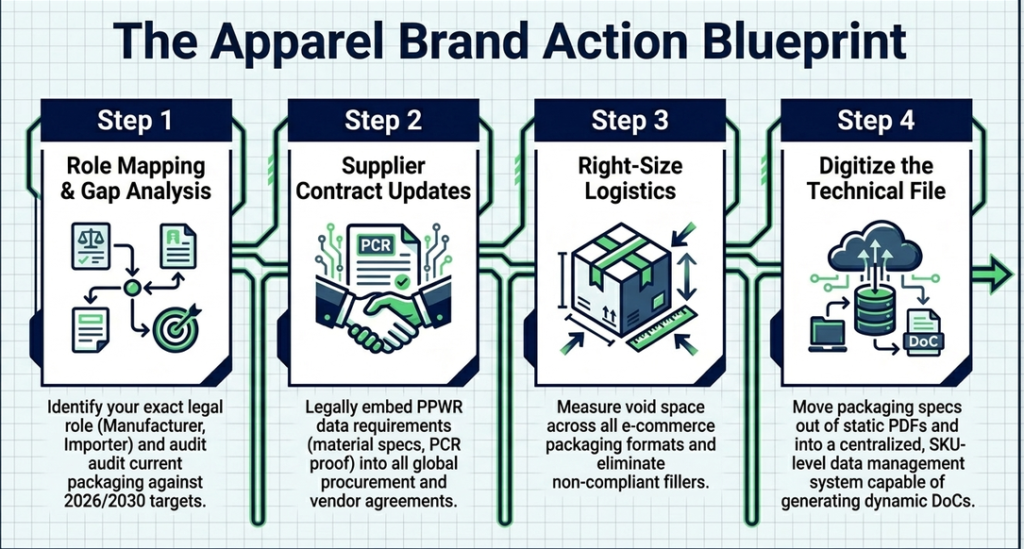
A garment exporter shipping to an EU retailer may start with a familiar polybag. Under PPWR, the buyer may now ask whether that bag is mono-material, whether it includes PCR content, whether its ink system affects recycling, and whether the supplier can provide technical documentation.
That changes the sampling process.
Instead of approving only look, feel, and cost, the buyer also reviews:
- Packing line fit
- Garment protection
- Seal performance
- Recyclability evidence
- Substance declarations
- Packaging weight and dimensions
- Data needed for EPR
Another example is e-commerce. A retailer may want to replace plastic mailers with paper mailers. That can work, but only if the paper pack protects the garment, survives handling, avoids unnecessary coatings, and does not rely on vague “better for the planet” claims.
For eco-friendly retail packaging headed to Europe, credibility comes from specifics.
A strong supplier proof pack gives EU buyers confidence before RFQ, before bulk approval, and before the first shipment is blocked by missing documentation.
Frequently asked questions
Does PPWR affect private-label apparel sold by EU retailers?
Yes, the EU’s Packaging and Packaging Waste Regulation also affects private-label apparel. In private label, the retailer who is selling the product is considered to be the manufacturer. The retailer is responsible for ensuring everything being sold meets the latest EU norms.
Are reusable mailers useful for buyers in the EU who want sustainable clothing packaging?
When recycled properly, reusable mailers cut carbon emissions by 40% to 80% compared to single-use plastic mailers. They also generate 85% less plastic waste. The PPWR encourages adoption of recyclable mailers for these reasons.
Can one sustainable clothing packaging design work across all EU countries?
Not really, since the EU is multilingual. There are 24 languages in use, and it is difficult to fit them all onto packaging. Besides, despite efforts to standardize recycling, local requirements still vary.
Do paper packaging solutions naturally meet EU fashion packaging compliance?
Not in all cases. While paper scores highly for recyclability, it has to be non-composite. If it is blended or uses laminates or ink that is non-recyclable, it will fail the 2030 recyclability criteria.
How does the packaging minimisation rule affect PPWR apparel packaging?
By 2030, there will be an empty space ratio cap. You cannot ship a single t-shirt in a large box padded with plastic air pillows. All packaging has to be tightly scaled to the product size. There can be no more than 50% excess space.
Expert quote
“PPWR will change how suppliers talk about packaging. A buyer will no longer ask only whether a material is sustainable. They will ask whether the supplier can prove its composition, recyclability, recycled content, compostability, and compliance fit. The supplier who prepares this data early will be much easier for EU buyers to trust.”
Vishal, Founder, Ukhi
Get a PPWR-ready apparel packaging sample kit
If you are reviewing PPWR apparel packaging for EU retail supply, start with the actual packaging job.
Share the garment type, pack format, micron, packaging layer, destination market, expected order volume, printing requirement, and whether the pack is for retail, ecommerce, or export handling.
UKHI can help you evaluate:
- sample kits for apparel packaging formats
- grade recommendations for film or coated-paper options
- material and documentation support for EU buyer review
- WhatsApp procurement support for faster RFQ discussion
The best time to fix apparel packaging is before the buyer asks for the compliance file.
For EU retailers and exporters, PPWR readiness is no longer a final label check. It is a packaging design decision, a sourcing decision, and a documentation decision made together.