
In 2026, PLA resin price in India was at around ₹205 per kg for basic quality imported virgin grades. The price per kg for PBAT resin in India is a bit lower, at roughly ₹148 to ₹150 per kg. PLA/PBAT blends that are compounded domestically are priced around ₹190 for agro-filler based formulations to ₹300 for commercial-grade drop-in granules.
At UKHI, we manufacture compostable biopolymer granules under the brand name EcoGran at our compounding facility in IMT Faridabad, Haryana. The pricing for our PLA/PBAT blended biopolymer granules is ₹190 per kg. We encourage procurement teams who are evaluating compostable resin suppliers to request a free EcoGran sample, which we can ship within 7 days at no cost.
PLA and PBAT Resin Price in India
The table below covers the main tiers of PLA and PBAT resin price in India.
| Material Category | 2026 Price (India) | What This Covers |
| Imported virgin PLA resin | ~₹205 per kg | Pure PLA pellets, typically from Thailand or the USA. Brittle on its own, requires compounding before conversion. |
| Raw PBAT bulk import index | ~₹148 to ₹150 per kg | Q2 2026 index price for industrial PBAT imports. Linked to crude oil and petrochemical feedstock costs. |
| Spot PLA / PBAT granules (traders) | ₹157 to ₹222 per kg | Grade-specific offerings on wholesale trading platforms in India. Price varies by grade and order size. |
| Domestic compounded compostable resin (e.g. EcoGran) | ~₹190 per kg onwards | Indian-compounded resin using local agricultural residue fillers. Avoids import duties and freight surcharges. |
| Commercial PLA/PBAT compounded granules | ₹250 to ₹300 per kg | Standard commercial drop-in granules suitable for blown film, injection moulding, thermoforming and extrusion coating. |
| PHA-based granules (for context) | ~₹450 per kg | Marine-degradable biopolymer. Premium segment, not a direct substitute for PLA/PBAT in most packaging applications. |
PLA vs PBAT: What Each Resin Does and Where It Is Used
Before comparing PLA vs PBAT resin price in India, buyers should first understand what each polymer brings to the table, because price alone does not determine which resin will be suitable for a given packaging application.
PLA (Polylactic Acid) is a 100% bio-based polymer made from fermented plant starch, which is primarily corn and sugarcane. PLA provides high rigidity, structural strength, and optical clarity above 90% transparency to the packaging manufactured from it. But pure PLA is brittle. Its elongation-at-break is only 2% to 10%. However, PLA works well in rigid packaging applications such as cold-beverage cups, thermoformed food trays, salad containers, and disposable cutlery. Pure PLA cannot be used for flexible films or carry bags because the film will crack and tear.
PBAT (Polybutylene Adipate Terephthalate) is a fully biodegradable flexible copolyester. PBAT provides rubber-like flexibility and elongation-at-break of 400% to 800%, which makes it ideal for compostable carry bags, garbage liners, courier mailers, and agricultural mulch films. But pure PBAT lacks structural stiffness on its own.
Compostable resin manufacturers blend PLA (20% to 40%) with PBAT (60% to 80%) to create a balanced compound. PLA adds stiffness, tensile strength, and printability. PBAT adds puncture resistance, tear strength, and flexibility. Compatibilisers and agricultural fillers such as corn starch or rice husk are also added during compounding to improve melt flow and reduce raw material cost.
Factors That Affect PLA and PBAT Resin Price in India
Five factors determine PLA and PBAT resin price in India.
Import dependence and logistics
India imports a large share of its virgin biopolymer resin from Thailand, China, the USA, and Vietnam. This means that compounders have to pass on a part of the costs of ocean freight, customs duties, and currency fluctuations (which can add 30% to 40% to the base material cost) to the buyer.
Crude oil and petrochemical costs
PBAT is biodegradable but it is not entirely bio-based. Around 20% to 30% of PBAT’s raw material inputs, including purified terephthalic acid, adipic acid, and 1,4-butanediol, are petroleum derivatives. When crude oil prices rise, PBAT biodegradable polymer granules pricing rises with them.
Agricultural feedstock supply
PLA compounding depends on maize and sugarcane starch as a raw material. In India, an increasing percentage of these crops is diverted toward poultry feed and the national ethanol blending programme. As a result, the supply of feedstock has become tight and the costs of starch have gone up.
Domestic compounding vs. imported resin
A few resin manufacturers are able to compound PLA and PBAT locally in India. At UKHI, we compound our resins using domestic agricultural waste as fillers. Such compounders can offer compostable biopolymer granules at a price of around ₹190 per kg.
Why Most Packaging Converters Buy PLA/PBAT Blends Instead of Pure Resins
Converters who manufacture compostable packaging in India almost never run pure PLA or pure PBAT based processes.
Pure PLA has a tensile strength of 50 to 70 MPa but an elongation at break of only 2% to 10%. This means that a blown film line running pure PLA will produce film that will split and tear during winding. On the other hand, pure PBAT has elongation at break of 400% to 800% but a tensile strength of only 15 to 35 MPa. So, films made from pure PBAT are not able to offer the stiffness needed for printing, sealing, and automated packing-line handling.
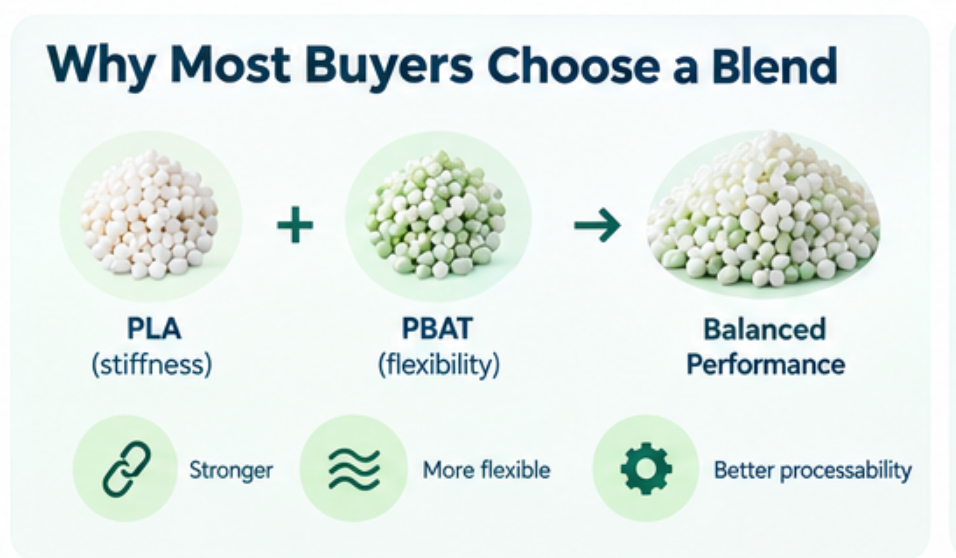
Compounders solve this problem by blending PLA and PBAT in their biopolymers. The PLA fraction acts as the structural backbone of the biopolymer. The PBAT fraction provides flexibility and puncture resistance. The result is a balanced polymer alloy that converters can process on standard blown film, cast film, and extrusion coating lines.
How Does PLA and PBAT Resin Wholesale Price Work in India
Typically, the first order a converter places for a biodegradable or compostable resin is for a production trial. For a machine trial, converters require anything between 100 and 500 kg of material. The trial allows converters to stabilize the production line long enough for the supervisors to check film formation, sealing, output and finished-product performance.
Once a grade is approved, commercial resin pricing normally depends on:
- Required application and processing method
- Monthly or annual quantity
- Required mechanical properties
- Colour and transparency requirements
- Specific formulation or grade
- Packing quantity
- Delivery location
- Freight and applicable taxes
A procurement team should therefore send the same specification to every supplier. Otherwise, the quotes may end up describing different materials.
Why Converters Buy EcoGran Compostable Resin from UKHI
UKHI is one of India’s few integrated compostable and biodegradable biopolymer manufacturers that compound resin and coordinate finished product development from a single facility.
We compound EcoGran in-house at our IMT Faridabad plant.
EcoGran granules are drop-in compatible with standard PE/PP processing equipment.
EcoGran biopolymers are made from locally sourced Indian biomass (rice husk, sugarcane waste, hemp).
Our pricing starts around ₹190 per kg.
Procurement teams who are in the process of evaluating compostable resin price in India for their production lines can request a free EcoGran sample. We ship within 7 days at no cost.
FAQs
What is the difference between PLA and PBAT resin?
PLA is a rigid, bio-based polymer made from plant starch. PBAT is a flexible, biodegradable copolyester. PLA provides stiffness and clarity. PBAT provides flexibility and tear resistance. Most compostable packaging uses a compounded blend of PLA and PBAT.
What is the price of PLA and PBAT resin per kg in India in 2026?
Imported virgin PLA resin is priced around ₹205 per kg. Bulk PBAT import index price is ₹148 to ₹150 per kg. Domestically compounded PLA/PBAT compostable resin starts around ₹190 per kg. Commercial-grade drop-in granules range from ₹250 to ₹300 per kg.
What is the minimum order quantity for EcoGran compostable resin?
Machine trial quantities start at 100 kg to 500 kg. Pilot compounding runs start at 500 kg.
Is compostable resin more expensive than conventional plastic?
Per kilogram, compostable resin costs 80% to 200% more than LDPE. But per bag, the cost is comparable or lower. Certified compostable bags are legal at 25 to 30 microns, while conventional plastic bags must be at least 120 microns. One kilogram of compostable resin produces 4 to 5 times more finished bags than one kilogram of LDPE.