
In India, plastic bag legality is no longer determined by a single question such as “Is plastic banned?”
It is more useful to ask: What type of plastic bag is it, how thick, and can the business prove that it is compliant?
Here is the plain answer first.
The plastic bag ban framework in India does not ban every plastic bag. It bans thin, low-utility, high-littering plastics.
In 2025, standard plastic carry bags can be legally made, sold and used in India only if they are 120 microns or thicker. Non-woven plastic carry bags are allowed only if they are 60 GSM or above.
Selected single-use plastic items are also banned under the single-use plastic ban rules in India.
That is the short answer. The practical answer needs more detail.
Which plastic bags are legal in India?
The search intent behind this topic is direct, so the answer should be direct too. The following table gives a quick view of legal plastic bags for business in India in 2025.
| Bag type | Legal status in 2025 | Main condition |
| Plastic carry bag made from virgin plastic | Allowed | Must be 120 microns or more |
| Plastic carry bag made from recycled plastic | Allowed | Must be 120 microns or more and follow recycled-content rules |
| Non-woven polypropylene carry bag | Allowed | Must be 60 GSM or more |
| Compostable plastic carry bag | Allowed | Must be CPCB-certified and IS/ISO 17088 compliant |
| Thin polythene carry bag | Banned | Below 120 microns |
| Non-woven carry bag below 60 GSM | Banned | Below prescribed GSM |
| Selected single-use plastic items | Banned | Includes cutlery, straws, stirrers, thermocol decoration, and listed thin films |
The most important number for ordinary plastic carry bags is 120 microns thickness.
This applies to carry bags made from virgin plastic as well as recycled plastic. A recycled plastic carry bag also must still meet the required thickness, labelling, and compliance conditions.
Non-woven bags have a different rule. These are usually made from polypropylene and are measured by GSM, not micron thickness. Non-woven plastic carry bags below 60 GSM are prohibited. Non-woven bags of 60 GSM or more are allowed under central rules.
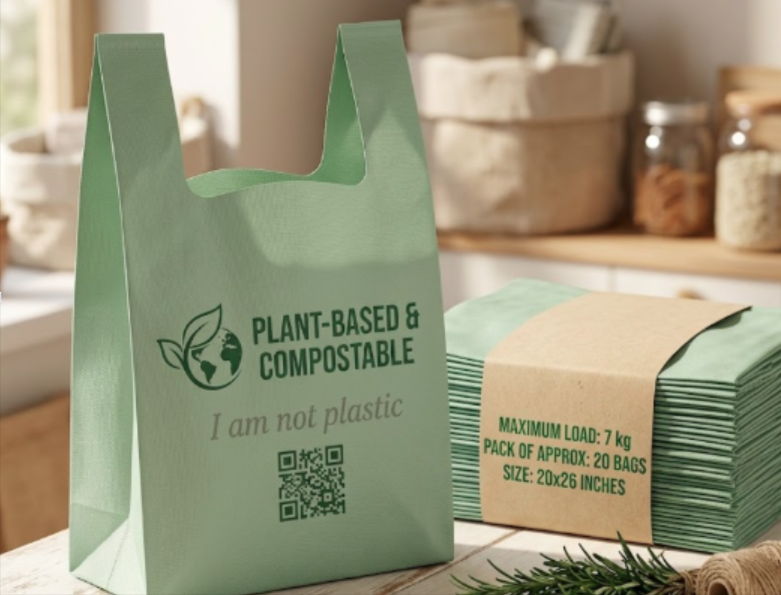
Compostable plastic bags are treated differently. They are allowed, but only when they are properly certified. A compostable bag should conform to IS/ISO 17088 and must be certified by the Central Pollution Control Board.
Which plastic products are banned in India?
The most clearly prohibited category is the thin plastic carry bag. Any plastic carry bag with less than 120 microns thickness is banned in India.
This is the rule most retailers, grocery shops, and local sellers need to understand first.
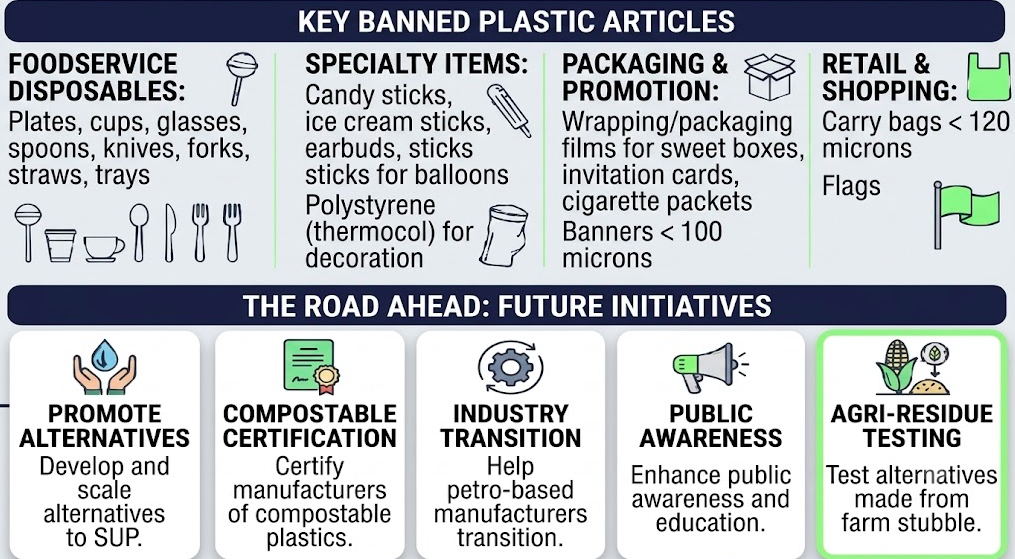
The plastic bag ban rules in India also cover more than carry bags. Businesses should avoid the listed single-use plastic items banned from July 2022, including:
- Plastic sticks used for earbuds, balloons, flags, candy, and ice cream
- Plastic plates, cups, glasses, forks, spoons, knives, trays, straws and stirrers
- Thermocol used for decoration
- Wrapping or packaging films around sweet boxes, invitation cards, and cigarette packets
- Plastic banners below 100 microns thickness
These products are not made legal just because a customer asks for them or a wholesaler still sells them.
In the market, illegal bags are still visible because enforcement is uneven. Small vendors may continue using old stock. Wholesalers may supply unmarked bags. Some bags may appear thick but still fail the actual micron requirement.
For a business, that is not a safe defence. If the bag is banned, unlabelled, uncertified, or sourced without proper proof, the business carries the risk.
The 120 micron plastic bag rule explained
Buyers are often confused by the required thickness of plastic bags in India. This is because at one time, bags of 50-micron or 75-micron thickness were allowed. Those numbers are outdated for plastic carry bags, but the legacy information survives on the internet. Under the Plastic Waste Management Rules, carry bags must be at least 120 microns thick to ensure they are durable and reusable.
India has increased the minimum thickness in stages. The rule moved from 50 microns to 75 microns, and then to 120 microns. The policy logic was practical. A thicker bag is harder to give away casually, more likely to be reused, and easier to collect for recycling.
This does not mean thicker plastic is automatically good for the environment. A 120-micron bag is still plastic. It does not disappear naturally. The environmental benefit depends on repeated use, proper collection, and responsible recycling.
Legal requirements for businesses using plastic bags
For most businesses, plastic compliance begins before the bags arrive at the store.
You must never buy unmarked bags from an unknown wholesaler just because they are cheap. Nor should your buying decision be based only on appearance.
The legal plastic bags for business India checklist should include:
- Thickness of 120 microns or more for plastic carry bags
- 60 GSM or more for non-woven plastic carry bags
- Manufacturer name and registration details
- Plastic type and recyclability marking
- Invoice and procurement record
- CPCB certification for compostable bags
- EPR-related registration where applicable to the business category
State and city enforcement can also be stricter in practice. Municipal bodies may run inspections, seize banned stock, or issue fines. Maharashtra, Tamil Nadu, Karnataka, Kerala, Delhi, and other regions have had active enforcement environments around plastic use. The central rule matters, but local enforcement decides how quickly a business faces action.
Where Ukhi fits in
For businesses, the plastic bag question is no longer only about what is banned. It is also about what can replace banned or risky packaging without creating new problems in performance, supply, or compliance.
Ukhi works on that exact material gap.
We have developed compostable and biodegradable biopolymer solutions from agricultural waste such as hemp, nettle, and flax. Its EcoGran™ material platform is designed for packaging applications such as blown films, cast films, extrusion coating, thermoforming, and injection moulding.
That means businesses looking beyond conventional plastic carry bags can explore materials that are built for real packaging use, not just sustainability claims.
For retailers, food brands, e-commerce companies, and packaging converters, our experts can help evaluate:
- Whether a compostable or biopolymer bag suits the product
- Which format works for carrying, sealing, printing, or conversion
- What documentation may be needed for buyer or compliance review
- How to test samples before shifting from conventional plastic
The legal plastic bag market in India is moving toward thicker, reusable, traceable, and certified materials. Ukhi helps businesses prepare for that shift with packaging materials designed around both performance and environmental responsibility.
Frequently asked questions
Do Indian states have different plastic bag ban rules from the central government?
The law is the same, but enforcement varies by state and region. There is a national framework that sets a baseline and bans bags under 120 microns. States like West Bengal have restricted thin bags only in specific tourist or religious sites. On the other hand, Maharashtra and Tamil Nadu have an almost blanket ban on all single-use plastics.
Are biodegradable and compostable plastic bags exempt from India’s plastic bag ban?
Biodegradable and compostable plastic bags can be used, but only if they meet the following conditions:
- The bags have a thickness of at least 120 microns
- They are certified by CPCB as per IS/ISO 17088 standards
To put it simply, a biodegradable bag cannot be thinner than 120 microns. Just because a bag will break up in a landfill, it cannot circumvent the minimum thickness rule.
Can retailers charge customers for legal plastic carry bags in India?
There is no provision in the rules that makes it mandatory. However, quite a few establishments charge an extra fee to recoup the cost of a thicker bag and discourage unnecessary use.
How can businesses verify whether their plastic bag supplier is compliant?
To be sure that you are compliant with the Plastic Waste Management Rules, ask for:
- Supplier registration
- Thickness or GSM declaration
- Material details
- Recycled-content declaration
- CPCB certification (for compostable bags)
Is recycled plastic allowed for making carry bags in India?
Yes, recycled plastic is allowed for making carry bags in India. But it must be at least 120 microns thick and be labeled “Recycled” with the percentage mentioned.