

Choosing to switch to compostable garment bags is just the first step in your sustainability journey. The next, more important step, is understanding how to source sustainable garment bags.
Now, when you start looking for suppliers of wholesale apparel bags, you’ll find countless options. All with different prices, certifications, materials, and claims. Knowing which differences actually matter is what separates smooth transitions from expensive mistakes.
So, whether you’re a fashion brand placing your first bulk order, an apparel exporter meeting international compliance requirements, or a retailer testing sustainable packaging at scale, there are a few things you should check before placing an order.
This guide walks you through that evaluation step by step. Plus, the questions every buyer should ask before buying compostable garment bags wholesale.
What format actually works for garment shipments
Not all compostable garment bag formats work the same. Your garment bags will travel through Indian heat, humidity, and logistics. They’ll get folded, compressed, and handled multiple times before they reach a customer. The format, sealing method, and material thickness all affect whether a bag survives that journey.
Here are the main options and how they compare:
| Feature | Standard Apparel Bags | Custom-Printed Branded Bags | Premium Padded Garment Bags | Polymailer Tear-Strip Bags |
| Seal Type | Permanent adhesive | Permanent adhesive with custom printing | Permanent adhesive with bubble padding | Self-sealing tear strip |
| Typical MOQ | 10,000–25,000 units | 15,000–50,000 units | 20,000–100,000 units | 10,000–30,000 units |
| Protection Level | Basic (dust and moisture protection) | Basic protection with brand visibility | High (impact and humidity protection) | Medium (moisture-resistant) |
| Typical Cost per Unit | ₹0.80–₹1.20 | ₹1.50–₹2.50 | ₹2.00–₹3.50 | ₹0.90–₹1.40 |
| Best For | High-volume, budget-focused packaging | D2C brands and premium packaging | High-value garments and export shipments | Fast fulfilment and cost-efficient shipping |
| Sealing Method / Temperature | 60–80°C | 60–80°C | 60–80°C | Manual tear strip |
Apparel needs protection from moisture and dust during transit, but not the impact cushioning that food or electronics require. That’s why tear-strip bags are fastest to seal on your production line. But permanent adhesive seals are harder to counterfeit and more visually tamper-obvious to customers.
The documents that actually protect your order
This is where most compostable garment bags’ wholesale buyers get lost. Most compostable packaging suppliers just share prices, product images, and promises. But what you need is documented proof.
So, don’t just accept verbal assurances of eco-friendliness, ask for these specific documents.
Certification & Compliance
- CPCB registration certificate for the manufacturing unit (verify the expiry date—this matters)
- IS/ISO 17088 test report for compostability (from a CPCB-recognized lab, not the supplier’s own lab)
- Certificate number that should be printed on the bag itself
- Raw material approval letter (showing the biopolymer grade: PBAT, PLA, or blend)
- Six-monthly CPCB compliance reports for the previous two years (proof they report regularly, not just once)
Quality & Performance
- Tear strength test report (ASTM D1938 or equivalent—shows the bag won’t tear under normal handling)
- Sealing strength data for permanent adhesive (failure point should be above 4 kg pull force)
- Humidity resistance test (water vapor transmission rate or moisture ingress test, critical for Indian monsoon shipping)
- Thickness uniformity report (micron tolerance, usually ±10%)
- Sample of actual film and finished bag from the last production batch (not a generic sample)
Logistics & Traceability
- Batch code system (how bags are numbered for recall if needed)
- Quality control photos from your production run (before shipment)
- Production schedule and shipping timeline in writing
- Storage and shelf-life guidance (compostable packaging can degrade in extreme heat or humidity and their shelf life is typically 2–3 years)
- Proof of liability insurance (for export shipments especially)
Why ask for all this? Because when a seal opens on 500 units, or a tear appears, or a batch doesn’t compost on schedule, you need proof of what was actually supplied. Memory and promises won’t help, the documents will.
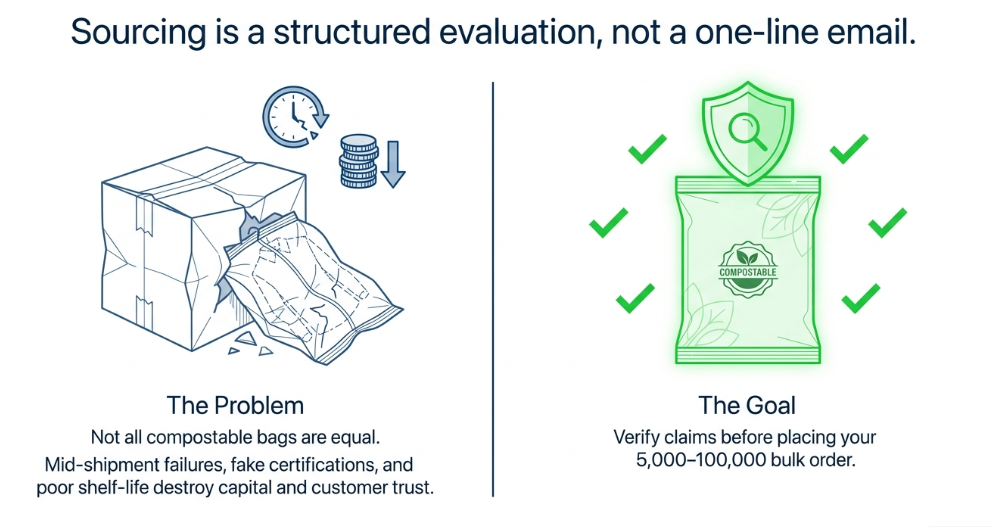
As Vishal Vivek, Founder of UKHI, explains, “Sourcing compostable garment bags is not a one-line email. A good supplier gives you certified bags, test reports, and batch traceability. Plus, an honest conversation about performance trade-offs. If a supplier cuts corners on documentation or promises results they cannot prove, they’ll cut corners on your order too. The documents come first. The bags come second.”
Three red flags that should stop you
These are the three signs that you should be on the lookout for. And as soon as you spot any of these, reconsider your engagement with the supplier.
Flag 1: “We have CPCB approval” (without showing the certificate number)
If a supplier cannot print the CPCB certificate number on the bag or give you a copy of the registration, walk away. This is the most basic proof. Without it, the bag does not count as legally compostable packaging in India. This is non-negotiable.
Flag 2: “Our resin is certified, so the bag is certified”
Resin certification does not automatically equal bag certification. The finished pouch can fail if the sealing, additives, or inks are not also approved. Always ask for the finished-bag test report, not just material specs.
Flag 3: “Compostable packaging means it’ll break down in your warehouse”
A properly made compostable garment bag is shelf-stable for 2–3 years in normal conditions. If the supplier warns you about storage instability, something’s wrong with the material or manufacturing. This is a sign they don’t understand their own product.
Test before you commit to 50,000 units
Most suppliers will give you samples. It is your job to not just look at them but actually run them through your actual workflow. Here’s what you should do:

Week 1: Seal Testing
Run 20 sample bags through your actual sealing equipment at your normal settings. Check for consistent seal strength across the pull test by hand, and the seal should not open easily. Keep some sealed samples in a humid environment (80% relative humidity, 30°C) for a week and verify that the seals don’t weaken under moisture.
Week 2: Logistics Test
Pack real products in 10 bags and ship them via your normal logistics partner. Request handling photos if possible. Upon delivery, check for tears, seal integrity, and moisture ingress.
*Print Quality Checks (if custom)
Verify print clarity and ink adhesion. Check color matching to your brand specs. Confirm the CPCB certificate number and “Compostable” marking are legible.
After testing, ask yourself: Would you accept 50,000 units of this quality? If the answer is “mostly” or “with notes,” negotiate terms or ask for improvements. Don’t move forward with “good enough.”
What do wholesale apparel bags actually costs in India (2026)
Here’s what you’ll actually pay, supplier-to-buyer:
- Standard compostable apparel bags: ₹0.80–₹1.20 per unit (10,000+ MOQ)
- Custom-printed branded bags: ₹1.50–₹2.50 per unit (25,000+ MOQ)
- Premium padded garment bags: ₹2.00–₹3.50 per unit (50,000+ MOQ)
Important: If a supplier quotes significantly lower, don’t assume they are cutting you a deal. Instead, ask why. Common reasons for lower cost include:
- Lower MOQ (less efficient production, higher per-unit cost absorbed)
- Older inventory (risking shelf-life issues)
- Recycled material blends (which may not meet compostability standards)
If you are getting a lower cost quote due to these reasons, it is not the deal you’d want to take.
Getting started with wholesale apparel bags
You now have a framework on how to source sustainable garment bags. The next step is to actually move forward and start your move towards sustainability. Get a sample kit from UKHI or WhatsApp our team for grade recommendations specific to your use case today!
FAQs
What’s the minimum order quantity for custom printed compostable bags?
Most suppliers require you to place an order for a minimum of 15,000–25,000 units to be able to offer custom printing. Some offer semi-custom options (choosing from pre-designed templates) at lower MOQs, which can reduce costs.
Can compostable garment bags run on existing PE pouch-sealing lines?
Yes, usually. Most compostable films seal at 60–80°C, similar to LDPE. But test first with sample bags. Some sealing lines have temperature sensors that may behave differently with biopolymers. Don’t assume compatibility.
Do compostable bags survive Indian monsoon logistics?
Yes, if that’s made to CPCB/ISO 17088 standards. The material is moisture-resistant during transit, however, prolonged storage in very humid conditions (>80% humidity for weeks) can affect shelf life, so rotate inventory properly.