
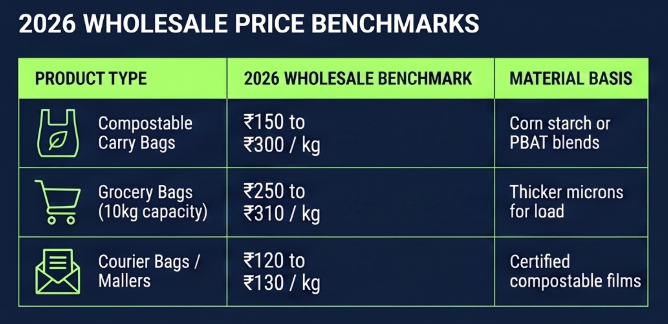
The prices of compostable bags in India in 2026 usually hover between ₹150 and ₹310 per kg for common retail and grocery formats.
The exact rate depends on bag type, micron thickness, resin blend, print requirement and order quantity.
But the price per kg is just a starting point. The number of bags per kg gives a much clearer comparison. A cheaper kg rate can become expensive if the bag is too thick, poorly sealed, uncertified, or unsuitable for the load it must carry.
Compostable bag price benchmark in India
The 2026 wholesale price for compostable bags is best understood by format. Carry bags, grocery bags, courier bags, garment bags, and garbage liners fall into different price ranges because of their material structure or micron range.
The wide range is normal. A 25-micron retail carry bag and an 80-micron grocery bag may both be sold by kg, but the buyer receives a very different number of bags from the same kg of material.
Why the per kg rate of compostable bags is only half the picture
Per kg pricing works only when size, micron, and piece count are also clear. Without these three details, the quote is incomplete.
For example, a 10 x 14 inch compostable carry bag at around 25 microns may yield roughly 160 to 165 bags per kg.
At ₹200 per kg, the compostable bags cost is close to ₹1.20 to ₹1.25 per bag.
A larger grocery bag may yield far fewer pieces per kg, so the usable unit cost will be much higher even if the kg rate looks similar.
This is why procurement teams should ask for both:
- Price per kg
- Expected pieces per kg
A supplier who gives only the kg rate is leaving out the number that affects the buyer’s real margin.
Use this simple check before comparing quotes:
Real bag cost = quoted price per kg ÷ expected pieces per kg
- If Supplier A quotes ₹180 per kg with 120 bags per kg, the compostable bag cost is ₹1.50.
- If Supplier B quotes ₹210 per kg with 165 bags per kg, the bag cost is ₹1.27.
The second quote looks costlier by kg, but it is cheaper per usable bag.
Why compostable bag prices vary in India
Most compostable bags are made from PBAT, PLA, corn starch, or other compostable biopolymers. PBAT improves flexibility. PLA gives stiffness and structure to a bioplastic bag. Whereas, starch-based blends improve cost efficiency.
So, the price will depend on the raw material of a compostable bag.
A bag meant for light retail use does not need the same thickness as a grocery bag carrying 5 to 10 kg. Higher microns increase material use, which can also increase the per-bag cost, even if the per kg rate stays within the market benchmark.
Large order quantities help manufacturers run longer production cycles and reduce conversion costs.
What a fair supplier quote should include
A reliable compostable bag quote should not be a single line saying “₹X per kg.” It should include:
- Material grade and compostability claim: The quote should name the resin or blend family, such as PBAT, PLA, or corn-starch blend, and state the compostability standard being claimed.
- Micron and dimensions: The supplier should mention thickness, width, height, gusset if applicable, and handle type.
- Expected pieces per kg: This is essential for comparing the real cost per bag.
- CPCB and IS/ISO 17088 documentation: The quote should commit to providing the relevant certificate, test report, and certificate scope.
- Mandatory labelling: The supplier should confirm that bags will carry the required “COMPOSTABLE” marking, certificate number, manufacturer or seller details, and QR-code traceability where applicable.
- Total landed cost: Ask whether the quote includes GST, freight, print setup, packaging, and delivery.
Price red flags buyers should watch for in 2026
The biggest red flag is a quote far below the market range without certification. If a supplier offers compostable carry bags well below the ₹150 to ₹310 per kg benchmark, the buyer should verify the material and certificate before placing an order.
The second red flag is loose wording. “Biodegradable,” “eco-friendly,” “green,” and “plant-based” do not mean the same thing as CPCB-certified compostable packaging. A compostable claim must be supported by the right test and certificate.
The third red flag is the missing piece count. A lower kg rate can hide a heavier bag. The buyer may end up paying more per usable piece.
The fourth red flag is missing compliance cost. Printing, freight, GST, labeling, QR-code traceability, and documentation support should not appear as surprises after approval.
What the 2026 benchmark means for different buyers
Retailers and supermarkets
Retailers should focus on carry bags in the ₹150 to ₹300 per kg range. For stores, the cost difference per piece is usually measured in paisa or a few rupees, but the compliance risk can be much larger. A non compliant bag can expose the outlet to inspection issues, customer complaints, and brand damage.
D2C and e-commerce brands
D2C brands should compare courier and mailer bags around the ₹120 to ₹130 per kg benchmark. For these buyers, packaging is also a brand signal. The right compostable mailer can support sustainable positioning without making fulfilment costs unpredictable.
Hotels and institutions
Hotels, offices, and institutions usually buy garbage liners by volume. The benchmark can vary widely because bag size and roll format change material consumption. These buyers should insist on certified compostable liners rather than vague biodegradable alternatives.
Export-oriented brands
Exporters need to check destination-market requirements. Indian CPCB compliance matters for domestic legality, while EN 13432 and ASTM D6400 may matter for Europe and the USA. The cheapest local quote is not useful if the packaging later needs replacement for export compliance.
“Compostable packaging should not be bought like a commodity plastic bag. The buyer has to compare price, pieces per kg, certification, and actual use-case performance together. A good quote protects the buyer from both material failure and compliance failure.”
— Vishal Vivek, Founder, Ukhi
Get a compostable bag price benchmark from Ukhi
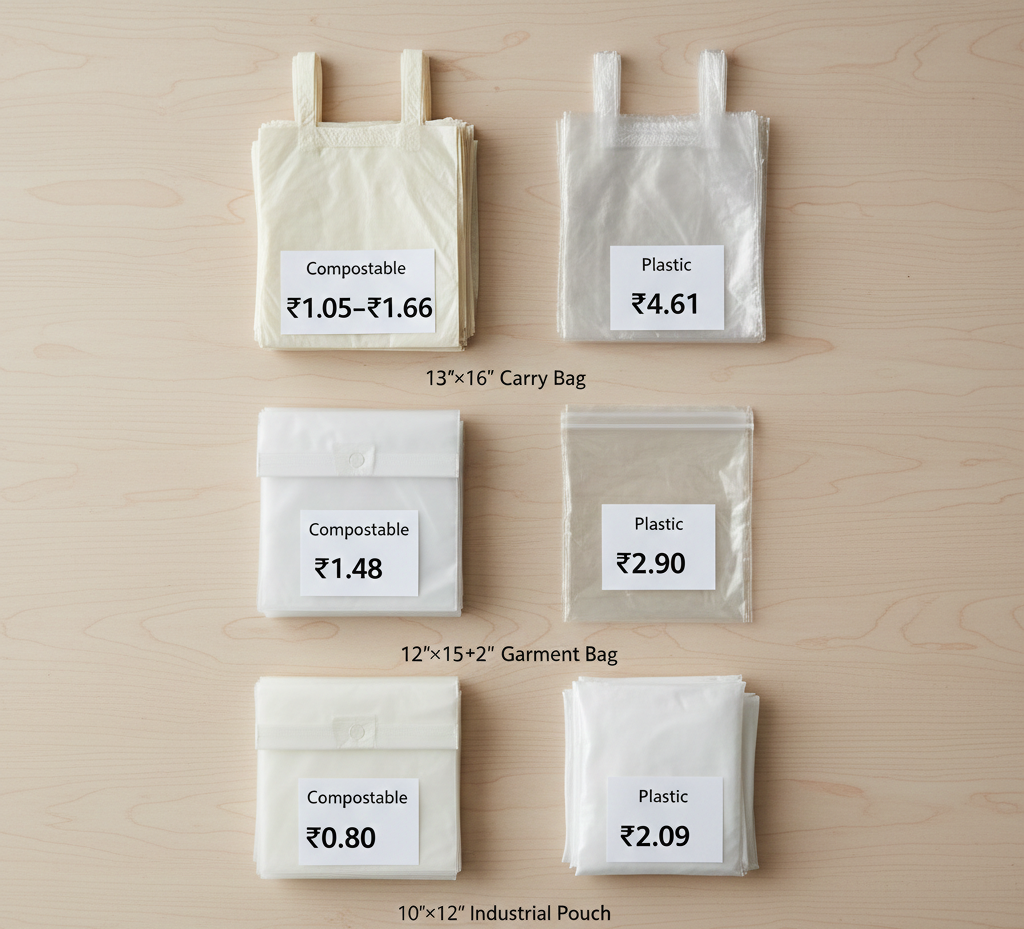
Ukhi manufactures compostable bags using Ecogran biopolymer granules. The table below shows what our bags cost per kg and per piece across the formats we produce, alongside traditional plastic rates for reference.
| Type | Size | Ecogran Micron | Per Kg (INR) | Plastic Per Kg |
| Carry Bag (ECO) | 13″ x 16″ | 25 | 120 | 110 |
| Carry Bag (Standard) | 13″ x 16″ | 25 | 155 | 110 |
| Carry Bag (Premium) | 13″ x 16″ | 25 | 190 | 110 |
| Transparent Garment Bag | 12″ x 15″ + 2″ | 20 | 230 | 120 |
| Industrial Pouch (Transparent) | 10″ x 12″ | 30 | 220 | 130 |
| Industrial Pouch (Opaque) | 10″ x 12″ | 30 | 130 | 120 |
Share your bag size, monthly quantity, load requirement, print requirement, and delivery location. We can help benchmark the right compostable bag grade, estimate pieces per kg, and support sample kit approval before bulk procurement.
FAQs
- How much does a biodegradable bag cost per kg in India?
In normal market language, buyers often use “biodegradable bag” when they mean compostable bag. In 2026, certified compostable bags cost about ₹150 to ₹310 per kg.
- How many biodegradable bags are in 1 kg?
There are about 160 25-micron bags per kg. But a large or heavy-duty bag may give far fewer pieces.
- Are corn starch compostable bags cheaper than PBAT bags?
All compostable bags need some amount of PBAT for flexibility and strength. Only using corn starch might not always be the best idea for a bag, so the price will depend on the blend, micron, and performance.
- Why do compostable bags wholesale prices differ across Indian suppliers?
Prices differ because suppliers use different resin blends, certification status, production scale, print setup, freight terms, and MOQs.