
For businesses, the cheapest packaging is not always the least expensive choice.
Conventional LDPE packaging is the most economical and therefore popular option. It has been in use for decades, and the supply chain is well established.
But packaging decisions in India are becoming more complex. The government is increasingly strict in imposing plastic bans. EPR and sustainability are also part of the equation. In such a situation, the unit price alone should not be the sole determinant.
This guide compares compostable vs LDPE packaging. We look at why compostable packaging is more costly, and what drives the premium.
What is the difference between compostable and LDPE packaging?
It is important to understand what these two materials are. They look very similar, but their end-of-life outcomes are very different.
LDPE packaging is a by-product of oil refining. The material is highly flexible and lightweight. It also exhibits good resistance to water, moisture, and chemicals.
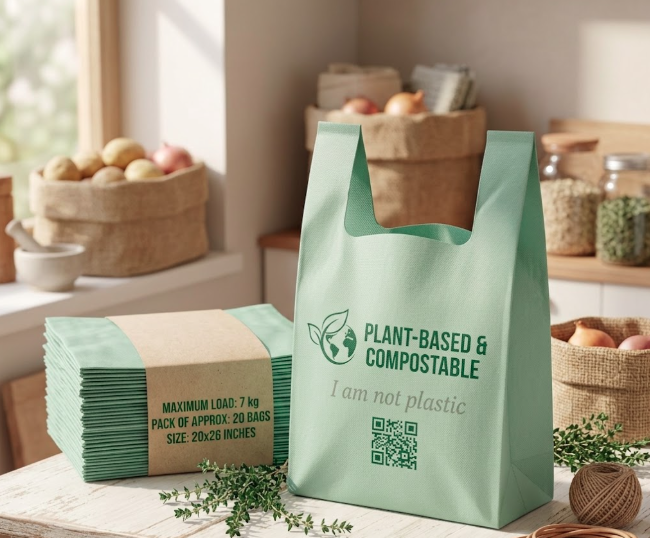
Compostable packaging is typically made using blends of PLA (polylactic acid), PBAT (polybutylene adipate terephthalate), and starch-based materials. In India, products marketed as compostable must comply with the ISO 17088 standard and carry a compostability certification issued by the CPCB.
The following table provides a detailed side-by-side comparison of compostable vs LDPE packaging.
| Feature | Compostable (e.g., PLA, PBAT, Starch Blends) | LDPE (Low-Density Polyethylene) |
| Raw Material | Bio-based (PLA, PBAT, starch blends) or partially bio-based | Petroleum-derived polyethylene (fossil fuels) |
| Source | Renewable resources (corn, sugarcane, cassava) | Non-renewable fossil resources |
| End-of-life | Industrial composting (requires specific temp, humidity, and microorganisms) | Recycling (where facilities exist) or landfilling/incineration |
| Degradation Time | 90–180 days in commercial compost facilities | 400 years in the environment |
| Certification | CPCB certification and IS/ISO 17088 compliance (India) | Not applicable |
Is compostable packaging costlier than LDPE?
The short answer is yes.
At present, compostable packaging cost is higher than conventional LDPE packaging.
However, the premium is not uniform. It varies due to:
- Bag or packaging type
- Resin composition
- Order quantity
- Supplier capabilities
- Certification requirements
This table compares traditional LDPE and certified compostable packaging across cost metrics.
| Packaging Metric | LDPE packaging | Compostable Packaging Price (PLA/PBAT Blends) | Price Premium / Ratio |
| Wholesale resin cost per kg | ₹96–₹139/kg (LDPE/LLDPE film grade, pan-India open market) | ₹93–₹350/kg (wide range: basic biodegradable blends from ₹93–₹150/kg up to premium PLA/PBAT compounds at ₹210–₹350/kg) | Roughly 0%–150% more, depending on grade — budget blends are near cost parity, while certified PLA-heavy compounds run 2x–3x higher |
| Small bags (16–20 inch), per piece | ₹0.82–₹2.13/piece (oxo/photo-degradable, low-volume MOQ) | ₹3.01–₹3.14/piece (300–360 pc MOQ) | ~50%–270% more, narrowing sharply as order size grows |
| Medium bags (19–24 inch), per piece | ₹1.13–₹3.52/piece | ₹3.64–₹8.40/piece (depending on MOQ tier) | ~100%–200% more at comparable volumes |
| Large/jumbo bags (28–32 inch), per piece | ₹4.39–₹6.65/piece | ₹11.29–₹18.82/piece | ~150%–200% more; premium stays elevated as size increases |
| General carry/courier bags (medium volume, 5,000–50,000 units) | ₹1.50–₹3.00/bag | ₹5.00–₹9.00/bag | ~130%–200% more (confirmed accurate at this specific volume band) |
| Retail packs (small consumer quantities, e.g. 90 pcs) | Not typically sold retail at this scale | ₹6–₹7/piece equivalent (₹595 for 90 pcs) | Reflects retail markup, not wholesale economics |
Broadly, these trends can be seen:
- The compostable price premium ranges from ~1x to 3.8x across bag sizes and order volumes.
- The narrowest premium (~1.5x–2x) is seen in large/jumbo bags.
- The widest (~1.5x–3.8x) is in smaller bag categories.
Why does compostable packaging cost more?
There is no single reason why compostable packaging costs are significantly higher.
It is a combination of:
- Higher raw material cost
- Complex manufacturing processes
- Certification and testing costs
- Immature supply chain
Here is a more detailed look:
Compostable raw materials cost more
The principal cost of oil refining is absorbed in the cost of petroleum. LDPE is a by-product and naturally costs less.
On the other hand, PLA, PBAT, and starch-based blends are made in small batches of a few tons. Some of the chemicals needed for the process are imported. This drives up the cost. Once the supply chain reaches maturity, the costs will diminish substantially.
Manufacturing is more specialised
Producing compostable films also requires tighter process control. Depending on the material grade, manufacturers may need to:
- Dry the resin before processing
- Carefully control extrusion temperatures
- Maintain narrower processing windows
- Monitor product quality closely
These extra steps increase manufacturing costs.
Certification adds to the overall cost
Compliance with ISO 17088 means obtaining CPCB certification. It involves:
- Laboratory testing
- Technical documentation
- Regulatory review
- Periodic recertification
Certification from a CPCB-approved laboratory adds to the cost of production.
Supply chain and production scale matter
Finally, economics improve with scale. Producing large batches means costs can be apportioned over millions of units instead of thousands.
The same applies across the supply chain.
As domestic resin demand grows, more manufacturers will enter the market. As production volumes increase, the gap between compostable packaging price and conventional plastics will narrow.
But that will take a few years to happen.
Is purchase price the only cost to consider?
The purchase price is the easiest number to compare. However, it is not the only cost that affects a packaging decision.
Businesses also need to consider the combined impact of LDPE packaging.
These can include:
- Extended Producer Responsibility (EPR) obligations
- Reporting requirements under India’s Plastic Waste Management Rules
- EPR certificate costs where applicable
- Potential environmental compensation for non-compliance
- Future regulatory changes
Export-oriented businesses have another consideration. You cannot export plastic packaging to most countries. The EU, UK, Canada and Australia in particular have strict bans on single-use plastics.
The key takeaway is simple. Less purchase price does not automatically convert to overall savings. Operational risk and future regulations influence the final economics of a packaging decision.
When does compostable packaging make economic sense?
The high cost of compostable packaging cannot be absorbed by every type of business. But for some sectors, the premium is easily absorbed.
For example, compostable packaging is ideal for:
- Brands shipping large volumes
- Food-service businesses
- Exporters serving markets abroad
- Businesses with strong ESG
At Ukhi, we help you understand how to cut down on packaging costs while adopting compostable packaging. In our experience, better material selection, thoughtful package design, and choosing the right manufacturing bring the largest savings instead of choosing the cheapest per-unit packaging.
Compostable vs LDPE Packaging: Which Should You Choose?
There is no single answer that fits every business. The right choice depends on regulatory obligations and your long-term goals.
This table helps you choose between LDPE and compostable packaging based on your business priority.
| Your business priority | Better choice |
| Lowest upfront cost | LDPE packaging |
| Regulatory preparedness | Compostable packaging |
| Sustainability goals | Compostable packaging |
| Export market requirements | Depends on destination regulations |
| Existing recycling systems | LDPE packaging |
| Long-term environmental strategy | Compostable packaging |
Conclusion
There is little doubt that compostable vs LDPE packaging is largely a cost discussion. But it is not only a cost discussion.
Packaging decisions should be based on more than the cost factor alone. As regulations evolve and EPR expands, businesses must learn to view packaging through the lens of total cost of ownership. Compostable packaging cost appears high at first glance but is a commercially and strategically sound decision over the long term.
At Ukhi, our goal is to make sustainable packaging more scalable, more affordable, and easier for businesses to adopt. If you need any advice, call us.
Frequently asked questions
Are LDPE bags always cheaper than compostable packaging?
Yes. Presently, LDPE is cheaper because it has a supply chain that is very mature. As biopolymer production scales up and demand grows, it is expected that compostable packaging prices will drop to comparable levels. But it will take a few years for this to happen.
Why is compostable packaging cost higher?
Compostable packaging costs more due to four reasons:
- Expensive raw materials
- Low production scale
- Complex manufacturing process
- Compostable certification costs
Does compostable packaging break down naturally anywhere?
No. It requires a specific environment with high humidity and around 55°C. If it is thrown randomly in nature, it still decomposes but takes a few years.
What is Extended Producer Responsibility or EPR?
EPR is a policy that passes the onus of disposal of plastic waste from citizens and local bodies to manufacturers and sellers. This makes the manufacturer and distributor of plastic waste responsible for the entire lifecycle of their products.
How can businesses reduce compostable packaging costs?
There are three possible routes to reduce compostable packaging costs:
- Use design optimization and employ fewer materials
- Bulk orders, which come with larger discounts
- Employ Just-In-Time logistics to avoid storage costs