
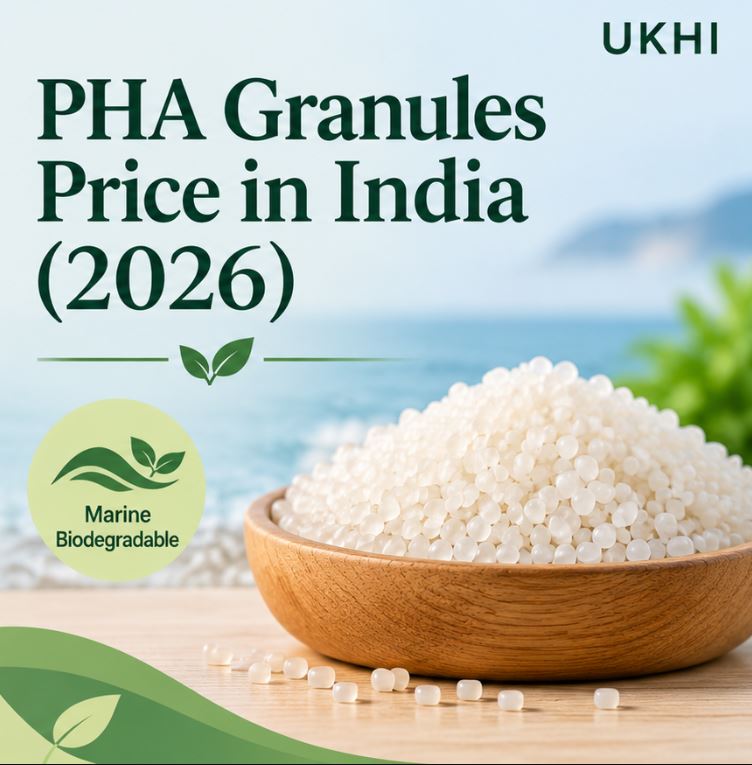
PHA granules price in India in 2026 starts at roughly ₹800 per kg for imported film-grade pellets and goes up to ₹5,400 per kg for specialty grades. Domestically made industrial-grade PHA is priced at around ₹3,500 per kg. The pricing range may appear confusingly wide to buyers. The factors that cause this variability are feedstock source, fermentation method, polymer purity and order volumes. For context, PLA/PBAT compostable compound granules cost ₹130 to ₹365 per kg in India, which makes PHA the most expensive compostable resin available today. We at UKHI are currently piloting EDHA, a PHA biopolymer produced through precision fermentation of agricultural waste. EDHA is not commercially available yet. Our commercial compostable resin, EcoGran, is available today for buyers who need a certified, cost-competitive compostable granule right now.
PHA Granules Price per Kg in India in 2026
The table below gives procurement teams a realistic picture of what biodegradable PHA granules cost in India right now, broken down by grade and form.
| PHA Grade / Form | Indicative Price per Kg for PHA granules (India, 2026) | Typical Application |
| Imported film-grade PHA pellets (e.g. sugarcane-derived, home-compostable certified) | ~₹800 per kg (excluding GST) | Blown film, flexible packaging |
| Imported PHBV powder (compounding grade) | ~₹1,000 per kg | Compounding, specialised injection moulding |
| Domestic industrial-grade PHA (Indian synthesis) | ~₹3,500 per kg | General-purpose biodegradable products |
| Specialty and co-polymer grades (PHBHHx, P3HB4HB) | ₹3,500 to ₹5,400 per kg | High-elongation films, medical, precision moulding |
PHA granules price on international spot markets ranges from USD 4 to USD 8+ per kg, depending on purity and volume. Price of packaging-grade PHA averages around USD 7.60 per kg globally, and medical-grade PHA averages USD 11.90 per kg or higher.
Why Does PHA Granules Price Vary So Much
A total of six factors influence the price of PHA granules in India, to such an extent that the quoted amounts can differ by 5x or more between two suppliers.
Feedstock cost
The cost of feedstock accounts for 30% to 60% of total production cost of PHA. Compounders use refined sugars like glucose and sucrose to produce high quality PHA polymer, but these sugars are hard and expensive to procure. Feedstocks based on agricultural waste can also be used, and these include agricultural residues, cheese whey or municipal wastewater. While the cost of procuring these is low, the cost of the PHA polymer itself may not change much because compounders have to incur heavy costs to manage the variability in the process that occurs when the feedstock is changed.
Fermentation method
Compounders use pure bacterial cultures as they can accumulate PHA at up to 80 to 90% of dry cell weight. However, this process can be managed only in sterile conditions which are energy-intensive. The costs of sterilization can be evaded by using mixed microbial cultures but for these the feeding regimes are complex and the production output is less predictable.
Downstream extraction
As much as 50% of the cost of producing PHA can be attributed to extracting PHA from bacterial cells. At the moment, compounders do not have any reliable low cost alternatives to reduce or bypass these costs.
Production scale
Most PHA producers globally are still operating at small scale, and this is one of the biggest reasons the PHA per-kg price is high. Studies show that when a fermentation plant expands capacity from 2,000 tonnes per year to 10,000 tonnes per year, the unit cost of producing PHA drops by 22% to 28%. As more manufacturers invest in larger facilities, PHA granules price in India will come down, but that shift is still underway.
Polymer type
PHA is not one material. It is a family of polymers, and each type behaves differently and costs differently to produce. PHB is rigid and highly crystalline. PHBV offers moderate flexibility. Advanced co-polymers like PHBHHx can stretch to 250% to 680% elongation at break, which makes them suitable for flexible films and pouches. The more complex the co-polymer, the more capital-intensive is the fermentation and extraction, and the higher the PHA granules price per kg.
Application grade
A compounder that produces PHA granules for standard packaging does not need the same level of purity as one that produces PHA for use in medical devices or surgical sutures. Packaging-grade PHA averages around USD 7.60 per kg globally. Medical-grade PHA averages USD 11.90 per kg or higher. Buyers should be clear about their end application when requesting quotes, because the grade determines the PHA granules price.
PHA Granules vs Conventional Plastic Granules: Cost per Kg Comparison
Buyers who compare biodegradable plastic granules price in India against conventional petroleum-based plastics will find a significant gap. The table below gives the comparison.
| Polymer Type | Price Range per Kg | How It Compares to PHA |
| Conventional PP and PE (petroleum-based plastic granules) | ₹65 to ₹170 per kg in India | 4 to 16 times cheaper than imported PHA granules |
| PLA (compostable, requires industrial composting at 58°C or above) | USD 2.20 to USD 3.20 per kg | 1.5 to 2.5 times cheaper than PHA granules |
| PBAT and PLA/PBAT compostable blends (industrially compostable) | ₹120 to ₹170 per kg in India | 4.5 to 6.5 times cheaper than imported PHA granules |
| PHA granules (biodegradable in soil, freshwater, home compost, marine) | ₹800 per kg (imported) to ₹5,400 per kg (specialty) in India | Baseline |
How Bulk and Wholesale Pricing Works for PHA Granules in India
Minimum order quantities for PHA pellets in India follow three tiers, depending on the stage of evaluation.
| Order Type | Typical MOQ |
| Trial batch (imported resin, initial machine test) | 10 to 25 kg in moisture-sealed bags |
| Converter trial (factory-floor processing trial with sustained production) | 100 to 250 kg |
| Commercial wholesale order (full-scale production) | 500 to 1,000 kg |
Buyers requesting a quote for bio-based granules should share four things with the supplier: the target application (blown film, injection moulding, thermoforming or another process), the estimated annual volume, the required polymer grade or MFI range, and the delivery location. Sharing these upfront helps the supplier quote accurately instead of giving a generic number that changes later.
What Buyers Should Compare Before Choosing the Lowest PHA Granules Price
Procurement teams comparing biodegradable and compostable granules from different suppliers should look beyond the per-kg sticker price for PHA granules.
Total conversion cost matters more than resin cost. A cheaper PHA resin that has not been properly stabilised can cause bubble instability, melt fractures or erratic sealing on a blown film line. The scrap rate goes up, the line slows down, and the material wasted during failed runs costs more than the saving on PHA resin price.
Grade specifications must match the processing method. Blown film lines need PHA granules with a melt flow index below 5 g/10 min at 190°C. Injection moulding needs 10 to 25 g/10 min for proper mould filling. PHA is also extremely sensitive to moisture. Granules must be dried below 0.05% moisture content before processing, typically at 60 to 70°C for 4 to 6 hours. If moisture is present during extrusion, the polymer chains break down and the finished product turns brittle. Buyers should confirm that their facility has controlled drying and moisture measurement equipment before ordering PHA resin.
Trial support from the supplier. Reliable suppliers of biodegradable and compostable granules are in a position to recommend barrel temperature profiles, screw speed configurations, drying protocols and offer on-site technical assistance during the first trial run. Buyers should treat this support as a selection criterion, not a bonus.
Why Buy Compostable PHA Granules from UKHI
UKHI operates across both compounding and fermentation, which is uncommon among biodegradable and compostable granules manufacturers in India.
EDHA is our PHA biopolymer, currently in pilot phase. We produce EDHA through precision fermentation of renewable agricultural feedstocks. EDHA is 100% bio-based and designed to biodegrade in home compost, soil, freshwater and marine environments. EDHA is not available for commercial purchase today. Converters and brands who want to be among the first to test an India-made PHA resin can register for early access to our EDHA pilot supply.
Frequently Asked Questions
Can PHA granules run on standard plastic processing machinery?
PHA granules and certified compostable resins like EcoGran can run on standard blown film, injection moulding, thermoforming and cast extrusion lines.
What is the difference between PHA and PLA granules?
PLA is a compostable polymer that requires industrial composting facilities operating at 58°C or above to biodegrade. PHA is a biodegradable biopolymer produced by microbial fermentation that breaks down in ambient soil, freshwater, home compost and marine environments without managed composting infrastructure.
Are compostable bioplastics exempt from India’s single-use plastic ban?
Certified compostable materials carrying a valid CPCB certificate and IS/ISO 17088 test reports are exempt from India’s 2022 single-use plastic ban.
Does UKHI sell PHA granules today?
Our PHA product EDHA is in its pilot phase and not commercially available yet. Our compostable resin EcoGran, based on PLA/PBAT, is available for commercial orders today and ships within 7 days for sample requests.