
![PHA Granules Manufacturers in India [2026]](https://ukhi.com/wp-content/uploads/2026/09/PHA-Granules-Manufacturers-in-India-2026.png)
Quick Answer
PHA granules are biodegradable and compostable bioplastic resins that are produced through microbial fermentation from renewable feedstocks. Domestic PHA granules manufacturing in India is still at an early stage. Most of the PHA resin available in the Indian market is actually imported. The price of PHA resin ranges from ₹800 to ₹5,400 per kg depending on grade, composition and source. UKHI is building PHA fermentation capability through our upcoming EDHA resin, currently in the pilot phase. As an alternative, our EcoGran resin is an industrially compostable PLA/PBAT compound that ships today and runs on standard plastic processing machinery.
What to Look for in a PHA Granules Supplier in India
Procurement teams sourcing PHA granules in India will find that most of the suppliers actually import the PHA resin. Domestic manufacturing of PHA biopolymers in India is still at an early stage. Only a handful of companies have built any PHA biopolymer fermentation capacity within the country. This makes supplier evaluation more important than it would be for a mature material.
Five criteria matter most for buyers evaluating a PHA granules manufacturer or supplier in India.
Fermentation capability
Buyers should check whether the PHA resin supplier manufactures the resin through its own fermentation and extraction process, or simply trades imported pellets under its own label. A manufacturer who controls the fermentation step can tune the polymer composition, adjust molecular weight, and maintain batch-to-batch consistency.
Feedstock source
The carbon feedstock used in fermentation affects the cost of the final PHA granules. First-generation feedstocks like refined sugarcane or corn starch are common in India but all of them are expensive. Suppliers who use second-generation feedstocks like waste cooking oil, agricultural residues or plant oils can offer a lower cost base.
Technical support for converters
PHA has a narrow thermal processing window compared to conventional plastics. A reliable biopolymer manufacturer should be able to provide processing guidelines for the buyer’s equipment. Buyers who are evaluating PHA for the first time should ask whether the PHA granules supplier offers trial quantities and on-site technical assistance.
Certifications
Certifications for biodegradable and compostable bioplastic granules differ from those for conventional plastics. Buyers should look for end-of-life certifications specific to PHA, such as TÜV Austria OK Compost HOME, OK biodegradable SOIL, and OK biodegradable MARINE. Quality system certifications like ISO 9001 and ISO 14001 also remain relevant. For PHA resins that are meant to be used in food-contact applications, FSSAI certification is required in India.
Supply continuity
PHA production capacity in India is limited. So, buyers should assess whether the PHA granules supplier can guarantee consistent delivery volumes over 6 to 12 months.
UKHI is one of the few companies in India building PHA biopolymer manufacturing capability through fermentation. Our upcoming EDHA resin is produced from renewable agricultural feedstocks using precision fermentation.
What Specifications Matter When Buying PHA Granules?
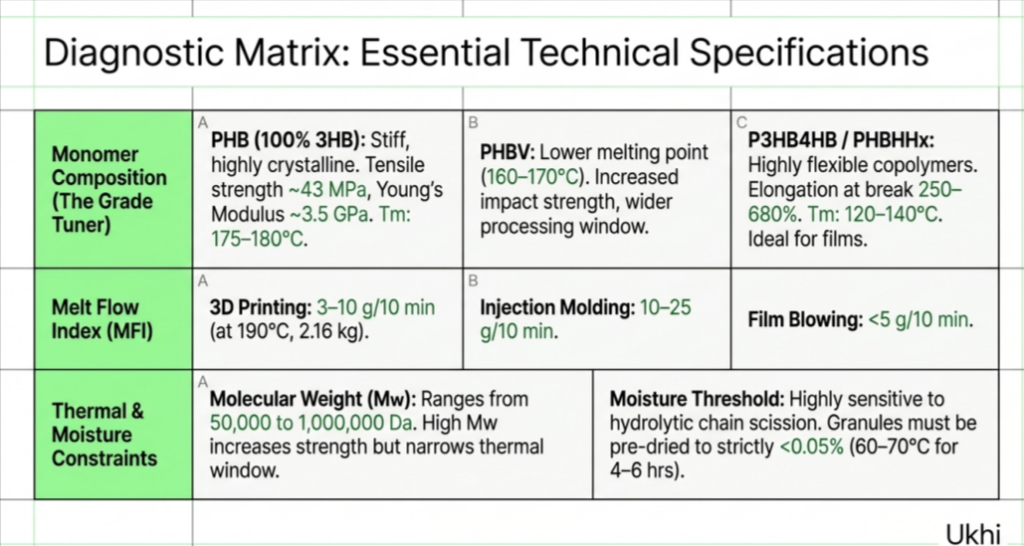
Converters who are evaluating PHA granules for their production line need to match the resin grade to their specific process and end product. The table below covers the key specifications.
| Specification | What it tells the converter | Typical range for commercial PHA grades |
| Monomer composition | Whether the PHA grade is stiff (PHB), semi-flexible (PHBV), or highly flexible (P3HB4HB, PHBHHx). This determines which end products the resin is suited for. | PHB: rigid, high crystallinity. PHBV: moderate flexibility. P3HB4HB: elongation at break of 250 to 680%. |
| Melt flow index (MFI) | How easily the molten resin flows through the barrel and die. Different processes need different MFI ranges. | Injection moulding: 10 to 25 g/10 min. Film blowing: less than 5 g/10 min. |
| Molecular weight (Mw) | Higher molecular weight increases tensile strength but narrows the thermal processing window. | 50,000 to 1,000,000 Da for commercial PHA grades. |
| Melting point (Tm) | The temperature at which the resin transitions from solid to melt. This sets the baseline for barrel and die temperatures. | SCL-PHA: 160 to 180 degrees C. Copolymers like PHBHHx: 120 to 140 degrees C. |
| Moisture content before processing | PHA is highly sensitive to moisture. Residual moisture above the threshold causes chain scission during extrusion, which weakens the final product. | Must be dried below 0.05%, typically at 60 to 70 degrees C for 4 to 6 hours. |
| Delivery form | Whether the supplier ships pre-compounded pellets (ready to process), fine powder (for coatings or rotomoulding), or masterbatch (for blending). | Pellets are the most common form for injection moulding and film blowing. |
Buyers who are evaluating PHA pellets for the first time should request a full technical datasheet from the supplier before ordering trial quantities.
Which Feedstocks and Processes Are Used to Manufacture PHA Granules?
A PHA biopolymer is not made through petrochemical refining. It is produced through microbial fermentation. It is a process where bacteria are fed a carbon source and accumulate PHA inside their cells as an energy reserve.
The carbon feedstocks used in PHA fermentation fall into three broad categories.
- First-generation feedstocks include refined sugars from sugarcane, corn or cassava starch. These produce high-purity PHA resin with predictable properties, but the feedstock cost is high.
- Second-generation feedstocks include waste cooking oils, spent palm oil, inedible plant oils, animal fats and fisheries by-products. These are cheaper.
- Agricultural and industrial by-products like molasses, lignocellulosic biomass and glycerol are also used as feedstock to manufacture PHA.
The manufacturing process for biodegradable and compostable PHA granules follows a general sequence.
- The chosen feedstock is prepared and sterilised.
- Engineered bacteria are introduced into industrial fermentation tanks along with the feedstock.
- The bacteria convert the carbon source into PHA polymer over a controlled fermentation cycle.
- The polymer accumulates inside the bacterial cells.
- The polymers are then extracted from the cells.
- The extracted PHA is compounded with stabilisers and nucleating agents, then pelletised into granules ready for converter use.
UKHI’s EDHA process uses renewable agricultural feedstocks like starch, plant oil and sugarcane. the feedstock is processed through proprietary engineered bacteria and green extraction. EDHA is designed to biodegrade in open air, soil, freshwater and marine environments. EDHA is in pilot phase at the moment. Please contact us to check whether/when it becomes commercially available.
Certifications and Compliance to Look for in a PHA Granules Manufacturer in India
Buyers who are sourcing compostable and biodegradable granules in India should verify certifications at two levels: the material level and the facility level.
Material-level certifications for PHA granules
- The most important certification for compostable plastics in India is IS/ISO 17088, which tests biodegradation, disintegration, ecotoxicity and heavy-metal limits under controlled composting conditions.
- PHA is capable of biodegrading beyond industrial composting conditions. So buyers should also look for TÜV Austria OK Compost HOME, OK biodegradable SOIL and OK biodegradable MARINE certifications.
- For export markets, EN 13432 (Europe) and ASTM D6400 (United States) are the relevant standards.
Facility-level certifications
- ISO 9001 standard compliance can confirm that the manufacturer operates a documented quality management system.
- ISO 14001 confirms environmental management practices.
- GMP certification is relevant for manufacturers supplying resin for food-contact end products.
- FSSAI certification is required in India for any material that will come into contact with food.
UKHI holds IS/ISO 17088 compliance (tested by CIPET), ISO 9001, ISO 14001, GMP, FSSAI and Halal certifications. These cover our commercially available EcoGran resin. Certification for EDHA will follow as the product moves from pilot to commercial phase.
How Much Do PHA Granules Cost in India?
The price of PHA granules in India varies widely depending on the following factors:
- polymer grade,
- the copolymer composition,
- whether the resin is imported or domestically produced, and
- the delivery form (pellets versus powder).
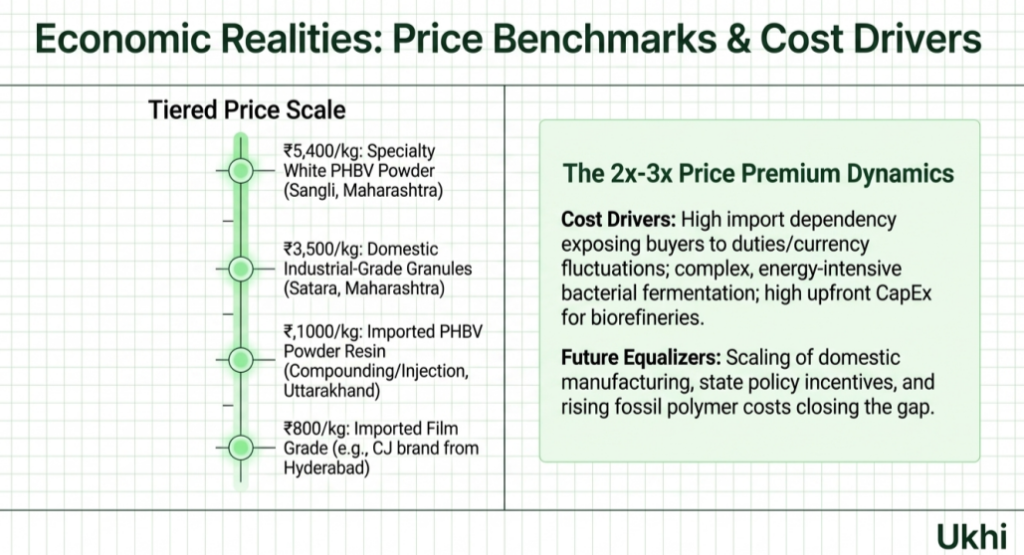
| PHA grade and form | Indicative price per kg (excluding taxes) |
| Imported PHA granules, film grade, home-compostable certified | Around ₹800 per kg |
| Imported PHBV powder resin, compounding or injection grade | Around ₹1,000 per kg |
| Domestically manufactured industrial-grade PHA granules | Around ₹3,500 per kg |
| Specialty PHA granules and PHBV powder for injection and blow moulding | ₹3,500 to ₹5,400 per kg |
Three factors drive the current cost of biodegradable and compostable PHA granules in India.
- A significant share of PHA resin sold in India is imported, which adds freight, customs duty and currency risk to the base material cost.
- PHA fermentation is a resource-intensive process compared to petrochemical polymerisation, which keeps production costs high.
- The capital investment required to build a commercial-scale PHA fermentation plant is substantial, and very few such plants exist in India today.
The price gap between PHA granules and conventional plastics is expected to narrow as domestic fermentation capacity grows and production volumes increase.
For buyers who need a compostable resin that is commercially available and cost-competitive today, UKHI’s EcoGran is a PLA/PBAT-based compostable compound priced competitively with conventional plastics. EcoGran runs on standard plastic processing machinery.
Why Buy Compostable and Biodegradable Bioplastic Granules from UKHI
Dual manufacturing capability
UKHI is one of the only companies in India that operates across both compounding (EcoGran, commercial today) and fermentation (EDHA, in development). This means we can supply a compostable biopolymer resin that works on existing machinery right now. At the same time, we are also building toward a fully home-compostable and biodegradable PHA resin for buyers who need soil and marine biodegradability.
In-house resin manufacturing
UKHI manufactures EcoGran resin within its own facility at IMT Faridabad, Haryana. We control quality from granule compounding to finished product, unlike traders or assemblers who source resin from third parties.
Drop-in machine compatibility
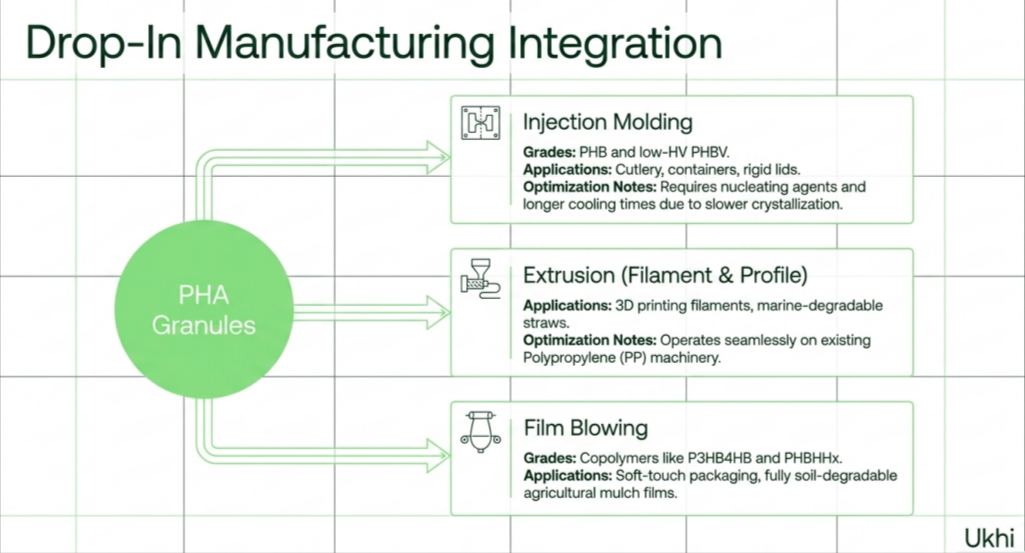
EcoGran granules run on standard blown film, cast film, profile extrusion, injection moulding, thermoforming and extrusion coating lines. Converters who switch to EcoGran do not need to buy new machinery or modify existing equipment.
Institutional and scientific backing
UKHI’s material science work is supported by IIT Guwahati, IIT Mandi Catalyst and IIM Bangalore NSRCEL.
Full certification stack
UKHI holds IS/ISO 17088 (CIPET tested), ISO 9001, ISO 14001, GMP, FSSAI and Halal certifications across our compostable resin range.
Procurement teams who are evaluating biopolymer manufacturers in India for PHA or compostable resin supply can request a free EcoGran sample. We ship samples within 7 days at no cost. For buyers interested in EDHA, we are open to pilot-phase collaboration and can share development timelines on request.
FAQs
1. What is the difference between PHA granules and PLA granules?
PLA is made from fermented plant starch and is industrially compostable. PHA biopolymer is made through bacterial fermentation and can biodegrade in soil, freshwater and marine environments. PHA does not require an industrial composting facility.
2. Can PHA granules be processed on standard plastic machinery?
PHA granules can run on injection moulding, film blowing, thermoforming and extrusion lines. Processing parameters like barrel temperature, drying time and cooling cycles need adjustment because PHA has a narrower thermal window than conventional plastics.
3. Are PHA granules approved for food-contact packaging in India?
PHA resin intended for food-contact applications must carry FSSAI certification in India. Buyers exporting food packaging should also verify FDA or EFSA compliance depending on the destination market.
4. What is the minimum order quantity for PHA granules in India?
MOQ for PHA pellets varies by supplier. Imported grades are typically sold in 10 to 25 kg packs for trials. Bulk procurement from domestic biopolymer manufacturers in India usually starts at 100 to 250 kg for machine trials.
5. What shelf life do PHA granules have before processing?
PHA granules stored in sealed, moisture-proof packaging at ambient temperature typically remain stable for 12 to 18 months. Buyers should confirm shelf life and storage conditions with the supplier before placing bulk orders.
![Biodegradable and Compostable Garbage Bags — Manufacturers in India [2026]](https://ukhi.com/wp-content/uploads/2026/09/Biodegradable-and-Compostable-Garbage-Bags-—-Manufacturers-in-India-2026-365x260.png)